Chapter 1 — Closing Is Closing
I had been telling myself it was nothing for two years, and I was, on balance, very good at it.
The trick, I had learned, was to do the work. Lift the shutter. Light the irori. Set the kettle. Fold the noren back along its rod with the same three motions every morning, the same three motions my great-aunt had used in 1963 and her grandmother in 1908 and her grandmother before that, until the motion stopped belonging to me at all and became a kind of small, hand-shaped prayer that the day, like the day before it, would continue to be ordinary.
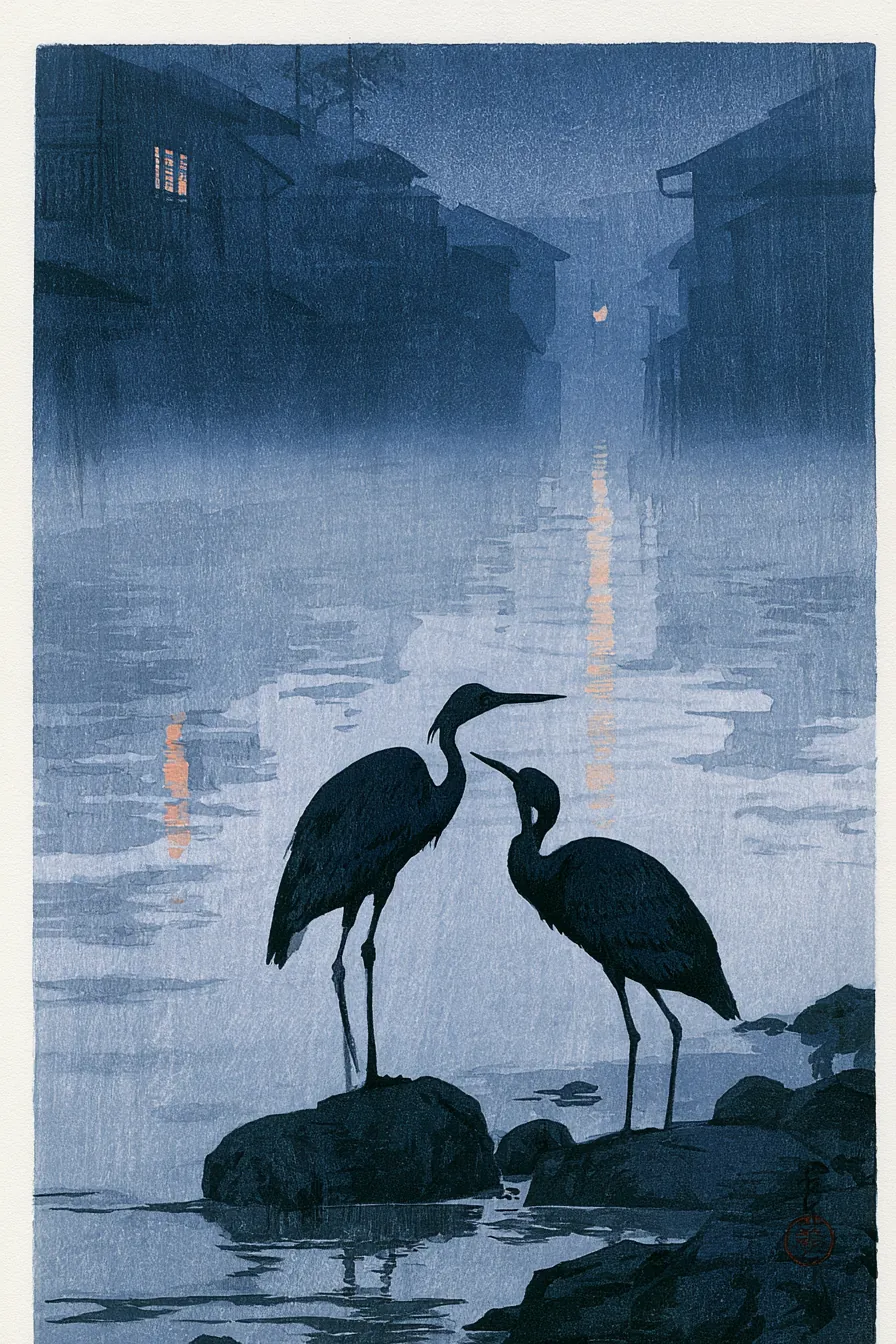
Tuesday, late May. The Kamogawa had been the color of wet slate when I crossed Shijō Bridge at six, and the herons had been standing in the shallows the way they always stood — one-footed, judgmental, the river's own elder statesmen. By the time I reached the alley, the rain had thinned to that particular Kyoto drizzle that doesn't fall so much as hang, suspended, a held breath of water. I rinsed my hands at the stone basin in the genkan. I tied on the indigo apron. I lit the irori.
The copper kettle, set above the coals, began its slow climb toward singing.
Pip was already on the counter, sitting cross-legged on the unfinished hinoki with both small hands wrapped around a teacup it didn't need. The cup was empty, which was Pip's joke about being a ghost; the apparent six-year-old in the faded red kimono had been attached to this house since 1888 and considered the kitchen its personal jurisdiction.
"Pip moved the spices," Pip said.
"I see that."
"Pip put the sansho on the second shelf because the sansho was crying."
"Mm."
"Pip is also hungry."
"You don't eat."
"Pip is hungry in principle."
I poured a thimble of hojicha into the empty cup, because that was the bit, and Pip lifted it to its mouth with great ceremony and pretended to swallow. The roasted-tea smell filled the front room. I let it. There were mornings — there had been a long bad stretch of them, last winter — when I'd had to remind myself, every hour, that smelling something was not the same as casting. That liking a smell was not a spell. That wanting was allowed in increments under fifty grams.
This was not one of those mornings. This morning the rain hung in the alley like a curtain and the hojicha smelled like a roasted thing and a thing-that-is-roasting at the same time and the copper kettle had begun, just begun, that low almost-human note it made when it was about to embarrass itself. I lifted it off the coals before it could.
Outside, somewhere on Pontocho proper, a delivery scooter ran its bell.
The bell on my door did not ring.
The door slid open anyway.
I turned, because turning is what one does, and Tanaka-san was already through the noren, shedding rain like a small grey-suited dog who had forgotten an umbrella on purpose. He always forgot it on purpose. He liked, he had told me once over his fourth cup of genmaicha, to arrive damp. It reminded him to be grateful for indoors.
"Hana-chan," he said, in his apparent-sixty-something voice, beaming the way he always beamed, "I have been to the dentist."
"At seven in the morning?"
"He is a friend. He owed me." He hung up his coat — beige, thirty years old, somehow still beige — and arranged himself on a counter stool with the air of a man settling in for a long story. Under the coat he was wearing a cardigan, also beige, and beneath the cardigan he was, technically, a three-hundred-and-forty-year-old tanuki, but you would not have known it unless you knew where to look, and the only place to look was the slight extra fullness at the base of his spine when he sat, where a tail might, under sufficient sake, suggest itself. "He says I am to floss. Floss. At my age."
"Genmaicha?"
"Please, dear. Three cups in succession, then we will discuss further."
I set the water back over the coals. Pip drifted off the counter and onto the beam above the irori, where it liked to perch when there were grown-ups. Outside, a tourist's voice — American, sharp, the vowels skating off the wet stones — asked someone whether this alley actually goes anywhere, and someone else, Japanese, replied with the polite shrug-shaped phrase that meant yes, but not for you. I had not put up a sign. I did not need to. The alley took care of its own.
"My cousin in Shiga," Tanaka-san began, "has married a human."
"You told me."
"I am telling you again because the human is now taller."
"Mm."
"Hana-chan. Are you listening."
"I am pouring you tea. The pouring is the listening."
He laughed, and his laugh, which was the warmest sound in the building most days, made the steam over the kettle rearrange itself. I set down his first cup. He took it in both hands the way old men take small things they are afraid of crushing, and he sighed at it, and the sigh smelled, very faintly, of the persimmons he would bring me in October, when October came, from a tree he refused to identify.
"You look tired," he said.
"I look the same as yesterday."
"Yes. That is what I said."
I poured my own cup. I did not drink. The white streak at my left temple had grown out another quarter inch this month; I had stopped trying to tuck it behind my ear. It went where it wanted. I had not earned it the way most early-grey hair is earned, which is to say slowly, by ordinary worry; I had earned mine in a single night at twenty-four in a hospital corridor in Osaka, and I had decided, somewhere in the long quiet years since, that pretending it wasn't there was a worse insult to it than letting it sit.
"Hana-chan."
"Mm."
"There has been," Tanaka-san said, in the particular gentle voice he used when he was about to be useful, "a body."
I did not move my hands. I had practiced not moving my hands. I had practiced not moving my hands in front of mirrors, in front of dishes I was washing, in front of customers who said sharp things while I poured. The kettle began its low note again, and this time I let it sing, because the singing covered the small absence of my hands.
"Where," I said.
"Sanjō Bridge. The east side. Goro will come tonight to tell you properly. I am only telling you now because I do not want you to learn it from him at the end of a long day. It will be in the news by lunchtime, perhaps. A jogger, perhaps." He blew on his tea. "His throat. Cleanly."
"A human?"
"A man in a suit. With certain shoes."
I set the kettle down.
There is a kind of shoe that the Hand of the Onmyōkai issues to its field operatives. It looks like a normal black work shoe. It has a sole stitched in a particular way, with a particular thread. If you have spent four years of your life in the Library at Mt. Kurama, watching boots come and go past your study carrel, you know the stitch. I had, once, been able to tell you the manufacturer. The manufacturer's name was no longer in my head; I had spent it on something else.
"Thank you," I said.
"Hana-chan. I tell you only because—"
"I know why you tell me. Drink your tea."
He drank. He drank with the particular care of a man who knows he has just delivered a small grenade and would like to give it time to settle in its packaging. Pip, on the beam, was looking at me with both enormous eyes, and I could not — would not — look back, because Pip was a sponge for any feeling it was offered and I had decided long ago, on Pip's behalf, that I would not soak it through. I turned, instead, to the irori. I rebuilt the small triangle of charcoals. I added a piece of cherry. The cherry smoke joined the hojicha smoke and the rain smoke from Tanaka-san's coat in the kind of three-part chord that, if I had been a different person, in a different decade, I would have called home.
I was not casting. I was not casting. I was only tending a fire.
But I had heard the kettle start to sing without me asking it to, and Pip had heard it too, and Pip's eyes, on the beam, were getting larger.
"Pip," I said quietly, without looking up. "Spice shelf. Now."
"Pip already did the spice shelf."
"Pip did it once. Pip will do it again."
Pip vanished, sulking, in the direction of the back room, leaving a small origami fox folded out of yesterday's receipt on Tanaka-san's saucer. Tanaka-san picked it up between two thick fingers and considered it.
"The child likes a theme, naa," he said.
"The child has decided we are in autumn already."
"The child has decided," Tanaka-san said, "that someone is coming." He set the paper fox down very carefully and tapped it once on its small folded nose. "I will not stay for the third cup, dear. I have business. Tell Goro I will be at the Sanjō property after eight if he wishes me. And Hana-chan."
"Mm."
"Eat lunch."
"I'll eat lunch."
"That is what you said yesterday."
"Tanaka-san."
"Yes."
"Eat lunch yourself."
He laughed again, that warm sound, and the steam over the kettle did its small dance, and then he was at the noren, beige coat back over his shoulders, and the door slid shut behind him with the soft tok of cedar against its frame. The bell did not ring. The bell almost never rang for the regulars. The bell was for strangers.
I stood in the empty front room with my hands flat on the counter and I made myself count to thirty.
At thirty I poured myself a cup of hojicha and I drank it.
At sixty I picked up the small origami fox and I put it in the back pocket of my apron, next to the notebook. I did not write anything down. There was nothing, yet, to write.
The day went on the way days do.
A pair of French tourists wandered in at half past eleven, having taken a wrong turn off the Pontocho lanterns, and stayed for an hour and a small pot of genmaicha and four photographs each of the irori. The man asked, in careful Japanese, whether the teahouse was very old, and I said, in careful English, that the teahouse was as old as it needed to be, which made him laugh in the way Westerners laugh when they suspect they have been told something they will repeat later as wisdom. They paid in yen. They tipped, against custom; I gave the tip to Pip, who hid it in the rice jar with the others.
At one o'clock I went next door and bought a single onigiri from the konbini and ate it standing in the genkan, because I had told Tanaka-san I would eat lunch and I am a person who, by and large, does what she has told a tanuki she will do. The onigiri was salted plum. It was fine. It was fine. The flavor of salted plum had been on file in my head, demonstrably, for twenty-eight years, and the part of me that had stopped trusting my own memory checked, against my will, at every bite — yes, that is salted plum, yes, you remember salted plum, salted plum has not been taken from you. This is an exhausting way to eat lunch. I do not recommend it.
At three the rain stopped.
At four it started again.
At five — five exactly, by the small temple bell three streets over that I do not own and cannot hear with my human ears but always seem to know is striking — I went to the second noren, the deeper indigo one with the silver embroidery, and I pressed my palm flat to its center seam and I felt the wards open the way I always feel them open, which is the way one feels the inside of one's ear pop when an airplane begins to climb. The back room received its first breath of the evening. The koi in the garden moved, once, a slow silver arc through the moss-darkened water. The tatami exhaled the smell of old grass and older incense. The seven small paper talismans along the rafters, the fudasetsu I had hung on the night I'd opened, settled into their nightly hum.
This is the part I never tell anyone. The wards do not feel like power. They feel like a kettle on a low flame. They feel like an apartment where someone has just turned on the heat. They feel — and I am aware that this is the most embarrassing thing a former Library researcher of the Onmyōkai can possibly say about her own hand-built wards — they feel cozy.
That is the whole job. That is why I built them.
Yuki came at sunset.
She always came at sunset, in her long pale-grey coat year-round, hair so dark it had a blue cast, eyes so light a person could fall into them if a person were the kind of fool who fell into eyes. She did not speak. She bowed, very slightly, at the threshold. She took her usual table by the shōji, the table closest to the garden, and she set down — as she had set down every Tuesday for three years and four months — one folded silk handkerchief at her left elbow. She would not unfold it. She never had. Whatever was inside was hers; the handkerchief was the company.
I brought her the kuromoji-cha, lukewarm, twig-fragrant, in the cup with the chipped lip she liked. She wrapped one cool hand around it. Condensation formed on the porcelain immediately, which it always did, because Yuki's skin ran ten degrees colder than the room and the room knew it.
"Yuki."
"Hana."
"Tanaka-san told me. About the bridge."
Yuki did not look up. "I heard at noon."
"Goro will come tonight."
"He will say more than Tanaka-san did."
"He always does."
A small silence. The kuromoji-cha steamed faintly between her fingers — Yuki's tea did not steam upward like other tea; it steamed into her, a thin pale curl of warmth being patiently absorbed by something a hundred and eighty winters cold. I had stopped finding it strange. I had stopped finding most things strange.
"Hana."
"Mm."
"You will be careful tonight."
"I am always careful."
She looked up then. Her colorless eyes met mine, and held, and there was, in them, the particular quality of an old woman who has buried a child and watched the world go on being foolish about smaller losses ever since. She did not blink. She did not need to.
"Be careful," she said again, "tonight."
She did not say why. She did not have to. Yuki had never in her life used a word she did not need, and the word tonight sat on the counter between us like a small folded thing, like the origami fox in the back pocket of my apron, like the salt rim on a cup I had not yet been served.
I bowed. I went back to the counter. I let her drink in peace. When she rose, at the hour she always rose, she left a thousand-yen note and a single small ice flower beside the cup. The flower was the size of my thumbnail. It was perfect. It had six petals and a tiny crystallized center. It would not melt until morning.
It would, by morning, be gone, and the cup would have a tiny ring of clear water where it had been, and I would touch the ring with one finger and feel — I had stopped pretending I did not feel this — the small clean grief of a yuki-onna who had buried a child a hundred years ago and could still, on a Tuesday in May, perform a courtesy that was also an act of being known.
She bowed at the noren. She went.
The bell did not ring.
Goro came at ten, soaked to the chest, smelling of river.
He brought a cucumber in a plastic bag, because Goro never came without one, and he set it on the counter with the seriousness of a man making an offering at a shrine. The cucumber was the wrong shape — the strange curled cucumber the bridge-side stands sold cheap in May — and he liked them better that way. He pulled the brim of his baseball cap low against the lantern light. Underneath the cap, on the crown of his head, was the sara, the saucer-depression that no kappa likes a human to look at directly, even me, even after seven years.
"News," he said.
"News."
"The man at Sanjō."
"Throat?"
"Throat. Clean. Single cut. No struggle. He'd been there since maybe three in the morning. The river hadn't gotten to him yet — somebody propped him on the stones above the waterline, on purpose, where the joggers would find him."
"On purpose."
"Display." Goro lifted his cap, scratched the rim of the sara with one careful finger, set the cap back down. "Hana-chan. It wasn't a yokai's work. Yokai do throats sloppy. This was trained."
"Trained as in—"
"Trained as in your old people."
I poured him a glass of water. I added one slice of cucumber from the bag. He nodded his thanks. He did not drink yet.
"He had the shoes," Goro said.
"Tanaka told me."
"He had a talisman. In an inner pocket. Paper, folded sevenfold, in Library script. It hadn't been removed. Whoever killed him left it. Like a signature, naa — we know what he was. We're telling you we know."
"A signature for who."
"For you, hana-chan. Or for somebody who comes here. I don't know which. But it wasn't for the police."
I set my hands flat on the counter again. Counting. Thirty.
Pip was back on the beam, very still, watching. Yuki's ice flower was still on her cup at the back table; I had not yet cleared it. The hojicha in the kettle was at the low simmer I kept it at after eight, when the front-room business was over and the back room ran on its own slower clock.
The wards, I noticed — and I noticed in the way one notices a tooth has stopped hurting, by its sudden absence rather than its presence — were quieter than they had been at five. Not gone. Not failing. Just attentive. As if the wards, like Goro, had been listening to the alley.
"Goro."
"Mm."
"Was there anything else in the inner pocket?"
He looked up at me from under his cap. He held the look for a long second. Goro and I had known each other a long time and one of the things we had agreed on, without ever saying it, was that I did not ask him questions to which I already knew I would not like the answer. This was one of those questions and we both knew it.
"A photograph," Goro said.
"Of."
"Of you, hana-chan."
He said it gently. He said it the way a friend tells you the test is positive.
"From when," I said.
"Old. Twenty-four, maybe. Library days. Hair shorter. No white." He tipped his cap further down, ashamed for me, the way kappa are ashamed on behalf of their friends. "I took it. The photograph. The police didn't get that one. It will be in the river by midnight, naa."
"Thank you."
"Don't thank me."
"I thanked you."
"Hana-chan."
"Drink your water."
He drank. The cucumber slice bobbed once. He set the glass down with a small wet ring on the hinoki, which would be there tomorrow when I came down to open, which was Goro's particular signature, the small wet ring, I was here, I drank, you are not alone, see you tomorrow. He stood. He bowed.
"Be careful," he said, and it was the second time tonight a person had said it to me, and he went out through the noren without looking back, and the door slid shut, and the bell, again, did not ring.
I cleared Yuki's table. I put the ice flower into a small lacquer dish in the freezer, where it would last another day or two before deciding to be gone. I rinsed her cup. I rinsed Goro's glass. I wiped the wet ring off the counter and apologized, silently, to the hinoki for doing so, because the hinoki and I had been through a lot together and we both, I think, liked the wet ring.
At eleven I went to the noren and pulled it in.
This is the thing about closing. Closing is closing. I had a sign — a small wooden plaque I had carved myself, badly, my first month here — and the plaque said, in five characters of Hana-the-Library-researcher's least-good calligraphy, 営業終了, eigyō shūryō, business ended. I hung it on the hook. I slid the outer door three-quarters shut. I put one foot up on the genkan step to undo my apron strings.
I had my hand on the strings when the rain in the alley changed sound.
It is hard to describe how rain in a Kyoto alley changes sound. The drops do not change. What changes is the gap between them, the small intervals of silence into which a sound that is not rain might fit. You learn, as a person who has lived alone in an alley for two years, that the gap has a shape, and you learn the shape of it the way one learns the shape of a friend's footsteps on stairs. Tonight the gap had picked up an extra weight. Something — someone — was in it.
I did not turn. I undid the apron strings. I retied them.
The outer door slid the rest of the way open.
A man stepped through the genkan, and even through the half-shut second noren, even in the lantern shadow, even with my back still mostly to him, I could feel, very precisely, that the wards had decided they would not be a problem about him. The wards, which had hummed all evening, settled — settled — the way a cat settles into a windowsill it has chosen for the afternoon. The wards liked him.
The wards do not get to like people. The wards do not have opinions. The wards are mine.
I turned.
He was tall — six feet and a small change — and he was wearing a charcoal wool overcoat that had been cut, very carefully, perhaps in 1989. Beneath the coat: a dark henley, soft, the kind of expensive that does not advertise. Slim trousers. Geta with worn-down teeth he had not bothered to replace. He had taken the coat off rain in the genkan — I had not seen him do it, but the coat was dry along the shoulders in a way that no coat is dry in a Pontocho drizzle without a small intercession — and he held it folded over one forearm with the unconscious grace of a man who had been folding coats for a long, long time.
His hair was black. He had tied it back. It was long enough to tie. There was, at his left temple, a single thread of white. I noticed this because I had one too, on the same side, which was the kind of coincidence I did not have the energy to be charmed by tonight.
His eyes were brown.
His eyes were brown the way the kettle was, just now, sitting on the coals.
"We're closed," I said.
"I know," he said.
His Japanese was — and I had heard a lot of Japanese, in a lot of registers, in a lot of voices, from a lot of throats both human and not — too formal. He used watashi. He used the verb endings my great-grandmother might have used, if I had had a great-grandmother whose voice I still remembered. He used them with the matter-of-factness of a man for whom this was not formality at all but simply the way one spoke; the way I might still, when very tired, slip into the polite Kyoto register that my own mother had —
I stopped that thought. I was good at stopping that thought.
"You'll have to come back tomorrow," I said. "I open at eleven."
"I know that as well."
"Then."
"I would like a cup of tea."
I looked at him. He looked at me. The rain hung in the alley behind him and was, very faintly, not falling on him in a way I would have to examine later, when I was alone, and had the resources to be afraid. The lantern light fell on his face and made it the color of bone-warm porcelain. His hands were folded in front of him, one over the other, in the posture of a man waiting at a counter at a country inn three hundred years ago.
His right hand was turning, very slowly, between thumb and forefinger, a small silver coin.
I knew the coin. I knew the coin in the way one knows a face one has only ever seen in a museum. Kan'ei tsūhō. Edo period. Pre-circulation, by the look of the rim — uncirculated, this coin, untouched by another hand in three hundred and fifty years.
"We're closed," I said again, more quietly this time, because closed was the only spell I was allowed to cast anymore and I was, for the first time in twenty-four months, not entirely sure it would take.
The man — the man who was, I understood with a slow descending clarity, not a man at all — bowed, very slightly, the way one bows to an equal under a roof one had not been invited under.
He did not smile. The corners of his mouth tipped, almost, but did not commit.
"I know," he said again.
And he sat down at the counter.