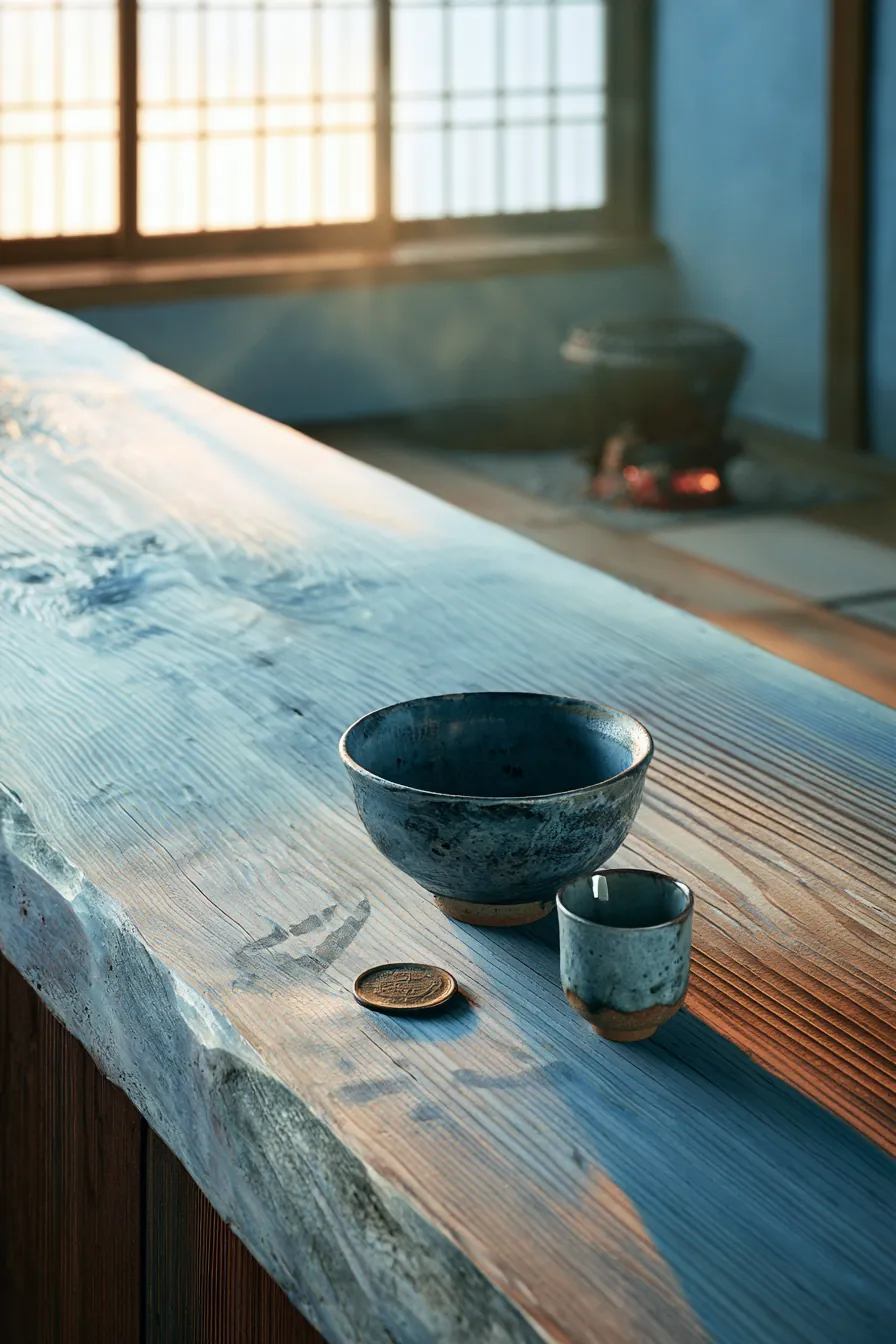
Chapter 3 — The Kan'ei Coin
By morning the coin had not moved, which was a thing I had checked, twice, before I had let myself put on the kettle.
I had not, exactly, expected it to move. I had not, exactly, expected it not to. The coin was the kind of object that, in a Library training carrel at twenty-two, one would have been required to seal in a paper envelope and label and put in a drawer for an Elder to come and decide about; and the coin was, also, the kind of object that, in my own kitchen at twenty-eight, simply sat on the unfinished hinoki of the counter where its owner had set it and reflected, very faintly, the dawn light coming sideways through the lower shōji.
It was a coin. It was, on examination, only a coin.
The dawn was the color of dilute green tea. The rain had stopped overnight and the alley was, again, that wet-stones-gloating particular Kyoto post-rain that I had decided yesterday I would not be sentimental about, which had not yielded for me one inch. I lifted the shutter at six-forty. I rinsed my hands at the genkan. I tied on the apron. I lit the irori.
The kettle, when I set it over the coals, did not sing.
This was a kind of small disappointment I did not give myself permission to examine.
Pip was already on the counter, sitting cross-legged in the unfaded red kimono, both hands wrapped around the empty cup with the chipped lip. Pip had, in the night, repositioned the silver coin by precisely half an inch closer to my side of the counter. I noted this. I did not comment. Pip was performing the kind of intervention that small ghost-children perform when they think the adults of a house need a small physical nudge in a direction they are too cowardly to walk in themselves.
"Pip," I said.
"Pip moved the coin," Pip said, with the bright pride of a child who has reorganized a thing it has been told not to reorganize. "Pip moved it because the coin was lonely."
"The coin was not lonely. The coin is a thing."
"Pip is also a thing."
"Pip is not a thing."
"Pip is a thing-in-principle," Pip said, and reached for the small wooden saucer where I kept the day's first thimble of hojicha, which Pip was not, this morning, going to get until I had decided whether or not we were friends.
I poured the thimble. I set it down. Pip drank ceremonially. The roasted-tea smell came up. The kettle, again, did not sing.
"Pip."
"Pip."
"The man last night."
"Pip is happy you brought it up. Pip has thoughts."
"Pip will share one thought."
"One."
Pip considered. The small face arranged itself into the particular look of a ghost-child trying to choose between several brightly colored balloons, and after a moment, Pip said:
"He smelled like cedar smoke."
"Mm."
"The good kind."
"Mm."
"The kind that means a fire on a mountain a long way away. Not the kind that means a fire in your house."
"That is two thoughts."
"That is two parts of one thought." Pip lifted its small chin. "Pip is allowed."
I did not argue. I had, on balance, been losing arguments with Pip since 2023 and had decided, as a matter of household policy, to concede in advance and reserve my energy for the koi.
I picked up the coin. I held it in my palm.
It was warm. It should not have been warm. It had sat on the counter, in the early-spring chill of a Kyoto morning, for seven hours, and it was, very lightly, body-warm — the temperature of a hand that has just been laid against another hand. I closed my fingers around it. I opened them. The coin sat in the small basin of my palm and did not, by anything I could detect, change temperature in the time it took for me to count to thirty.
I wrapped it in a square of indigo cloth. I put it in the inner pocket of my own jacket, against the lining where it would not knock.
I locked the front door. I hung the small sign — closed for inventory — on the noren rod, which was a sign I had had carved my first month here and had used three times in seven years. I told Pip, on my way out, that I would be back by ten and that Pip was to mind the kettle and the koi and Pip's own behaviour.
"Pip will be excellent," Pip said.
"Pip will be passable."
"Pip will be passable."
I went out into the alley and took the long way to Teramachi, by the river, because the river was the place I went when I needed to be in a wide place that was not also a thinking place. The herons were back this morning. Both of them, on the flat book-shaped stone, one-footed, judgmental, the river's elder statesmen. They watched me cross. They did not, on balance, approve.
The numismatist's shop on Teramachi was on the second floor of a building that had not been re-fronted since 1971 and had no intention of starting now.
The stair was narrow. The landing smelled of dust and brass and the faint sweet rot of paper that has been kept too long in a humid country. The door was a single dark frame with a small brass plate that said only Mochizuki and the kanji for coins, which was the kind of signage that, in Teramachi, told you exactly what you needed to know if you needed to know it and told you nothing at all if you didn't.
Mochizuki-sensei was at his loupe when I came in. He was eighty-one. He was the kind of eighty-one that means a man has decided, several decades ago, that he was going to live to a hundred and is making a slow careful project of it. He had a thin neck and a small bald spot at the crown of his head and he wore a pale grey sweater over a clean white shirt every day of the week, including Sundays, including the one time I had come on a national holiday and had found him here anyway with the loupe in his eye and a cup of green tea cooling beside him.
"Shirakawa-san."
"Sensei."
"You have not been here since March."
"April."
"April." He set down the loupe. "April was a slow month for you. May, I gather, has been less slow."
"I have a coin."
"You have."
I unwrapped the indigo cloth. I laid the kan'ei tsūhō on the small black velvet pad he kept on the desk for valuations. He did not pick it up. He looked at it for one slow beat. Then he reached for his loupe with the unhurried hand of a man who had been waiting for this coin his whole career and had not, until this morning, known he had been waiting.
"May I."
"Please."
He picked it up. He held it under the lamp. He turned it. He held it to the loupe. He did not, for almost a full minute, breathe out, and when he did the breath came out small and even and a fraction of an octave higher than his usual.
"Shirakawa-san."
"Mm."
"Where did this come from."
"A customer."
"A customer paid you with this."
"Yes."
"For."
"A cup of tea."
He set down the loupe. He set the coin back on the velvet pad. He folded his hands in his lap. He did not, I noticed, breathe out for another long beat, and his hands, in his lap, were very still in a way I had only seen them be still twice in seven years.
"Shirakawa-san. I am going to tell you several things. I would prefer you sit while I tell you them."
He gestured to the small low stool at the side of the desk. I sat. He poured me, without asking, a cup of green tea from the pot beside his elbow. The pot had been sitting since dawn; the tea was cool, slightly bitter, perfect. I held the cup. I did not drink. He took a small breath.
"First. This coin is a kan'ei tsūhō of the bun type. Cast in Edo, at the Mito mint, in the autumn of the third year of the Kanbun era. That is to say, 1663."
"Mm."
"Second. It has not, by any visible wear pattern, been circulated. There is no thumb-rub on the obverse. There is no rim wear. The square hole has not been ribboned. The patina is — and this is the part I would like you to understand, Shirakawa-san — consistent across the surface, which means the coin has not been alternately handled and stored. It has been, by my estimation, held. In one position, by one hand, for an extremely long time. The patina has darkened where the thumb and forefinger rest. The reverse, where it would have lain in the palm, is brighter."
"You can tell that."
"I can tell that." He almost smiled. "I have been looking at coins for fifty-seven years, Shirakawa-san. I can tell that."
"Third."
"Third." He paused. He looked at the coin. He looked at me. "Third, Shirakawa-san, this coin is warm."
I drank, finally, the cool bitter tea. I set the cup down. I did not say anything. I did not need to. He waited the kind beat one waits for a person who has been told a thing they already, in some smaller chamber of themselves, knew.
"You felt it," he said.
"Yes."
"And you knew."
"I knew."
"You are a Shirakawa, child. Your grandmother used to come to me with coins. Not this one. But coins like this." He set the loupe down very carefully, the way a man sets down a thing that has earned the right to be set down carefully. "I will give you ¥48,000 for it. That is, I want you to know, well below its market value. Its market value is the kind of number that, if I said it aloud, would make both of us uncomfortable. I am offering ¥48,000 because — Shirakawa-san — I do not think you should sell it."
I sat with this. I drank the rest of the tea. I held the cup in both hands until the porcelain matched the temperature of my palms.
"Sensei."
"Mm."
"If I don't sell it. What do I do with it."
He looked at me for one long careful beat over the rim of his glasses. The glasses, I noted, had been mended at the bridge by a small drop of solder, the kind of mending an older Japanese man did when he loved the glasses more than he loved going to the optician.
"You put it on the counter where he placed it," Mochizuki-sensei said. "And you wait until he places another one. And when he places the second one — and he will place a second one, Shirakawa-san; I have known your grandmother and her grandmother and her grandmother, and this kind of coin is never placed only once — then you ask him what he is paying for."
"What he is paying for."
"Tea is not a thing one pays for in coin like this. Coin like this is a vow."
I did not move. I held the empty cup in my hands and I did not move and I did not, importantly, breathe out. Mochizuki-sensei reached, with the careful hand of a man who has spent fifty-seven years not damaging delicate things, and refolded the indigo cloth around the coin, and pushed it gently across the velvet pad back toward me.
"Take it back," he said. "I will not charge you for the consultation. Your grandmother once gave my wife a remedy for a cough. I have been waiting fifty-five years to repay it. This is not the repayment. The repayment, also, is coming."
"Sensei."
"Shirakawa-san."
"Thank you."
I bowed. I bowed deeply, the kind of bow you give a man who has told you the truth at a cost to his afternoon. He bowed back, and we held the bow for the long beat that, in the Teramachi second-floor numismatist's office, was the small currency we paid each other in. When I straightened, he had taken his loupe back up and was, with the deliberate composure of a man returning to his work, examining a Meiji silver yen with a stain on the rim.
"One more thing, Shirakawa-san."
"Sensei."
"The coin. When he placed it on your counter. Did the kettle sing."
I did not lie. I did not nod. I held very still.
"The kettle sang," I said.
"Yes."
"Sensei, what does it mean."
Mochizuki-sensei did not look up from the silver yen. He turned it in his fingers. He coughed, very slightly, into his fist.
"It means, Shirakawa-san," he said, "that the wards in your house have made a friend. I would not, on balance, fight them about it."
He did not look up again. I bowed once more, even though he could not see it. I went down the narrow stair into Teramachi.
The street, when I came out, smelled of yakitori smoke from a small stand at the corner, and of the slightly chemical wet of stone that had been pressure-washed at five in the morning by a city employee in a yellow vest, and of the small lemon-and-soap smell that came off the bakery three doors down. The herons, on the river behind me, were still there. I knew this because I knew this. I walked home along the river without looking back.
In the inner pocket of my jacket, the coin sat against the lining, and was warm.
I opened at eleven. The day went on the way days do.
A pair of older women, mother and daughter, in from Nagoya for a wedding, drank matcha and complimented the koi. A solo man — Japanese, my father's age, very tired — had a cup of hojicha and ate the wagashi without speaking and left a thousand-yen note and tipped his head at me on the way out, the way men tip their heads when they have come into a small kind teahouse on the wrong day of their lives. I gave him an extra wagashi to take. He did not thank me. He did not have to.
At four I opened the back-room ward. The fudasetsu hummed. The flat-note paper near the tokonoma was, this evening, a quarter-tone flatter than yesterday. I made a small mental note, the kind of mental note I had been making lately and not writing down — the not-writing-down was, I had decided, itself a discipline. If I wrote it down, I was saying I would lose it. If I held it in my head, I was saying I would keep it. The arithmetic of this discipline did not, I knew, hold; but it was the arithmetic I had.
Yuki came at sundown. She wore the long pale-grey coat. She set the silk handkerchief at her left elbow. She did not unfold it. She drank the kuromoji-cha, lukewarm. The steam, as always, curled into her instead of upward. I did not, this evening, ask after her cousin in Otsu. Yuki had told me, in a previous April, that she did not enjoy being asked about graves; I am not a topic, she had said, I am a season. I had not asked again.
She drank slowly. She looked, twice, at the empty third stool at the counter. She did not, the rest of the visit, look at it again.
When she rose, she left a thousand-yen note and a single small ice flower. The flower had, this week, eight petals instead of six. I did not ask. I bowed her out. The bell, again, did not ring.
I cleared her table at nine. I rinsed her cup. I put the ice flower into the small lacquer dish in the freezer, beside yesterday's, which had melted to a clear ring of water that I had not had the heart to wipe up. I added the new flower's small ceremony to the old one's small ceremony. The freezer hummed.
At ten thirty I made the midnight blend.
I did not, for a long moment, examine why I had done this. I made it. I poured it into the warming pot. I set the warming pot on the side of the irori. I went to the cabinet for the cup with the chipped lip — Yuki's cup, the cup Pip had stolen this morning and which Pip had, between four and ten, somehow returned to the rack with no acknowledgment — and I took it down and set it on the counter, and I stood with my hands flat on the hinoki and I counted to thirty.
At thirty I picked up the cup and went to put it back in the rack.
The bell rang.
I had not, this time, expected it. I had told myself I had expected it. I had been wrong.
It rang once. Clear. The single brass note of a stranger.
I turned. The outer door was sliding open. The man came through the noren. He took off the coat in the genkan and folded it over his forearm and stepped up and was, by the time I had set the cup back down on the counter, standing very still at the threshold of the front room as if he had decided, this evening, to wait for an invitation he had not waited for the previous two nights.
The third stool from the left, I noted, was the stool he had not yet sat down at.
"Good evening," he said.
The voice was the voice. Watashi. The verb endings my great-grandmother might have used. He inclined his head a fraction; he did not bow. I returned a fraction. I did not bow.
"Closed," I said. "But."
"But."
"But you knew."
"I knew."
"Come in. Please."
He came in. He sat. He folded his hands in his lap. He did not, this evening, immediately produce a coin. He waited. He had, I understood with the slow descending clarity that had become, this week, my whole inner weather, decided not to play the coin twice in a row. He was a man — a being — who knew the rhythms of small ceremonies. He was pacing them out for me. He was being, in his too-formal way, patient.
I poured the midnight blend. I set the cup on the counter between us.
He lifted it. He drank. He closed his eyes — that fractional closing, less than a blink — and opened them again, and they were the color of the kettle just lifted off the coals.
"Thank you," he said.
"Mm."
"You went to Teramachi today."
He said it without inflection. He said it the way a man says the rain has stopped. He said it not to provoke and not to confess but to lay down, between us, a small clean fact, the way one lays down a coin.
I poured myself a cup. I drank. The smoked cherry rose at the back of my throat and held.
"You followed me."
"I did not."
"Then."
"I saw the indigo cloth on your counter this morning. It was not there last night. The cloth is one you use for, I think, important small things — there is a similar one in the drawer beside the till for the spice you do not name. I drew an inference. I am sorry if it is presumptuous."
"It is presumptuous."
"Yes."
"Do not do it again."
"I will not."
We drank. The kettle, on the irori, sang — softly, briefly — and stopped. He did not look at it. He did not, by any motion of his face, acknowledge that it had sung. This was, I understood, also a courtesy. He had decided not to comment on my kettle until my kettle had decided what it was going to do.
Pip was on the beam above the irori. Pip had been on the beam since six, sulking about the coin, and Pip was at this moment fully visible — to me, to him, presumably, to the koi — and Pip was watching him with the kind of enormous absorbed eyes that small ghost-children turn on small interesting strangers when they have entirely forgotten how to be a small ghost-child.
He turned, very slightly, on the stool. He looked up at the beam. He saw Pip.
His face did the thing his face did, which was that the corners of his mouth tipped, almost, but did not commit. He inclined his head. To Pip. Not deeply. The depth of head-incline one offers to a small person on a beam who has been resident in a building for one hundred and thirty-seven years and is, in the matter of being seen, the senior party in the room.
Pip went, immediately, the color of the inside of a strawberry.
"Pip is —" Pip began, in a voice an octave higher than usual, and then, mercifully, lost the rest of the sentence.
"I have not had the honor," the man at the counter said, very politely, to the beam, "of being introduced."
"Pip," Pip said, and put both hands over its mouth, and slid behind a rafter so that only the small embroidered hem of the unfaded red kimono was visible.
"Pip-san," the man said. He bowed to the rafter. He bowed it carefully. He stayed bowed for a beat longer than he needed to, which was, I understood, the courtesy he had decided to extend a being he could see and which most of the world could not.
When he straightened, he was looking at me again, and his face was the careful unreadable face I had begun, in two visits, to recognize as the face he wore when he wanted me to know that he had seen, and that the seeing had cost him a small careful effort he was choosing not to disclose.
"You see Pip," I said.
"Yes."
"That."
"Yes."
"That is."
"Yes."
I held the cup. I did not drink. My hands, under the apron, were shaking, and I had not noticed when they had started. I set the cup down so that he would not, if he was the kind of man who noted these things, note the small clink of porcelain on hinoki that my shaking would have made.
"You can either be a seer," I said, very quietly, "or you can be — that. You cannot be both."
"There are exceptions."
"Name one."
He paused. The pause was the long pause of a man choosing, very carefully, which truth he would lay down between us tonight. The wards, very faintly, hummed. The flat-note paper near the tokonoma — I felt it more than heard it — moved a quarter-tone closer to its proper pitch.
"I am an exception," he said. "I am sorry. I will not be more explicit tonight than that."
"Tonight."
"Tonight."
"So you will be, another night."
"If you ask me to be."
"And if I do not."
"Then I will not."
He drank. He set the cup down. He did not, importantly, touch the coin he had not, this evening, produced. He sat with his hands folded and he looked at me, not directly — he had not, in three visits, looked at me directly — but at a point on the counter between us, which had become, by the small geometry of how we sat, a third party in the room.
"Shirakawa-san."
"Don't."
"Forgive me. I do not know your given name."
"You do not."
"I would like, if it is acceptable, to address you as Hana."
"Why."
"Because the surname is, in this room, a kind of formality I do not, by my own hand, deserve."
I did not answer. I poured him a second cup. He had not asked. I poured it anyway. The pot was, in any case, only a one-and-a-half-cup pot at this hour, and the second cup was, I understood as I poured it, a kind of small answer I was choosing to give in liquid because my mouth was busy with not shaking.
"Hana," he said, the once.
He did not say it twice. He let it sit. He drank the second cup as slowly as the first. The kettle, on the irori, did not sing.
When he set the cup down, he stood. He bowed. He did not, this evening, place a coin on the counter. He had decided, I understood, that one coin per visit was the rhythm he would honor. The rhythm of a man who had been visiting tea-houses since before tea-houses had existed.
"Tomorrow," he said.
"Tomorrow."
"Thank you for the tea, Hana."
He went to the noren. He paused. He turned, fractionally, back, and he looked, this time, at the beam — at the rafter where the hem of the red kimono was still, just barely, visible — and he bowed again, more slightly, the bow one gives a small person who has been hiding politely and would like to be acknowledged in the hiding.
"Goodnight, Pip-san."
"Goodnight," came a small fierce whisper from behind the rafter.
He went out. The door slid shut. The bell did not ring on the way out.
I stood at the counter with both hands flat on the hinoki, and I counted, this time, to sixty, because thirty was no longer enough.
Pip slid out from behind the rafter. Pip slid down the rafter. Pip arrived on the counter the way Pip arrived on counters, which was the way leaves arrive on still water — by surface tension and the conviction of having always been there. Pip sat cross-legged on the hinoki and folded the small hands on the small knees.
"Hana-chan."
"Pip."
"He saw Pip."
"He saw Pip."
"He bowed at Pip."
"He bowed at Pip."
"He called Pip Pip-san."
"He called Pip Pip-san."
"Hana-chan."
"Mm."
"That has never happened."
"I know."
Pip considered for a long beat. Pip's small face, in the lantern light, was wet at the corners of the eyes — Pip cried, occasionally, when Pip was very happy or very afraid, and could never tell the difference — and Pip wiped the tears with the back of one small sleeve and then composed itself with the dignity of a six-year-old who had decided to be a hundred and thirty-seven for the rest of the evening.
"Pip is going to bed," Pip said.
"Pip does not have a bed."
"Pip is going to go to a beam. Pip has had a lot. Pip needs to think."
"Pip should think."
"Pip will think very hard."
Pip floated up. Pip arranged itself on the highest beam, the one closest to the small skylight above the irori, and folded its hands and closed its eyes and pretended, with the magnificent self-seriousness of small ghost-children pretending things, to be asleep. The kimono settled. The lantern light pooled. I stood at the counter with the empty cups and the empty pot and the coin I had wrapped in indigo and the coin I had not, tonight, been given.
I went to the drawer below the till. I took out the notebook. I opened it to the first empty page. I held the brush. I set the brush down. I picked it up. I set it down.
I wrote, in a hand that was not as steady as it had been at twenty-four:
He saw Pip. Which meant he was a seer, or he was a yokai. Or — I knew, in my chest, before I knew it in my head — both.
I closed the notebook. I put it away. I did not, tonight, write anything else.
In the inner pocket of the jacket on the hook by the door, the kan'ei tsūhō coin in the indigo cloth, against the lining, was warm.
The kettle, on the irori, did not sing.
But the fudasetsu, along the rafters, hummed at the precise frequency a kotodama witch hangs them to hum at, and the flat-note paper near the tokonoma was, by midnight, fully in tune again — a thing I had not done, and would not have known how to do, and which the house had, for reasons it had not consulted me on, decided to do for itself.
I went upstairs.
I did not sleep. I lay in the dark and listened, instead, to the kettle on the irori below, which did not sing and did not sing and did not sing, in the way a thing that has decided to be patient does not sing.
At three I went down.
I poured the cold midnight blend out of the warming pot into the koi pond, because the koi loves the smoked cherry and would, in the morning, surface twice instead of once. I rinsed the pot. I rinsed the cups. I wiped the counter. I did not move the coin. The coin, in the indigo cloth, on the hook, was warm.
I went back upstairs.
At dawn the kettle sang once, on its own, very softly, the way a thing that has been waiting all night might sing the smallest hello to a morning it has decided, against every promise it ever made itself, to be glad of.
I let it.