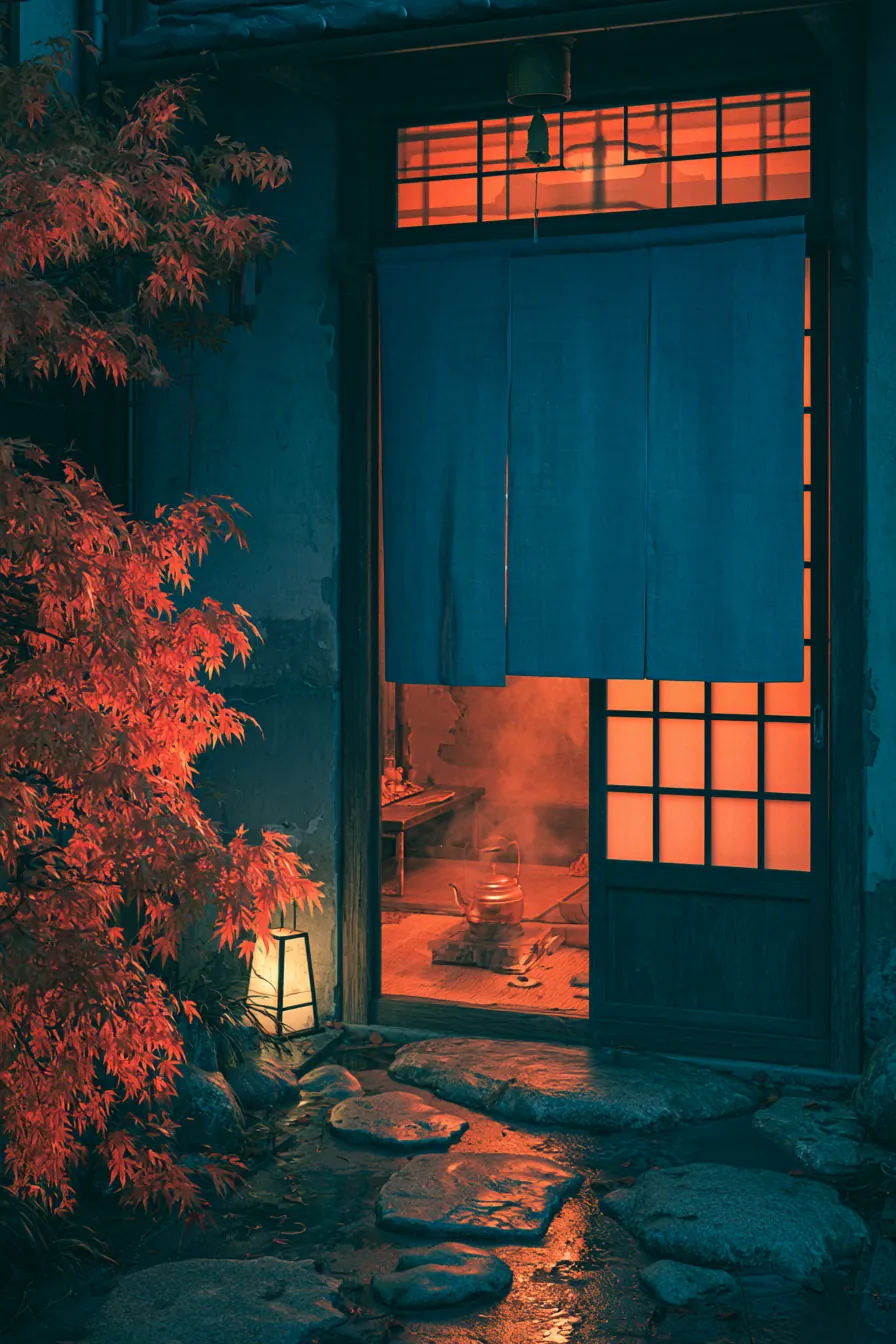
Chapter 22 — The Equinox
The autumn equinox came in, in Pontocho, on the kind of evening that does not announce itself. There was no wind to speak of. The cicadas had given out the week before — all at once, in the way they do, as though the city had agreed in a single night to set the instrument down — and what was left in the alley at six was the first cold edge under the warm, the small dry note of the year turning over that one can hear only if one has spent two years learning to listen for the things one is afraid of.
I had spent two years learning to listen for the things I was afraid of.
I was, this evening, listening for a different thing.
The teahouse, by the count of the days since July, had become a place that had a great many more people in it than it had had in June. Hisako-san came on Tuesdays now, and her warabi mochi had, by the end of August, become a thing the Nara woman timed her visits around. Akiko came on Saturday mornings at six in the Doshisha sweatshirt and sat at the second stool and read the alley's wards with me over the kuromoji-cha, not because the wards needed reading any longer but because the reading had become the shape of a Saturday. Sumire's bowls had come home in July on a bus from Sanjō, and I had washed each of the eight and put them on the third shelf where they had wanted, by their own weight, to go, and the cupboard at Kogitsune-an had become, by some long arithmetic of two witches' bowls, a cupboard that knew whose it was.
The kettle sang on its own, now, when it was moved to.
It was moved to perhaps four times a day. I had stopped, by September, being surprised by it. I had learned — the way one learns a habit of an animal one lives with — its phrases: the someone is at the threshold, the the day has been good, the a thing is changing in the alley, and the one it had sung first, at four-twenty-three on a Sunday in July, which I had not heard it sing again and which I had begun to understand it was keeping.
At six this evening the kettle sang the phrase it had been keeping.
I was at the cedar counter with a cloth in my hand. I set the cloth down. I did not, by any rule with myself, breathe out.
Pip, from the central beam, said: Hana-chan.
Yes.
The phrase.
Yes.
Pip will, this evening, be at the upstairs window from now until midnight.
Yes.
Pip will not, at the upstairs window, come down.
No.
Pip will, by Pip's own custom, watch the alley and not the stair.
Yes, Pip.
Pip is, Pip said, in a register I had heard from Pip exactly twice in three years, glad.
I let that sit on the counter the way I had been taught, this summer, to let warm things sit.
I am also, I said, glad.
Pip went up the cedar stair in the slow careful patter of a honbun-of-the-threshold who had been waiting at a window since 1888 and had decided that tonight was a night for being exactly where it had agreed to be. The seventh fudasetsu was at the upstairs window's lower jamb, at one and a quarter degrees off the vertical, where it had been since July. Pip settled behind the indigo curtain.
I poured the midnight blend into Sumire's blue pot.
I had not, since July, poured the midnight blend. The midnight blend was for one person, and the one person had been, since July, walking west to his own grove and then — by the slow careful patience of his own road and his own discipline and a thing the back of me had been counting without my permission — not coming until the equinox. I had poured, in the meanwhile, every other tea in the cupboard. I had not poured the midnight blend.
I poured it now.
The smoked cherry rose into the front room, and the front room — which had held a good many warm things this summer, and learned to — held this one differently.
At eleven the bell rang.
He came through the noren.
He took off the charcoal coat in the genkan. He set his shoes at the angle of a man who has, by his own long discipline, never once in eleven hundred years set his shoes carelessly in another person's doorway. He stepped up onto the cedar floor.
He looked, this evening, like a man who had walked a long way and arrived. The kimono of the older sleeves was the kimono of the older sleeves; but the body inside it was no longer the body that had come through the bamboo at the inner grove at four-twelve on a Sunday in July with sixty-one years of carrying still on its shoulders. The carrying was on a flat stone on an island. The man who came through my noren on the equinox was, by some fraction at the shoulders only I would have known to read, lighter by the weight of a coin.
Hana, he said.
Kuzunoha.
It was the second time, in the whole of our acquaintance, that I had said the name aloud. The first had been on a moss floor under seven cedars, in concert, in a cadence that was not entirely mine. This time it was entirely mine, and it was quiet, and it was meant for no one but the man in the doorway and a kettle and a honbun at an upstairs window who had, by its own promise, agreed not to listen.
He heard the difference. I watched him hear it. The being-young that had used to last a half-second, and then three, lasted, this evening, as long as he wished it to.
You poured the midnight blend, he said.
I did.
You have not, by my reading of the cupboard from the genkan, poured it since July.
You can read my cupboard from the genkan.
I can read, he said, a great many things from a great many distances. I have spent eleven hundred years learning to read things from distances. It is, I have begun to suspect, a habit I learned because the distances were the only place I was permitted to stand.
I set the cup with the chipped lip on the counter. I poured. He came to the third stool. He did not, this evening, fold his hands in his lap and wait. He sat, and he looked at the cup, and he looked at me, and he let the looking be the thing it had not, for fifteen days in the spring, been allowed to be.
Hana.
Yes.
The form finished in July. The carrying finished. I told you, on the moss, thank you, and I told you I would not make the thank-you do the asking for you, because you were not, on that afternoon, asking.
I remember.
I have walked west to my grove and stood at my own stone and let the grove read what was left of me after the coin. I have spent the summer, by my own discipline, being a man who is no longer imo by anticipation and learning what such a man is, when he is not the carrying. It is — Hana — a strange thing to learn at eleven hundred years. It is the thing a much younger creature learns and forgets it ever did not know.
He turned the empty right hand over once, slowly, on the counter, the way he had turned it over in the grove. The hand was empty. The hand was, this evening, at rest.
I have learned, he said, that I am a man who would like, if he is permitted, to be asked.
I did not, by any rule with myself, look away.
I had spent two years, and then a spring, and then a summer, being a woman who graded her wanting by produce weight and kept it under fifty grams and refused, by long discipline, to want a particular thing because the wanting of it might cost her the thing. I had given the resentment to the kotodama on a moss floor in July. The chamber where it had lived was empty in the clean way and had stayed open. I had been, all summer, learning what such a chamber is, when it is not the resentment.
It is, it turns out, a room.
A room is a thing one may, if one wishes, let someone into.
Kuzunoha, I said.
Yes.
Come upstairs.
He set the cup down. He did not, this time, almost-smile. He smiled — the whole of it, unhurried, a thing I had watched him decline to do for fifteen nights in the spring because the declining had been the only courtesy his loneliness knew how to pay.
I would, he said, with my whole hand, accept.
The upstairs room of Kogitsune-an is four mats and a low desk and a round mirror that wore, in its lower right corner, the small flaw where the silvering let go in 1971. There was a lantern on the floor. There was a futon I had laid out — I, who had not laid out a futon for two in the whole of my keeping of this house — at some hour of the afternoon, in a small careful disbelief at my own hands.
I had not, in laying it out, allowed myself to decide it meant anything. The hands had decided. The hands, this summer, had been deciding a great many things, and I had been learning to let them.
He came up the stair behind me. Pip, on the ledge behind the indigo curtain at the window, did not turn around. Pip kept its small face to the alley, in the small careful discretion of a honbun who had promised to watch the alley and not the stair, and who would, by its own long custom, keep the promise to the last syllable. The seventh fudasetsu at the window's jamb held the room the way it had been holding the room since July.
He stood in the doorway of the small room.
He looked at the lantern on the floor, and the low desk, and the round mirror with its flaw, and the futon, and at me.
Hana.
Yes.
Your hands.
What of them.
They are not, this evening, chapped.
It is September. They heal in autumn. They always do.
He crossed the small room. He stood close, in the small private geography of a man who has, for fifteen nights and a spring and a summer, advanced by no more than two degrees a night and has been given, this evening, the rest of the way. He lifted one hand — the unhanded hand, the empty one, the one that had carried a coin for sixty-one years and now carried nothing and was, for the first time in his very long life, free to carry whatever it chose — and he set it, cool and certain, against my cheek.
His hand was cool the way the inside of a grove is cool. It was the temperature of a thing that has been alive for eleven hundred years and has learned that the warm things are worth coming in out of the rain for. It was, against my cheek, the most careful thing that had ever touched me.
I am, he said, very quietly, going to be incrementally forward.
I laughed.
It came out of me before I had decided to allow it — a real laugh, short and surprised and warmer than anything I had let out of my chest in two years, the laugh of a woman who has just been quoted her own spring back at her by a man who had been keeping the line all summer to give to her now. He had heard me almost-laugh in May and had not pressed the almost. He pressed it now. The almost became the whole.
You may be, I said, when I could, as forward as you like. I am, in the matter of doorways and lanterns, no longer keeping the ledger.
No, he said.
No.
He kissed me.
The rest of it I will not put in the notebook, because the notebook is for the things I have chosen to remember, and there are some things one does not need to write down in order to keep — there are things the body keeps, in a chamber that was empty in the clean way and is now, by some long careful arithmetic of one equinox, a room with someone in it. I will say only that it was tender first, and then it was not careful at all, and that there was a moment, somewhere in the unhurried middle of it, when the kettle two floors below us sang — by no hand, in an empty front room, a phrase I had not heard it sing — and I understood, in the small clear way one understands a thing in the dark, that the kettle had sung the phrase because the honbun of the threshold of a teahouse opened in 1888 had decided, on this equinox, that the witch of the house was at last, by every honest accounting, not living alone.
After, the lantern had burned down to the low warm round it kept at the bottom of itself. The alley below the window was the alley. Pip, behind the indigo curtain, had not, by any sound, turned around once.
He lay with his head beside mine on the futon Sumire had bought from the futon-man at Demachi in 1979, the one that was meant to outlast me by a factor of at least two. The cool of him had warmed, where we touched, to something that was neither his temperature nor mine but the third thing two temperatures make when they have been, for a long while, in the same small room.
Hana.
Yes.
I am going to tell you one true thing about myself.
You do not have to.
I know. That is why I am going to.
I turned my head on the pillow to look at him. The lantern light was on the white at his temple, the streak that was on the same side as mine, the streak that Yuki had told me in May was only an accident and that I had decided, on balance, to keep believing was only an accident, because the accidents one chooses to keep believing in are a kind of faith and I had decided to have, in the matter of this man, a small amount of faith.
When I was young, he said — and the young was a word that, in his mouth, meant a span of time I could not hold in my head, a young of eleventh-century roads and a Kyoto that was not Kyoto — I was apprenticed. Not in the way your line apprentices. In the way mine does, which is older and worse and which I have not, in eleven hundred years, spoken of to anyone who was not of my own blood. I had a teacher. The teacher was not a kitsune. The teacher was a thing that lived in an object, the way Pip-san lives in a threshold and the way the umbrella-man Kasamoto lives in his hundred years of rain. My teacher lived in an inkstone.
I went very still.
The inkstone, he said, was carved in the south, on the continent, in a year I will not give you because the year is a door and I am not, tonight, going to open the whole of the door. The thing that lived in it had been awake a long time before I met it — longer than I have been awake now. It taught me the grammar of my own line. It taught me the address-mood. It taught me to read things from distances. And then, by a thing that happened that I am also not going to give you tonight, the inkstone was taken south again, across the water, to a town of bridges and canals, and I did not — by my own failure, by a young creature's failure, by the worst failure of my very long life — go after it.
Kuzunoha.
The thing that lived in the inkstone, he said, had a name. It could not speak the name above a whisper, because to speak above a whisper split the page it wrote on, and it had decided, by its own long discipline, that the pages were worth more than the speaking. It whispered the name to me once. I have carried it — the way I carried the coin, except that the coin I could set on a stone, and the name I cannot set down anywhere but in the one place it has, for nine hundred years, refused to leave.
What is the name.
He was quiet for a long moment. The lantern ticked, very faintly, the way a lantern ticks when the oil is low. Below us, the kettle did not sing; the honbun, at its window, kept its small disciplined silence; the alley was the alley.
Mò, he said.
He said it the way one says a name one has not been permitted to say in nine hundred years. He said it the way Mariko had not said a name in fifty-five years. He said it the way a man says the one true thing about himself, which is to say the thing that is not, in fact, about himself at all, but about the thing he failed.
墨, he said. Ink. And two more syllables I will give you another night, because the two more syllables are the part that is a door, and I have, tonight, opened enough of the doors.
I did not, by any rule with myself, ask the two more syllables.
I had spent the summer learning the difference between a question one asks because one cannot bear not to know and a question one leaves open because the leaving-open is a kindness the other person has not yet been able to afford. I had learned the difference from a yamabuki on a previous page and a not-answering kept for forty-six years. I had learned that the most expensive of the small grammars is the one you decline to use.
I declined to use it.
Another night, I said.
Another night, he said.
He closed his eyes. His breathing went, after a while, into the slow even thing a breathing goes into when a creature who has not, in eleven hundred years, fully let his guard down in another person's house has — on an equinox, in an upstairs room, beside a woman who had chosen to remember — let it down.
I did not sleep at once.
I lay in the dark and listened, with the part of me that had spent two years listening for the things I was afraid of, and found that I was not, tonight, afraid of anything. I listened instead to a thing I had not, in two years, had to listen for: the breathing of a person in my room.
I got up, very quietly, near three.
I went to the low desk. I did not light a second lantern; the low warm round of the first was enough, the way it had been enough in July in a cottage on an island. I uncapped the small brush. I held it over a fresh page.
I wrote, in the second-degree-larger hand of my great-aunt at sixty-three — the hand the brush had given me on a Sunday morning in July and had kept giving me since, the hand of a woman who had learned to write the things she wanted to remember — two lines.
Autumn equinox. The cicadas are finished. He came at eleven. I asked. He accepted. The kettle sang the phrase it had been keeping.
There is a name. It is Mò. It is in a town of bridges and canals, in an inkstone, and it has been waiting nine hundred years for a young creature who failed it once to come back. I think — by some long careful arithmetic I do not yet have all the numbers for — that we are going to go and get it.
I capped the brush.
I did not close the notebook.
I let the page dry, the way I had let a page dry on an island in July, the way one lets a thing dry that one intends to keep.
I went back to the futon.
He had turned, in his sleep, toward the place where I had been, in the small unconscious geography of a creature whose body had decided, before the rest of him had finished deciding, that the place where I had been was a place worth turning toward. I lay down in it. He settled, without waking, against me — cool, and then warm, and then the third thing.
Behind the indigo curtain at the window, Pip kept its watch on the alley. The threshold lantern below was lit. It would, by Pip's small careful keeping, remain lit.
And somewhere south of all of it — past the bay, past the long water, in a town I had never seen, of bridges and canals and three stories of stacked classical texts above a slow green channel — an inkstone that had been awake since before either of us, and could not speak above a whisper without splitting a page, sat in the dark and waited, the way the patient things wait, for the small distant sound of a kettle in a teahouse in Pontocho beginning, on an equinox, to sing.