Chapter 1 — The Cleansing
The sword that was going to ruin her had been polished by her own hands at dawn for three years.
Lin Yao knew this because she knew that sword the way another woman might know a lover's voice — by the grain of the iron in its hilt, by the angle of the cold-pool whetstone she'd been taught to drag along the spine, by the precise harmonic the blade rang when it cleared the scabbard on a morning thin enough to crack. Hánshuāng. Frost-Rime. Pei Shenzhi's blade. Four feet of single-edged northern steel that the senior disciples whispered had never tasted unrighteous blood.
It was about to taste hers.
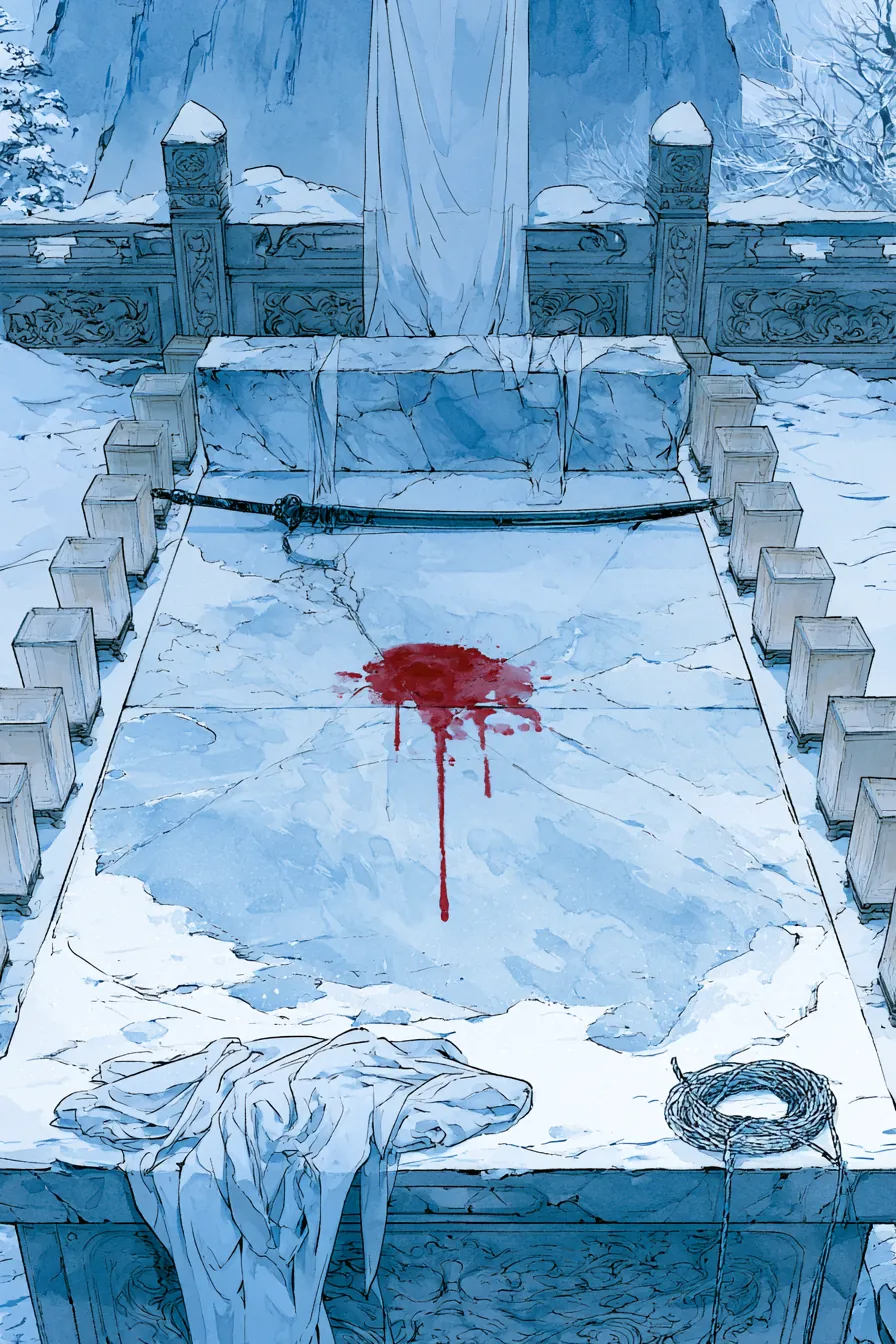
She knelt on white frost-jade in the white robes the sect reserved for two occasions — brides and the condemned — and tried to count the lanterns. There were three hundred of them ringing the ancestral altar of 寒玉峰, Cold Jade Peak, and three hundred witnesses behind the lanterns, and one hand-bound 锁灵索 spirit-rope around her wrists that hummed a frequency calibrated to break a Foundation-stage cultivator. She was Lianqi 7th, on the public roster. The rope was redundant. The rope was theater.
Count the lanterns, she told herself. Count the lanterns and do not look at his face.
It was easier than expected. He was not looking at hers.
"The disciple Lin Yao." The voice that read out her crimes belonged to Elder Yan, the recordkeeper, a man who had taught her to write her own name at fourteen and now seemed to have forgotten how to pronounce it. "Of the outer line. Five-element trash-root, mixed registration. Admitted to the sect in the seventh month of the Wuyin year on grounds of mercy."
Mercy. She tasted iron at the back of her teeth and resolved, with the cold pristine clarity of the about-to-die, that she would never eat the word mercy again in her life.
"On the night of the third moon-quarter, the disciple Pei Yan, of the inner line, was discovered behind the woodshed of the eastern dormitory, throat cut. The disciple Lin Yao was the last person seen in his company. The disciple Lin Yao's storage ring, upon examination, contained an unaccountable trace of demonic 灵气. Three witnesses observed her eyes flash red in the courtyard at the second watch the same night."
The witnesses sat in a neat row behind Elder Yan. Lin Yao knew all three of them. Sister Su, who had cried in her arms after a failed breakthrough in the second month and sworn eternal sisterhood. Junior Cheng, whose translation of the Cold Pool Sword Manual into common script she had ghostwritten when he sprained his calligraphy wrist. Senior Mei, who had once asked Lin Yao to mend her ceremonial sash because "yours is the steadiest hand on the peak, Yao-mei, and I cannot trust the seamstresses with my mother's silk."
Steady hand. Lin Yao looked down at her bound wrists. Yes. I have a very steady hand.
She had not killed Pei Yan. Pei Yan had cornered her behind the woodshed for the seventh time in four months, and she had said no for the seventh time, and walked away with her hand on her father's old knife in her sleeve, and that had been at the first watch, not the second, and his throat had still been intact when she left. Someone else had cut it. Someone with a clean blade and clean robes and the kind of standing in this sect that meant three of her sisters-in-cultivation would sit in a row and lie about her eyes.
She did not waste qi on hating them. Qi was for surviving the next hour.
"Per the Cold Pool Oath, Article Seven," Elder Yan read on, "the contamination of the sect with demonic resonance, the murder of a senior inner disciple, and the deception of one's masters constitute the three unforgivable transgressions. The verdict of the Hall of Discipline is 清门 — cleansing. The disciple Lin Yao is hereby —"
"Read the rest." Pei Shenzhi's voice cut him neatly in half.
It landed the way frost lands on a blade-edge — soundless, total, instantly transformative. Elder Yan stopped speaking. Three hundred lanterns seemed to draw their breath.
Lin Yao did not look up. She did not have to. She had memorized his stillness the way a moth memorizes the angle of a lantern. He would be standing at the head of the altar in 白衣 so white it made the snow look soiled, hands behind his back, sword across his shoulders horizontally on its silk hanger — a carrying stance, not yet drawn — and his face would be the same face it had been every dawn for three years when she had walked past the sword pavilion to scrub the courtyards and pretended not to look in at him through the open lattice.
A face carved out of winter. Eyes the colour of river-ice at second moon. A man whose mother had died when he was four and who had not, by sect record or rumor, had a single personal want recorded in the nineteen years since.
She had loved him stupidly, fully, and with the kind of clarity moths achieve only after the wing is already on fire. She had loved him through the ten thousand mornings she had not been allowed to enter the sword pavilion, and the ten thousand evenings she had stolen back fragments of his discarded notes from the rubbish-trough at the rear gate, copied them on the cheapest rice paper, and learned. The footwork of the Cold Pool Sword Manual lived in her left calf. The breathing pattern of the Frost Lung Method lived in her ribs.
The man who had unwittingly taught her every drop of cultivation she had was about to drive his sword through her shoulder.
It was almost funny. Almost.
"The disciple Lin Yao," Elder Yan began again, his voice now narrowed to the precise civil-service register of a man pretending not to be afraid, "is hereby sentenced to the 清门大典 — Sect Cleansing Ceremony. Her meridians shall be publicly severed at the Hall of the Ancestors. Her storage ring shall be burned with talisman-fire. She shall be remanded to 断魂崖, Severed Soul Cliff, and cast down to such fate as the 道 permits her."
Three hundred witnesses exhaled in a long, soft hiss that the wind almost ate.
Public severance. She had braced for execution. Severance, paradoxically, was worse — severance was the cleanest political dodge available to the sect head's faction. Alive but harmless. If you cut a Tianmo —
No.
She buried the word before it could finish forming. Trash-root, she told herself, the way her mother had taught her at nine. I am trash-root, five-element, untalented and unwanted, and I have always been trash-root, and the warmth at the base of my spine right now is hunger. Just hunger. Just hunger.
The warmth at the base of her spine was not hunger.
She had felt it crack open last night for the first time in ten years — the soul-nail her father had driven through his own 丹田 to anchor her seal — and it had hummed in her sleep, and her eyes (she now understood) had flashed red in the courtyard at second watch, because that crack had let through a single thread of the thing inside her that her father had killed himself to keep buried, and someone had been waiting in the courtyard with the express purpose of seeing it. Someone who had cut Pei Yan's throat clean and waited for her to walk past in her plain outer-disciple greys and seen what they needed to see.
Frame. She had been framed. Within hours. Surgically. By someone who had been watching her seal for a long, long time.
Who knew?
The question was a hot wire under her sternum. She filed it under survive first, ask later, the way she had filed every important thing in her life.
Pei Shenzhi stepped down from the head of the altar.
She heard his boots on the frost-jade — three measured steps, the same cadence the manual recommended for the 饮霜 / Yǐnshuāng opening form. He was approaching her in form. He was approaching her as if she were a technique.
She felt, against her will, the smallest possible flicker of admiration. Of course. He could not approach her as a person, so he had recategorized her as a sword exercise. It was almost elegant. It was almost beautiful. She filed that away too, under do not love a man who can do that to a feeling.
His shadow fell across her bound hands.
She raised her face. She had decided, somewhere between lantern two-hundred and lantern two-fifty, that she was going to look at him. She owed her father's daughter that. She owed the ten-year-old who had carried a sword too heavy for her wrist down a mountain road in the snow that.
He was looking just past her. At the altar. At the ancestral inscription. At anything but her face.
"Pei-shixiong," she said.
His jaw flickered. A muscle moved at the corner. A normal person would have missed it. She did not.
"You have not asked me," she said, conversationally, the way she had once heard her mother speak to a creditor at the door, "whether I did it."
A silence so total fell across the altar that she could hear the wind threading through Senior Mei's hairpin three rows back.
"It is not for me to ask," he said. Each word was its own verdict. He still did not look at her face.
"It is for you," she said, "as the presiding disciple of this ceremony, to ask. It is in the Discipline Hall Compendium, Article Three. The presiding officiant shall give the accused one opportunity to speak in their own defense, in the hearing of the ancestral altar, before sentence is carried out."
A small sound — almost a cough — from Elder Yan's direction. She had quoted the article verbatim. She had memorized it last winter, copying it for Junior Cheng's poor sprained wrist.
Pei Shenzhi was silent.
"Ask me," she said. Softly. Not as a beggar. As a woman handing a clerk a piece of correctly filed paperwork.
His throat moved.
"Disciple Lin Yao." His voice was a glass blade. "Did you kill the disciple Pei Yan."
"No," she said. "I did not."
She held his shadow. She still could not see his eyes.
"Did your 灵气 register demonically at second watch on the night of the third moon-quarter."
"I do not know what was in my storage ring," she said carefully. "Someone planted it. I have not cultivated demonic methods. I would not know how."
"Did your eyes," he said, and now there was the smallest possible tremor in the precision of his consonants, the way frost-jade hums before it cracks, "flash red."
She breathed in. She breathed out. Soul-nail. Father. Mama. I'm sorry, Mama, but here it comes.
"I do not know," she said. "I was asleep. I cannot speak to what my eyes did. Pei-shixiong. I can speak only to what I did. I did not kill him. I did not cultivate demonic arts. I have served this sect for ten years scrubbing the courtyards your boots crossed each dawn, and copying the manuals you discarded at the rear gate, and I have been hungry every day of those ten years and I have never once complained, and I am telling you now — under the witness of the ancestral altar — that I am innocent of these charges."
The wind did not move. The lanterns did not move. Three hundred witnesses did not move.
Pei Shenzhi looked at her.
For the first time in three years, Pei Shenzhi looked at her face.
It was a third of a second. Less. The duration of a sword's breath at the apex of a clean cut. His eyes were grey-blue, river-ice eyes, and inside them — for that one nameless fraction — was the entire structure of a man being asked to carry something too heavy for his hands, and choosing to carry it anyway, and never, never permitting himself to set it down to look at it.
She memorized the colour. She would need it later.
"Sentence has been recorded," he said. He had looked away again. His voice was perfectly level. "Sentence will be carried out."
Coward, she thought, with a great clean tenderness. Oh, you coward. I would have followed you anywhere. I would have polished your sword every dawn of my life. Look at me when you cut me. Look at me. Look.**
He raised Frost-Rime.
The sword cleared the silk hanger with the soft chime it had been making at dawn for three years on her own polished blade. Tiing. The sound was so familiar it almost made her smile.
Memorize the angle of his hand on the hilt.
She did. The grip was the 五指压剑 — five-finger pressure, the formal-execution variant, thumb at exactly the second knuckle, three fingers under the guard, little finger flat against the pommel. He was using the form a sect head used at an ancestral cleansing. He was using the form correctly. He had practiced this.
He had practiced this.
She wondered, with that same great clean tenderness, when. In what hour of what night had he stood in the dark sword pavilion and walked through the form of how he would put his sword through her shoulder? Two nights ago? Last night? An hour before dawn? Had he eaten anything afterward? Had he slept?
She would never know. He would never tell her.
The sword came down.
There was a sound — the sound of frost-jade splitting around a blade-tip — and then a sound that was not a sound but a colour, a great hot red colour blooming through the world from a point in her left shoulder. The blade had gone through cleanly. Through the meat. Through the meridian-gate at the 肩井 / Jiānjǐng point. Into the altar.
She did not scream.
She had decided that some hours ago. The decision had a weight to it now. She breathed through her nose and kept her eyes open and memorized the angle of his hand on the hilt. Five-finger pressure. Thumb at the second knuckle. Wrist straight. Forearm aligned with the blade. Elbow tucked. Shoulder square. He was breathing through his nose too. He was breathing the way one breathed at the eighth layer of the Frost Lung Method, four-count in, six-count hold, four-count out, and he was doing it because he was a half-breath away from breaking and that was the only thing keeping his form clean.
She knew this because she had copied the Frost Lung Method off a sheet of his discarded notes when she was sixteen and she had been using it to sleep through hunger for three years.
He twisted the blade.
The meridian severed. She felt it go — a soft, terrible pop in the warmth of her shoulder, the way a stem pops when it is broken under wet leaves. The cultivation pathway that had run from her 肩井 down through the muscle and connected — through ten years of patient stolen study — to the network of her dantian, simply ended. The qi she had spent ten years gathering one rice-grain at a time spilled out of her shoulder and was eaten by the altar.
She had been Lianqi 7th, in secret. She had been Lianqi 7th, alone in the dark, when no one would have permitted her to be even Lianqi 1st. She had built that with her own two hands and his discarded notes.
It was gone in three heartbeats.
She made a sound at last — but only one, and it was not a scream. It was a single, soft oh. The sound a person makes when they discover, mid-step, that the stair beneath their foot has been removed.
Pei Shenzhi was still not looking at her face.
But his hand on the hilt — she saw this, she would never unsee this — his hand on the hilt of Hánshuāng was shaking. A high, fine tremor at the wrist. The kind of tremor a sword-master never permits and a sect First Disciple never, never displays, and which lasted exactly until he pulled the blade out of her shoulder and let her body fall sideways onto the altar.
She lay on the frost-jade with her own warm blood pooling at her ear and the cold biting through it at once and thought, with the clarity of dying things: I am going to live through this. And then I am going to make you kneel.
The thought had its own warmth. It was a small warmth, but it would be enough.
Distantly she heard Elder Yan announce the burning of her storage ring. She heard the whuff of talisman-fire. She heard the spirit-rope at her wrists chime as two outer disciples she did not know stooped to lift her by the arms and drag her, the heels of her white slippers leaving two thin trails of blood across the altar like a courtesan's parting gift, toward the cliff.
Severed Soul Cliff was a thousand-zhàng drop into a frost-gorge full of wraiths. Two thousand chǐ. No body had ever been recovered from it. No body needed to be recovered from it.
The sentence was a sentence of disappearance.
She thought, dragged on her useless legs, clever. The sect head wants me gone, but his son didn't want me dead, so he negotiated this — severed meridians and a cliff. Severance means I cannot cultivate. The cliff means I die anyway, but he gets to tell himself the cliff did it, not him.
She would have hated him for that, if she had not, in the same instant, understood that this was the cleanest mercy a man like Pei Shenzhi was capable of, and that he believed — in the small, locked, sword-shaped place where he kept his terrible love — that he had just spared her life.
Stupid. Stupid man. Stupid, beautiful, breakable man.
She filed that away too.
The cliff edge. The wind. The two outer disciples were not looking at her face either. They had been instructed not to look. Don't worry, she thought, I am not contagious. Demonic 灵气 doesn't pass through eye contact. Although by the end of this year, perhaps it will. Perhaps I will see to it personally.
A voice from the altar behind her — a voice that had carried no inflection through the entire ceremony, that had not used her name, that had not looked at her face — said, "Carry out the sentence."
And then, very quietly, almost to itself: "…May the dao receive her."
She heard it. The wind nearly ate it. But she heard it.
She turned her head, with the last clean strength left in her neck, and looked over her shoulder. Look at me. Across the courtyard, across the lanterns and the rows of bowed witnesses and the altar where her blood was steaming, she found his face one last time.
His eyes were closed.
He could have looked. He did not look.
I will teach him to look.
The disciples pushed her over the edge.
The wind took her at once, white as a wedding sash, and she fell — not screaming, not turning away, the dull black sword that had been hidden inside her sleeve all morning humming for the first time in ten years against her wrist like a heartbeat returning to a corpse — and her last thought, before her ribs hit the first ledge of stone and the world went white, was not Pei Shenzhi and not Father and not Mama and not even I will live.
It was: I forgot to count the last lantern.
She had counted two hundred and ninety-nine.
It is the kind of detail the dead remember.
Two thousand chǐ below and a half day's walk to the south, the mortal town of 流云镇 was waking up under a sky the colour of bruised plum.
A young man was lying flat on the tile roof of an inn called the Three Cups, eating a peach he had not paid for, watching Cold Jade Peak through a sliver in the morning mist. He had been lying there for an hour. He had eaten three peaches.
He had heard the sect bells at first light — the deep ceremonial peal that Frost Sword Peak rang only when an oath was being broken in front of the ancestral altar. He had grown up on caravan roads. He knew the sound of a sect cleansing the way other men knew the sound of their own mother's voice. He had counted: three bells, then a pause, then nine. The three-and-nine pattern. 清门大典. Someone up there had just been declared not-a-person.
The kind of thing a wise 散修 moved away from, fast, on a fresh donkey.
He took another bite of peach.
A speck fell from the white face of the mountain.
He sat up. He squinted. The speck was too small to be a person and too large to be a stone and it was falling wrong — not tumbling the way a body tumbles down a frost-gorge, but turning in the wind, once, twice, slow and oddly graceful, as if whatever it was had not entirely decided to die.
His mother had told him, once, the year before she died, sitting on a porch in a town very much like this one with her hand in his hair: Jiu-er, listen. If a woman ever comes off a mountain with a sword in her sleeve and dignity she has not had time to put down — you walk toward her. You do not run. You do not ask questions. You go. Understand?
He had been six. He had said yes. He had not understood.
Yan Jiu set his peach down on the inn tile, very carefully, as though it deserved that respect.
The speck disappeared into the mist of the lower gorge.
"Well," he said aloud, to nobody and to the silver fox who was pretending to be asleep at his hip and to the morning and to himself. "Well. Mama. Maybe today, then."
He licked peach juice off his thumb.
Below him, in the alley behind the inn, the first farmer of the day was already shouting about the price of cabbages. Somewhere in the gorge above, a wind was carrying a wounded thing it had not decided what to do with yet.
He stood up. He brushed peach skin off his robe. He went down the back stairs to find a donkey-cart.
She woke once on the way down — only once, only for a heartbeat — and what she saw was not the gorge floor and not the wraiths and not the wind.
What she saw, painted under her closed eyelids in the bright pure red of arterial blood, was a hand on a sword hilt. Five-finger pressure. Thumb at the second knuckle. The smallest possible tremor at the wrist.
Memorize the angle, she thought.
Memorize it. We will need it again.
And then the dark came up to meet her, and the dull black sword in her sleeve — the sword everyone in Frost Sword Peak had mistaken for trash for ten years — began, for the first time since her father had died sealing her, to sing.