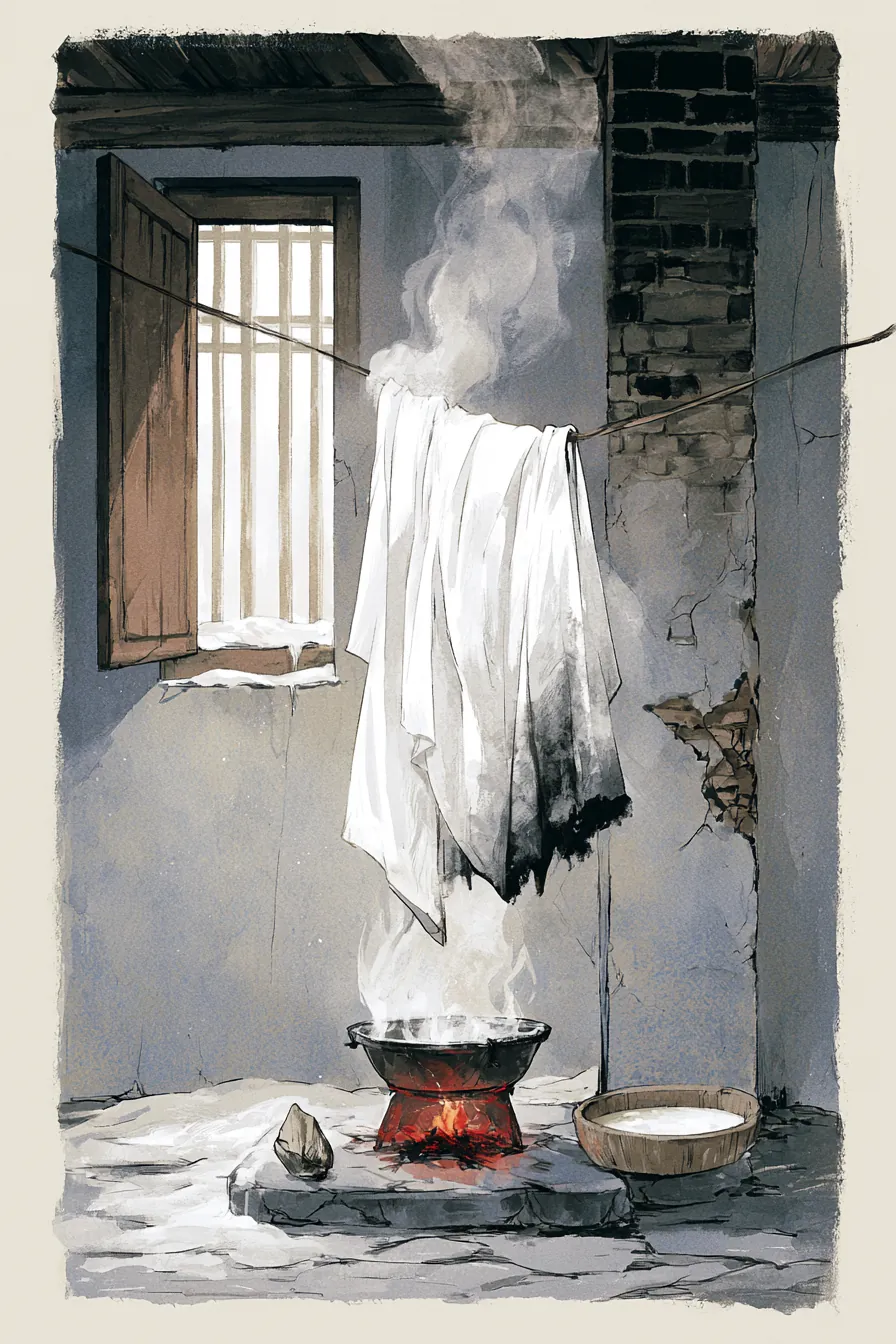
Chapter 3 — Drifting Cloud
The first thing about a mortal town, after ten years of sect bells, was the noise.
Not the volume — sect was loud, in its own way, three hundred disciples chanting at dawn and the qin-pavilion humming at second watch and the wind across nine peaks doing its theatrical I am wind over the eaves all night. Sect noise was ordered noise. It was vertical. It moved up and down the same six pitches all year, like a temple bell that had been put to music.
Mortal town noise was horizontal and broken. Three hundred small different voices going three hundred small different ways. A woman in the next alley shouting at a son who had taken a copper coin from a jar he had been told not to touch. A man further off bargaining for cabbages with the unhurried theatre of someone who had been arguing about cabbages every morning of his life. A flute being practiced — badly — out of a tea-house upper room. Three women laughing in unison about a dirty joke. A baby. A goat. A clay pot dropped, then sworn at. A dog. A door slammed. A cart wheel over a wet stone. A second cart wheel, also wet. A frying pan, somewhere very close, with hot oil going clean into it the way only mortal oil goes — hiss-snap.
Lin Yao opened her eyes.
She was looking at the underside of a thatch ceiling. The thatch was old — a deep almost-black colour at the rafters, fading to honey under the smoke-hole — and someone had patched a section above her head with a square of new straw the colour of fresh corn. The patch had been done well. Three weeks ago, at the latest. A man on the roof who had not been hurrying.
She listened.
Nothing was on fire. No talisman was active in the next room. No qi was moving in the building above the second floor — meaning no cultivator was here on a flying sword and there was no array circle drawn anywhere in the inn. The frying pan was on the ground floor. The man with the cabbage opinions was outside, two walls and a window away. The fox — she felt this without looking — was on the wood plank at the foot of her cot, breathing the slow round breath of a creature who had decided the room was safe and was therefore being asleep about it.
The young man — Yan Jiu, she made herself say it once inside her ribs, because she had decided two days ago on the cart that if she was going to owe him a debt she was at minimum going to say his name when she counted it — was not in the room.
She moved her right hand.
The peach was gone — eaten on the cart, three days ago, the same way she had drunk her first water from the stream: with the patience of a person who knew the body could refuse a sudden gift. The dull black sword was at her wrist, cool, quiet, satisfied. The frost-jade splinter in her left shoulder was still there. The skin around it was warm to the touch and no longer screaming. Healing. Properly. Faster than mortal flesh ought to.
The Tianmo Ti repairs the body whether you ask it to or not, her father's voice came up from somewhere, the soft scholarly voice of him at twenty-nine, the year before he died. That is the gift and also the trouble. The body will be ready before you are.
Yes, Baba, she said inside.
She moved her left hand.
The left arm worked at the shoulder. It worked at the elbow. It would not — yet — work above the line of the chin without the bright clean line of pain announcing itself, but it worked. She rotated the wrist. The wrist worked. She tried, very carefully, to call up the smallest possible thread of qi.
Nothing came.
She tried again.
Nothing.
She tried a third time — pushing — the way one pushed at a closed door that had simply, on a recent occasion, been opened, to test whether the door had remembered it was a door.
The third push hurt.
It hurt the way a cup hurts, when you put your hand inside it and find the cup is no longer there, only the shape of the cup, and your hand has nowhere to set the water down. She breathed through it. She set the qi-attempt back, very gently, into the place she had taken it from. Not yet, she told the inside of her ribs. Not yet, not yet. The cup will come back.
It would. The Tianmo Ti would build her a new cup. She had only to live long enough for it.
She propped herself up on her right elbow.
The room was small. Whitewashed adobe, the bottom zhang darker where decades of damp had stained it. One window with rice-paper, unbroken. One door, plain pine, the latch on the inside (someone had thought of this; someone had thought for her). One low table by the window. One pottery basin of clean water on the table. One folded grey cloth beside the basin. One small ceramic jar with a wooden stopper — labelled, in the careful round characters of a man who had only learned to write as an adult, 跌打 / Diédǎ. Bruise liniment. Mortal-grade. Good for the kind of injuries one expected of a person who had fallen out of a tree, not out of the sky.
One bowl. Lidded. Covered with a small square of cloth to keep the heat in. From it, a thin curl of steam.
She lifted the cloth.
White rice congee, with a single salted plum at the centre and three thin slices of pickled radish ringing it. Drifting Cloud Town breakfast — old style — the kind of plain congee a working woman fed a child she did not have time to coddle.
She put the lid back on.
She did not eat it yet.
She lay back down. She looked at the corn-colour patch in the thatch above her head. She breathed. She listened. The fox at the foot of the cot breathed evenly. The frying pan downstairs got a piece of fish or possibly tofu — by the second hiss-snap. Outside, a child somewhere said baba in the universal three-syllable scream of a child who had been told no about something that was not negotiable. A wife laughed in another room — a real laugh, the kind of laugh a woman makes who is laughing at a man she has been laughing at every morning for twenty years.
Lin Yao closed her eyes.
She let herself, for the count of three breaths, hear the world.
She had not, she realized, heard a real laugh in ten years. The sect had laughs. The senior sisters laughed in the same key the way bells in a row hum in the same key. The inner disciples laughed for politics. The outer disciples did not laugh; we were on rations and the air was thin and we had been told at intake that cheerfulness is for yāojīng / sect-demons and a gentleman practises 端肃 / dignified gravity.* I had memorized that line off the wall of the dining hall when I was fourteen. I had carved it, with the back of my own thumbnail, inside the lid of the wood pail I used to carry water up from the well, so that I could read it every morning when I bent for the rope.
The thought was so funny, and the funny was so old, and the laugh in the other room was so easy, that Lin Yao made the smallest possible sound. It was not a laugh. It was a huff — half a syllable, a single bright hh out of the nose — and the fox at the foot of the cot opened one eye, looked at her with the academic attention of an embassy clerk, and closed the eye again.
The thatch patch did not respond.
Lin Yao lifted the lid of the congee bowl. She ate the salted plum first because the plum would not keep. Then she ate two slices of pickled radish. Then she ate three slow spoons of congee, which was, by the standard of her stomach right now, an entire week's banquet.
She set the bowl down.
She slept again.
She slept fourteen hours.
She knew this because when she woke, the light coming through the rice-paper had moved across the wall and gone away again. It was now night. A lamp had been lit at the low table — a small mortal oil-lamp, not a spirit lamp, the wick wrapped tight enough not to smoke — and someone had cleaned the congee bowl out from under the cot and replaced it with a new one.
The fox had moved to the windowsill. Tail neatly curled.
Yan Jiu had not entered the room. She knew this because the dust at the threshold was undisturbed in three places — Sister Su had once shown her how to check this for a courier-tracking exam, and Sister Su was one of the witnesses, but the technique was the technique — and the only person who had come in was someone in soft cloth slippers, with a slight drag in the left toe, who had walked twice between the door and the table.
The innkeeper. Or the innkeeper's woman. The same person both times. The slight drag — bad hip from a younger fall. Polite of her not to peer.
Lin Yao breathed in. She filed the innkeeper. Or the innkeeper's woman away.
She tested the bowl. New congee. With egg this time — a single soft-set egg yolk centered in white. A small dish of zha cai — Sichuan-style preserved mustard root — beside it, julienned thin enough to chew through with a bad jaw. A second small dish: three dried longans, the kind a mother fed a sick daughter. A third small dish: nothing. Just empty. Polished clean.
She frowned at the empty dish.
Then she understood.
The empty dish was for salt, the household kind, mortal grain — and someone had put the empty dish there because they were not sure whether sect cultivators ate salt or whether sect cultivators considered salt unclean. They had set out a dish for her in case she wanted salt and not put salt in it in case she didn't.
She turned her face into the pillow for a count of two breaths.
Salt, she thought. They left me a dish for salt.
She filed the dish. She did not file the breaths into the pillow. The pillow could keep those.
She sat up. She drank the congee. She ate the longans one at a time and saved the third in her sleeve for later. She drank the water in the basin, which had been changed while she slept, and was clean enough that she could see the candle through it.
She took inventory.
Right hand: works. Left hand: works at wrist and elbow, mostly. Left shoulder: clotted with frost-jade splinter, no qi pulse, range of motion forty degrees and rising. Legs: terrible. The right ankle the worst — she could feel each individual bone-fragment when she shifted weight. The left tibia had set crookedly during the cart-ride; someone with mortal medical training would need to break it again and reset, and she did not yet have a person who could do that for her cheaply.
She would need three weeks.
She had two.
By the third week, the Frost Sect would have dispatched its first ring of tracking-talismans to allied courier networks. By the fourth week, the rings would have closed on Drifting Cloud, because Drifting Cloud was the obvious mortal town for a body — almost-body — drifting south out of Severed Soul Cliff in a westerly wind. By the fifth week, a Foundation-tier hunter would be three days out. By the sixth, the hunter would be at the inn door.
Two weeks.
She lay back and counted lanterns in the thatch.
Tonight is day six, she calculated. Yan Jiu found me on the road on day five. The cart took us a day and a half to bring down. I have been asleep — by the light of the room — for at least one day and a night and most of another day. So tonight is the seventh evening since the altar. The ride down out of the foothills was slow because of the leg. The slow ride means we were not pursued. The not-being-pursued means the sect has not yet realized I am alive. They will realize within four days of the storage-ring burning, because the cleansing protocol requires a qi-sweep of the gorge on the seventh day after sentence, and the seventh day is tomorrow.
Tomorrow morning. The qi-sweep happens at dawn.
Tomorrow morning, the sect notices that the gorge has no body.
Tomorrow afternoon, twelve disciples leave the mountain with tracking arrays.
By the eighth night they will have reached the foothills. By the ninth night they will be in the lower country. By the eleventh night they will be in Drifting Cloud.
Four days. Three days, if Pei Shenzhi himself rode out, which she did not allow herself to assume because allowing herself to assume meant allowing herself to hope, and hope was a luxury she would not budget for in a town that left her a dish for salt.
She breathed in. Four count. Out. Six count.
Survive first. Owe later.
She filed the calendar. She closed her eyes. She slept again, because the body would let her sleep now in a way the gorge would not, and the body knew.
She woke at dawn of day seven.
The room was grey. The lamp was out. The fox was already at the windowsill in the I am being inscrutable posture all foxes adopted when there was something they intended to be photographed against, eventually. The fox's tail moved once, twice, a slow lazy ripple of don't make me say it.
The fox said it anyway. Not in words.
The fox said, in the precise shape of her tail and the precise turn of her ear: the well is in the courtyard. The household is up. The man who carries water is the man you want to see. Wash, child. Walk a little. Eat the second longan I left in your sleeve. Do not bow to the woman with the bad hip; bow to her dog. It will mean more.
The fox did not say any of this in words.
Lin Yao understood every word.
She made the smallest possible mental note: the fox is not a fox. The fox is a person of indeterminate rank who is choosing not to speak. I will respect this. I will not press. I will not ask the young man about her. The fox will tell me when the fox tells me.
She filed it.
She got up.
It took her four minutes. She used the cot post as a brace; she used the wall; she used the corner of the table once, briefly, when the left tibia did the small wet pop of a bone-fragment shifting and her vision went black for two heartbeats. She did not fall. She did not breathe out of pattern. She had practiced standing-up under worse conditions, in the dark, in the dining hall, after Senior Mei's discipline talk in the third winter, with a meal she had not been allowed to finish.
She walked to the basin.
She washed her face.
She washed it the way her mother had taught her at four: temples first, in two small circles, then under the eyes, then the cheekbones, then the jaw, then — the place no one would teach you to wash because no one would think to — the small soft hollow behind the ear, because that is where the day's grief collects and you should not carry the day's grief into the second day. Wash it out, baby. Wash it out.
She washed it out.
Then she turned, with great care, and looked at her own reflection in the lamplight pottery basin.
A woman of nineteen looked back. Cultivator-time nineteen, she corrected. Chronologically twenty-three. Outer disciple grey scrubbed off; condemned-bride white burned in a brazier; she did not know yet what robe she was wearing because she had not looked. A neat dark cut at her right brow, half-healed. Bruising around the left jaw, yellow-green at the edges, two days past. A new line at her mouth — a small bracket from the right corner of the upper lip — that had not been there a week ago. That is the new mouth, she thought, looking at it. The mouth that will not eat the word mercy again.
She looked at the line. She approved it.
She filed her own face.
She turned around.
She had been put — by someone with enough decency not to leave her unconscious in white-and-blood — into a plain grey 中衣 / zhōngyī, the long inner robe, slate-coloured, clean, mended at the left elbow. The mend was professional. A woman's mend, with the lattice-stitch of someone who patched livery for a mortal inn for a living. On the cot, folded neatly, an outer robe in the same colour, with — she peered — a small white plum-blossom embroidered at the hem, off-centre, as if the seamstress had finished the robe and then, on impulse, put the flower there for someone.
She looked at the flower for a long time.
The flower was new. The robe was at least four months old, the linen softened at the cuffs the way only laundering softens. The seamstress had embroidered the plum-blossom recently.
Two days ago, probably. While I was asleep.
Someone had embroidered her a plum-blossom while she was asleep on day five.
Lin Yao did not file the flower.
She put on the robe. She tied the sash. She combed her hair with her fingers because she did not have a comb and would not yet ask for one. She braided it into a single thick rope down her back — a 散修 braid, not a sect knot — and tied it at the bottom with a strip of the inner sleeve she had ruined yesterday.
She looked at herself once more in the pottery water.
She was unrecognizable.
She was an outer-disciple ghost in plain grey with a plum-flower on her hem and a half-healed cut at her brow and a mouth she had not had three weeks ago, and the only thing on her that was the same was the dull black sword at her wrist and the small jade pendant her mother had given her at four, which she had hidden inside the lining of her inner robe before the altar and which had survived the cliff because nothing made of her mother had ever, in twenty years, failed to survive.
She approved this. She filed it.
She picked up the second longan from her sleeve.
She ate it.
She went out to find the well.
The well was in the inn courtyard, exactly where the fox had said it was. The courtyard was small, brick-paved, walled in old whitewash. There was a black pot of orchid at the south wall, three chickens scratching at the north, a square of morning light across the centre, and a man drawing water.
The man was about sixty, mortal, no cultivation. His hair was tied in a plain workman's knot and his sleeves were rolled to the elbow and the muscle under his forearms was the precise long muscle of someone who had drawn water from this well, twice a day, for forty years. He looked at Lin Yao when she came out into the courtyard with the polite expression of an old man who had decided not to be surprised by anything at the back of his own inn at this point in life.
"Daughter," he said. Politely. Not sister.
"Innkeeper," she said.
"My wife does the welcoming." He hauled the bucket. "I do the lifting. There is hot water in the kitchen if you want a wash. There is a stool here if you want to sit. There is breakfast in three quarters of an hour. There is —" his eyes ticked, very briefly, to the dull black wrist of her right hand and back to her face — "no business of mine, daughter, except for the room and the breakfast. You will hear nothing from me. The young man paid through next jiǎzǐ by mistake; he overpaid two cash; my wife will not give them back."
Lin Yao bowed.
She bowed correctly — not the deep bow of a sect outer disciple to an elder, which would have flagged her, but the precise town bow her mother had taught her at six: hands folded at the waist, the head dipped exactly one degree, the kind of bow a daughter gave a man who was a friend of her late father's and not in any other way her superior.
The innkeeper's eyes warmed half a notch.
"Daughter," he said, "your mother taught you to bow."
"She did."
"Mortal mother."
"She did."
"Mm." He set the bucket down. He pushed it with the side of his foot — a slow exact push — across the brick toward her, the way a man would push a chair to a guest he did not want to startle. "I have water. You can wash here if you don't want to climb the stair twice. There is a screen at the south wall. You can have the screen. The chickens do not look."
"Thank you," Lin Yao said.
The innkeeper turned, picked up a second bucket from the rim of the well, and went into the kitchen without looking back.
Lin Yao stood for a moment by the pushed-bucket.
She knelt — with great effort, hand on the brick — and dipped her good hand into the water.
She washed her face a second time. She washed her right wrist around the cuff of the sleeve. She washed under her braid at the back of her neck. The water was cold and clean and full of the small specific minerality of well-water in a town that lived off river-fed wells, and the smell of it was identical to the smell of her own home well at five, three provinces away, in a small 散修 compound that had burned down when she was nine. The well at the compound had been deeper. The bucket had been smaller. The smell was the same.
She did not weep.
She had decided some hours ago she was not going to weep until she had bought groceries.
But she did, for two breaths, kneel on the brick of the inn courtyard with her wet hand against the back of her own neck and let the well-water smell exist in her ribs the way a chord exists in a room after the qin has stopped.
Then she straightened.
She filed the well.
She filed the innkeeper.
She turned to the stool the innkeeper had set at the wall — a low pine three-legged thing that someone had carved a small dragon on, badly, perhaps a grandson's project of last winter — and she sat down with the same exact dignity she had used kneeling on frost-jade three mornings ago. She put her right hand over her left in her lap. She watched the chickens.
The chickens watched her back.
The fox came out of the doorway, padded across the brick, and sat at her right ankle with the precise grave attention of a small black umpire.
A voice, easy, behind her: "Don't lie to chickens. Chickens remember. Wake up looking innocent in the morning, and they will recall."
Lin Yao did not turn her head.
"Yan Jiu."
"Mn."
"I owe you for a peach."
"You owe me for a peach and one cabbage. I bought a cabbage with my own honest cash for the donkey on the road back. The donkey was unimpressed. The cabbage was Tuesday."
"You ate the cabbage."
"I ate some of the cabbage. The donkey is now in mourning."
She closed her eyes very briefly. She filed the cabbage.
He came around to the front of the stool. Soft step. He sat down on the brick — on the brick, with the lazy folded posture of a thief who had grown up sleeping in worse places — exactly two paces from her right knee, and he leaned his back against the well-curb and tipped his chin toward the chickens.
"How are the legs."
"Worse than the arms."
"How are the arms."
"Worse than the chickens."
He laughed once. A real laugh — the kind of small hh through the nose her mother had once made laughing at her father — and he didn't look at her face while he did it. He looked at the chickens. Polite, she filed. He laughs at me but he won't watch me hear him do it. He has been raised by someone who knew that some women do not like to be watched laughing.
"There's a healer in this town," he said. "Mortal. Bone-setter, second-generation, doesn't read but knows hands. He can re-break the left tibia. The right ankle is harder. There's a 散修 healer two days east — Foundation, retired, drinks. He could regrow the ankle, but he charges spirit-stones, and his loyalty is uncertain. There is also —" he stopped. He looked at her sleeve. "Your father's blade is going to put back what it broke."
She looked at him.
"You don't know that," she said.
"No," he agreed. "I don't. But I know what I saw on the road. The frost-jade splinter was the wrong piece of altar to keep a woman alive for two days through a wraith and a frost-stream and an inn cart. The blade is feeding you. Slowly. Politely. It has not asked your permission because it knows you would say no. So it is helping you survive in the way that does not require permission, which is to refuse to let you die. The ankle will repair. Possibly the tibia. The shoulder is already in better shape than it ought to be."
"How do you know what frost-jade does."
"Caravan boy," he said. He tipped his head back against the well-curb and closed his eyes. "I have seen a frost-jade splinter put under a dying man's tongue once. Senior cultivator wanted his apprentice to live a week longer than he ought. The apprentice died on the morning of the eighth day. The senior buried him. The splinter was extracted afterward and resold. Two hundred spirit-stones the cubic cùn. Frost-jade is the most expensive shrapnel in Liuzhou, ya-tou. Whoever pinned you to that altar pinned you with a thing that costs more than this inn."
Lin Yao filed the price of frost-jade.
She filed whoever pinned you with the same neat clean care she had filed the dish for salt.
He did not press. He did not ask. He did not look at her face. He did not — and this was, she understood, the entire architecture of how he was choosing to be — make her speak.
The fox at her ankle yawned again. The chickens scratched. The morning thinned out into proper morning, and somewhere in the kitchen the innkeeper's wife began a low conversation with the iron skillet about the failings of egg.
"Yan Jiu," Lin Yao said.
"Mn."
"Why are you here."
"In the courtyard? Because the fox said you would come out."
"The fox said."
"With her tail."
"The fox's tail spoke to you."
"It said don't go in the room or she will hit you with the basin."
"That is a wise fox," Lin Yao said, looking at the fox.
The fox refused to react.
"In the town," she said, returning. "Why are you in the town. Not on the road. Not on the cart. Not in the back of the woodshed. Here. In the inn, in the courtyard, on the brick, two paces from a woman who has not paid you for a peach or a cabbage or a donkey or the back room or the salt dish or the plum-flower on the robe."
He opened his eyes.
He looked at her at last — for one second, then a second more, the same length of look he had given her on the road — and the grin was gone and the eyes were dark and very awake and the voice had become the steadier voice from the road again, the one that lifted by the sash and did not joke.
"Ya-tou," he said. "Outside this door, in the last two days, four people in this town have noticed that you don't belong here. Two are harmless — the woman who runs the dye-shop noticed you because she saw the cart and was curious. The third is a biāoshī on his way out of town who saw the cart on the road and remembered, professionally, that the cart was carrying a woman not native to this province. The fourth —" he paused. "The fourth has not approached the inn. The fourth has walked past it three times in the last day at the slow pace of a man pretending to look at the dye-shop. I do not know him. He is not Frost Sect. He is — let me say it carefully — interested in a way that is older than this week. He has the wrong kind of patience."
She watched his face.
"And so," he said, gently, gently, the way one might tell a child a story she did not want to hear, "you will need a partner, ya-tou. And you can hate me for the saying-so. That is allowed. But I am going to keep being in the courtyard, and on the road, and in the corridor outside your door, until either you say Yan Jiu, leave, or the fourth person stops walking past the dye-shop."
She looked at him for a count of three breaths.
"Yan Jiu," she said.
"Mn."
"Do not say partner. The word has a contractual weight I am not yet able to honour."
He blinked once. He inclined his head, very slightly, with a precision she had not expected. He had once, somewhere, been taught manners — and the manners had been good ones, before the road had got at them.
"Noted," he said.
"You may stay in the corridor."
"Ya-tou."
"You will not enter the room without invitation."
"On my life."
"You will not buy any further cabbages on my account."
"I will buy them on my own account and we will pretend they are mine."
"You will not feed the fox from the bowl. The fox eats first or the fox eats nothing. That is the fox's rank, not mine."
The fox at her ankle moved her ear a quarter of a cùn — that's right — and Yan Jiu, who had been watching the fox out of the corner of his eye the entire time, made a small noise of betrayed brotherhood.
"Mei-mei," he said. "Do not poach my fox."
Lin Yao did not respond.
He looked at her for one more second. Then he stood up — a single fluid motion, dust on his palms from the brick, the sshk of the slender stolen sword shifting on his back — and he bowed to her. Not the town bow. Not the sect bow. A biāoshī's bow. Hands at the side, the head dipped one cùn, the right knee braced. I am yours, in this small task. Use me. I have not asked your name.
"Ya-tou." The grin had come back, soft, lopsided, with the lazy southern accent. "I'll be in the corridor. I'll be the one not eating the cabbage."
He walked off.
The chickens settled. The fox at her ankle leaned, infinitesimally, against the side of her foot. The innkeeper, in the kitchen, dropped a wooden spoon and said aiya, lao tou-zi to no one in particular. The morning continued.
Lin Yao breathed in four. She breathed out six.
She stayed on the stool another quarter of an hour, because the well-smell was good and the brick was warm and the chickens were not lying to her about anything important and the dull black sword at her wrist was singing the small slow note of yes, daughter, you can sit here for fifteen minutes and the world will keep turning without you.
When she went back inside, she went up the stair by the rail, one step at a time, with the dignity of a woman who had just acquired four problems and was beginning to triage them in order of which problem she was going to enjoy solving most.
Problem one: the fourth person walking past the dye-shop.
Problem two: re-set the left tibia.
Problem three: open the talisman.
Problem four: stop being told what to do by a thief with a fox.
She filed them, in that order.
She filed Yan Jiu's bow at the bottom of the list — do not solve. observe. file. — and she put her right hand flat against the lintel of her own door for a moment, the way her mother had taught her to do at five when entering a room of any importance: acknowledge the threshold. The threshold is the door's name. You will be passing it many times.
Then she went in.
The cot was made up. The lamp was relit. The basin had clean water. The bowl on the table had a steamed bun in it, and a small saucer of soy and ginger, and — placed beside the saucer, on a square of clean paper — a single peeled peach.
The peach had been peeled with a knife so sharp the peel had come off in one long unbroken spiral, which lay coiled on a corner of the paper like a sleeping cat.
Lin Yao stood in the doorway looking at the peach for a count of three breaths.
Then she closed the door.
She locked the latch.
She walked, slowly, to the table.
She set her right palm flat against the wood next to the peach.
She did not pick it up.
She bent her head over the peach until her hair fell forward and the room was dim with her own braid, and she breathed in, once, a long full breath through the nose, and she let the smell of fresh peach and ginger and soy and steamed bun and old whitewash and a fox who was not a fox sit, for that one breath, where her ribs had been hollow for ten years.
Then she straightened.
Then she ate the bun first, because the peach would not go cold.
She ate the peach last.
She did not eat the spiral peel. She folded the paper carefully around it and put it in her sleeve, because she had decided — quietly, without permission, without acknowledging the decision in any other room of her mind — that she was going to keep it.
For what, she did not yet know.
She filed for what under survive first, owe later, and she put the question aside, and she went and lay down on the cot, and she stared at the corn-yellow patch in the thatch above her head, and she thought, for the first time since the altar:
Memorize the angle of his hand on the peach.
She did.
She did not know yet that she had filed it next to Pei Shenzhi's. She did not know, yet, that her ribs had begun to keep a second register — the they-touched-something-for-me register — and that the register would, in the eleven months that followed, fill until the spine of it cracked and the cover would have to be rebound by hand.
She slept.
She slept the way the saved sleep when they have not yet admitted, even inside their own ribs, that they have been saved.
Outside the door, in the corridor, two paces from the lintel and one pace from the rail, the thief with the soft voice and the unfair grin sat down on the bare wooden floor with his back against the wall and his stolen sword across his knees, and he closed his eyes, and he did not sleep, because — for reasons he was not going to articulate out loud — the fourth person walking past the dye-shop had walked past again two minutes ago, and the wind on his cheek was the wrong wind.
He would tell her in the morning.
He would not, he had decided very firmly, tell her tonight.
The fox, who had moved to the rail above his head, looked down at him with an expression he had learned at twelve to interpret as don't make me come down there.
He winked at her.
She did not, of course, wink back.
She did, however, very deliberately, point her snoot at the window over the corridor stair — the window that gave a clean angle on the lamp-lit alley behind the dye-shop and the long lean shadow of a man in a flat brown hat that did not, at this hour, have any business standing exactly where it was standing — and she made the smallest possible sound at the back of her throat.
Yan Jiu opened his eyes.
He looked at the window.
He looked at the alley.
He looked at the long lean shadow.
He thought, Mama. Mama. You did warn me.
He stood up. He stretched. He looked, briefly, at the closed door of room three. He did not knock. He took the back stair down. He paid the innkeeper's wife for the second cabbage. He went out into the alley behind the dye-shop with both hands empty, peach-juice still under his nails, the grin already in place, the way a thief walks toward a problem when the alternative is to wait for the problem to walk toward the woman behind a thin pine door at the top of his stair.
The shadow under the flat brown hat turned.
Yan Jiu smiled.
"Dàgē," he said pleasantly, "you've walked past the dye-shop three times. Either you want fabric or you want a fight. The dye-shop is closed. I'm open."
He cracked his knuckles.
He did not, anywhere in his body, look like a man who was not enjoying himself.
Inside the inn, four walls and one floor and two breaths away, Lin Yao slept on, and the dull black sword at her wrist did the small slow patient hum of a thing waiting for its turn, and the fox on the rail above the corridor watched the alley with the academic neutral interest of a woman who had been a person, once, and was waiting to see whether the boy she had decided to lend her tail to was going to need her tonight.
The boy did not, in the end, need her tonight.
But it was close.