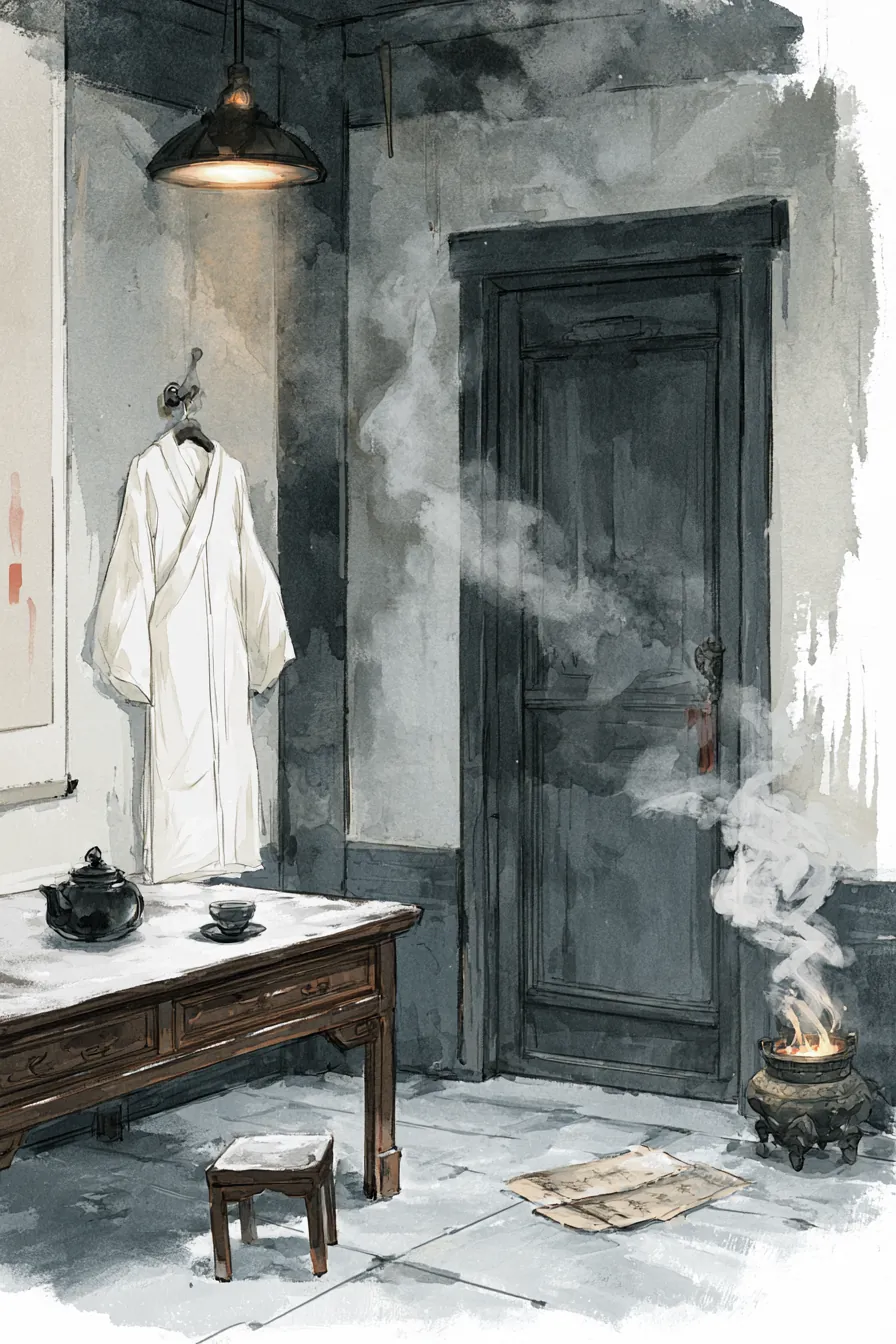
Chapter 5 — Ginger Broth
She tried to cultivate for the first time on the morning of the eighth day, and it went very badly.
She had decided the night before — sometime between the cold roast duck Yan Jiu had not knocked to deliver and the second watch when the fox had finally hopped off her feet to patrol the windowsill — that she would attempt the smallest possible 吐纳 / tǔnà, the breath-pranic basic of any sect manual: in for four count, hold for two, out for six, with the 会阴 / huìyīn point in the lower pelvis tipped half a degree toward the spine. Lianqi One, sub-page one, the way every nine-year-old sect intake learned it at the door.
She knew, intellectually, that the cultivation pathway was not the same pathway it had been a week ago. The meridian-gate at her 肩井 point was severed clean. The 任脉 / Conception meridian, which ran from the perineum up through the pelvis and the sternum and the throat to the lower lip, was — by the report of her own ribs at dawn — still continuous, the way a road remains a road through an earthquake even when the road has cracked. The cracks were workable. The road existed.
But the gather would not gather.
She sat in the lotus on the cot, broken legs folded with great care, palms up on her thighs, eyes closed, the dull black sword across her knees. She breathed in four count. She breathed out six count. She lowered her chin half a degree to align the throat. She did not — she had decided this with the small bright clarity of a survivor — push down into the dantian to demand qi to come up. She did not push up either. She opened. The way a window opens.
Nothing came in.
She breathed for a quarter of an hour. She tried again. She lowered the chin a quarter of a degree more. She let the breath go even slower. She listened.
Nothing.
She breathed for another quarter of an hour. Then, with the cold precise patience her father had taught her at six, she tried it a third way — the 阴 register, the rising-water way, drawing up from the yongquan points in the soles of the feet instead of the top of the head. She had not — strictly — ever been taught this way; it was an older method, a 散修 method, copied out from a single rotting page she had found in Pei Shenzhi's rubbish-trough five winters ago and had spent two days reconstructing from the ghost of an ink-line. The page had been thrown away because it was older than the sect protocol and not recommended for sword-cultivators. She had thrown it away too, after copying. She had carried it in her ribs.
She tried it now.
A thin thread of qi did come up.
It came up through the soles of her broken feet, through the long fragile column of the right tibia, through the cracked left tibia, through the angry hip, through the warm soft hollow of the lower dantian.
It came in through the gate of the huìyīn and it ran up the 任脉 — clean, slow, breath-sized — and it reached the lower dantian, and it —
— the dantian opened.
The dantian opened the way a cup opens that is not, any longer, a cup. The qi-thread arrived at the place where the cup ought to be, and there was no cup, and the qi did what qi did when it could not be contained: it spilled. Not back the way it had come. Sideways. Through the cracked pathways of her 少阴心经 / Heart-Yin meridian, up into the chest cavity, where the suppressed thing inside her ribs — the Tianmo Ti, the great old terrible not-name she had been raised to file under trash-root, hunger, not me, not me, not me — recognized the qi as food.
The Tianmo Ti ate.
It ate the qi-thread. It ate the breath that had drawn the qi-thread up. It ate the six-count of her exhale in the middle of the exhale, and the air went down her throat and did not come back out, and her ribs — her own ribs — locked under the sudden hot pull of somebody is feeding me and I have not eaten in ten years.
She opened her eyes.
The room was — wrong.
Not visibly wrong. The thatch was the same thatch, the corn-yellow patch where she had counted dawn lanterns for two nights. The lamp at the low table was a lamp. The cot under her thighs was a cot. The fox at the foot of the cot — the fox — was on her feet, not sleeping, her white-tipped ears flat back along her skull, her snout slightly open, her teeth showing in the small precise way teeth show when a creature has decided to begin a warning and is calibrating whether the warning will be necessary.
The fox was looking at her.
The Tianmo Ti, inside Lin Yao's ribs, reached.
It reached the way a hand reaches in the dark for a warm cup that has been promised to it. It reached toward the fox.
Lin Yao —
— shut.
It was not a thought. It was not a technique. It was not a manual. It was the same single-word no her mother had used at the door with creditors, said into the inside of her own ribs with the same flat conversational calm, and the no came with the dull black sword's small bright clean don't, daughter humming under her sternum exactly the way her father's hand had rested on the small bright clean don't at the base of her spine when she was nine and the seal had first been driven.
The reach stopped.
It did not retract. It stopped — the way a dog stops at a fence when the fence has been a fence its whole life.
Lin Yao exhaled.
The exhale went all the way out. The held six count completed.
Her hands were trembling on her thighs. Her left palm — she discovered with the academic neutral attention of a woman cataloguing a fresh injury — had a burn on it, the size of a copper cash, in the centre of the palm. The skin was not blackened. It was paler than the surrounding flesh. Bleached. A small precise round spot where the qi had pulled through her body so fast it had taken the colour out of the meat.
She looked at the fox.
The fox's ears, very slowly, came forward.
The fox sat down.
The fox closed her mouth.
The fox looked at Lin Yao with the great steady level look of an embassy clerk who had just declined to file a complaint that would have ended in someone's death.
"I am sorry," said Lin Yao. Aloud. To the fox. Politely.
The fox flicked an ear.
"I will not do that again," said Lin Yao. "Without warning."
The fox flicked the other ear.
"I will not do it again to you," said Lin Yao, "with or without warning."
The fox's tail moved, once, a slow lazy ripple. Better.
Lin Yao breathed in four. She breathed out six. She breathed in four. She breathed out six. She watched the small bleached spot in the centre of her left palm refill, very slowly, with normal capillary colour, over the course of two minutes. The colour came back unevenly. The edge of the spot stayed paler than the surrounding skin even when the rest had filled in. A small round mark.
The Tianmo Ti is going to mark me wherever it eats from, she filed.
The marks will be visible.
I will need long sleeves.
She added it to the list, in order. Right after re-set the left tibia.
She uncrossed her legs. She put her right hand to the floor. She used the cot post to stand. She did not — she filed this — fall. The cultivation attempt had failed, but the body had not failed with it. The body was still doing the slow politely-unauthorized repair work of the dull black sword and the frost-jade splinter, and the body did not, in its own opinion, give one cùn about whether the cultivator on top of it had succeeded or not.
She filed the body has its own opinion.
She filed long sleeves.
She put her right hand flat against the lintel of her own door.
She went out into the corridor.
Yan Jiu was on the inn roof.
She found this out by the simple expedient of going down the back stair, asking Aunt Three Pots in the kitchen — Aunt Three Pots, where is the young man with the bad braid — and being told, without preamble, the roof. Aunt Three Pots had not asked which roof. There was apparently only one roof of any interest.
Lin Yao did not go up to the roof. She went out into the back courtyard. She stood at the well-curb with her pine stick in her right hand and she looked up.
Yan Jiu was lying full-length along the ridge-line of the inn roof with one knee bent and one arm under his head, eating — by the way the wind brought a small soft sweet smell down to her — another peach. The braid was over his shoulder again. The dust-grey of his outer robe was the same dust-grey. The slender stolen sword was, she noted, not on his back this morning. It was lying along the tile next to him, hilt within reach of his right hand, in the lazy attentive arrangement of a man who had been on a roof for two hours and was prepared to remain on the roof for four more.
He had heard her step into the courtyard. He had not turned his head.
She watched him for a count of three breaths.
She breathed in. She breathed out. She lifted her right hand off her stick and she — with the small clean precise patience her father had taught her at four — picked up a pebble from the rim of the well, weighed it in her palm, calculated the angle without thinking, and threw it.
The pebble hit the tile six inches from his left ear.
Yan Jiu, on the roof, did not move.
He did, however, say, very politely, "Ya-tou. The peach is mine. The roof is technically the inn's. The tile you just abused is on the household tab."
"Yan Jiu."
"Mm."
"You said the fourth person walked past the dye-shop last night."
"He did."
"You broke his collarbone."
"I did."
"He is gone."
"He is."
"Who is replacing him."
A small silence.
"Ya-tou," he said. "Are you a witch."
"No."
"You are not — I would like to confirm — not a witch. Because if I am about to spend the rest of my life with a woman who can guess the next sentence out of my mouth before I have decided to speak it, I would like to know that on day eight, when I can still flee."
"You would not flee."
"...No. No, I would not. I retract the threat. Continue."
"The replacement."
He turned his head very slowly. He looked down off the ridge-line. His face above the tile was lit by the morning at the precise angle that made the small bruise along his jaw a deep purple-yellow and the split lip a soft pink scab and the corner of his mouth a grin he did not deserve to have right now.
"Ya-tou," he said. "There is no replacement yet."
"There will be."
"There will. Two days. Three at the outermost. The collarbone man's bird went south at dawn — I watched the dye-shop, not because I am suspicious, but because I am bored and a man on a roof watches everything, and there is a small grey-feathered courier-bird that came down off the dye-shop chimney at half past the rabbit hour and went south-by-south-east, which is the bearing of the 南陈 courier hub in 柳安. The dye-shop man will be relieved of his shop by another east-province courier within three days. The new one will not walk past the dye-shop. The new one will sit in the dye-shop. He will sell — let me guess — funeral cloth, because someone in the east-province guild has a sense of humour."
She filed 柳安.
She filed funeral cloth.
She breathed in. Four count. Out. Six count.
"Yan Jiu."
"Ya-tou."
"How long would you like to stay in Drifting Cloud."
"I would like — speaking honestly — to stay another month. The donkey is fond of me. Aunt Three Pots' kitchen makes a green-onion noodle that has become foundational to my emotional architecture. There is a girl at the cabbage stall who has not yet figured out that I am robbing her by twelve cash a day in good faith. I would like to be here for the equinox."
"How long should we stay."
"Three days."
"Three days."
"Possibly four. Not five. Five is the day the next courier sits in the dye-shop. Five and onward, this town is a room with three doors and one of them is locked from the outside."
She turned the pine stick in her hand once. The dragon some unloved grandson had carved on the leg of the stool yesterday afternoon was, she now noticed for the first time, also carved on the haft of the stick — three small marks where someone had practiced the 爪 / claw stroke with the back of a kitchen knife. The same hand.
The innkeeper's grandson, she filed. The grandson is not at this inn. The grandson is somewhere else. Possibly south. Possibly with the biāoshī the innkeeper's wife told me about. The wife told me a story about a girl who had run away from a sect at fourteen and was now in a different province under a different name. The wife was telling me — politely, without any pressure — that she has a granddaughter who has done what I am doing, and her granddaughter is alive, and the granddaughter is fine.
She was telling me — politely, without any pressure — that her inn can be a way-station, if I need it to be, for the same reason it was once a way-station for her own.
She filed Aunt Three Pots.
She filed Drifting Cloud is not — strictly — a neutral town. Drifting Cloud has at least one household that has done this once before.
That was useful. She put a small star next to it in her ribs.
"Yan Jiu."
"Ya-tou."
"We will stay three days."
"Three days."
"During those three days you will go to the bone-setter and tell him I am coming. The right ankle is not negotiable. The tibia he can re-break tomorrow. You will then go to whichever biāoshī is on his way out of town with a load going south-by-south-west — not east, not south-by-south-east, not north — and you will purchase me a place in his cart-line. Quietly. Off his ledger. With the bone token of the east-province courier you took off the collarbone man, because I am not paying for a cart-line ride with my last spirit-stone shard."
He sat up.
He looked at her properly for the first time that morning.
"Ya-tou."
"Yes."
"You — would purchase a cart-ride out of town with the enemy's guild token."
"Yes."
"That is —" he paused. He laughed. A real laugh, the hh-hh through the nose, the cheek flushed. "Ya-tou. That is vicious. I take it back. You are not a witch. You are worse."
"Yes."
"I am — I am — I am going to enjoy this. I am going to enjoy it greatly. Should I purchase one place in the cart-line or two."
"Two."
He breathed out.
He did not say anything.
He looked, for the count of two breaths, at the small grey morning sky above the inn roof, the way a man looks at a sky he had not been expecting to be his sky much longer.
Then he stood, the way he always stood — single fluid motion, dust on his palms from the tile, the sshk of the sword shifting on the roof as he scooped it up by the scabbard, the lazy I am here, I am yours, I will be your last bad idea shape of him — and he came down off the roof by the simple expedient of stepping off it sideways and landing in the courtyard four paces from her.
He landed soundlessly.
She filed he lands soundlessly. She filed he is more practiced than he looks. He is far more practiced than he looks.
He bowed — the biāoshī's bow, hands at the side, head dipped one cùn, right knee braced — and he said, "Ya-tou. I will go to the bone-setter at the hour of the snake."
"And the biāoshī."
"And the biāoshī. The good one. The one who hates the east-province guild because they undercut his rates on the spring tea-line three years ago and he will be delighted to be paid with one of their own bone tokens. He will also undercharge me, because his nephew is sweet on Aunt Three Pots' second daughter, and the second daughter has spoken to me. I have not yet, ya-tou, charmed her. I have not yet needed to charm her. I do not charm people I have not yet needed to."
"Liar."
"Mostly liar. Partial liar. Selective liar. Ya-tou. You are sharpening."
"I am being mended. There is a difference. Go."
"At the hour of the snake."
"You may take a peach with you," she said. "There is a basket in Aunt Three Pots' kitchen."
He looked at her.
He looked at her for a long count of breaths.
He did not say anything.
He bowed again — this bow was a different bow, smaller, softer, the kind of bow a son might give a mother who had just, unexpectedly, packed him a lunch — and he went into the kitchen without another word, and Lin Yao stood by the well with her right hand on the pine stick and the small private file of he is going to come back with two peaches and one of them will be peeled sitting quietly under her sternum like a slow-warming stone.
He came back with two peaches.
One of them was peeled.
The peel was in a single unbroken spiral.
He left it on the well-curb beside her hand as he passed.
He did not, at any point, look at her face while he did it.
She tried, that afternoon, to open the talisman.
She did it at the low table by the window with the rice-paper open so the sun came in clean and the light fell at the angle her father had taught her was best for reading old seals: shoulder-over, never head-over, because the seal in the page should be read into and not bowed at.
She set the talisman on the paper square Yan Jiu had laid the peach on yesterday. She had unfolded the spiral peach-peel and used it as a paperweight for the corner; it had gone leathery overnight in the way peach peel did, and it lay on the paper now like a small dried question mark, and she did not file it because the peach-peel was stayed, not filed, and the staying was a small precious thing.
She bowed to the talisman.
Not — strictly — the kind of bow a sect daughter gave to an ancestral seal. The kind of bow a woman gave a letter from her father that had been written on her ninth birthday and had been waiting to be opened for ten years.
She put her right palm flat above the talisman, the way her father had once taught her to hold a hand over a candle without putting the candle out: enough qi, daughter, to ask the seal who it is. Never more.
She had — she discovered, with the small dry sardonic smile that was becoming her standard expression for catastrophes — not enough qi to ask the seal who it was.
She had no qi at all to ask the seal who it was.
The seal lay on the rice paper, black and obsidian-smooth, and it did not respond to her, and it did not punish her for the asking, and it did not — she understood — recognize her. The seal had been written to recognize the qi of a woman cultivating along the orthodox path. The seal had been written for the daughter her father had hoped she would be allowed to become. The seal had not been written for the Tianmo Ti.
The Tianmo Ti, under her ribs, noticed the talisman with the slow lazy attention of a snake that had been told the rabbit was inedible. Not food, the Tianmo Ti said inside her, with the tone of an unhappy ten-year-old. Not food. Why am I being shown not-food. The not-food smells like — like Baba. Why am I being shown Baba.
She filed Baba. She filed the Tianmo Ti has a child's voice.
She filed the talisman will not respond to me until I have qi the seal would recognize.
She picked the talisman up. She turned it over in her right palm. She looked, again, at the four seals — her father's 林, her mother's 桂, and the two unfamiliar marks on the side. The seals on the side were tiny. One was a half-moon over a single character she could not — yet — read at this distance. The other was the bottom-half of a tree.
A bottom-half of a tree was the radical 木 / mù. The half-moon over a character: 月 / yuè radical. Yuè-mù. Or mù-yuè. Or, more precisely — because the moon was over and the tree was under — yuè atop mù.
She did not know any seals that combined 月 over 木.
She did, however, recognize the second seal — the bottom-half of a tree, 木 — as the bottom radical of a sect emblem she had seen in the dining hall scroll-paintings as a child. 药王谷 / Yàowáng Gǔ. Medicine King Valley. The valley used 木 as the inner radical of its own seal, because medicine in Liuzhou ran from the elements water and wood and the valley had chosen 木 as its founder's emphasis.
A senior cultivator of 药王谷 had — at some point — written a layer on her father's talisman.
She filed 药王谷.
She did not, yet, file who.
She closed the talisman in her right palm. She held it for a count of three breaths. She bowed — softly, the no-pressure bow her mother had taught her — and she put it back in the inner seam-pocket of her sleeve, next to the storage ring with the plum-blossom love-knot.
The talisman, in her sleeve, was warm.
The love-knot was warmer.
She filed neither.
She let Yan Jiu brew her ginger broth that night.
It was, in the end, a small thing. He came back from the bone-setter at the hour of the goat with a small package of dried 干姜 / gānjiāng root and a paper twist of 红枣 / hóngzǎo jujubes and a single fresh ginger-knuckle the size of a child's fist, and he set them down on the corner of the low table without asking, and he said, conversationally to the rice-paper of the window: "Ya-tou. I do not, by training, drink the brews of Wanshou-Mén, because my mother left them when she left the sect and she said the sect deserved to lose its tea. But she taught me one. A qi-stabilization broth. It is — by sect standard — a fourth-rate broth. It tastes like foot. I have not made it in eleven years. I would like to make it for you."
She did not respond immediately.
She was sitting on the cot with the dull black sword across her knees, the bone-setter having spent the late afternoon performing the kind of patient mortal-grade work on her left tibia that involved a leather strap and a folded towel between her teeth and a wooden mallet, and her body was — politely informing her — that the broth was not negotiable.
"Yes," she said.
He looked at her, surprised.
"Yes," she said again, slower. "Yan Jiu. I will drink your foot broth."
He laughed.
He turned to the table and began to work.
She watched him.
She had not — strictly — watched a man cook in ten years. The sect kitchens did not have men. The outer-disciple dormitory was a single long room with a single long stove and Senior Mei cooked her own porridge in solitude every morning with a face she had practiced for the occasion. Lin Yao's father had been a 散修 who could not cook; his idea of a meal had been to put rice and one vegetable and one strip of dried fish into a pot together and walk away. Her mother had cooked. Her mother, who had taught her at four to wash the back of the ear because that was where the day's grief collected.
The young man at the low table was not her father and was not her mother.
He was, however, cooking the way her mother had cooked.
He set the kettle. He warmed it. He took the dried 干姜 in his fingers and rolled it between his palms, because dried ginger blooms better warm. He sliced the fresh ginger-knuckle into discs with the small thin paring knife at his hip — the small thin paring knife she had not noticed he carried, with the bone-handle and the Wanyue chrysanthemum chased so faint into the heel of the blade you would not see it unless you had been looking. He added the dried first and let it bloom in the warm water; the kitchen oil-and-rope smell sharpened into the bright clean foot smell he had warned her about. He added the jujubes second. He added the fresh ginger discs third, but only when the dried had bloomed for nine breaths, because — she filed this — the fresh and the dried have different jobs, and the dried takes longer to start to talk.
He did not look at her while he worked.
He did not, she filed, look at her when he was doing something for her, because he had been raised by a woman who knew that some women do not like to be watched while they were being made the object of an act of love.
Her mother had been such a woman.
She had been raised — she had, with the slow round patience of a survivor cataloguing a fresh injury, just discovered — to be such a woman herself.
She did not file this.
She did, however, watch his hands.
He had long thin clean hands. The knuckles of the right hand were slightly fatter than the knuckles of the left — the right hand has done more cutting, she filed; he is right-handed, the sword is right-handed, the paring knife is right-handed, the cooking is right-handed, the pocket-pick is right-handed. The left hand was steadier. He held the pot lid in the left hand without it moving by a cùn for the whole nine breaths of the bloom.
There was a thin pale scar across the inside of his left forearm. Old. Six years. The angle of a blade going horizontally — defensive, not offensive — across the inside arm of a man who had blocked a strike with the muscle of his own forearm rather than the bone of it. Trained reflex. He had been taught — or beaten into the habit, more likely — to take the cut on the meat and save the bone.
She filed the scar.
She did not look away.
He poured the broth into a small clay bowl.
He came across the room.
He knelt — knelt, on the wooden floor, the way her father had once knelt to teach her the kowtow her mother said she would never need — beside the cot. He did not look at her face. He set the bowl on the blanket beside her right hip.
He said, to the floor: "Ya-tou. The broth is mortal-grade. The qi-stabilization is mortal-grade. It will not — not — repair the meridians. It will, only, give the body a small bit of cushioning against the next attempt. The next time you sit in lotus, it will spill less. Try to drink one bowl per day for three days. If it works, we keep doing it. If it doesn't, we stop. It tastes —"
"Foot."
"— foot. Yes."
She picked up the bowl.
She drank.
It did not taste like foot.
It tasted like home.
It tasted like the small mortal kitchen of a 散修 compound she had not seen in fourteen years, on a winter evening when she had been ill with a small mortal childhood cough, and her mother had brewed exactly this broth, with exactly this ginger ratio, and she had drunk it sitting up in her mother's lap with her mother's left hand on the back of her neck washing out the day's grief with her right thumb tracing the small dry circle behind her ear, and her father had been at the door whittling a small wooden bird for her birthday because they had not been able to afford to buy one, and the bird had — eventually — been finished, and she had — eventually — been given the bird at her tenth birthday by her mother on her own dying breath, six months after her father had been dead in a different province, and the bird had been in her storage ring at fourteen, and the bird had been burned with the storage ring at the altar on the day of the cleansing.
She set the bowl down.
She had drunk less than half of it.
She put her right hand over her mouth.
She did not weep.
She had decided — some hours ago, some many many hours ago — that she would not weep until after groceries.
She did, however, breathe in four count and breathe out six count for a long time, and the fox at the foot of the cot put her chin on Lin Yao's knee very lightly, and Yan Jiu, on the floor beside the cot, did not look up at her face — did not, with the small steady patience of a man who had been raised by a woman who had taught him at six that some women did not want to be looked at when they were unmaking the meal of themselves —
— and after a long count of breaths he said, to the floor, conversationally:
"My mother used to make it with star anise. She thought she was sneaking it past us. The star anise tasted like a foot too. She was — ya-tou — a terrible cook."
A small huff of breath escaped Lin Yao's nose.
It was not a laugh.
It was — possibly — the beginning of a laugh.
"Yan Jiu."
"Ya-tou."
"It does not taste like foot."
"...No?"
"No."
A pause.
He looked up, at last. He looked at her. He did not — she filed — say what does it taste like. He did not press. He did not — she filed twice — try to trade the silence for information. He just looked. The dark awake eyes. The small soft scab at the corner of the lip. The bruise yellowing along the jaw.
She closed her own eyes for one breath.
"It tastes like my mother," she said.
Yan Jiu did not move.
He did not speak.
He did not — and she filed this with so much care she felt the file land in her ribs like a deposit at a temple bank — say anything.
He did, however, after a long count of breaths, very softly, the way a man speaks to a small bird he is trying not to scare off a porch: "Then we will keep making it. You will tell me what to change. We will get the ratio back. Ya-tou. That is — that is the smallest thing I have ever been able to offer a person. You should be allowed to drink it for the rest of your life."
He stood up.
He picked up the kettle. He went to wash it at the courtyard well.
He left the bowl.
She drank the rest of it, slowly, alone, with the fox's chin on her knee and the dull black sword across her thighs and the talisman in her sleeve still refusing to open, and she did not, in any conscious place of her mind, file Yan Jiu under any heading at all.
She stayed him.
She stayed him with the same care she had stayed the peach-peel spiral on the corner of the rice-paper, and the small star next to Aunt Three Pots in her ribs, and the home-seal love-knot on her storage ring, and the four characters of silver script that had bloomed and faded along the spine of the dull black sword in the gorge.
The stayed register inside her sternum had — she now noticed with academic curiosity — five entries on it.
She would, she suspected, need to rebind the spine of that register quite soon.
[Meanwhile, three hundred li south-west of Drifting Cloud Town, at the edge of the Blood Lotus Marsh, in a black-stone garden under a canopy of pear-blossom.]
He felt it at the hour of the dog.
He had been pouring his second cup of pear wine — slowly, the way he did all things at this hour of his evening, because the cup was old porcelain and the wine was new and he had decided some years ago that the pleasure of pouring was to be savored even when there was no audience for it — when the small bright cold pull, at the edge of his perception, moved.
He set the cup down.
He did not — and his disciples in the watch-tower a hundred paces away noted this with the small precise alarm of disciples who had served their lord for forty years — spill a drop.
He sat very still.
He turned his head a quarter of a degree. He closed his eyes.
He listened.
There — yes — a thin thread of 天魔 / Tiānmó resonance. Faint. Almost not there. Three hundred li north-and-east. A single pulse, three breaths long, followed by an exhalation that had, with extreme — and interesting — discipline, shut the pulse off before it had quite finished bleeding.
Three breaths.
A child's pulse-window.
A bearer who did not yet know how to manage the bleed, and who had nevertheless, somehow, closed it manually.
The bleed had also been — and this was the part that made him pour his pear wine very slowly, the way one poured wine in the presence of a thing one was beginning to suspect was a gift — trained. Not by any of the eleven manuals he had read in his life on the subject. Trained by listening. By breath-count. By the sword across the bearer's knees. By the small dry no of a woman who had decided, somewhere in the last ten years, that she would not eat what she did not give herself permission to eat.
He smiled.
The smile did not reach his eyes. The smile never reached his eyes.
He picked the pear wine up. He sipped. He set it down. He turned to the disciple at the eastern lantern — a girl of seventeen, third-rank, with a brush at her ear and the small bright competence of a bookkeeper.
"Xiao Lan," he said. Pleasantly.
"My lord."
"There is — I think — a 天魔体 bearer in the northern foothills. The signal was very faint. Three breaths of bleed at the hour of the dog. Direction —" he tilted his head one degree, "— bearing twenty-two cùn east of north, three hundred li."
She wrote it down without looking up.
"The bearer," he said, "is sealed. The seal has cracked. The crack is bleeding, slowly, in manageable bursts. The bearer is also — and this part is new, Xiao Lan, this part is interesting — capable of shutting the bleed off before the burst has completed."
"My lord."
"Add it to the long ledger. Not the short. The long. Confirm twice before we move. I do not want — Xiao Lan — to chase a rumour and find a sleight-of-hand priest with a parlor trick the way we did last spring."
"My lord."
"And, Xiao Lan."
"My lord."
"Triple the courier-bird budget for the northern circuits. Quietly. Off ledger. Do not bother my father with the requisition."
She wrote that down too. She bowed. She did not say yes my lord. She did not need to.
Mo Yexing — 少主 / shǎozhǔ of the 血煞宗 / Blood Reaver Sect, one hundred and thirty-four years old, late-stage 元婴, with a black jade hairpin in the shape of a closing lotus and a face carved out of an old portrait of a younger uncle who had not been allowed to age past twenty-eight — picked his pear wine back up and sipped, very slowly, and watched the pear blossom drift across the black stone in the garden.
"Three breaths," he said. Almost to himself.
He set the cup down.
"Three breaths," he said again. Softly. "That is — that is very good discipline. For a child who has not been told what she is."
He smiled at the pear blossom.
The smile, again, did not reach his eyes.
It did, however — Xiao Lan would record this in her ledger later, in the long careful hand of a disciple who had served her lord for nine years and had never seen a smile reach his eyes — change the temperature of the garden, in the small precise way the room changed temperature when a door closed in an empty house.
She did not write down what she had seen.
She knew better.
She wrote, instead: 天魔体 confirmed. Bearing 22 cùn east of north, 300 li. Direction holds. Long ledger. Triple courier-bird budget, off ledger. Hour of the dog, fifteenth day of the second moon of Year One of Tianqian.
She closed the ledger.
She did not, in her precise round hand, write down the small private word she had seen her lord — for the first time in nine years of standing at the lantern at this hour of the dog — mouth at the empty pear-blossom air, just before he had picked the cup back up.
The word had been hello.
She did not write it.
She did, however, file it.
Three hundred li north and east of the black-stone garden, in a whitewashed back room above an inn called the Three Cups, Lin Yao set down the empty bowl of ginger broth, and she lay back on the cot, and she breathed in four count and out six count, and she closed her eyes for what she intended to be a short rest.
The dull black sword across her thighs hummed, once — a small bright clean note.
The fox at the foot of the cot flicked her tail.
In the corridor, two paces from the lintel and one pace from the rail, Yan Jiu came back up with the washed kettle and a folded blanket and a second clay bowl, and he sat down on the floor with his back against the wall, and he did not knock.
He listened.
He heard her breathing.
He closed his own eyes.
He did not — anywhere in his ribs — yet know that, three hundred li south-and-west of him, a man with a black jade hairpin had just opened a long ledger and added a line.
He did not know it.
He would, eventually.
Tonight, he ate the broth that was left in the kettle — cold, the foot taste reasserting itself — and he sat with his back against the wall, and he listened to the small soft breathing of the woman on the other side of the pine door, and he thought, with the same low patient warmth he had used at six when his mother had told him a story about a porch in a town very like this one:
Mama. I think I see what you meant.
The fox, on the rail above his head, flicked her tail, twice.
Yes, her tail said. Yes, you do. You see it. You are slow, boy, but you are kind, and the kindness is what I lent you the tail for. Now hush.
He hushed.
He fell asleep, eventually, in the corridor, with the empty bowl in his lap.
The night closed around the inn and the courtyard and the small whitewashed room and the dull black sword and the broken ankle and the talisman that had refused her qi.
The eighth day ended.
The ninth would begin in four hours.
In four hours, the first of the Frost Sect's level-three tracking talismans would activate, three days' flight south of Cold Jade Peak, in the hand of a junior disciple with a small tremor at the right wrist and a folded paper crane in his memory.
But for these four hours — these four small mortal hours — the inn was quiet, and the breath was even, and the woman who had been declared not a person was staying a thief, and a fox, and a peach-peel, and a love-knot, and an aunt with a granddaughter, and the small dry foot-tasting ginger broth that was, in the end, the smallest thing one human being had ever offered another human being for nothing, and which she had — without yet quite admitting it inside her own ribs — accepted.
The Tianmo Ti under her ribs slept too.
It dreamed of Baba.
It did not — not yet, not yet — dream of food.