Chapter 7 — Names
They left the cart-line at the hour of the dog, three li short of the next way-station, and walked off into the scrub by the simple expedient of asking the head-clerk for a piss-stop and not coming back.
The head-clerk did not look for them.
He had been paid extra by the biāoshī for the not-looking.
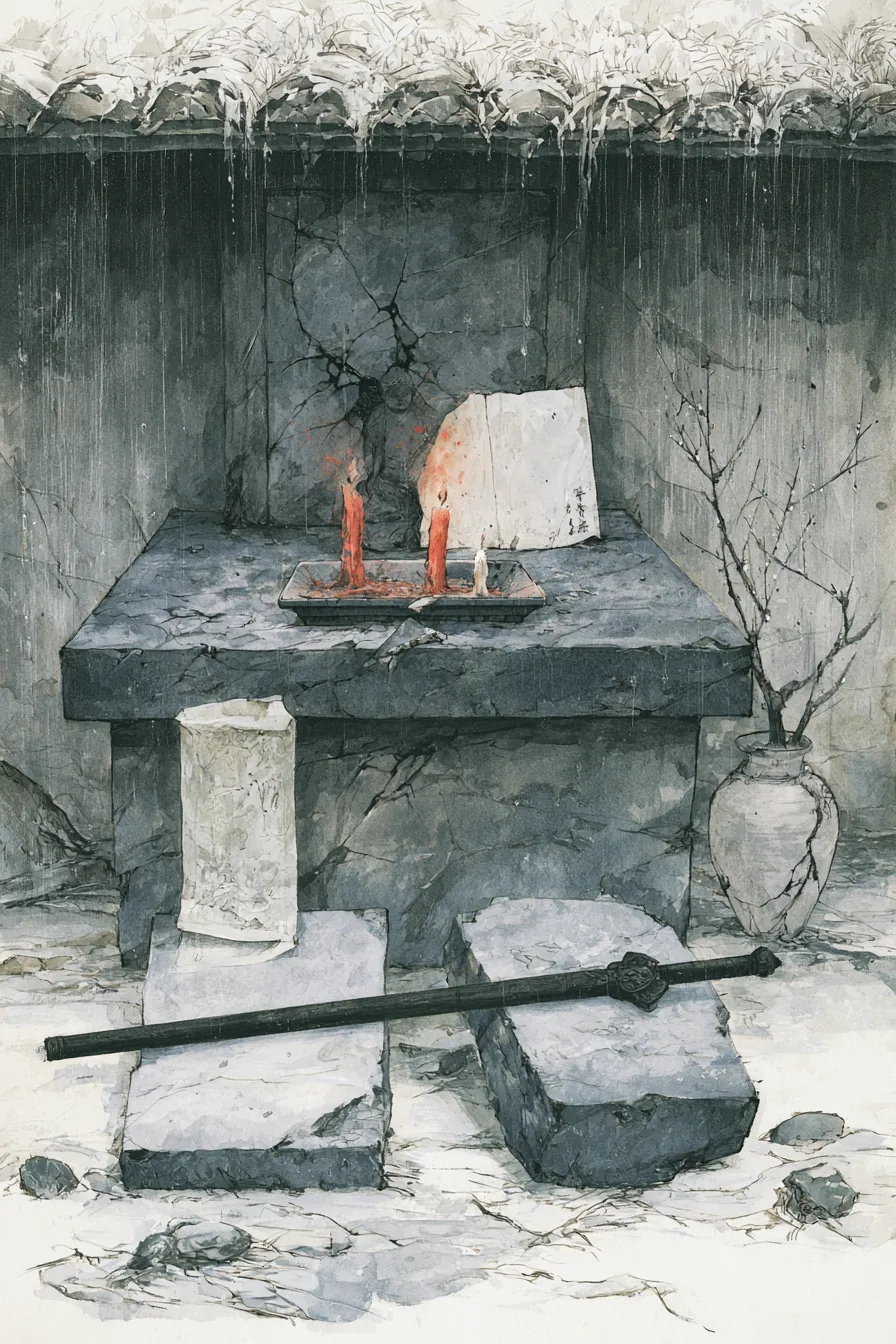
By the second watch they had crossed two ridges and a dry creek bed and were standing in front of a small forgotten shrine in a stand of black pines at the top of a third ridge — three cùn of moss along the threshold, a stone fox at the door with the left ear broken off, a wooden bowl on the altar with three copper cash in it and a small dried plum.
Yan Jiu bowed to the stone fox.
The stone fox did not bow back.
The live fox along his shoulder did, however, hop down from him onto the threshold and touch noses, very lightly, with the broken ear of the stone fox, the way a junior cousin paid respects at a grave.
"Ya-tou," said Yan Jiu. "Welcome. This is — I want you to understand the gravity of this — the finest shrine on the south-by-south-west road. The fox is the patron. The plum is the offering. The cash are not, strictly, ours. We will leave one of mine and a peach pit when we leave."
"You have a peach pit on you."
"Mei-mei. I have always a peach pit on me. There is also a peach. I was, in the cart, going to eat the peach. I have not eaten the peach. It is in the bottom of the pack. The peach is yours, tonight."
"The peach is mine."
"The peach is yours."
She stepped over the threshold.
The shrine smelled of pine-resin and old cinnabar and the faint clean cold smell of a stone that had been bowed to for two hundred years by people who had nothing else to give. A single low altar at the back. A single thin sleeping pad rolled along the wall. The pad was not, by the dust on it, two years old. It was — by the way the dust was bare in a strip down the middle — three months old, and someone had recently slept on it, and someone had recently shaken it out, and someone had — she noted with the small dry sardonic precision that was beginning to feel almost affectionate — left a clay water-jar at the head, sealed with a strip of red cloth, and the red cloth was the same red cloth Aunt Three Pots had used to bind her right ankle yesterday.
She looked at Yan Jiu.
Yan Jiu did not look at her.
He set the bedroll down. He set the gānjiāng pot down. He set the small canvas pack down. He bowed, second time, to the stone fox, and he said, conversationally to the altar:
"Mama. Hello. It has been four months. I have brought a guest. Her name is — ya-tou, she has not told me yet, but it is going to be a very good one. The guest is bone-tired and her ankle is a loan. I am going to put her to bed. The cash in the bowl I am going to leave for now. We are not, currently, in the kind of season where I take more than I leave. Mei-mei — there is the pad. Sleep. I will sit at the door. I will be the door."
She did not move.
She said: "Your mother."
"My mother."
"Comes to this shrine."
"My mother built this shrine. She did not, strictly, build it; she paid an 散修 mason to do it for her one autumn nine years before she died. She paid him with a hairpin. The hairpin had been her mother's. The mason — Old Geng, he is dead now, the cough — never used the pin. He kept it in the lining of his cap. He gave it back to me at his deathbed. It is currently —" he tapped his right boot, "— in the heel of this boot. With three other things. I would rather not be searched."
"This is her shrine."
"This is her shrine. Yes. Ya-tou. I take guests to this shrine very rarely. I have brought, in seven years, three. Two were dying. The third was a fox-witch I owed a favor and she ate the offerings and laughed at the altar and I have not spoken to her since."
"How many of them did you ask the name of."
A pause.
He said, very softly, looking at the altar and not at her: "Ya-tou. None."
She breathed in. Four count. Out. Six count.
"Sit," she said. "I will tell you my name."
He sat.
He sat at the threshold, where he had said he would sit, with his back to the doorframe and his sword across his knees and his fox curled on his thigh and the small steady awake patience of a man who had decided to be a door for the rest of the night.
She sat across from him on the sleeping pad.
She did not — she had decided this somewhere in the last six li of scrub — sit pretty. She sat the way she had sat on the kitchen floor of her mother's compound at three years old when her mother had told her she was going to teach her something important. Legs crossed. Hands open. Shoulders down. Eyes on the eyes of the person doing the telling.
She looked at him.
The dark awake eyes were on hers.
The grin was nowhere.
The first face and the second face were both somewhere else.
The third face — the face she had seen in the cart, the face of a man who had been given his life back — was the face that was looking at her now, and the third face was very steady, and the third face was afraid in a way that had nothing to do with her teeth.
She said: "Lin Yao."
He did not move.
"Lin," she said. "林. The character is the double-tree, the radical for grove, and my father chose it because he said the trees of a forest could not be cleansed individually without killing the soil. Yao is the yao of jade-stem, not the yao of medicine — 瑤, with the king radical on the left and the yao phonetic on the right. My mother chose it. She said a 瑤 was the kind of jade a young king kept in his sleeve and forgot he was carrying, and she would rather I be carried than worn."
A long silence.
"Lin Yao," he said.
It was the first time anyone had said her two-character name aloud in nine days.
The sound of it in this man's mouth was not — she discovered, with the cold round attention of a woman discovering that the dog she had been told her whole life was rabid had just licked her wrist — the sound she had been afraid of.
The sound was warm.
The sound was the sound of a word being lifted, carefully, from the floor of a temple by a man who had decided it was not the temple's word any longer.
He said, after a count of breaths: "Lin Yao. It is a good name. Ya-tou. I am sorry it has been on a kill-list for nine days."
"Yan Jiu."
"Lin Yao."
"Tell me yours."
The grin came back, just for one beat — flickered, half-formed, and went out — and the third face returned, and he said:
"My name is on a kill-list too."
"Yan Jiu."
"I am giving you the long answer because the short answer requires it. Mei-mei. I am — currently — Yan Jiu. 燕九. The swallow-nine. The ninth and last swallow of a sect-line my mother walked off the high path of, twenty-two years ago, the spring before I was born. She kept the surname because it was hers; she discarded the given the way a woman discards a husband's ring at a river. I was given the given by an 散修 uncle who could not read very well and who picked Jiu because he had nine fingers and thought it was funny. The given is mine. The surname is hers."
She breathed in.
"Your true name."
A longer pause.
He said, very quietly: "Mei-mei. The biāoshī in the gate-town would pay six hundred spirit-stones for that sentence. I am going to give it to you because you have given me yours and I do not know how to be in a temple my mother built and lie to a woman who is sitting on her pad."
"Then give it."
"燕九河. Yan Jiuhe. The water character at the end. My mother gave me the water character at the end on her own deathbed, three breaths before the breath went, by writing it on the inside of my left wrist with the last of her qi. It faded. It was not — strictly — a seal. It was — strictly — the gift of a name. She had been keeping the Jiuhe for me for eleven years. She had been afraid to give it to me earlier because the Jiuhe was a Wanshou-Mén lineage-name and would have killed me if I had been carrying it on the road. She waited until I was old enough to choose. I was eleven. I have been Yan Jiu in public, Yan Jiuhe in private, in five teahouses in nine years and now in one shrine. The shrine is yours."
"Yan Jiuhe."
"Lin Yao."
The fox in his lap lifted her head, very slowly, and looked at Lin Yao with the great level attention of an embassy clerk who had decided that the document on the desk in front of her had just become, by the small bright clean transit of two names, a treaty. She lowered her head. She tucked her snout under her tail.
The fox closed her eyes.
The clerk had gone off-duty.
The peach was small and bruised and very fragrant.
He had not, in the end, peeled it. He had handed it to her with the bruise side away from her thumb, and his hand had not lingered, and the gesture had been the gesture of a man giving a woman her own fruit back, and she had eaten it slowly, sitting on the pad, with the juice on her chin, and she had not wiped her chin because she had decided that the dignity of the shrine permitted juice on the chin of its guest.
Yan Jiuhe — Yan Jiuhe, she said inside her ribs, learning the weight of the second character, the water radical at the end, the way the name settled — sat at the door.
He had taken his outer robe off and folded it.
The middle-robe was dust-grey with a darker patch under the right shoulder where the talisman-frost had not, quite, gone out of the weave, and his collarbone was visible in the V of the under-robe, and there was a faint pale scar along the line of the bone — the kind of scar a hand left when a hand tried to hold a man back from a fall and the man had fallen anyway.
She did not ask about the scar.
She did, however, watch his hands.
He had laid the Wanyue paring knife across his right thigh. He was sharpening the blade with the back of his right thumbnail, in the lazy attentive way men sharpened blades when they wanted both hands to be doing something while the mouth did something else. The blade made a small dry hiss against the nail.
She finished the peach.
She held the pit in her right palm.
She said: "Yan Jiuhe."
"Lin Yao."
"South."
He looked up.
She said: "I will not go back. I will not present myself to the 仙盟 to be tried. I will not — strictly — present myself to my father's old contacts in 散修 territory. I will go south. I will go to 神州 / Shenzhou. I will rebuild my cultivation as a 散修. I will not — strictly — return to the orthodox path. The orthodox path has a sword that goes through my shoulder at the end of it. I will take the other path. The path my father left in the talisman that has not yet opened. The path the 药王谷 seal on the talisman is a sign of. I do not know — yet — whose hand wrote the 药王谷 layer. I do not know — yet — what the path is. I will know. I have time. I have a sword. I have a fox. I have a pot of gānjiāng and a peach pit and seven entries in a ledger I have stopped calling a ledger. I will go south. I will not go alone, because I cannot — strictly — walk on my right leg, and because the cart-line driver thinks I am someone's honeymoon-wife and that is the only reason I am still moving. I will go south with you, if you will come."
He set the paring knife down.
He breathed in. Four count. Out. Six count.
He said: "Lin Yao."
"Yes."
"You — would — invite a 散修 sword-thief with one true name and three false ones and a Wanshou-Mén mother's death-debt and four biāoshī who would gut him for the spring tea-line and a fox who is reading our conversation right now — to go south with you."
"Yes."
"Do you understand what you are asking."
"I am asking you to come."
"I am — Lin Yao, I am — I am going to require you to say it twice, because I have not been asked anything in nine years that did not have a price-tag in the second sentence, and I am required, by the discipline of my profession, to verify that you are not going to follow it with one."
"Yan Jiuhe."
"Lin Yao."
"I am asking you to come south with me. There is no price-tag in the second sentence. There is also no price-tag in the third. The fourth will be: do not, when we are walking, look back at the road behind us more than once an hour, because I have ten years of looking back and I am tired of it, and I would like to share the work with another person. The fifth will be: I do not know how to be in love. I have only known how to be useful. If I am tender with you I will be slow and I will be bad at it. The fourth person who saw me in Drifting Cloud was watching me because I am dangerous; the third was watching me because I am hunted; the second was watching me because she had a granddaughter; the first was you, and you were watching me because you had noticed that I was —" she stopped.
"Hungry," he said.
"Hungry."
"And."
"And no one had — for ten years — asked me what I would eat if I were given the choice. You asked, on the seventh day, peach or plum. I have not, Yan Jiuhe, answered. The answer is peach. You knew before I knew. I would like, now, to come south with the man who knew."
He had not moved through any of this.
He moved now.
He stood — single fluid motion, the way he had stood on the inn roof, dust on his palms from the threshold — and he came into the shrine, three steps, and he knelt — knelt, on the bare stone floor, the way her father had once knelt at her seventh birthday to tie the small red ribbon around her wrist with the small soft awkward earnestness of a man who had been taught to bow only once in his life and who was now using the bow on a daughter he did not, in his ribs, believe he was permitted to have — and he said, looking at the meat of her left hand and not at her face:
"Lin Yao. I am yours from this shrine to whatever is on the road. I am yours under whatever name you would prefer. I am yours as a biāoshī if you require a biāoshī. I am yours as a thief if you require a thief. I am yours as a 散修 sword-cultivator if you require one. I am yours as a man if you ever require a man, and I will not — I am telling you this now so that the contract is clean — ever press you to require a man. The man is yours if you ask for him. He will not be asked for first. I will be the door. Mei-mei. I will be the door for as long as the door is what you need."
He bowed his forehead to the floor of his mother's shrine.
His braid slid forward over his shoulder.
The stone fox at the door watched.
The live fox in the corner watched.
The clay water-jar with the red cloth at its mouth — the cloth that had been on her ankle, the cloth that had been bought with the cash she had not paid for the room — watched.
Lin Yao did not — strictly — breathe for four counts.
She breathed in, eventually.
She said, after a long time, in a voice that was not the voice of the woman who had killed a frost-wraith in a gorge: "Yan Jiuhe. Stand up."
He stood up.
He did not look at her face.
She reached out her right hand.
She did not — she made this decision in the small bright fluid time of a woman who had spent ten years measuring distance and had finally given herself permission to close one — extend the hand at the polite distance her sect manners had bred into her wrist. She extended it the third distance, the no-thumb's-breadth-between-us distance, the distance her mother had used at four when she had pulled her up onto her lap and her right thumb had traced the small dry circle behind her ear.
He understood.
He came one half-step closer.
She put her right hand on his sternum, where her left hand had been in the cart. Over the small precise dragon. Over the deflection-scar. Over the slow steady drum of the biāoshī's lung.
She left it there.
She did not push.
She did not pull.
She — because she had decided in the cart at the hour of the snake and again in the shrine at the hour of the dog and she would not unmake the decision now — let him have her hand on his ribs for the count of her own breath. Four in. Six out.
He did not move under her palm.
He did not breathe. Or he breathed so small she could not hear it.
His eyes — the dark awake ones, the third-face ones — went, for one half-beat, all the way down. The line of his lashes, longer than they had any right to be on a man who lived on roofs, lay along his cheekbone in a soft dark fan, and the bruise along his jaw had yellowed almost to gold, and a single bead of sweat had begun, with no permission, at his temple, and was running down very slowly toward the small precise scar at his throat.
She watched it run.
She did not — because the heat of his sternum was already a great deal warmer than the meat of her own palm and the meat of her own palm was, already, beginning to ask questions of her her ribs were not, yet, prepared to answer — let her thumb move.
She breathed out the six count.
She took her hand back.
He breathed.
It was — she discovered with the small dry sardonic precision she now reserved for catastrophes — the first breath he had taken since her hand had touched the meat of his chest.
She said, around the corner of her mouth, the smallest possible smile she had made in nine days: "Yan Jiuhe."
"Lin Yao."
"You are alive."
"...Mostly."
"South."
"South. I have — Lin Yao, I have — a friend with a boat. Sort of a friend. Sort of a boat. The boat is on the 漓江, eleven days' walk and one ferry south. The friend is a Wanyue sect washout who washed for cause and now runs cargo. He owes me a very old favor. He will not ask questions if I introduce you as my fiancée. You may, if you wish, kick my shin when I do."
"I will kick your shin."
"You will. Yes. Mei-mei, I would like that to happen at least once a week. I would like to plan for it. Lin Yao — south."
"South."
He bowed — the biāoshī's bow, hands at the side, head dipped one cùn, right knee braced — and he stepped back to the threshold, and he sat down again with his back to the doorframe, and he picked up his paring knife, and the small dry hiss of nail against blade resumed in the soft pine-and-cinnabar dark of his mother's shrine.
She lay down on the pad.
She lay on her left side, facing the door, facing him.
She did not — strictly — go to sleep.
She closed her eyes.
She breathed.
The fox, very quietly, came across the floor and curled into the warm hollow at the back of her knees, and laid her snout on the bandage of her right ankle, and the bandage warmed by half a cùn of degree under the steady fox-breath, and the right tibia — the loan — was a little less of a loan by morning, and Lin Yao slept.
She did not dream.
It was the first night in nineteen days she had not dreamed.
Yan Jiuhe sat at the threshold the entire night.
He did not — at any point — sleep.
He did, around the hour of the rat, very softly, to the altar his mother had built and to the stone fox his mother had bowed to and to the woman on the pad whose hand had been on his sternum for the count of one slow breath:
"Mama. I think I have — I think we have — one."
The altar did not answer.
The stone fox did not answer.
The live fox, at the back of Lin Yao's knees, flicked her tail.
Yes, the tail said. One. Now hush.
He hushed.
The shrine was quiet.
The road south began at dawn.