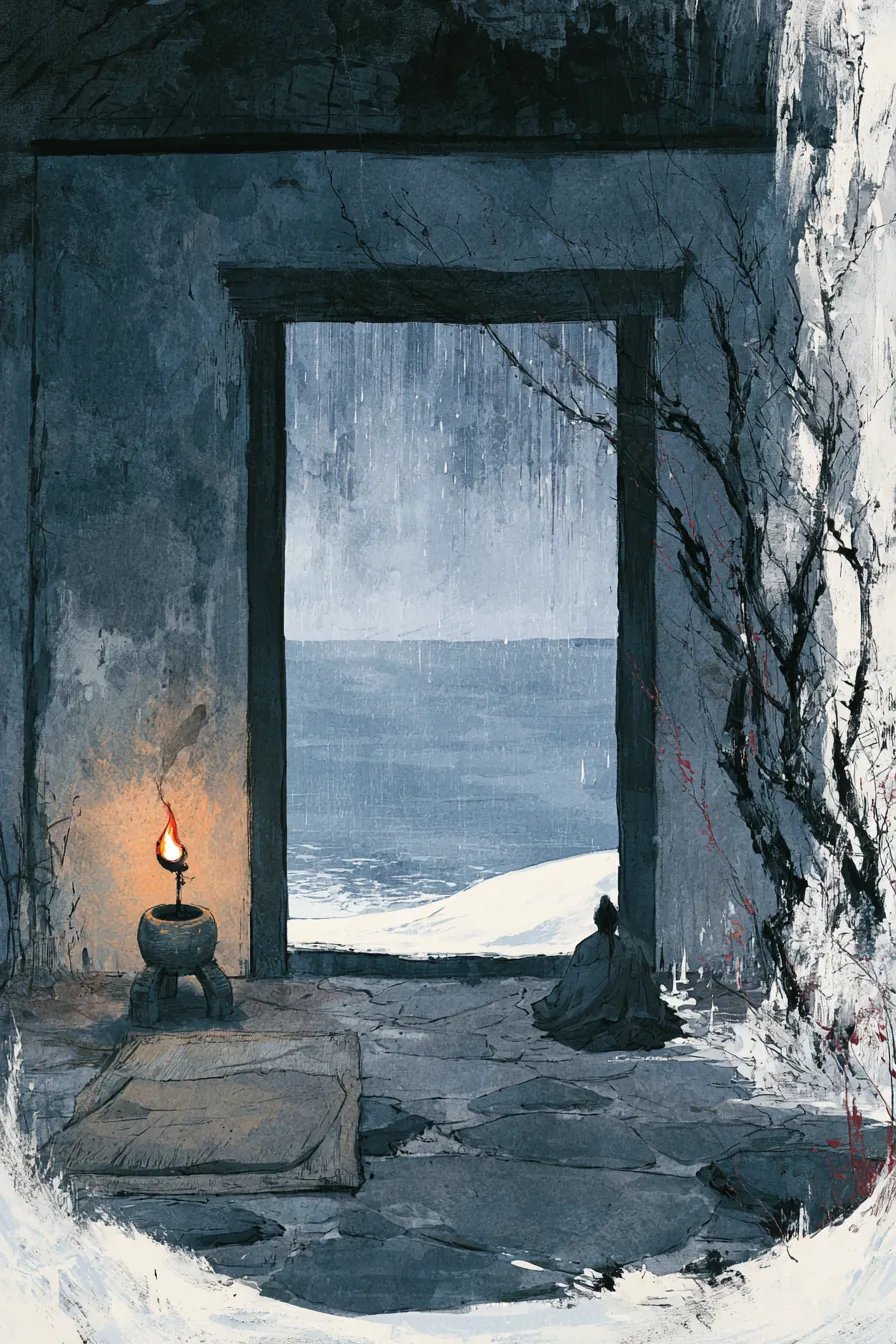
Chapter 11 — The Shrine of the Forgotten God
The rain caught them at the hour of the sheep, twenty li south of the 青芦 stone, on a ridge road that had no shelter for the next li and a half except a roadside shrine to a mountain god whose name the rain had been wearing off the lintel for three hundred years.
The shrine was small. Three paces by four. One futon, donated and old. One brazier, dry. One painted board of the forgotten god — face half-rained-away, hands still legible, the right hand making the gesture of open the door anyway, traveler.
Yan Jiuhe read the gesture, bowed one cùn to the board, and opened the door.
The fox in the canvas pack at his hip made the small soft hh of an embassy clerk noting a change in venue.
"Mei-mei."
"Yan Jiuhe."
"The brazier wants kindling. The kindling is wet. The futon wants sun. The sun is — by the season — gone for the day. The god wants incense. The incense is — by the inventory of my left sleeve — three sticks. We have, by the biāoshī nose of the wind, four hours of hard rain and six of soft. We will sleep here. I will sleep — Lin Yao — by the door."
"By the door."
"By the door. Thieves never sleep deep. Mei-mei. I will sleep at the threshold. You will sleep on the futon. The fox will sleep on you. The forgotten god will sleep on the lintel. Everyone will be — by the standards of a god whose name has been raining off for three centuries — fine."
She did not answer. She set her sword against the wall beside the futon. Her father's dull black blade. Wuming. The name she had not yet spoken aloud to Yan Jiuhe, because the day she spoke the name aloud she would have to admit, also, what her father had wanted from her by carrying it for fourteen years and dying with the third notebook half-finished on his knee.
She filed the not-yet-speaking under stayed.
She sat on the futon.
She put her hands palm-up on her knees the way her mother had taught her at seven, daughter, when you do not yet know what the room is for, sit and let the room arrive.
The room arrived as rain.
Yan Jiuhe coaxed a small flame from the brazier with a thumbnail-shaving of his own outer-robe hem and a single piece of dry pinewood he had — at the second water-house — taken without comment from a passing carter's load. The pine smelled, when it caught, of the courtyard at 寒玉峰 where she had been allowed to sweep at six. She did not, by any small movement of her face, let Yan Jiuhe see that her ribs had registered the smell.
He saw.
He did not, however, look at her.
He sat by the door, his back against the lintel, his sword across his knees, the canvas pack with the sleeping fox tucked into the curve of his thigh, and he watched the painted face of the forgotten god as if the god were the only company a biāoshī could decently keep at this hour of this rain.
She lay down on the futon.
She closed her eyes.
She did not sleep.
The dream came at the second watch.
It was, as it had been every night for nine nights, the same dream. 寒霜 at the angle Pei Shenzhi's right hand had made it on the 清门大典 morning. Her own shoulder. The breath she had not taken because she had been counting his.
In the dream his hand did not shake.
In the dream she remembered, with the new clarity that had been arriving since the brine-bowl, that his hand had — on the actual morning, against the actual hilt — shaken once.
She woke with her own left hand around her own right wrist.
The shrine was dark.
The brazier had gone to red.
Yan Jiuhe was — she saw, when her eyes finished — not at the door.
Yan Jiuhe was one pace from the futon.
He was on the floor. He was on his heels. He had set his sword on the boards beside him, hilt away from her, the way he had set the peach pit on the rice paper in the inn yard at Drifting Cloud, carefully, like the object deserved the respect.
He had not, in any small cùn, touched her.
She breathed in. Four count.
He breathed out. Six count.
He said, very softly: "Mei-mei. You were — for the count of three breaths — making a sound."
"A sound."
"A small sound. The sound of a woman being held by the shoulder. Mei-mei. I came over."
"You came over."
"I came over. I did not — for the record — come over the threshold. The door is still — by the floorboard at my left foot — behind me. I came over as a biāoshī. I came over as a door. I came over — Mei-mei — as a thing that gets between you and the shoulder. I did not come over as anything else."
She breathed out. Six count.
She said, around the dark: "Yan Jiuhe."
"Mei-mei."
"Sit closer."
She heard, for the first time in nine days, his breath catch.
It caught for one count. One.
Then the biāoshī discipline at his throat reasserted itself, and he moved exactly one cùn nearer the futon. One. Not two. Not three. He did not, with any part of himself, touch the futon.
He said: "This close?"
"This close."
A long quiet. The rain on the thatch. The fox in the canvas pack at the threshold making the slow even hh of an embassy clerk asleep on her own boots.
She lifted her right hand from where it had been clamped around her left wrist. She set it, slowly, palm-down on the linen of the futon between them. She did not extend it past the futon's edge.
Her hand was at the no-thumb's-breadth distance from his.
His good right hand, which had been flat on his own thigh, did not — for the count of three breaths — move.
Then it moved. He did not put his hand on hers. He set the back of his right knuckle against the outside of her right wrist, where the bone made the small clean ridge, and he held it there with the biāoshī discipline of a man pressing a fingerpad to a wound to check if the bleed had stopped.
The knuckle was warm.
The knuckle did not press.
She breathed out. Six count.
Her wrist — under his knuckle, in the dark, with the rain — registered the warmth. It registered the warmth in the meat under the skin and in the pulse under the meat and in the small new place at the inside of her sternum where the stayed clerk had been keeping her ledger for nineteen days.
Her body — hers, not the constitution's, not the hungry-child voice that lived at the back of her dantian — said yes.
She filed the yes with the deliberate clinical hand of a woman who had — at twelve, in the corner of the 知客堂 — once filed a poem her senior brother had left on a tea-table.
She filed it under stayed.
She also, with a precision she had not had before the brine-bowl, filed the filing. This is what my body is for. This is what it is doing. I am — for once in ten years — not going to look away from it.
She turned her face on the pillow.
She turned it the half cùn her mother had once turned her own face on the road outside the magistrate's gate, the night her mother had been asked by a man with a wedding cup whether she would take the door if it were opened now.
Her mother had taken the door later. On her own day. By her own hand.
Lin Yao would take a door — she filed the resolution with a clerk's cleanness — later. On her own day. By her own hand.
But, here, in this shrine, in this rain, with this man's knuckle at this wrist, she would lean. One cùn. The lean was — by the angle her mother would have approved — not the door. The lean was — by the angle Yan Jiuhe had been building the biāoshī discipline for nine days to permit her to lean — into.
She leaned.
Her forehead came, by the half cùn of a woman who had counted, against the place at the corner of his shoulder where his outer-robe met his collarbone. She set it there. She did not, in any other small cùn, touch him.
His breath went out — six count, but the last two counts were thin.
He said, against the air over her temple, not into her hair: "Mei-mei."
"Yan Jiuhe."
"You are — for the count of one breath — leaning."
"I am leaning."
"Mei-mei."
"Yan Jiuhe."
"Mei-mei. I will — for the record — sit here until the rain stops, or the brazier dies, or the fox tells me to move. I will not — Lin Yao — close any further cùn. Tell me you understand."
"I understand."
A long quiet.
She said, with the small clear clean voice she had used to her mother at nine: "Why."
He did not, for three counts, answer.
Then, very carefully, with the biāoshī discipline of a man who had spent nine days at one cùn clear of her shoulder and had — at the 漓江 willow — handed her the fourth face of himself with both knuckles white on the sword-pommel: he answered.
He said, against the air over her temple: "Mei-mei. I will not take the door tonight."
"Yan Jiuhe."
"Mei-mei."
"This is not Ch07."
He did not, for one full breath, understand that she had numbered the night at the mother's shrine. Then he did. Then he made — at the corner of his mouth, against her temple — the smallest amused breath of a man who had been numbered by a woman in his own ledger.
"No, Mei-mei. It is not."
"At the shrine you said — I will not press you. The man is yours if you ask for him; he will not be asked for first. That was — Yan Jiuhe — the first refusal. That was the contract. The man does not press. The man waits for the asking."
"Yes."
"I am — Yan Jiuhe — asking."
A pause. The rain. The brazier. The fox.
"Mei-mei. You are asking. Lin Yao. I am — for the second time — refusing. The refusal is not the same. The refusal is — Mei-mei — the second refusal."
She held still. Four count in. Six count out.
"Name it."
He breathed in. He breathed out. The breath out went past her hair. The breath out smelled, by the small bright clean accident of a biāoshī who had drunk peach tea at the third water-house, of peach.
He said: "Lin Yao. I will not take you in this state."
"State."
"Lin Yao. You are — by the count of nineteen days — running. You are — by the count of the 漓江 willow — turning. You are — by the count of the kettle on the boat — boiling. You have not yet — Mei-mei — landed. If I take you tonight, I take a woman who is — in the air. I take a woman mid-turn. I take a woman who has — Mei-mei — given me her body because the dream gave her a sword in the shoulder and the brazier gave her my hand on her wrist. I will not — Lin Yao — be the brazier. I will not — Mei-mei — be the dream. I will be — Lin Yao — the door. The door does not open the door for you. The door — Mei-mei — waits for you to put your whole hand on the latch in the morning when you are not in the air. Then the door opens."
She did not, for three counts, breathe.
She breathed in. Four count.
She breathed out. Six count.
She filed the door under stayed.
The clerk inside her sternum — the new clerk, the clerk who had been waiting for nineteen days — wrote the entry with a hand that did not, at any moment, tremble:
Yan Jiuhe. Second refusal. Honor. The man is yours when the woman has landed. He has earned the wait.
Her body — the body that had registered the warmth at her wrist and had said yes — registered, also, the not yet. It registered the not yet in the meat at the small of her back and in the wedge at the inside of her hipbone where his thumbs had been four days ago on the descent from the 青冥, and the meat said — with a small new clean voice that was hers — I am still here. The wait is not the no. I will be here in the morning.
She filed the I will be here in the morning with both hands.
She lifted her forehead off the corner of his shoulder by the half cùn she had set it there.
She did not, in lifting, lose his knuckle on the outside of her wrist.
She said: "Yan Jiuhe."
"Lin Yao."
"Door."
"Door."
"You — Yan Jiuhe — are the door. I will, in the morning when I have landed, put my hand on the latch. You will, in the morning when I have landed, open the door."
"Yes, Lin Yao."
"Until then."
"Until then."
"You will sleep — Yan Jiuhe — at one cùn. You will sleep — Yan Jiuhe — with your knuckle at the outside of my wrist. You will not — Yan Jiuhe — take it back until the brazier dies. Yes?"
He breathed out. Six count. The last two counts were, again, thin.
"Yes, Mei-mei."
She closed her eyes.
The dream did not come back.
The brazier held until the hour of the rooster.
When the brazier died, she opened her eyes. He had — by the count of three breaths — kept his knuckle at the cùn she had asked for. He had kept it at no pressure. He had kept it at the warmth.
When the brazier died, he took his knuckle back. Slowly. With the biāoshī care of a man returning a borrowed kettle to the shelf it had come from.
He bowed — sitting, on his heels, head dipped two cùn — to her left wrist as he took the knuckle back.
He bowed to the wrist.
Not to her.
She understood.
She filed the bow to the wrist under stayed, in the small new register that had — at the 漓江 willow at dawn — finally — been opened.
Before the brazier died, before the rooster, before the dawn-crane — at the hour of the tiger, when the rain had fallen to the soft six-hour rain and the shrine had gone full dark except for the red coal — she did, with the small clean precision of a woman who had been numbering her own breaths since nine, the thing she had not done in ten years.
She meditated.
She did not sit up off the futon. She did not move his knuckle off her wrist. She did not turn her shoulder away from the cùn she had asked him to keep. She lay where she was. She put her own right palm against her own sternum at the place where the stayed register lived. She inhaled four count. She exhaled six count.
The dantian — the broken-bowl, the cup that had been re-glued and was holding nothing — did not yet hold qi. It held, however, the warmth at her wrist. It held the door word he had given her. It held the 月-木 seal and the third volume in the inside seam of her left sleeve. It held the silver needle at the cuff. It held the kettle.
The clerk inside her sternum lifted, for the first time since the cliff, the Frost Lung count.
Yongquan to Huiyin. Huiyin to the small ring at the navel. Small ring to the place under the sternum the clerk had been holding open for nineteen days.
The count went through.
A thread of qi — not Frost-Sect qi, not Tianmo Ti qi, but a thinner, simpler, human qi the count had drawn off the warmth at her wrist and the wax of the third volume and the brazier-red in the air — moved one full circuit through the lower meridians and arrived, bright clean cold, at the small ring above her dantian.
The dantian, when the thread arrived, did not break.
The cup held.
The cup held three fēn worth. Three. No more.
Lianqi 2nd. Tonight. In a rain-soaked shrine to a forgotten god, with a biāoshī's knuckle at her wrist, with a man waiting at the door he was being. Lianqi 2nd.
She did not, by any small cùn, let Yan Jiuhe see the cup holding.
She also did not, by any small cùn, hide it from him. The biāoshī discipline at his throat had, by the count of nineteen days, learned to read the shift in her breath the way a doctor reads the shift of a wrist under a thumb. He read the shift. He did not name it.
He bowed — sitting, on his heels — one cùn lower to the wrist than he had bowed the bow at the 漓江 willow.
The wrist took the bow.
The cup, holding, took the bow with it.
She filed Lianqi 2nd under stayed.
She slept.
She stepped out of the shrine at the hour of the rabbit.
The rain had stopped.
The road south was a thin grey ribbon along the ridge, the 漓江 a wider grey ribbon down the slope. A small bright cold dawn was opening at the east shoulder of the sky, and against the dawn, two li across the air, a crane was flying north.
Pure white.
The wing-folds were Frost Sect.
The wing-folds had been folded — by the small clean particular accident of a hand she had memorized for ten years — by Pei Shenzhi.
Yan Jiuhe came out of the shrine behind her. He saw the crane. He said, very softly: "Mei-mei. He has — by the dawn — found us."
"He has."
"Mei-mei. He has folded that crane in the last hour. The ink — by the lift of the wing — is wet. He is — by the count of dawn — one li east. He has been at the biāoshī checkpoint at the 青芦 stone since the second watch. He is — Lin Yao — coming."
She watched the crane.
The crane circled once over the ridge — confirming her, by the small bright cold clean accident of a Jindan talisman that had been keyed to her hair-oil for nine years — and then turned its longer wing over its shorter wing, in the way Pei Shenzhi had folded it, and flew back east.
It had not, in any small cùn, attacked.
It had not, in any small cùn, tagged.
It had — by the wing-fold — delivered a thing.
She put out her hand.
The crane, against the dawn, dropped a single folded paper into her palm.
The paper was thick. The crease was four years old. The ink on the inside, she could feel through the paper, was not the new ink.
The ink on the inside was the old ink.
The crane she had seen folded on his cliff-desk, the year she had been a girl who had not yet learned to count breaths.
She did not open the crane.
She filed it — with the small clean clinical hand of a woman who had, the morning before, taught a man to look up — under stayed.
The fox in the canvas pack at Yan Jiuhe's hip opened both eyes. She made the small soft hh of an embassy clerk acknowledging an unexpected ambassador.
The embassy clerk in the slats of Lin Yao's ribs — the clerk who had, the morning before, opened a register called stayed with four entries on it — added the crane.
The clerk's hand, in adding, did not tremble.
The clerk's hand also — for the first time in nineteen days, with a small clean precision the 药王谷 needle at her wrist would later, on the boat, register — filed the door.
The door and the crane sat on the register together.
They did not, by any small cùn, contradict each other.
The clerk, by the standards of the new register, was satisfied.
She turned to Yan Jiuhe.
"Yan Jiuhe."
"Mei-mei."
"South."
"South. Mei-mei."
"Quickly."
"Yes."
She put the unopened crane into the inside seam of her left sleeve where she carried the third volume's empty space, and she walked, with the small bright cold clean step of a woman who had — in a shrine to a forgotten god — been bowed to at the wrist, down the ridge toward the river, with the door at one cùn behind her right shoulder and the crane at the inside of her left sleeve and the kettle, still, on.