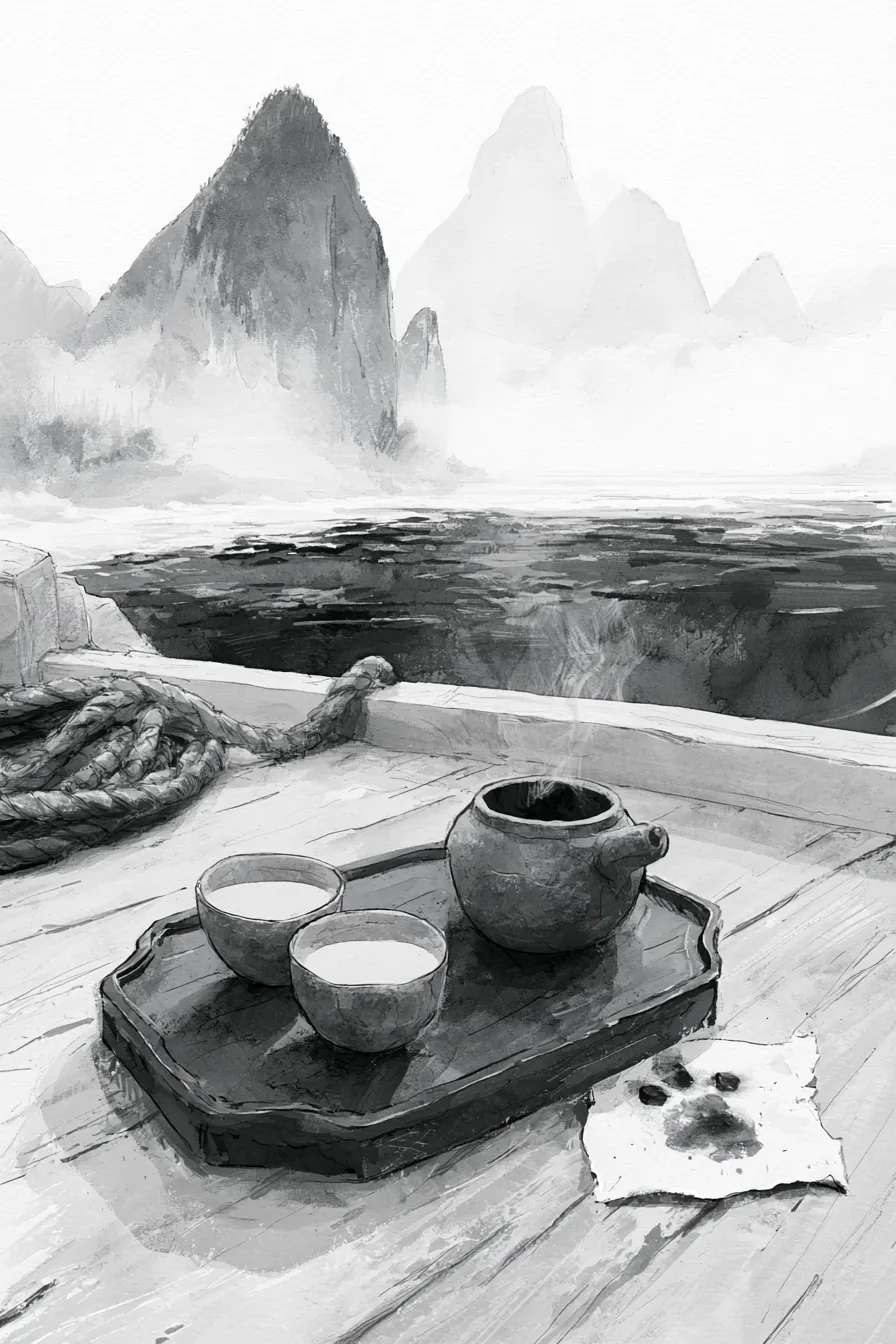
Chapter 14 — The Wanyue Boat
The boat at the 青芦 second-turn dock was, by the look of the gunwale, a 漓江 working boat for three generations.
The boatman was, by the look of his outer cuff, a Wanyue washout of the eighth class. Two sword-script tattoos at the inside of the wrist, half-burned. One Wanyue sword-pin missing from the third-button place. One small white scar at the inside of the thumb. A breath at the four-and-six count he had learned at twelve, on a pine roof in a city he no longer named.
Yan Jiuhe greeted him, without comment, by laying his own thumb against the inside scar.
The boatman said, very softly: "Jiuhe."
"Bo."
"Mei-mei."
He said mei-mei with a Wanyue cusp that meant nothing in biāoshī lore but everything in Wanyue lore. Lin Yao filed the cusp under named in the column called roads I have not yet walked.
The boatman did not, in any small cùn, ask her name.
He bowed — one cùn, palm up, eyes off her face — the boatman's bow.
He said: "Lady."
He looked, in the saying, half a cùn to Yan Jiuhe at her cùn.
The half cùn contained both the question fiancée? and the answer fiancée.
Yan Jiuhe said, conversationally to the gunwale: "Bo. Lady is — by the biāoshī permit at the inside seam — Liang Yao, fiancée of the second cousin of the biāoshī clan of the 双枫 turn. Liang Yao will, at the 白鹿洲 turn, be a Wanyue steward's intended. Liang Yao will, at the curl of bamboo, be a — Liang Yao will, at the curl of bamboo, not be on the boat. The boat will turn at the south-east. The boat will not — Bo — see the curl. Yes?"
"Yes, Jiuhe."
"The boat is — by Wanyue count — six days. Cargo to the second water-house. Cargo to the 白鹿洲 turn. Cargo at the 白鹿洲 turn off. The biāoshī's cargo on at the 白鹿洲 turn — three boxes, the second box black-lacquered, the third box marked with the Wanyue steward's third-button. The boat south to the 漓江 south-east. The boat back at the 漓江 south-east. Lady and biāoshī off at the south-east. Bo — back at the south-east. Yes."
"Yes, Jiuhe."
"The fee."
"The fee is — Jiuhe — no fee. My mother died in the guanxi second river flood. You delivered my mother's biāoshī portrait to my sister at the 清水县 turn at the second watch in the third year of the jiǎzǐ. You did not, by any cùn, charge. The boat is — Jiuhe — the kettle returned. The Lady will, in the Wanyue register, be entered as no name. I will, at the 南道, by my mother's hand on the Wanyue cusp, not speak."
Yan Jiuhe did not, by any small cùn, answer the kettle returned.
He bowed — one cùn, the biāoshī bow, hands at the side, head dipped two cùn — to the inside of the boatman's burned thumb.
He turned his face away.
The fox in the canvas pack at his hip made the small soft hh of an embassy clerk acknowledging an entry on a register she had not been asked to keep but had — by the standards of nine years of road work with him — been keeping anyway.
The clerk in Lin Yao's sternum, with the cup at four fēn of Lianqi 4th held at the morning's count, opened, for the second time at her own choice, the North column of the cardinal register.
She added an entry under Yan Jiuhe.
The entry was: the kettle he is being handed back today was the kettle he handed to a dying woman's daughter at the 清水县 turn in the third year of the jiǎzǐ when he was — by the boatman's Wanyue count — fifteen years old.
The clerk filed it under stayed.
The clerk filed, separately, in the smallest hand of the column called not yet spoken aloud, the entry: he has been doing this for nine years, and he has not, in any small cùn, told me.
She did not, on the boat, tell him she had filed it.
She climbed on board.
The boat held three days at the second water-house for the cargo.
Three days, in Wanyue boat-time, was Lianqi 6th.
She broke into Lianqi 5th on the second night, against the bow with both palms on the planking, with the river under the planks taking the breath the pine had taken on the road. The river took the count differently. The river took the breath at the four-and-six and the count at the Frost Lung third turn, but the river added, at the Yongquan-Huiyin gate sequence, a small new cùn her father had described in the third volume at the back-page note her mother had been the only one to read.
Daughter, when the gate sequence runs over water, the water adds. Do not refuse the add. The add is not Frost-Sect. The add is the way the family read the river before the family read the Cold Pool.
She did not refuse the add.
The cup at her dantian held five fēn.
On the third night, against the bow with both palms on the planking and the 漓江 under the planks at the second watch, with Yan Jiuhe two paces back at the wheel-house door not looking at her because he had — by the biāoshī discipline at his throat for nineteen days and the Mei-mei discipline of the South county boatman at his shoulder — taught himself not to interrupt, the cup at her dantian, with the 漓江 water and the 月-木 script on Wuming's spine and the 药王谷 needle at the cuff and the unopened crane in the inside seam, took the sixth fēn.
Lianqi 6th.
The cup did not, in the holding, crack.
She breathed out. Six count.
She did not, on the bow, weep.
She did, however, register — with the small clean precision a biāoshī register at her own inside thumb had been writing for nineteen days — that her father had built the cup for sixteen fēn. Sixteen, not seven, not nine. The cup was — by the standards of every Frost Sect register at 寒玉峰 — larger than it ought to be by the count of seven fēn.
She filed the cup is larger by seven fēn than the register says it ought to be under named.
The clerk did not, at the filing, know which column to put it under.
The clerk filed it under waiting for the West column.
It was on the fourth day, two hours short of the 白鹿洲 sandbank, that the West column opened.
It opened in the way the biāoshī lore at Yan Jiuhe's left thumb had — at 杏花渡 in the bamboo with the dot of the marsh — said it would open.
It did not open by a man on a road.
It opened by a qi.
She was at the bow, on the second watch of the fourth day, with both palms on the planking and the cup at six fēn of Lianqi 6th, when a thing the size of a thumb-needle gauge of not-Frost-Sect-not-药王谷-not-Yan-Jiuhe qi touched the inside of the cup.
It did not touch the cup the way the river had touched.
It touched the cup the way a man at the threshold of a door touches the lintel, one cùn, palm flat, asking.
The touch held for one breath.
It did not, in any small cùn, press.
It did not, in any small cùn, take.
It asked.
Lin Yao opened her eyes.
The 漓江 was the 漓江. The bow was the bow. The wheel-house door was the wheel-house door, and Yan Jiuhe at the cùn by the door had the small still biāoshī posture of a man who had — by the count of his own breath against her own — felt the touch on the cup at the same count.
She did not turn her face to him.
She said, into the river, in the small clean clear voice her mother had used at four on the road outside the magistrate's house at the moment a stranger had bowed and the stranger had been — by the magistrate's wife's count — not the brother of the bride: "Yan Jiuhe."
"Lin Yao."
"There is — at the inside of the cup, at the second watch, with my palms on the planking — a qi at the lintel."
"Yes."
"You felt it."
"I — biāoshī — felt it."
"It is — Yan Jiuhe — not Frost Sect."
"Not Frost Sect."
"It is — Yan Jiuhe — not 药王谷."
"Not 药王谷."
"It is — Yan Jiuhe — not Wanyue, not biāoshī, not fox."
"No."
"What is it."
He did not, for three breaths, answer.
He breathed in. Four count.
He breathed out. Six count.
He said, conversationally to the 漓江, the way he had said the trick — the wrist trick — do not tell anyone you can do that: "Lin Yao. The qi at the lintel is — by the standards of the biāoshī roll at the 双枫 turn — the man under the black banner."
The fox in the canvas pack at his hip opened both eyes.
The fox did not, in opening, make a sound.
The fox — for the first time since the cliff, since the gorge, since the 清门大典, since the inn at Drifting Cloud, since the 漓江 willow, since the rain-shrine, since the pine road, since the bronze board at 杏花渡 — spoke.
She spoke against the inside of the canvas pack at the cùn under his collarbone, in a soft Liuzhou-accent voice that was — by the standards of every register the embassy at her tail had not yet been asked to keep — older than the 漓江, older than the Wanyue, older than the Cold Pool, older than the biāoshī roll.
She said one sentence.
She said, to the bow and the river and the bow's woman and the bow's man: "Mei-mei. He is at three hundred li south-west. He has been tracking the constitution at the cup since the bronze board at 杏花渡. He is — Mei-mei — patient. Tell the biāoshī to keep the kettle on. The lintel will not press today. He will not press until he has — at the curl of bamboo — been asked. He does not — Mei-mei — break a door that has not been asked. He waits for the asking. He has waited for three years. He can wait for three more."
The fox closed her eyes.
She did not, on the boat, speak again.
Yan Jiuhe at the cùn by the wheel-house door did not, for the count of four breaths, breathe.
He breathed in. Four count.
He breathed out. Six count.
He said, very softly, into the 漓江: "Yinxu."
The fox did not answer.
"Yinxu. You have — by the count of nine years — never spoken in front of me."
The fox did not answer.
"Yinxu. You — small fox — spoke at the 漓江 bow in the second watch of the fourth day of a Wanyue boat run, because the qi of the man at the curl of bamboo touched the lintel of a cup at Lianqi 6th at the second watch of the fourth day of a woman whose biāoshī I have, by the count of nineteen days, been. Yes."
The fox, in the canvas pack at his hip, flicked her tail.
Once.
Twice.
A third time.
She did not, at the third, open her eyes.
Yan Jiuhe, in the watch, laughed.
He laughed the small soft hh laugh of a biāoshī who had — by the count of nine years on the road with a fox who had pretended not to speak — been out-played by an embassy clerk who had been waiting for nine years for the cup on a woman's bow to reach the Lianqi 6th cùn.
He said, against the river, the small biāoshī surrender of a man who had been bowed to by his own contracted beast: "Yinxu. Bo de bùcuò. Well played. Bo de bùcuò."
Lin Yao did not, in any small cùn, smile.
She did, however, file Yinxu has spoken in front of him at the count of Lianqi 6th on a Wanyue boat at the bow of the second watch of the fourth day at the touch of the qi at the curl of bamboo under named.
She filed it under the West column.
The West column, with the qi at the lintel and the fox at her tail and the biāoshī's laugh at her cùn, had — for the first time since 杏花渡 — a first true entry.
The entry was small.
The clerk did not, at the smallness, refuse the entry.
The clerk wrote it in the smallest hand the column had: the man under the black banner has, at three hundred li south-west, asked. He has not pressed. He is — by the embassy at the tail of the fox — a man who waits for the asking. The kettle is on. The asking is — by the count of three weeks — not yet.
The clerk closed the West column.
The clerk did not, in closing, lock it.
[Three hundred li south-west, on an island called 白莲泽 / White Lotus Marsh, at the same second watch — close third on Mo Yexing.]
The pear-wine cup at his left hand was the third cup of the watch.
The pear-wine in the cup was the second pour of the cup.
The pear blossoms at the lacquer tray on the low table were — by his own quiet count, strictly for the biāoshī lore he kept at the inside of his left thumb out of habit — seven.
He had — at the second watch of the fourth day of the Wanyue boat run she did not yet know he had been watching — touched the lintel.
He had touched the lintel at one cùn, palm flat, asking, the way he had been taught by his own teacher at twelve on the morning the teacher had — by the standards of the 血煞 sect at the 桑 east turn — handed him the Hanyue Zhenjun's third volume and had said, Yexing, the door of a Tianmo Ti bearer is the door of a magistrate's wife. You do not — boy — break it. You do not — boy — knock it. You lay your palm at the lintel. You wait. You wait until — at her own count — she asks. The asking is — boy — the only door. The rest is murder.
He had said yes to the teacher.
He had waited for three years.
The lintel, when he laid his palm against it at the second watch of the fourth day, had — by the count of one breath — answered.
It had answered the way a cup at Lianqi 6th on a Wanyue boat answered an unfamiliar qi: it had — by the standards of a daughter raised on daughter, the breath is the one thing they cannot take — not shut.
It had not, by any small cùn, opened either.
It had registered him.
The registering was — by the standards of every qi lintel he had laid a palm against in three years — the most precise registering he had ever felt at a Tianmo Ti cup.
He set the third pear-wine cup down.
He did not, for the count of seven breaths, breathe.
The seven breaths were — by Hanyue Zhenjun's lore at the back-page of the third volume — the count of the lintel. The count a Tianmo Ti bearer's body gave a stranger at the lintel before the lintel made its decision.
At the seventh breath, the lintel — her lintel, three hundred li north-east, on a Wanyue boat at the bow at the second watch of the fourth day — did the thing he had not, in nineteen years of waiting, expected.
It did not shut.
It did not open.
It filed him.
The filing was — by every standard the third volume had — the cleanest response a Tianmo Ti cup had ever given a stranger at a lintel in four hundred years of Tianmo Ti record.
He breathed out.
He picked up the third pear-wine cup.
He drank it in one cùn.
He said, conversationally to the seven pear blossoms on the lacquer tray, in the voice he had not, in three years, used to anyone at the 白莲泽: "Oh. Oh no."
The pear blossoms did not, in the lacquer tray, register the oh.
He set the cup down.
He laid his right hand, palm flat, no pressure, on the lacquer of the low table.
He said, very softly, to the lacquer: "Yao-er. I am — at three hundred li south-west — going to be — patient. I will not — Yao-er — be at the curl of bamboo before you ask. I will not — Yao-er — be at the 漓江 south-east before you ask. I will, by the count of every page of the third volume the teacher gave me at twelve, wait for the asking. The asking will — by the standards of your cup at the Wanyue bow — come. The asking will come — by Hanyue's count of the four lintels — when three of the four lintels are full. The three are — Yao-er — not yet full. The North is full. The South is one entry short of full. The East is one entry, soul-recall, fed, half. The West — Yao-er — is the new entry of the afternoon. The West is — Yao-er — me. I will, in the West, be — until the asking — one entry. One. I will not — Yao-er — add a second. I have, Yao-er, added the first by the small accident of a biāoshī dot on a bamboo map at 杏花渡 twenty days ago, and I will — by Hanyue's lore — not add a second until the South lintel has been asked and the East lintel has been fed the second of the 九转 and the North lintel has been — Yao-er — opened."
He breathed in. Four count.
He breathed out. Six count.
The pear blossoms did not move.
He stood.
He walked to the door of the pavilion at the 白莲泽 island and laid the back of his right knuckle against the lintel of the pavilion door for one count.
He took the knuckle back.
He bowed — two cùn, the Hanyue bow, hands at the side, weight off the left — to the lintel of the 白莲泽 pavilion at the second watch of the fourth day of a Wanyue boat that did not yet know it was being watched.
He bowed it as if the lintel were a magistrate's wife at the door of her own kitchen.
He said, against the wood: "Yao-er. I am — at three hundred li south-west — yours when you ask. I will not — Yao-er — be yours sooner. The pear-wine is on. The pavilion is on. The black banner is — Yao-er — folded."
He turned.
He sat back at the low table.
He did not, for the rest of the watch, pour a fourth cup.
The fox in the canvas pack at the biāoshī's hip on the Wanyue boat at the bow at Lianqi 6th, at three hundred li north-east of the 白莲泽 pavilion, made the small soft hh of an embassy clerk who had — at the same watch, at the same count — registered the Hanyue bow at the 白莲泽 lintel.
The clerk filed it under West.
The clerk filed it, small, under stayed.
That night, on the deck under the second watch lantern, with the cup at Lianqi 6th and the 月-木 script in the lacquer and the unopened crane in the inside seam and the four columns of the cardinal register now — for the first time — all with at least one entry, Yan Jiuhe sat at the cùn across the deck from her and did, for once, the thing he had not, in nineteen days, done.
He spoke into the silence first.
He said: "Mei-mei."
"Yan Jiuhe."
"On the second night you were on the boat — when the cup added at Lianqi 5th — you set your hand for a half count on the back of my hand at the rail. I have, biāoshī, not — at any small cùn — told you that I noticed. I am, on the fourth night, telling you now."
She did not, by any cùn, answer.
She set, after the count of three breaths, the back of her right hand against the back of his right hand at the rail.
She did not turn the hand. She did not lift it. She set it, one cùn, on the back, with the biāoshī discipline at the inside of the wrist his knuckle had been on at the rain-shrine.
She held it there for a count.
He breathed out. Six count.
She lifted the hand back.
She said: "Yan Jiuhe."
"Mei-mei."
"At the next port, at the 白鹿洲 turn, I will — by the count of Lianqi 6th — ask the Wanyue boatman to take me alone for a half-watch to the 漓江 sand."
"For the asking."
"For the asking. Yes. Yan Jiuhe. You will, at the next port, stay on the boat. You will, biāoshī, keep the kettle on. You will — Yan Jiuhe — not be at the cùn at the 漓江 sand. The 漓江 sand is — Yan Jiuhe — between me and the door. The door I am, at the 漓江 sand, going to ask."
He did not, on the rail, breathe.
He breathed in. Four count.
He breathed out. Six count.
He said, against the river, with the biāoshī discipline of a man who had been bowed to by his own fox at the inside of the canvas pack on a Wanyue boat at Lianqi 6th: "Mei-mei. The kettle will be on. I will be — Lin Yao — on the boat. I will — Mei-mei — not come to the sand."
"Yes."
"The door."
"The door."
"You will, Mei-mei, tell me — at the next watch after the asking — the name of the door."
She did not, on the rail, answer.
She set the back of her right hand, one more cùn, against his.
She held it for a count.
She lifted.
She said, in the small clean clear voice her father had used at six on the morning he had asked her if she was sure she wanted to learn the yongquan-huiyin gate sequence: "Yan Jiuhe. I will tell you the name of the door. After the asking."
He breathed out. Six count.
He filed it.
He filed it on the biāoshī register at the underside of his left thumb under the column called Mei-mei has — at her own count — opened her own door, and the door is the West door, and the West door is — by the embassy at the tail of the fox — a door I am not yet to attend.
He filed it under stayed.
The boat went south.
The 白鹿洲 turn came up at the hour of the dragon.