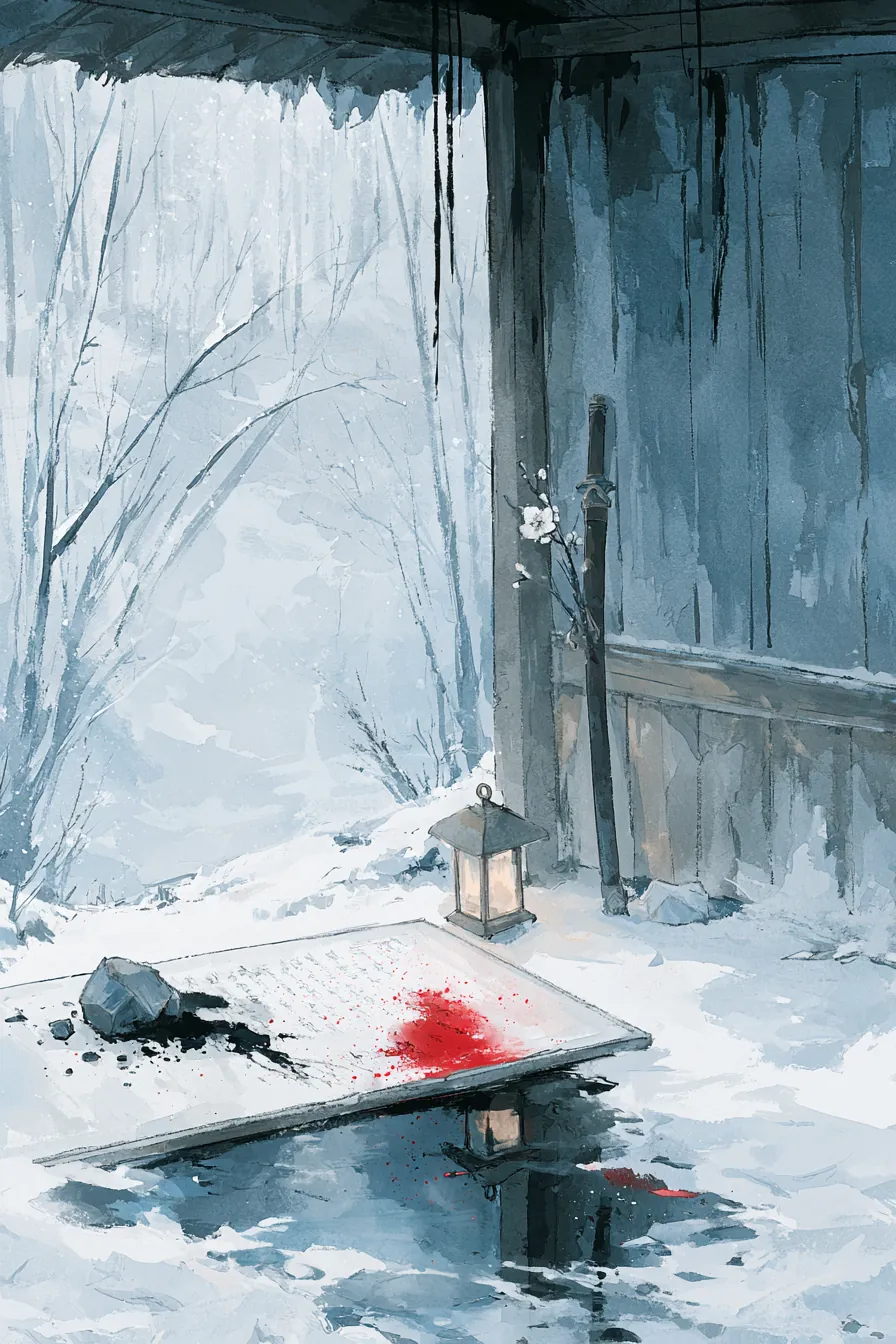
Chapter 16 — Pei in the Mirror
[Full Pei Shenzhi POV. The 沧浪驿 river outpost, two days behind the Wanyue boat. Hour of the rooster on the eighteenth day of the seventh moon of the third year of the jiǎzǐ.]
Pei Shenzhi reached the 沧浪驿 outpost at the hour of the rooster on the day Lin Yao opened her West column on the 白鹿洲 sand.
He did not know, on the arrival, that she had.
He knew only that a small grey woman in a small grey Wanyue outer-robe greeted him at the post-stage by the 寒玉峰 second bow, and that the bow was, by the standards of a postmistress who had been a Frost Sect aunt before her husband took her south, one degree too low.
He logged the degree and took no action on it. A senior brother of the 寒玉峰 line did not correct a postmistress's bow on the road. The matter was closed before it opened.
He let his horse to the stable boy.
He walked, with 寒霜 across his back and the third volume of the Cold Pool Sword Manual at his hip, into the public room of the post-stage.
The room was empty.
The room was always empty when he came in. He had stopped being surprised at this around the second year of the jiǎzǐ.
He sat at the corner table.
He did not order food.
The postmistress brought him a clay cup of plain hot water without asking. She set it down exactly where his right hand would reach for it. She did not bow a second time.
"Pei-shaozhu."
"Aunt Wu."
"The boat at the 白鹿洲 north went south at the third watch yesterday."
"Aunt Wu."
"The boat was not, by the 白鹿洲 register, on the 白鹿洲 register."
"Yes."
"The talisman the 清水县 outer disciple carried at the east-channel public dock was — by the steward's third-button — cold."
A pause.
"His name."
"Pei Yan-er, of the south-county. The third son of the third uncle. He is — by the second-watch report on my desk — going home for the new year. He is — by his mother's hand on the southern gate — not coming back. The talisman is, by anything my husband's brother knows, cold."
He set the clay cup down.
He looked at the postmistress.
He looked at her for the count of two breaths.
She did not, in the watching, breathe in.
She did not, in the watching, breathe out.
Then she did the thing he had not seen a Frost Sect aunt do for nineteen years. She set her right hand, palm flat, on the edge of his table. The four fingers were straight. The thumb was tucked behind the index in the old 寒玉峰 shape that meant I have a daughter and you will not have her.
He did not lift his eyes from the hand.
"Aunt Wu."
"Pei-shaozhu."
"You are taking a position."
"I am also a mother."
"Yes."
"The Lady who walked off the 白鹿洲 deck at the hour of the dragon yesterday was — by my husband's brother's report at the second watch — not the woman who was thrown from 断魂崖 in the seventh month of the year of the rabbit."
"Aunt Wu."
"She was the woman who had been thrown. The woman she is now is the woman who signed a kettle. I will not, by the count of my left thumb at the south-county gate, tell you which direction the boat went after the south-east turn. I will tell you only — Pei-shaozhu — that the boat is one day south of you. You will catch it if you ride at the second watch tonight. You will not catch it if you eat. I have, by my mother's hand on the 寒玉峰 second cup, not laid out a meal for you in this room. I will not, by the count of your father's name on the Frost Sect roster, lay one out tonight."
He looked at her hand for three breaths.
Then he did the thing he had not done, by any count of the third-volume scroll at his hip, since he was eleven years old and his mother had been alive.
He bowed.
He bowed to her hand.
He bowed one cùn, the way a son bowed to a mother at the magistrate's gate the year the magistrate had walked off the high path.
He did not bow the 寒玉峰 bow.
He did not bow the First Disciple bow.
He bowed the bow his mother had taught him at four.
He straightened.
"Aunt Wu. I will, by the count of the second watch, ride."
"Yes, Pei-shaozhu."
"Aunt Wu."
"Yes."
"Her forehead was at the deck."
Aunt Wu did not, on her own count, smile.
Then, very slowly, she took her right hand off the edge of the table and placed it, palm down, on his where it had landed on the cup.
For one breath.
She lifted it.
She said: "The kettle was on. The kettle is hers. You will not take it off her shoulder. You will let it boil. The Lady will, at her own count, tell you when to put it down. You will, in the meantime, ride."
"Yes."
"Pei-shaozhu."
"Yes."
"Mei-mei."
She used the cusp the Wanyue steward had used.
She bowed once, palm at her side, weight off the right hip. Then she turned and went into the back of the post-stage and did not come out.
He sat with the empty clay cup for the count of one watch.
He rode at the second watch.
The road south of the 沧浪驿 ran along the 漓江 ridge for forty li before it dropped into the river-bottom country of the 双枫 turn. The horse was a Frost Sect mountain breed and had not had a full day's rest in nineteen days. It would, by his calculation at the yongquan-huiyin gate of the Frost Lung circuit, hold for another two days at this pace. After that it would either die or he would set it loose at a postmistress's barn and ride on a hired river-boat the rest of the way.
He had not, in nineteen days, slept more than two watches at once.
He had not, in nineteen days, eaten more than rice balls.
He had not, in nineteen days, looked at his own face in a mirror.
He did not, at the second watch as he rode south, look up at the moon.
He looked at the road.
The road was a small dark line under the horse's hooves. The road went south. The road would, by the postmistress's hand on the Wanyue register at the south-county gate, eventually arrive at a boat that was carrying a woman who had — at the hour of the dragon on the 白鹿洲 deck — bowed her forehead into a kettle-carrier's collarbone.
He received the fact — she bowed her forehead into a kettle-carrier's collarbone — and did not act on it. There was nothing in the 寒玉峰 drill-manual that told a man what to do with a fact he was not permitted to feel. So he did what the drill-manual told him to do with everything else: he held the line and did not draw.
He held one thing behind the line. He had held it for nineteen years. It was not an entry in a register. It was a thing he had sealed the way his own master had taught him to seal a wound on the road — pressure, silence, and the refusal to look at it until the bleeding stopped. The bleeding had not stopped in nineteen years. He did not look at it.
The thing was the daughter of the south-county Lin who had — at six on the morning of the yongquan-huiyin — recited the third volume of the Cold Pool Sword Manual aloud in the practice court before he had finished his own first cup of cold water, and who had — at the 清门大典 of the seventh month of the year of the rabbit — looked up at him from a bound-wrist kneel and asked him, in the small clean voice her mother had taught her, whether he had asked her if she did it.
He had not.
He had not asked her.
He had driven 寒霜 through her left shoulder into the altar at the 寒玉峰 count of his father's hand on the Frost Sect roll because he had calculated — at six in the morning of the 清门大典, with his father's hand on his own shoulder and the Xianméng talisman on the table — that exile-with-severance was the lowest available sentence the sect head's faction would accept, and that the lowest available sentence was the highest available kindness, and that the cliff was two thousand chi and no body survived it.
He had calculated correctly on every variable except one.
He had not calculated that the daughter of the south-county Lin was Tianmo Ti.
He had not calculated that her father, the dead 散修 who had carried Wuming for fourteen years and died with the third volume half-finished on his knee, had sealed her at nine with his own soul-nail.
He had not calculated that the seal would crack on the night of the third moon-quarter under the stress of a Pei Yan throat-cutting that — he now knew, at the third watch of the eighteenth day of nineteen — had been engineered by a hand in his own father's 知客堂 for the explicit purpose of cracking it.
He had not calculated that the daughter of the south-county Lin was, by the bloodline at her father's left thumb on the third volume, capable of surviving two thousand chi.
He had calculated exile-with-severance. He had not calculated exile-with-survival.
He had been wrong about her capacity to survive him for every day of every year of the nineteen years he had been the first disciple of the 寒玉峰 lineage and she had been the trash-root cleaner of the courtyard at the second watch.
He did not let the fact past the line. The line was the line a swordsman held when the only correct action was no action. He had held it nineteen years. He held it now.
Behind the line the sealed thing did not, on the pressure, stop bleeding.
The sealed thing was a sentence he had never once permitted himself to say in the first person. Said plainly, with no register and no procedure and no permitted distance, it was: I have been in love with the daughter of the south-county Lin for nine years. He did not say it plainly. He had not said it plainly in nine years. To say it plainly was to draw, and he had decided at twenty-one that he would not draw.
He had decided this the year he was twenty-one. He had logged it on a winter night in the third practice court at the second watch when he had — for the third year running — set the seventh stance of the third volume of the Cold Pool Sword Manual on the corner of his desk at the inside seam where she could find it, and he had — for the third year running — found it the next morning at the inside seam refolded, with one corner turned down at the angle the third volume's annotator had instructed.
The annotator was his father's father's master, dead seventy years.
The corner-turn at the angle was a thing four people in the world knew.
Three of them were dead.
The fourth was, on that morning, sweeping the courtyard outside the third practice court at the second watch.
He had not, on deciding, looked at the sealed thing again.
He had ruled himself out of the field the way a sect head retired a disciple from active roster: cleanly, in one line, with no appeal. He had ridden out two days later on the south road to escort his father to the Xianméng tribunal at the 双枫 turn and had said, on the road, without preamble, against his father's collar: Father. I do not wish to take a wife. His father had said: Acknowledged. We will not require one. Two men of the 寒玉峰 line settling a matter of the heart in the procedural voice of a duty roster, neither of them naming what was being struck off it.
He had ridden home.
He had not, in nine years, expanded the column.
He had set the seventh stance of the manual on the corner of his desk at the inside seam every year on the year-day of the logging. He had found it the next morning refolded. He had not, in nine years, signed the seventh stance to her by her name.
He had set it down. He had not asked.
He had set the door. He had not opened it.
He had, by the 南county honor at his left thumb on the third volume — the honor his father had taught him at four, the honor that said the daughter of the south-county is by every standard the actor of her own day, and the senior disciple is by every standard the steward who sets things down where she can find them — left it.
He had left it for nineteen years.
He had, on the morning of the 清门大典 of the seventh month of the year of the rabbit, at the count of his father's hand on his own shoulder and the Xianméng talisman on the table, driven 寒霜 through the left shoulder of the daughter of the south-county Lin into the altar at the 寒玉峰 count of the lowest available sentence.
He had not, on the driving, looked at her face.
He had not, on the driving, asked her.
He had thought the cliff was a clean way to set the door.
He had been wrong.
The cliff was not the door.
The cliff was the wrong place.
The cliff was where a man set things down when he had been taught, at four, that personal want was a weakness, and had spent nineteen years filing his only personal want under no action on a column he had labeled no label, and who had, when his father had handed him a sword and a kneeling daughter and said here is the lowest sentence, taken the lowest sentence as if the sentence were the door.
The sentence had not been the door.
The sentence had been his door. His father's door. The 寒玉峰 door. The door he had been taught at four to keep his hands behind his back at.
The door of the daughter of the south-county Lin had been a different door. It had been the door where a man bowed to her hand on a table at a post-stage. It had been opened — by her own count, on her own day, by her own hand — at the 白鹿洲 deck at the hour of the dragon yesterday, with her forehead against a kettle-carrier's collarbone for one count, and the door had not been opened to him because she had not been asked.
She had not been asked because he had not asked.
He had not asked because — for nineteen years, by the 南county honor at his left thumb on the third volume — he had thought the asking would be the door he opened against her own.
He had been wrong about this.
He had been wrong about the geometry of the south-county door.
The south-county door was opened by both — set down by him at one cusp, asked by her at the second. He had only set it down. He had not, in nineteen years, asked.
The asking, he understood now at the third watch of the eighteenth day of nineteen, was the second cusp.
The asking was not, by every standard of the 南county honor, a violation of the door.
The asking was the door.
He rode south.
The horse held.
The moon did not, on the riding, drop.
He did not, on the riding, look up.
At the hour of the rat he reached the 双枫 turn.
The 双枫 turn was a small clean village at the second meander of the 漓江 below the 白鹿洲 north channel. There was an inn. There was a tea-house. There was a public dock with a Wanyue steward who was, at the second watch, dozing on a stool with his cuff burned the same half-burn as every Wanyue steward on the 漓江 turn.
Pei Shenzhi did not go to the inn.
He did not go to the tea-house.
He went to the dock.
He sat down on the dock plank one pace from the steward.
The steward woke.
He did not, on the waking, bow.
He looked at Pei Shenzhi for the count of three breaths.
"Pei-shaozhu."
"Steward."
"You are early."
"By how many watches."
"By six."
"Yes."
"The boat will, at the third watch of tomorrow, pass the 双枫 turn on the cargo run to the south-east. The boat will not, by my left thumb, stop. The boat will, at the second watch of tomorrow, pass within hailing distance of the 双枫 turn dock. The boat will, at the second watch of tomorrow, not answer a hail."
"Yes."
"Pei-shaozhu."
"Yes."
"You are not, by the lore at the cuff of the man on the boat, expected at this turn."
"Yes."
"You will, by the count of the lore at the cuff of the man on the boat, not be hailed."
"Yes."
A pause.
"Pei-shaozhu."
"Yes."
"There is a tea-house on the second street. The tea-house, by the count of the Wanyue register at the south-county gate, has — at the inside of the back room — a Frost Sect aunt who is the second cousin of the 寒玉峰 aunt at the 沧浪驿. She is, at the third watch, on duty. She will, by the count of her sister-cousin's hand on the paper at the third watch, not tell you to ride past the 双枫 turn. She will, by the count of her own son's name on the 清水县 roster, tell you to sit. You will, Pei-shaozhu, by the count of the third volume at your hip — sit."
He looked at the steward for two breaths.
He stood up.
He bowed, the 寒玉峰 bow.
"Steward."
"Pei-shaozhu."
"The 双枫 aunt."
"On the second street. Third door. The lintel is plum."
"Yes."
"Pei-shaozhu."
He turned.
The steward, against the dock plank, very softly, after he had taken three steps: "Pei-shaozhu."
He stopped. He did not turn.
"The Lady was, by the small bright clean count of an embassy clerk at the 白鹿洲 sand at the hour of the dragon yesterday, carrying a crane."
He did not breathe in.
"Steward."
"In the inside seam. Pei-shaozhu. The crane was four years old. The crane was — by the cleanness of the small cusped serif on the seventh stance of the third volume — yours. She read it. Pei-shaozhu. She read it once. She did not read it twice. She filed it. She put it back into the inside seam one finger below the third volume."
The dock plank did not, on the saying, answer.
The 漓江 did not, on the saying, answer.
The moon at the 双枫 turn, at the hour of the rat, did not, on the saying, drop.
He stood on the dock plank with his back to the steward for the count of seven breaths.
On the seventh breath, he did the small thing he had not, in nineteen years, done in the hearing of any man who was not his father.
He pressed the back of his right hand against his own sternum where his mother had — at four, at the count of his first cup of cold water — laid the back of her hand at his rib.
The hand was cold.
The sternum under the hand was, for the first time in nineteen years, warm.
He turned.
He bowed to the steward.
"Steward."
"Pei-shaozhu."
"The aunt."
"On the second street."
"Yes."
"Pei-shaozhu."
"Yes."
"Mei-mei."
He used the cusp the post-mistress had used and the boatman had used and the steward who had spoken to Lin Yao on the 白鹿洲 deck at the hour of the dragon yesterday had used.
He bowed it once.
He turned south on the dock plank toward the second street.
He walked, with the back of his right hand pressed flat against his own sternum where the warmth that had been gone for nineteen years was not gone, three hundred paces, to the third door under the plum lintel.
He knocked, the 南county knock.
The door opened.
The 双枫 aunt — a small clean grey woman in a small clean grey Wanyue outer-robe with the third button missing — bowed from the threshold.
"Pei-shaozhu. The kettle is on. Sit."
He sat.
She poured.
She set the cup where his right hand would reach for it. She did not, on the setting, bow a second time. Instead she laid the back of her left hand, palm down, on the corner of the table where his right hand was not yet.
For one breath.
She lifted it.
"Pei-shaozhu. The seventh stance of the third volume at the third practice court at the second watch of the third year of the jiǎzǐ was — by the count of the daughter of the south-county Lin's left thumb on the inside seam at the deck lantern of the 白鹿洲 north channel last night — read."
He did not breathe.
"Pei-shaozhu."
He looked up. For the first time in nineteen days.
His eyes were wet.
He did not weep.
Instead he did the thing his mother had told him at four was the second cusp of the 南county door — the thing he had not, in nineteen years, asked.
He said, against the cup, against the back of her left hand on the corner of the table, against the 漓江 under the dock plank at the 双枫 turn, against the moon at the hour of the rat that had not dropped, against the kettle on a biāoshī's right shoulder on a Wanyue boat at the hour of the dragon yesterday, against the daughter of the south-county Lin who had — at the 白鹿洲 sand — opened a West column at her own count and signed a North with her own forehead and read a South in her own hand at the deck lantern at the third watch:
"Aunt."
"Pei-shaozhu."
"How does a man — 南county, nineteen years late, cold-handed — ask."
The aunt set the kettle down.
She did not, in the setting, smile.
She laid her left hand flat on his right where it was wrapped around the cup.
For three breaths.
Not one. Not two. Three.
She lifted it.
"You ask the way the 南county daughter of the south-county Lin has been asking, by her own count, for nine years. You ride. You sit. You do not, by any small count, set the asking down where she can find it. You bring it. You carry it. You ask. Then, by the count of her left thumb on the inside seam, she answers. If she does not answer — Pei-shaozhu — you wait. The 南county aunt's mother taught her this on the morning the 南county daughter married out at the third year of the jiǎzǐ. The daughter said: Mama. He has not asked. The mother said: Daughter. You have not been at the door. He will, by the south-county honor at the inside of his left thumb, ride to the door. Be at the door when he rides. The asking is the door. The waiting is the threshold. The answer is yours. The door is — daughter — both.*"
He set the cup down.
He bowed his head.
He pressed his forehead, very lightly, against the back of her left hand on the corner of the table.
For one count.
One.
Not two.
Not three.
He lifted.
He said, into the cup, in the small clean voice he had not used since he was eleven: "Aunt. I will, by the count of the second watch tomorrow, ride to the door."
"Yes, Pei-shaozhu."
"Aunt."
"Yes."
"Mei-mei."
She bowed once.
She did not, in the bowing, weep.
He stayed at the 双枫 aunt's tea-house for the count of one watch. He slept on the floor of the back room for the first half-watch he had slept in nineteen days. He woke at the hour of the ox. He did not, on the waking, look at his own face in the small grey mirror in the corner.
He looked at his right hand.
His right hand was, for the first time in nineteen years, open.
It had been a fist for nineteen years.
It was open.
He had drawn.
After nineteen years of holding the line and not drawing, he had — over a cup of plain hot water, with two southern aunts' hands on his own on the corner of a tea-house table — drawn. The sealed thing was unsealed. He did not reseal it. For the first time since the year he was twenty-one he let himself say the rest of it in the first person, the imperative voice the 寒玉峰 drill had given him, but turned for once toward something instead of away from it: I will ride south. I will ride to the door. I will not set the asking down at the inside seam. I will carry it. I will, at the door, ask.
It was the only order he had ever given himself that was not a refusal.
He did not take it back.
He did not, in the folding, lock it.
At the second watch of the eighteenth day of nineteen, with the moon down at the 双枫 turn and the kettle in the back room of the plum-lintel tea-house at the second street still warm on the small clean iron of the inn brazier, Pei Shenzhi, first disciple of the 寒玉峰 line, took 寒霜 off his back, looked at it once, and laid it across the small clean lacquer tray on the table.
The blade was a four-foot single-edged northern steel that had not, in seventeen years, been laid across a table at any inn on the 漓江 turn.
He looked at it.
He looked at the place at the third notch of the rising motion of the seventh stance where the wrist-turn had — at the third practice court at the second watch of the fourth year of the jiǎzǐ — been slowed by half a breath.
The half-breath was a thing one woman in the world could read.
The woman was, at the third watch of the 白鹿洲 north channel last night, on a Wanyue boat carrying a kettle on the right shoulder of a man who had — by his own day, by his own hand — bowed lower than her mother had at the magistrate's gate.
He did not weep.
He placed the back of his right hand, palm up, on the spine of the blade at the place of the half-breath.
"Daughter of the south-county Lin. I have, by the 南county honor at the inside of my left thumb on the third volume, set the seventh stance down where you could find it. You have, by your own count, on your own day, by your own hand, read it. Daughter of the south-county Lin. I will, by the count of the second watch tomorrow, ride to the door. I will, at the door, ask. I will not — by any standard of any honor I have been taught at four — set the asking down at the inside seam. I will carry it. Daughter of the south-county Lin. The kettle is — by the Wanyue register at the south-county gate — yours. It is also coming south on its own day. I will not — Lin Yao — drive it through any shoulder of yours again. I will lay it at the door. I will ask. If you answer — Lin Yao — I will, by the count of the 双枫 aunt's hand on the corner of the table, come in. If you do not answer — Lin Yao — I will wait at the threshold for the count of the rest of my unfinished life."
He lifted his right hand off the blade.
He laid it, palm down, against his own sternum where his mother had laid hers at four.
It was warm.
He did not smile.
He did, for the first time in nineteen years, close his eyes against the lacquer tray and sleep — two watches without waking, his right hand open on his own sternum and the sword that was no longer his to drive through her laid on the lacquer tray on the table beside him.
The kettle, in the small clean iron brazier on the third corner of the room, was on.
The Wanyue steward at the 双枫 turn dock plank, at the second watch of the eighteenth day, did not, by any small count of the lore at his left cuff, hail the boat.
The boat passed within hailing distance.
The boat did not, on the passing, know that the man who had — at the 清门大典 of the seventh month of the year of the rabbit — driven 寒霜 through the left shoulder of the daughter of the south-county Lin had, at the 双枫 turn at the hour of the ox, opened his right hand for the first time in nineteen years and laid it, palm down, on a kettle that was no longer his to take.
The boat went south.
The man at the lacquer tray slept.
The kettle was on.