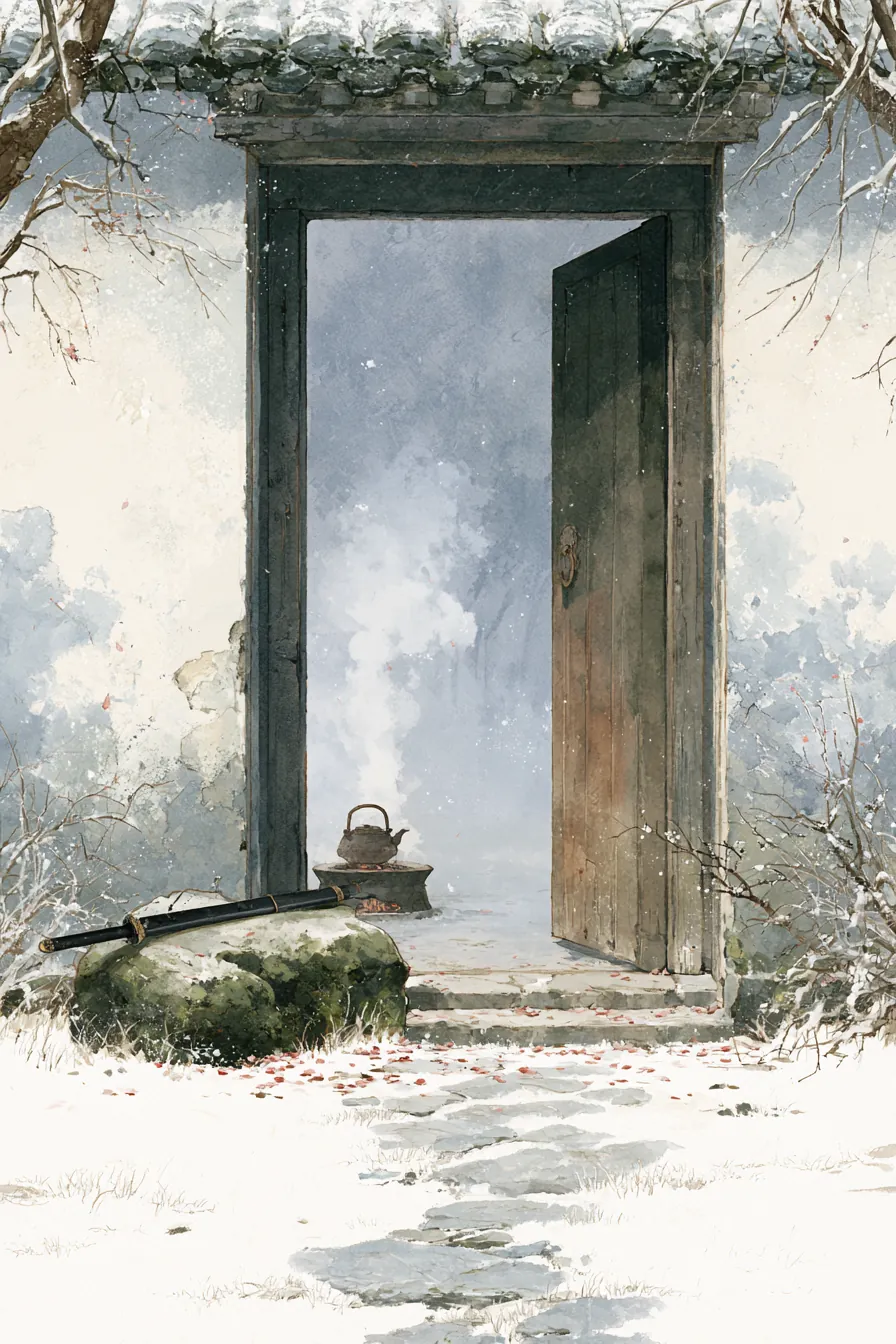
Chapter 22 — The Cost of Confirmation
[Lin Yao POV. Third watch of the snake on the seventh day at the 白莲泽, one count after a man at the gate of the north outer wall has laid 寒霜 palm-flat on the gate-step.]
She walked toward the gate at the cusp her mother had taught her at six on the kitchen step at the 清水县 turn — heel first, ball of foot second, weight on the back of the right leg until both feet were past the threshold of the second corridor. She did not hurry.
Three breaths after the South gate at her dantian had answered with the kettle-tone of a 清水县 morning, she had opened it. She had not named what she had opened.
She named it now, in plain syntax, on the seventh step of the corridor, her right hand at the seam of her left sleeve where the unopened crane lay below the third volume of the Cold Pool Sword Manual she had copied at fourteen from Pei Shenzhi's discarded notes:
Pei Shenzhi is at the gate.
She filed the entry under the South column. The clerk at her ribs — the one who had been keeping the register since a market street at Drifting Cloud twenty-six days past — set the entry in the named sub-column where the other three names had sat a watch. The clerk did not lock the column. Then, very softly, the clerk did the thing it had not done in nineteen years on any column of any sealed 天魔体 daughter's sternum on the 漓江 turn.
The clerk underlined the entry.
The underline was the mark her father had drawn on the inside margin of the third volume the winter morning of her sixth year — the morning he had taught her, in a kitchen that smelled of frost-jade and 清水县 mountain spring, that the daughter of the south-county Lin underlines a name only the one time the daughter is, by her own hand, walking toward it.
She walked toward it. She did not drop her face.
At the door of the room across the corridor, Yan Jiuhe sat up on the cot. He did not swing his legs over. He laid his open right hand — palm up, fingers loose, thumb tucked behind the index in the 南道 shape his mother had taught him at four — on the wool blanket the small grey aunt had spread across his lap a watch past at Zhuji 6th.
She did not stop. On the third step past his door, with the back of her left hand, she brushed the doorframe — the brush her mother had taught her at six a daughter of the south-county Lin gave to the doorframe of a man she had kept, when she could not yet give the man her hand.
He saw the brushing. He did not breathe in. Then he lifted the second knuckle of his open right hand on the wool blanket toward the door. The fox at the foot of the cot made the soft kk of a clerk who had registered the brush under the North column at kept.
Lin Yao kept walking. She walked past the lacquered door of Mo Yexing's room at the south end of the corridor. The door was open. He sat on the inside bench, the cup at his right hand cold, the black pear bough at his left, the 寒月真君 scroll closed on his knee. He did not look up. He lifted the cup toward his own mouth, did not drink, held it at his collarbone, and set it back.
She did not stop. She walked the corridor through the inner courtyard — the bronze brazier at the southeast and the brazier at the northwest both on, the kettle-tone of a 清水县 kitchen morning rising from the southeast kettle that had been on since the South gate at her dantian opened. She walked the outer courtyard, the slate path to the gate of the north outer wall. She walked alone.
She had not asked the man at the cot to come. She had not asked the man at the lintel to come. She had not asked the silver fox to come. She walked alone the way her mother had walked alone to the magistrate's gate at the 清水县 turn the year she walked off the high path.
She did not weep. She laid her right hand, palm flat, against the seam of her left sleeve where the third volume lay above the crane and the silver 药王谷 needle. The third volume did not answer. The third volume was paper. The man who had, for ten years at the third practice court of 寒玉峰 at the second watch, set the third volume down where she could find it, was three paces inside the gate she walked toward.
She reached the gate. With the discipline of a daughter who had been thrown by his own hand at the cliff, and had opened her South gate to the kettle on the southeast brazier three days past, she raised her right hand to the gate-talisman line. She did not channel. Then she opened the gate.
It opened slow and soft, the way it opened when it had waited two and a half watches for the hand of a Lady who had named the four corners of her own wheel.
The man on the black wet jade of the gate-step did not stand. He sat with his open right hand a pace from 寒霜 on the stone. 寒霜 lay palm-flat under the spine, the way a man laid down a sword he had driven through the shoulder of a daughter he had known he was driving it through. The blade was clean. It had not been drawn since the gate-step at the 漓江 second water-house six days past. She filed not drawn under the South column, in the sub-column at the seventh stance of the third volume. She did not name the entry.
She stepped onto the black wet jade. He raised his face.
The face she had memorized at fourteen at the second watch of every winter morning in the third practice court — the face that had not, in his own register, named her at any roster for nine years — was two paces from her own.
He had not slept. She filed not slept. He had not eaten. She filed not eaten. By the cold blueing below his left index, he had not taken a horse-rest in two days. She filed no rest. She did not lock any sub-column. She let the column breathe.
She said, into the cold of the gate-step: "Pei-shixiong."
He did not breathe in. Then — a man who had taught himself at fourteen not to breathe in at any cusp of any junior sister's voice — he bowed from the seated position. He did not lift his hand from the stone.
He said: "Lin Yao." He did not look at her shoulder.
The clerk filed not at the shoulder under the South column at coming.
She said: "Pei-shixiong."
"Lin Yao."
"You have not — Pei-shixiong — eaten."
"No, Lin Yao."
"You have not — Pei-shixiong — slept."
"No."
"You have not — Pei-shixiong — drawn."
A breath.
"No, Lin Yao."
"You have — Pei-shixiong — come."
"Yes."
"By every breath at the second watch of the third practice court, at the count of the seventh stance of the third volume — you have come."
"Yes, Lin Yao."
A breath.
She did not kneel. Then she laid her right hand — palm flat, fingers loose — on the black wet jade a pace from the spine of 寒霜. She did not touch the blade. She laid her hand on the stone the way her father had taught her at six a daughter laid her hand on the stone of a gate she had opened to a man who had driven a sword through her shoulder nineteen days past.
She said: "Pei-shixiong. The asking is yours. Ask."
He did not breathe in. Then — a man taught at fourteen, on a kitchen step the year his mother was killed by a 天魔体 hunter, to lay his asking not at the lintel but at the floor — he laid his open right hand, palm up, on the black wet jade a pace from her own.
The hand was colder than her own. For the first time in their lives, his hand was colder than hers.
She did not weep. She filed colder than mine under the South column, in the sub-column where named lay. She did not name the new entry. She let it breathe.
He said: "Lin Yao."
"Pei-shixiong."
"The shoulder."
A breath.
"Yes, Pei-shixiong."
"The shoulder I — Lin Yao — at the seventh month of the year of the rabbit at the 寒玉峰 ancestral altar, at the count of my own day on my own hand, drove 寒霜 through. The shoulder."
"Yes."
"Lin Yao."
"Pei-shixiong."
"I will, Lin Yao, by the count of my mother's hand on the third volume the year I was four on the kitchen step at the 清水县 turn, ask the asking I was taught at fourteen to lay at the floor of a gate I had driven a sword through the shoulder of the daughter at."
A breath.
"Pei-shixiong."
"Lin Yao."
"Ask."
He did not breathe in. Then — a man who had not, in nineteen years, spoken her name at any roster — he spoke it.
He said: "Lin Yao."
"Pei-shixiong."
"I — Lin Yao — did not know what you were."
A breath.
"I — Lin Yao — knew the seventh stance. I knew that a daughter at the third practice court had, for ten years, copied it off the inside margin of a third volume I set down at the second watch every day. I knew the four scars at the inside of your left wrist were not the scars of a trash mixed-root. I knew the wrist-turn at the third notch of the rising motion was slowed by half a breath because the daughter at the third practice court had practiced it from a third volume she was not allowed to read."
"Yes, Pei-shixiong."
"I knew. I — Lin Yao — did not know. I did not know what you were. I did not know what the constitution at the inside of your sternum was. I did not know what my father had ordered. I did not know that the framing was the framing my father had drawn at his own register the night of the third moon-quarter at the woodshed. I knew only that the sentence was severance, that severance was the lowest sentence the 清门大典 my father's faction would accept, and that severance would, by any 寒玉峰 manual, put the constitution back to sleep. I drove the blade. I drove it clean. I did not look at your face. If I had looked at your face, I would not — by every winter morning of every year of the rabbit on the third practice court — have been able to drive it."
A breath.
"Pei-shixiong."
"Lin Yao."
"You — Pei-shixiong — drove the blade clean because you did not want the next blade to be the blade the 清门大典 my father's faction would demand."
"Yes, Lin Yao."
"The next blade — Pei-shixiong — would have been the 死刑 blade."
"Yes."
"The 死刑 blade — Pei-shixiong — would have been an 元婴 hand at the second sect head's cuff."
"Yes."
"You drove the severance blade clean because the severance blade — Pei-shixiong — was the cliff."
"Yes, Lin Yao."
"The cliff — Pei-shixiong — was a cliff a daughter of the south-county Lin could survive."
A breath.
"Yes."
She did not weep. Then, very slowly, with the back of her right hand on the black wet jade, she covered the open right hand a pace from her own. She did not touch the palm. She covered the back of his hand with the back of her own — the way her mother had taught her at six a daughter covered the back of a hand of a man who had not let the 死刑 blade fall.
His hand under hers did not breathe. She did not lift. She held her hand at the back of his. For three breaths. One. Two. Three. She lifted.
She did not weep. Then she did the thing her father had told her at six a daughter did on the morning of a day she had opened the South gate of her own wheel and walked toward a man at a gate-step who had driven the severance blade.
She said his name. She said it without the shixiong.
She said: "Pei Shenzhi."
He did not breathe in. Then — a man who had not heard his own name from the daughter he had thrown — he breathed out. The breath was small. The breath was clean. It was the breath of a man who had not, in any winter morning of any year of the rabbit, breathed out at any roster of any inner court of 寒玉峰 — and had, at the count of one breath after a Lady he had not named in nine years said his name, breathed out.
She filed breathed out. She did not name it. Then — a daughter who a watch ago had read the colophon of the 寒月真君 scroll on the eighth page and named the four corners — she opened the South gate at the dantian one further count.
The South gate answered. The answer was the kettle-tone of a kitchen at six on a winter morning, a daughter's hand on the lid, a father's hand at the brazier, a mother's hand at the bow, at the 清水县 turn. The kettle was on. The brazier was on. The South anchor at the dantian of the cup at the center was now at open at one count. She filed open at one count under the South column. She did not lock it.
Then she raised her face from the black wet jade and looked at the man on the stone two paces from her own. She did not drop her face.
She said: "Pei Shenzhi."
"Lin Yao."
"You will, Pei Shenzhi, by my own day on my own hand, stand."
He did not move. Then — a man taught at fourteen that the daughter of the south-county Lin would never ask any man to stand who had not laid his own sword on the stone — he stood. He did not draw. He laid his open right hand, palm up, at his own hip.
She said: "Pei Shenzhi."
"Lin Yao."
"You will, Pei Shenzhi, by my own day on my own hand, come in."
A breath.
"Lin Yao."
"Through the gate."
"Yes, Lin Yao."
"寒霜 on the stone."
"Yes."
"You will, Pei Shenzhi, not lift it off the stone of the gate-step until — Pei Shenzhi — I, by my own hand, give it back."
"Yes."
"You may, Pei Shenzhi, not get it back at all."
A breath.
"Acknowledged. Terms accepted in full. I waive the right of appeal." A breath. He had spoken the only way he knew how to say yes to a thing he wanted more than his own life — in the flat procedural voice a man used to sign away a thing, because the procedural voice was the only voice that did not shake. "Yes, Lin Yao. I — Lin Yao — accept."
She filed accept under the South column, in the sub-column where named sat and coming sat and colder than mine sat and open at one count sat — the fifth entry. She did not lock the column.
She turned. She did not look back. She walked through the gate into the outer courtyard the way her mother had taught her at six a daughter walked through a gate she had opened to a man whose sword she had left on the stone.
The man on the stone stood. He bowed to the gate. He walked through. He did not look back at the blade. The blade lay palm-flat under the spine on the black wet jade, the way a man laid down a sword he had driven clean. The gate closed at his second step inside. It closed partway. It did not close all the way.
The fox at the door of the corridor — at the foot of a cot where Yan Jiuhe sat with his open right hand on the wool blanket — made the soft hh of a clerk who had registered an entry on the South column at open at one count and was keeping it now at in.
Lin Yao led him through the outer courtyard. She did not speak. She did not look back. He did not ask. He did not speak. He walked two paces behind her, the way her mother had told her at six a daughter let a man walk behind her when she was leading him to a room where the Lady would name the cup at the lintel.
She led him through the inner courtyard, to the door of the inner hall at the south end of the corridor. She did not knock. She opened it.
Mo Yexing was at the bench inside the lintel, the 寒月真君 scroll closed on his knee, the cup at his right hand cold, the black pear bough at his left. He did not stand. Then — a man taught at twelve that a 少主 of the 白莲泽 line stood only at the cusp of a Lady of any 天魔 line walking into his lintel and naming the fourth corner — he stood. He did not draw. He did not smile. He bowed — the bow of a 少主 to a man at the lintel of a room that was, by the colophon at the year of the cock, the room of the South.
He said: "Pei-jūn."
Pei Shenzhi did not breathe in. Then — a senior brother who had not, in nineteen years, bowed to a 少主 of any demonic line — he bowed. The bow was clean.
He said: "Mo-jūn."
A breath. The room held.
Lin Yao crossed to the bench. She sat a hand from Mo Yexing on his right, and a hand from where Pei Shenzhi would sit if she named the seat. She did not drop her face. She raised her right hand and gestured, with the back of it, to the bench at her own left.
Pei Shenzhi did not breathe in. Then — a man taught that a senior brother sat only at the gesture of a Lady — he sat. He sat a hand from her left.
The room held three.
Outside the door, on the cot, his open right hand on the wool blanket and his cup at Zhuji 6th, Yan Jiuhe heard the third breath after Pei Shenzhi's sitting and laid his open right hand, palm down, on the cot beside his ribs in the 南道 shape — not the asking, not the keeping, but the shape his mother had taught him at four for the count of one breath at the cusp of a Lady who had seated the third corner of her own wheel and was not alone.
The fox at the foot of the cot made the soft kk of a clerk who had registered the third entry under the South column at seated, and was keeping the column at seated, a hand from her left, inside the room.
The kettle on the southeast brazier was on. She filed the on. She did not name what the kettle had answered. She let it breathe.
The cup at the center of her wheel held at Foundation 2nd. The four gates held at the four cardinal points — one full at North, one half at West, one one-count at East, one open at one count at South — at the third breath of the four-gate hold of the seven-day count.
The wheel turned. The wheel did not crack. The wheel did not core. The wheel — by the colophon on the eighth page of the scroll on Mo Yexing's knee — held.