Chapter One
Hannam-dong, Seoul. February 14, 2026. 11:47 p.m.
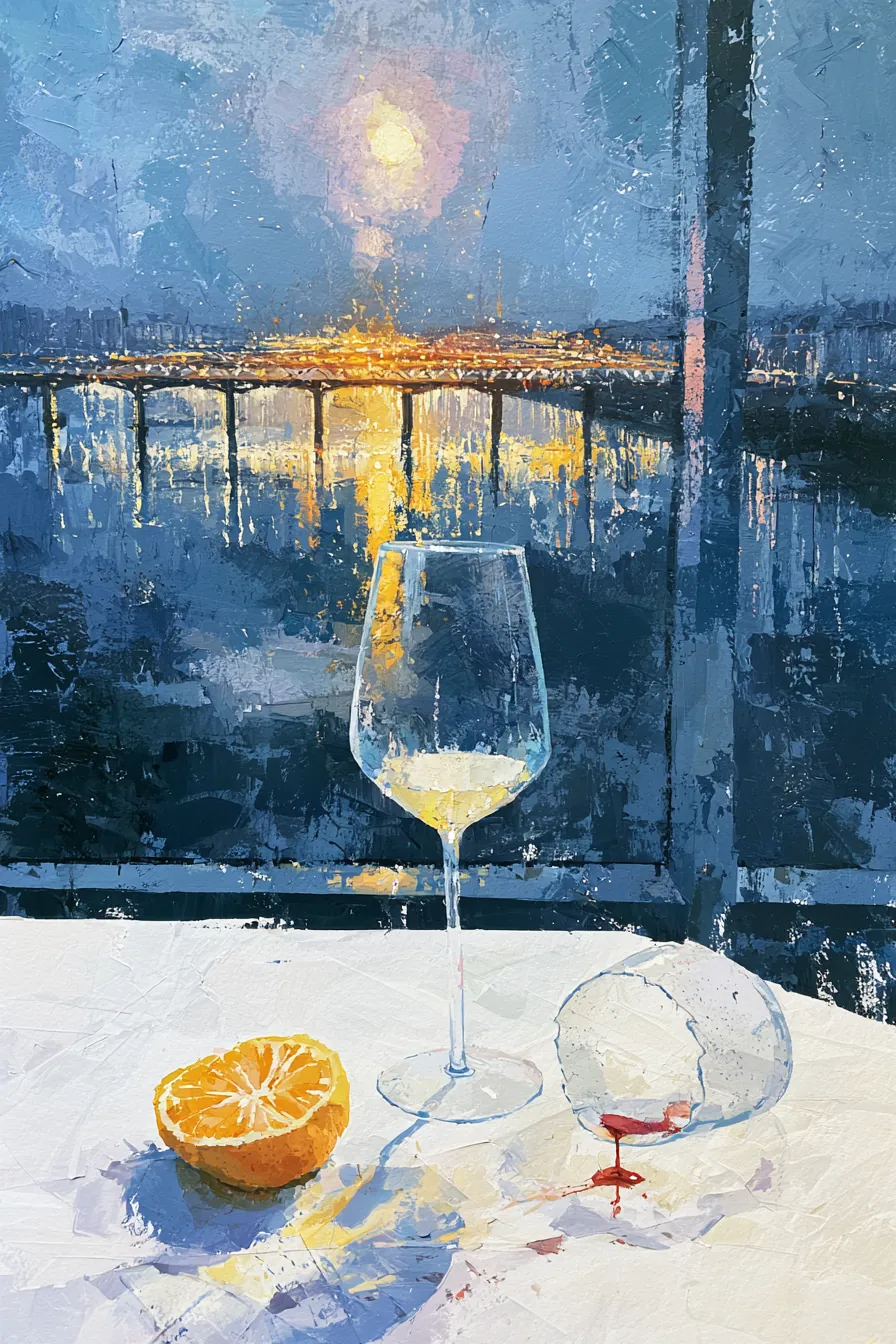
The intern was telling a joke that wasn't funny, and I was laughing because I was the senior person at the table and that is how grace works in a Korean dinner. Three soju in, the laugh came easier than it should have. We were on the eighth floor of a fusion place above the Hangang, the kind of restaurant where the menu prints truffle ssamjang in seven-point font and charges thirty thousand won for it. Floor-to-ceiling glass on the river side. From where I sat the bridges looked like long bones of light laid across black water.
I peeled a tangerine. The smell, sharp and green, cut through the room's perfumed noise — laughing executives, the engineered burn of soju on ice, the kitchen's far-off clang. I split a segment with my thumb and listened to the intern reach the punchline. He was nineteen. He had the gelled side-part of someone who had been told by an older sister this was how to look professional. The joke was about a Pomeranian. I laughed.
"You're too easy on him, unnie," said Choi Min-ji to my left. She was the vocal coach for our girl group's B-team, and the only person at this table I would actually call a friend. "Don't laugh. He'll think he's funny for the rest of the quarter."
"Let him think it," I said. "He'll be on a plane to L.A. by April. Confidence is the only thing that survives flying coach."
Min-ji rolled her eyes and clinked her glass against mine. Geonbae. The intern's face went pink to the ears, and I felt a small ugly twist of fondness for him — the same fondness I used to feel for my brother in middle school when he tried to grow a mustache. I had been at JL Entertainment fourteen months. I was twenty-six years old. I had a Stanford degree in English literature and an officetel in Itaewon with a leak in the bathroom ceiling and a closet of clothes my mother had bought me at Bloomingdale's, dragged across the Pacific in a suitcase. I was, as my American friends said with a particular flat tone, living the dream.
I was, as my Korean coworkers said with a different flat tone, gyopo.
I ate the tangerine.
Across the room, near the long window facing the river, someone dropped a glass.
It wasn't a loud sound. It was, in fact, almost no sound at all — a thin, bright pop, like a wineglass meeting the lip of a marble countertop and breaking once, cleanly, on the first try. The kind of sound a person makes when they are not surprised, when their hand has simply forgotten its job. Heads turned. Min-ji glanced up. The waitress was already moving. And then — for two seconds, maybe three — the room arranged itself so that I was looking down the length of two long tables, past a Senior VP of A&R laughing at something on his phone, past a junior staffer trying to find a napkin, into the face of a man at the far end.
He was looking at me.
It is one thing, in Seoul, to have a man look at you. It is another to have a man stop looking at anything else. Soju goggles, I thought first, automatic — but he was not drunk. His glass had broken. He had not flinched. He was very still in a way that did not, somehow, feel like stillness. It felt like a held breath. It felt like the moment before something at the bottom of a pond decides to come up.
I'd never seen him before in my life. I knew exactly who he was.
You absorb a face like that the way you absorb a brand. Black wool suit, no tie, white shirt buttoned to the throat. Hair cut short, neat, a half-step out of fashion in a way that read either expensive or indifferent. He was — I had been told — exactly thirty-two. He was, according to a footnote in the onboarding deck, Seo Yi-jun, Chairman, JL Entertainment, hired 2018. He never came to hwesik. He never came to anything. The trainees called him the ghost on sixteen, because his office was on the sixteenth floor and nobody had ever seen him use the elevator. He moved around the building like a rumor of weather.
He was looking at me as if I were the weather.
His face did the thing a face does when the body behind it has lost its instructions. The jaw was a half-second slower than the rest of him. His eyes — and here, with the soju in me, I will say what I thought even though I knew it wasn't true — his eyes caught the light wrong. Caught it the way the cat caught it once at my aunt's house in Gwangju when the headlights crossed the window, that flat coin-flash you see in animals at night.
That face was at my mother's funeral.
The thought arrived, fully formed, while my fingers were still wet from the tangerine. It arrived without preface, the way a strong gust slams a window. That face was at my mother's funeral, only it wasn't, because my mother is alive, she texted me this morning to remind me to take vitamin D, she sent three different links to articles about young women in Seoul and seasonal depression.
My mother is alive.
I had no funeral memory. I had no man-in-a-black-suit memory. And yet there it was, sliding under the door of my mind like a wet leaf: a man, standing at the back of a room I did not recognize, his face white as the white we wear when we mourn. Looking at me. Looking down at his hands. Looking back at me.
I felt Min-ji's elbow in my ribs.
"Unnie," she said. "You okay?"
"Fine," I said. My voice was fine. My voice was always fine.
Across the room the man — Yi-jun, Chairman, Hired 2018 — looked down at his hand. There was a thin red line across the meat of his thumb, where the glass had broken in his grip. He was not bleeding the way a person bleeds. He was bleeding the way a wall bleeds in a horror film, slowly, almost decoratively, while it tries to decide what to do about the wound. He watched the red bead the way I might watch a stranger's child eat a cherry. Curious. Patient. Far away.
Then, without looking up, he excused himself from the table.
He did not say anything. He did not bow. He simply stood — and the small constellation of people around him stopped moving — and walked, with his bleeding hand pressed loosely against the inside of his suit jacket, toward the corridor where the bathrooms were. He did not look at me again. He did not look at anything. He walked like a man underwater, slow and lit only from above.
Min-ji's elbow stayed in my ribs.
"Unnie."
"I said I'm fine."
"You're white."
"I'm always white. It's the lighting in here."
"It's not the lighting."
I looked at her — Min-ji, twenty-seven, born in Daegu, hair newly cut into the kind of bob magazines call French, eyes the steady patient eyes of a person who had been translating the world for me since my second week in this building. Her mascara was very slightly smudged. She was, somehow, the only thing in the room that looked the right color.
"Did the chairman just," she said, very quietly, "drop a glass while looking at you."
"I think the glass slipped," I said.
"Unnie."
"It slipped, Min-ji."
She lifted her own glass without taking her eyes off me, swirled it once, and set it down. I watched her mouth open and close on something she decided not to say.
The intern, oblivious, embarked on another joke.
I excused myself with the muffled urgency of a woman going to apply lipstick — jamkkanman, sorry, sorry — and walked the long way around the table, past the windows, past the bridges of bone-light over the river, past the door to the corridor where Seo Yi-jun, Chairman, had taken his bleeding hand. The bathroom was at the end of the corridor on the right. I went left.
The corridor turned, then turned again, the way corridors in restaurants designed by famous people do. At the second turn there was a small alcove with a console table and a single arrangement of pussy willow in a celadon vase. The vase was old. I knew it was old the way you know a thing in your hands is going to be heavy before you lift it. I stood in the alcove for thirty seconds and breathed. The hallway smelled, faintly, of new wood and old incense.
That last part was wrong. There was no incense in this building. There was no reason for there to be incense in this building. And yet I smelled it — that thin, sweet, vegetal smoke that lived in the back of my grandmother's house in Daejeon, in the linen closet where she kept the herb sachets, in the corner of the room where the old folding screen leaned against the wall. Hyang. Joseon palace incense. I had never been in a Joseon palace.
I steadied a hand on the console table. The wood was cool. My hand was not.
When I came back to the dining room the chairman was gone. His chair had been pushed in. His broken glass had been replaced. The Senior VP of A&R was telling a story about a producer in Atlanta. Min-ji's eyes found me across the table and asked me, without sound, a question I did not have an answer to. I shook my head once. I sat down. I ate another tangerine.
The dinner ended at fifteen past midnight. Min-ji wanted to share a cab. I told her I'd walk part of the way home — the air would be good, the soju needed walking off, I would be fine, eonni, I would be fine. She gave me a look that I have, over the past year, learned is the Daegu woman's specific look for you are lying and we both know it but I will let you go. She made me promise to text her when I got to my building. I promised.
I walked.
The Hangang at midnight in February is colder than the rest of Seoul somehow, a knife-edge of damp wind off the water that gets past three layers of wool the way money gets past most things. I went up the slope from the restaurant toward Itaewon-ro, past the dim hush of the embassy quarter, past a wine bar's last patrons spilling out under heat lamps. The sky over Namsan was the dirty pink of a city that has forgotten how to be dark. I had Diptyque on my collar — the green fig one, my mother bought it for me when I graduated — and a black wool coat and the kind of boots that make a Seoul walk possible. I had my keys in one pocket and a phone in the other. I had soju and three tangerines and one strange thought about my mother's funeral in my bloodstream.
By the time I crossed under the Noksapyeong overpass it had started to rain.
Noksapyeong-ro at midnight is a particular kind of empty. The traffic ebbs and ebbs and then for forty seconds nothing comes from either direction and you can hear the city under the city — the breath of the subway through the grate near the police box, the low motor-hum of a parked delivery scooter, a single distant siren two arrondissements away. The overpass throws a long dim concrete shadow over the road. There were two homeless men sleeping in the alcove of the bridge support, wrapped tight in industrial plastic sheets. There was an old man in a high-vis vest pushing a recycle cart up the slope.
There was a woman screaming.
I stopped walking.
I stopped, and the rain kept falling, fine and cold, on the shoulders of my coat. The sound was not loud. The sound was not even, strictly speaking, in the street. It was coming from a place behind my left ear, from inside the concrete behind me, from somewhere folded into the air at the level of my collarbone. A woman, screaming. Not a young woman. Not a frightened woman. The scream was the scream of someone who had been screaming for a very long time and had not yet been heard. It rose, and broke, and rose again, in a language I did not speak.
It was Korean.
I knew it was Korean the way you know a smell is bread before you have words for the loaf. The vowels were Korean. The shape of the breath inside the throat was Korean. The grammar of the cry — the way the word eomma sat inside it, half a beat ahead of the rest — was Korean. But the consonants were wrong. The consonants belonged to a Korean I had never heard. They had hard edges I did not recognize. They were old.
I turned around.
There was nothing behind me. There was the road, and the wet concrete, and the old man with his recycle cart, who had paused to look at me with the patient incurious face of a man who had seen women stop in the middle of the street at midnight in the rain a thousand times before and had concluded long ago that none of his business was waiting back there.
I put a hand to my left ear. Nothing.
The screaming went on. It did not get louder. It did not get softer. It existed in the space where my own pulse should have been, where the sound of my own blood should have been. The woman screamed eomma and then a word I could not parse and then a word that might have been my own name in some long-dead syllabary.
I will tell you what I did. I will tell you because later it will matter, later it will be the thing I describe to a therapist who will not believe me, and later still it will be the thing I describe to a 79-year-old herbalist in Daejeon who will weep without making any sound. I started walking again. I walked with my hand pressed against my ear like a woman with a migraine. I walked past the old man, who said agasshi, joshimhae — be careful — without breaking the stroke of his cart, and I said ne, ne, gamsahabnida without slowing down. I crossed the road on a green light. I walked up the hill to my building. I did not look back.
By the time I reached my door the screaming was gone. By the time I keyed in my passcode the rain on my collar had soaked through to my shoulders. By the time I was inside my officetel, kicking off my boots in the dark, the sound had been replaced — fully, cleanly — by the hum of the refrigerator and the click of the radiator and the low far-off rumble of a Line 6 train pulling into Itaewon Station two stops down.
I locked the door. I put my coat on the rack. I texted Min-ji: home, safe, love u, sleep.
She wrote back instantly. unnie. did u see his face when u laughed.
I stared at the screen for a long time.
I wrote: whose face.
She wrote: u know whose face. dont play.
I wrote: im going to sleep.
I went to the bathroom. I washed my hands with cold water because the hot tap took two minutes to wake up and I did not have two minutes. I looked at myself in the mirror. My face was wet from the rain. My eyes were the eyes of a woman who had been crying without knowing it. The whites of my eyes were a little pink. My mouth tasted like tangerine and citrus and faintly, far underneath, like something I had no word for. Iron, maybe. Old iron, the way a horseshoe found in a riverbed tastes when you can't stop yourself touching it to your tongue.
I brushed my teeth. I drank a glass of water. I lay down on top of the duvet without undressing.
The ceiling of my officetel had a water stain in the shape of a fox. I had noticed it on my third day in the apartment. The realtor, an aunt in pearl earrings, had told me, in cheerful real-estate Korean, that the upstairs unit had a hot-water leak once a winter and that the maintenance company was very responsive. I had filed it away as the kind of charming inconvenience you pay for when you choose to live in old Itaewon instead of new Songdo. I had never, until tonight, lain on the bed and looked at the stain and seen, with that whole-body certainty by which a person knows a thing without proof, that it was a fox.
A fox with — I counted before I knew I was counting — too many tails.
I closed my eyes.
This is where the night should have stopped. This is where, by all the laws by which a sensible woman manages her life, I should have fallen into a soju sleep and woken to a hangover and a meeting at ten. This is not what happened. I closed my eyes and instead of the dark there was a sky, and instead of the radiator there was a wind, and the wind had the smell of cedar after rain and something else, something hot and sweet, that I now know to call the smell of blood drying on stone but which I did not, in that moment, have any word for. I was standing on a slope of pine and rock. The sky was the color of a bruise three days old. There was a woman in front of me in a white dress that was not a dress, a long white robe with a sash, and her hair was a black river down her back and her face was turned away, and over her shoulder, in the smudge of the bruise-sky, the moon was wrong.
There were two moons.
No — there was one moon, and beside it, low, a pearl. The pearl was the size of an apricot pit and it was the color of nothing. It was hanging in the sky next to the moon as if waiting for somebody to put it down.
The woman in white turned.
She had my face.
She opened her mouth to say something.
I woke up. My phone said 12:38 a.m. The radiator clicked. The refrigerator hummed. The fox on the ceiling had nine tails, and I could see them now, faintly, where the water had spread and dried in faint vein lines I had not noticed before tonight, and I lay very still and counted them, and counted them, and counted them again.
In the closet of my mind, neatly folded between the things I knew and the things I did not, there was a new thing now. A man with eyes that caught the light wrong, in a black wool suit, in a restaurant above the Hangang, looking at me as if I should be dead.
As if he had once made very sure of it.
I got up and made instant coffee with hands that wouldn't stop shaking. I told myself it was the soju. It is always the soju, in Seoul. That is what soju is for.
I did not yet know that the woman screaming under the Noksapyeong overpass was me.