Chapter Three
Hanyang. The eighth month of the fifteenth year of King Gwanghae's reign. The inner court of Gyeongbokgung, the antechamber to the queen consort's pavilion. Two hours past the rooster's hour.
The lamp-oil is bad this autumn. Da-eun has noticed it for three nights running and now, on the fourth, she lets herself name it: the oil is cut with mustard, and the wicks are smoking a thin black smoke that smells faintly of old shoes. Someone in the household office is skimming. Her mother, kneeling at the low table beside her, does not seem to mind, but her mother has not minded a thing in two weeks that is not the autumn gut, and Da-eun has watched the not-minding tighten in her mother's shoulders the way a wet rope tightens around a post.
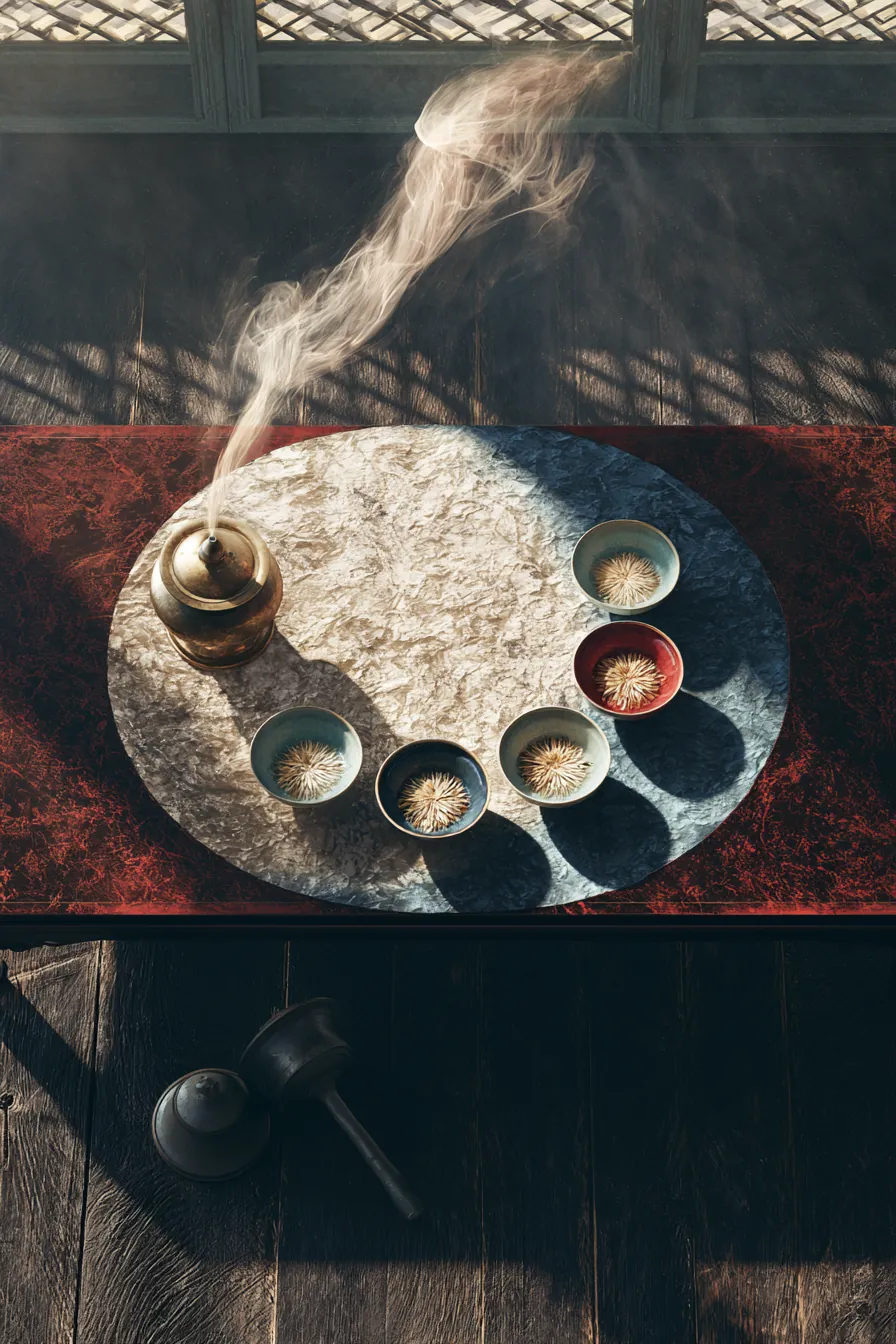
It is the eighth month. The rains are gone. The court ladies have begun to wear the second-layer chima again. In the kitchen wing, far off, someone drops a brass bowl, and the sound walks up the corridor in soft small steps and arrives at the antechamber doorway as no more than the memory of a sound. Da-eun does not flinch. Her mother does not flinch. They are folding the jijeon — the talisman papers — into thirds and then into sevens, the way a court mudang has folded them since the time of King Sejong, and the folding has the rhythm of a thing done by hands that no longer need the eyes.
Gae-hwa, her mother, is forty-one this autumn. She wears no kohl on the inside of her eyelid tonight. Da-eun notes this without comment. Her mother wears the kohl when she expects to be looked at; the absence of the kohl tonight tells Da-eun, more clearly than any spoken thing, that Gae-hwa does not expect the queen consort to come into the antechamber to inspect the work. The queen consort, it seems, is sleeping badly again. The queen consort has been sleeping badly for three months, ever since the rumor came in from the western provinces that the prince — that prince, the cousin-prince, the dangerous prince — had begun to receive scholars at his estate after dark.
Da-eun does not say the prince's name. Her mother does not say the prince's name. In the household offices the prince's name is now a name spoken only to one's wife after the children sleep. Da-eun knows it. Da-eun has known it since the seventh month, when the rumor first crossed the threshold of her father's old house and curled up like a cat on the maru porch where her mother sat carding silk thread for the queen consort's amulets. Neunyang-gun. The prince of Neung-yang. The cousin who would be king if a sufficient number of scholars decided that the present king's mercy toward the Manchus was a failure of the heavenly mandate. Sufficient. Choongbun-hada. It is an interesting word, sufficient. It is a word that means enough for the matter at hand but that has hidden inside it, like a tick in long grass, the word cut. Cha. To cut. Sufficient is what is cut to the size of the wound it must dress.
Da-eun is to be married in the eleventh month. She is to marry Yun Seong-jo, second son of the Yun of Mapo, a Sungkyunkwan scholar of twenty-two whose examination prospects this year are middling but whose family land is generous and whose mother has already begun to speak of grandchildren in the future tense. Da-eun met Seong-jo three times. Three is the appropriate number of times to meet a man one is to marry. Each meeting was supervised. Each meeting was brief. Seong-jo has a long face and a mouth that turns down slightly at the corners even when he is being agreeable, which Da-eun has decided not to mind. He smelled faintly of ink and faintly of the rice powder his mother had put on his neck, and his hands had been folded so precisely in his lap during the second meeting that she had counted, without meaning to, the number of times he swallowed. Eleven. He had swallowed eleven times in the half-hour they sat across the low table from each other. Da-eun did not hold this against him. She had been counting because counting was what her hands did when they had no thread.
Tonight she has thread. Tonight she has the jijeon papers and a small brush and a half-cone of cinnabar ink and the steady knee-to-knee warmth of her mother working beside her. It is the best of the hours. It will not last.
"Eomma."
"Hm."
"Are we doing the twelfth geori this year."
Her mother does not stop folding. Her mother's hands, smaller than Da-eun's, brown at the second knuckle from forty years of mountain wind, fold the next paper into thirds and then into sevens and lay it on the stack. "We are doing eleven."
"Only eleven."
"Eleven this year, Da-eun-ah."
"It is the autumn gut. It is always twelve."
"It is twelve when the consort is not afraid. It is eleven when she is. The twelfth is the geori for the gods who take, and the consort does not wish to invite gods who take this year."
Da-eun considers this. She lays her own folded paper on the stack. The stack now has thirty-one papers in it, and the lamp behind her mother throws the shadow of the stack into a small dark fan on the floor, which moves when the bad oil makes the flame jump.
"Eomma," she says, "the gods who take are coming whether we invite them or not."
Her mother does not answer for a while. Da-eun watches the way the lamplight pools in the small dent at the base of her mother's throat, where the norigae hangs, a single white knot tied with the long ribbon Gae-hwa has worn for as long as Da-eun remembers. The white is for waiting, her mother once told her. Anyone can wear color. Only the patient can wear white. Da-eun has never seen her mother wear color. Da-eun has not yet decided whether her mother is patient or whether her mother is simply tired.
"You will not say that in this room again," her mother says, mildly. Da-eun has learned to fear her mother most when the voice is mildest. "And you will not say it in the consort's hearing, and you will not say it in the kitchen wing where the cooks talk, and you will not say it to your father at the cemetery when you go to clean the stone next month."
"I will not say it."
"Promise."
"I promise, Eomma."
Her mother nods once. She folds the next paper. She wets her thumb on her lower lip and presses the fold flat. The cinnabar ink Da-eun has been mixing for the past hour sits in the small celadon dish between them, dark as old blood, and her mother does not look at it directly. There is a way her mother does not look at cinnabar, a way her mother's eye glances off the dish and goes around it, like water around a stone. Da-eun has noticed this for years. Tonight, for the first time, she allows herself to wonder whether her mother does not look at cinnabar because cinnabar is the ink that writes the names of the dead.
A footstep in the corridor.
Both women still. The folding has stopped. Da-eun's mother does not turn her head. Da-eun does not turn her head. The footstep is light, the footstep of a man who has been taught to walk softly on tatami and is now walking on a corridor of polished pine, which makes him sound like a young heron trying to be quiet in the reeds. The step is too light to be a guard. It is too composed to be a kitchen-boy. It is too deliberate to be a court lady.
A scholar.
Da-eun knows scholars by the way they walk. She has lived in the antechambers of the inner court since she was eight. She has watched scholars come through every corridor of this complex at every hour of every season; she has watched them walk the line between the queen consort's wing and the king's library; she has watched them adjust their gat hats with the same nervous middle-finger flick before entering any door behind which sat a woman of higher rank. She knows scholars the way her mother knows merchants. The step coming up the corridor now is a scholar's step.
It pauses at the antechamber door.
It does not knock. It does not enter. It pauses.
Da-eun keeps folding. She does not look up. Her mother keeps folding. The lamp gutters once. The bad oil snaps a small black star into the wick. The cinnabar in the dish trembles, very faintly, the way a pond's surface trembles at a footstep on the bank.
A voice, then, soft and dry. "Gae-hwa-mu. Ahnyeong-hashimnikka."
The Korean is impeccable. The honorific is correct. The address — Gae-hwa-mu, the mudang Gae-hwa — is the address one uses when one wishes the conversation to begin with the relationship clearly stated. Not daughter. Not honored sister. Not the queen consort's name. The man in the corridor has come to speak to her mother as a mudang.
Her mother lifts her head. She does not stand. She does not bow. She sets her brush down beside the cinnabar dish, and she folds her hands once on her lap, and she answers in the voice she uses with men, which is a voice lower than her speaking voice by half a pitch and slower by a quarter beat. "I am attending. Please enter."
The door slides.
Da-eun does not look up at first. She looks at the floor in front of her own knees, the way she has been taught, and she sees the man's shadow come into the room a moment before the man himself. The shadow is thin. The shadow has the long pinched outline of a man wearing the dopo, the long scholar's robe, with the jeongjagwan — the squared scholar's hat — folded into the lines of the shadow's head. The shadow stops at three paces and bows from the waist.
"I beg pardon. I do not come on the queen consort's errand."
"I expected as much," her mother says.
"I come, with respect, to consult a matter of household — divination."
"Speak."
There is a pause. The man — Da-eun can hear the hesitation in the small swallow he does before he speaks — is not a man who likes pauses. He is a man who has rehearsed this in some other corridor. "My honored mother is unwell. Her sleep has been broken by a recurring vision of a black bird at the western window. We have made offerings. We have hung the proper amulets. The vision continues. I am — I am told there is no finer mudang in Hanyang on the matter of household birds."
Her mother does not answer immediately. Her mother lifts her brush. Her mother dips it, very precisely, into the cinnabar.
"You have come at the wrong hour."
"I apologize."
"You have come at the wrong hour for the wrong consultation."
The man swallows again. "Mudang-nim."
"Stand," her mother says. Da-eun, surprised, does not show surprise. Her mother's voice has done a small bright cold thing it does not often do. Da-eun has heard it twice before in her life, both times in the seventh month last year, both times to men.
The man stands.
Da-eun lifts her eyes.
She does not mean to. She is supposed to keep her gaze on the folded papers. She is supposed to be the daughter, the apprentice, the silent thing in the corner whose job it is to keep mixing the ink and to not look at the men of the outer court. She lifts her eyes. The reflex is older than the rule.
She sees him for half a breath.
He is twenty-four. He is twenty-four the way a tree is twenty-four years old — there is a confidence in the bark already, but the rings are not yet many. He is tall enough that his gat nearly catches on the lintel; he has not noticed this; a man who notices the height of his own hat in a doorway is a man who has been welcomed into doorways. His face is narrow and clean and his mouth has the kind of straightness that comes from never having been kissed by someone he did not feel he had earned. His eyes — and this is what she sees, this is the thing she will think about later, in the willow grove in the third month of Injo's first year, when she watches the men beat her mother forward across the courtyard with the flat of their swords — his eyes pass once across the antechamber and they pass across her mother and they do not stop at her mother.
They stop at her mother for a different reason than the way men's eyes usually stop at her mother.
She has seen men look at her mother. Some look with respect; some look with the small condescension of literate men toward illiterate women; some, the better ones, look with the wonder of seeing a thing they cannot name. None of those is what this man is doing.
This man is looking at her mother the way a butcher, called in to assess a side of pork for the noble household's autumn feast, looks at a side of pork. There is no contempt in the look. There is no hatred in the look. There is the calm appraisal of someone calculating which cuts will go to which dish, which bones will go to the broth, which bristles can be saved. He is not measuring her mother as a woman. He is not measuring her as a mudang. He is measuring her as meat.
Da-eun's hands close around the brush in her lap.
The man's gaze lifts, then. Drifts. Travels in the small arc of polite scholar's attention and brushes, in passing, across Da-eun's face — and stops.
Stops for a heartbeat. Stops for two.
Then, very correctly, moves on.
He bows again. He says, "Forgive me, mudang-nim. I see I have come at the wrong hour. I will return when the moon is in the proper quarter."
"You will not return," her mother says.
The man does not show surprise. He bows a third time. He says, "Then I shall trouble you no further this season. My respects to the queen consort." He turns. He goes. His step in the corridor is the same scholar's step, going.
When he is gone — when the small sound of the door sliding into its frame is gone, when the light in the corridor has settled — her mother does not move. Her mother's hand is still over the cinnabar dish. The brush in her mother's hand has not been laid down. A single drop of cinnabar falls from the brush into the dish, and the surface of the ink swallows it and is again still.
The lamp behind them gutters and steadies and gutters and steadies.
Da-eun says, "Eomma."
Her mother says, "Hush."
"Eomma. Who was."
"Hush, child."
Her mother is looking at the cinnabar.
Da-eun looks at her mother. She has known her mother forty-one years' worth of mother, which is to say nineteen years of her own. She has read her mother's face the way other girls read sutras. She knows the small slope at the bridge of the nose that means her mother is choosing her words, and the small lift at the corner of the eye that means her mother has chosen them, and the small flat of the lower lip that means her mother is not going to say what she has chosen and will instead say something else.
The flat of the lower lip is in place now.
Her mother says, after a long moment, in the voice she uses to give an instruction Da-eun is to remember without writing down: "The lamp leaned away from him."
"Eomma — "
"Did you see the lamp lean."
Da-eun looks at the lamp. The lamp is steady. The lamp, now, is steady. But she has been folding by this lamp for two hours, and she knows the lean of the flame the way a sailor knows a wind, and she has — yes, now that her mother says so, yes — felt the small wrong tilt of the light when the man stood in the doorway. The flame had bent away from him. Not toward, the way flames bend toward a draft. Away. As if the flame had recognized something and would have preferred not to be in the same room with it.
"I saw," Da-eun says.
"You will remember the lamp."
"Yes, Eomma."
"You will remember that face."
"Yes, Eomma."
Her mother lays the brush down at last. The cinnabar drips once, twice, onto the rim of the dish. Her mother wipes her own thumb on the inside of the jeogori cuff with a small unworried movement and folds her hands again in her lap. Her face has, somehow, in the past four breaths, become five years older. Da-eun does not point this out.
"Who is he, Eomma."
"A scholar of the Westerners faction."
"What is his name."
Her mother considers, and decides. "Yi Hwan."
"Yi Hwan." Da-eun fits the name in her mouth. Yi Hwan. Two syllables, both common, the kind of name a man wears like a hat that fits because it fits everybody. "What does he want."
"He has come to look at me. He has looked. He has gone."
"Eomma. What does he want."
Her mother does not answer the question. Her mother says, instead, "Take the papers. Take the cinnabar. Tomorrow you go to your aunt's house in Seongbuk and you stay one week. Tell your aunt I asked. Take your father's yangban token and the small jade hairpin from my third box and the white ribbon from my mourning chest. Do not tell anyone in this complex that you are going. Walk out the south gate at the hour of the rabbit. The guard there is Cho Pyeong-su; he was a man my mother saved from a fever in his second year. Tell him I told you to go through. He will not ask."
"Eomma. The autumn gut is in eight days."
"I will perform the autumn gut."
"Eomma — "
"I will perform the autumn gut," her mother says, mildly, "and you will be in Seongbuk."
The lamp gutters. It steadies. The bad oil snaps another small black star.
Da-eun does not argue. Da-eun is nineteen and she knows when arguing will move her mother and when it will not, and tonight is a night of will-not. She folds the cinnabar dish into a clean cloth. She lifts the stack of folded papers and ties them with the thin red string her mother keeps for the purpose. She does these things slowly because her hands are not, suddenly, hers — they are doing the work of hands while she watches them — and her mother does not rush her. Her mother, in fact, has resumed folding, the new stack growing under her hands at the same patient rhythm as before.
When Da-eun rises to her knees, she looks once, briefly, at the door.
"Eomma."
"Hm."
"Was that the face."
"What face."
"The face you said I would see one day. When I was small. You said — when I was small you said one day there would be a face I would have to remember not because I knew it but because it knew me."
Her mother does not look up. She folds the next paper. She lays it on the stack.
"Yes, child," she says. "That was the face."
The lamp leans, then. The flame bends, very slightly, toward the door, as if remembering, after the fact, where the wrong man had stood.
Da-eun rises and goes to pack. She walks to the doorway. She does not look back. At the threshold she does, however, allow herself one small disobedient thing — she lifts her left hand, lays her palm flat against the lintel above her head, and presses her thumb gently into the wood, in the small habit of a daughter who is leaving a house she will return to and wishes the wood to remember the shape of her hand.
The wood is cool. The wood does not remember.
She does not, later — in the willow grove, in the snow, in the wayside shrine where a man with warm hands will pour her yakju — recall having pressed her thumb to that lintel. Many things will be taken from her. The lintel will be one of them. But the wood will keep it, the way old wood keeps the shape of any honest weight, and four hundred and three autumns later, on a renovated palace gate that no one realizes was once an antechamber door, the thumbprint will still be there for a tourist to lay her own thumb against and feel, in the smallest part of her right hand, a heat she cannot account for and will, in the cab home, blame on the soju.
For now, Da-eun goes.
The lamp burns on. Behind her, in the antechamber, her mother folds.
Outside, in a corridor she has not yet walked, the man Yi Hwan stops at the corner past the consort's pavilion and stands a moment in the dark. He does not turn around. He does not look back. He lifts his right hand, glances at his palm as if to confirm a thing already decided, and walks on. The corridor swallows him.
On the eaves above the antechamber, a single magpie wakes, considers, and does not call.
The night, having decided, holds.