Chapter Eight
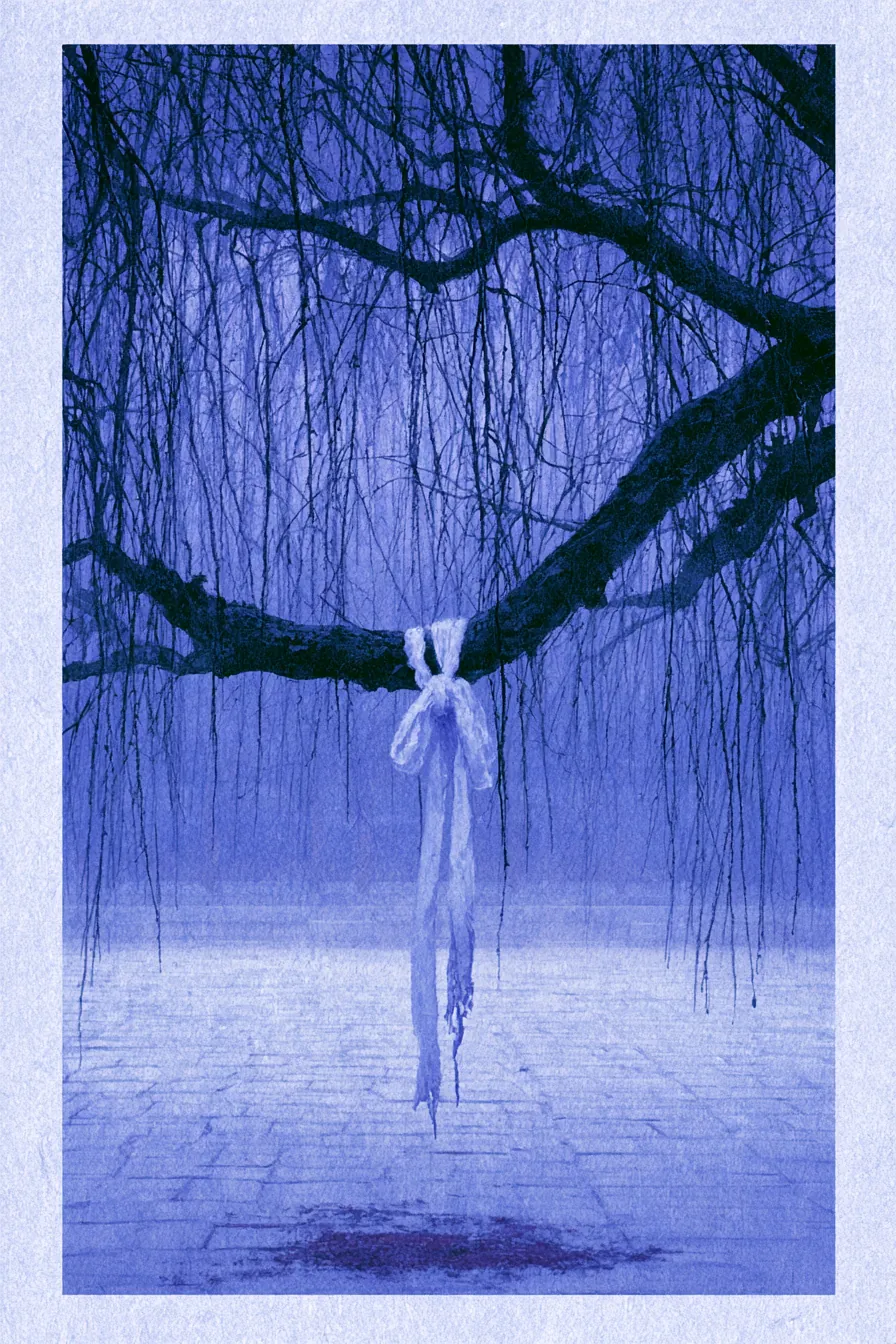
Hanyang. The third month of the first year of King Injo's reign. Eleven days after the coup. The willow grove on the south rim of the Geunjeongjeon courtyard, two hours past dawn.
The willow grove is older than the dynasty.
Da-eun knows this because her mother told her, on a summer afternoon in the eleventh year, that the willows along the south rim of the great courtyard had been planted in the time of King Taejong, the second of the Yi kings, to weep on the place where men would later be executed; that the willows had been chosen because the willow drinks more water than any other tree of comparable shade, and the courtyard had needed, over centuries, a thing that would drink; that her mother's mother had stood in this grove in the spring of the seventeenth year of King Seonjo's reign at the age of nine and watched her own grandfather, a court physician of the Pyongyang Lee, walk on his knees the last twenty paces to the executioner's blade with a calmness her mother's mother had not, in the decades after, been able to forgive. Da-eun has known the willow grove eleven years. She has not, until this morning, stood inside it.
She is hidden behind the trunk of the third willow from the east.
The willow is wide enough to hide her if she keeps her shoulders to the wood and does not, in any direction, lean. The trunk is wet against her left cheek, where the night's snow has run down it and frozen and run again at dawn, and her hair, pinned at the nape in the small simple braid her aunt's woman did for her at the third watch this morning, smells faintly of the wood. She is dressed as a kitchen-girl. She is dressed in the rough hemp jeogori and chima of a sixteen-year-old scullery-hand of the lowest rank, with her wrists hennaed for one day so that the upper-class slenderness of her own does not betray her. Her aunt's woman painted the henna at midnight. The henna will, by the seventh day, be gone. Many things will be gone by the seventh day.
She is nineteen years old this morning. She will be nineteen years old for the rest of her life.
She does not know this yet.
What she knows, this morning, hidden behind the trunk of the third willow from the east, is that her mother is going to be brought into the courtyard from the south gate at the hour of the snake, and that she is to watch, and that she is to remember everything, and that she is to leave, when it is finished, by the side passage between the willow grove and the wall of the eastern kitchen, and to go to her aunt's woman at the corner of the lane and to be put into a covered cart with two bushels of cabbage and to be driven north out of the city by the back lanes, and to spend the night in a wayside hut at the foot of Bukhansan, and to ride at dawn for Inwangsan, and to wait, on Inwangsan, for a sign her aunt's woman has not been told the shape of but which her mother, on her last night in the household, told Da-eun about in a small dry voice in the cell beneath the consort's pavilion, after the cell-keeper had been bribed for half an hour with three silver mun and a small embroidered handkerchief of Kim Gae-hwa's own work.
The sign — her mother said in the cell, with her wrists held against the iron of the cell-wall to keep them from shaking — will be a man.
The man will be at the wayside shrine on the high road, six li north of the Inwangsan ridge. The man will be sitting on the floor of the shrine. The man will have warm hands.
Daughter, her mother said, when you see the warm hands, you will think: that is a sign. You will not be wrong. The hands will be a sign. But you will be wrong about which kind of sign.
Eomma, which kind.
Her mother's mouth, in the cell, did the small thing it did when her mother was choosing what to say and what not to say in front of a daughter who had already had eight days of a coup's education and would need, on the road to Inwangsan, the rest of it.
Daughter. The sign is the kind of sign you brought down on yourself the year you were eight and lay on the maru and asked the small fox at the edge of the orchard to come and play with you in your dreams. Do you remember.
I remember.
The fox came.
The fox came.
The fox has come every year since.
Yes, Eomma.
Daughter, listen. Listen carefully because we will not have many hours. The fox is owed. Do you understand. The fox is owed. I will not say by whom. I will not say what. I will say only that what is owed must, on the day of the offering, be offered cleanly, and that you, of all the women in our line, have been the one chosen to offer cleanly, and that I have known this since the day I held you at the third watch in the herb garden of the Yun house and the lamp in the window leaned.
The lamp leaned, Eomma.
The lamp leaned away from me, Daughter. Not toward me. I was the one carrying you. The lamp leaned away from me and toward you. I did not, that night, know what the lean meant. I have, in the eleven years since, refused to know.
Eomma, what does it mean.
It means, Daughter, that the line ends with you. It means the gods who take have asked for you. It means I have, in my work, kept the gods who take quiet for nineteen years. It means I cannot keep them quiet any longer.
Eomma.
Yes, Daughter.
Eomma, am I to die.
Her mother considered this, in the cell, with the small infinite patience her mother had brought to all small infinite questions for forty-one years.
That, Daughter, is the part I cannot answer. I have asked. The gods who take have not yet decided. They have decided only that you are owed. They have not decided in what coin.
Eomma. The fox.
The fox is the coin. The fox will be the coin. Whatever happens, the fox is what is paid. Do you understand. Whatever happens, you will be paid in fox.
Eomma — I do not want to be paid in fox.
That, Daughter, is also not for me to answer.
Da-eun sat with her hands in her own lap in the cell. She did not, this once, weep, because her mother had asked her not to weep, and she had spent nineteen years learning to be the daughter of the kind of woman one did not weep in front of. She felt the slow cold rise of the iron under her thighs and the slow cold rise of the truth in her chest and she said, in the small flat voice she had learned, from her mother, to use for promises:
Eomma. I will go to the shrine. I will meet the man with the warm hands. I will not, from the moment I see the warm hands, run.
Her mother had looked at her with the look a woman gives her own daughter when the daughter has just said the precise sentence the woman had been waiting for the daughter to say and which the woman would have, on a different evening, hoped the daughter had the sense not to say. The look had three things in it. The first thing was pride. The second thing was grief. The third thing was the small steady weight Da-eun would, in the long winter to come, learn to call recognition — the look a craftswoman gives her tool at the moment the tool, by its own choosing, becomes the thing the craftswoman has been keeping it sharp for.
Yes, Daughter. I knew you would say so. I had hoped you would not.
Eomma. I should have run.
Yes, Daughter. You should have run.
Eomma. I am, even now, planning not to run.
Yes, Daughter.
Eomma. I am, even now, planning to stay.
Yes, Daughter. That is the fatal thing. That is your fatal thing. Her mother lifted her hand, slowly, against the iron of the cell-wall, and she placed her palm against the side of Da-eun's face the way a woman places her palm against the face of a daughter she is about to bury. Daughter, you and I have known, since the year you were eight, that you are a girl who does not run. I have prayed against the trait. I have offered to the gods for the trait. I have done what could be done. The trait remains. The trait is yours. It will be yours in this life and, if I have read the loom correctly, it will be yours in any life after this one. There is no part of you that runs. Do you hear me, Daughter.
I hear you, Eomma.
The fox will know this. The fox already knows this. The fox has known it for some time. I do not blame the fox. I would, in his place, also know. Listen, Daughter. Listen. When the fox knows this, the fox will use the knowing the way foxes use everything — slowly, kindly, in the small kind ways foxes have. He will be kind. He will be very kind. He will not, by any means I can describe to you, force you. He will, however, by way of the kindness, fail to release you when releasing you would be the kindness the moment requires.
Eomma. What do I do.
You do not, Daughter, do anything. Doing is no longer your part of the story. You stay. You stay because you are mine and your stay is mine and your stay is also the part of the offering that pays the debt. Do you understand.
I do not, Eomma.
You will. You will understand on the day the snow is at the wayside shrine. You will understand on the day the brazier is too small. You will understand on the day the floor mat is the only floor mat. Promise me one thing.
Yes, Eomma.
Promise me, when you understand, that you will not, in the understanding, hate me. I have set you in this. I have known I was setting you in this since the day the lamp leaned. I have not, in nineteen years, found a way to set you elsewhere. Promise me you will not hate me.
Eomma — I will not hate you.
Promise me on the white ribbon.
I promise, Eomma, on the white ribbon.
Her mother had taken, then, the white mourning ribbon from her own wrist — the long single ribbon Kim Gae-hwa had worn on her wrist since the death of Da-eun's father at the plague of the eighth year — and had pressed it into Da-eun's small henna-bound hand, and had wrapped it around Da-eun's wrist twice, and had tied a single knot of the kind a mudang ties when she is binding a soul to its own promise, and had said:
Daughter. One last thing. The fox is owed. He will pay. He will not pay enough. The line ends with you, but the curse begins with you. When you understand, on the day of the snow, that you have been left to die — do not, in that moment, accept the dying. Do not, in that moment, forgive him. Do not, in that moment, let him go. The forgiveness is not yours to give. The forgiveness is the next woman's. Do you understand.
The next woman, Eomma.
The next woman in our line. The one who comes after.
I do not have a daughter, Eomma.
You will not. The next woman is not your daughter. The next woman is yourself, by the slow work of the loom, four hundred years from now or thereabouts. I have asked. The loom has answered. Do not, in the moment of the dying, forgive him. Hold the forgiveness back. Hand the forgiveness forward. Do you swear this on the ribbon.
Eomma. I swear it on the ribbon.
Daughter, the words. Say the words. Say them after me. Say them slowly. Do not, in this cell, get them wrong.
And her mother had spoken, then, in the cell, in the small bright cold voice she used in the last hour of the autumn gut, the voice that was no longer her mother's and was no longer entirely a woman's voice but was, by long custom, the borrowed voice the gods who take used through her — the voice Da-eun had heard once in her life when she was twelve and had hidden behind the screen of the gut-hall and had watched her mother fall to the floor with the small white god-mask coming down over her face — and she had said:
Choe-i-gun, choe-i-shin, choe-i-ja, choe-i-jang. Cheonbeon-eul jukyeotdaedo hanbeon-eun gat-eul-ji-ni. I beon-ui kkeut-eun naega bo-go, Da-eum beon-ui kkeut-eun nae-ga an boneun-gu-na.
Sin of the body, sin of the spirit, sin of the hand, sin of the year. Even a thousand killings, one will return. This one's end I will see. The next one's end I will not.
Da-eun had repeated the syllables in the cell after her mother. She had said them in the small flat voice she had learned to use for promises. She had said them perfectly. Her mother, who in forty-one years had not in her hearing made a mistake about a syllable of a gut, had nodded once. Then her mother had untied the white ribbon from Da-eun's wrist and laid it back on her own wrist, with a small fresh knot Da-eun had not seen tied, and her mother had said, in her own voice now, in her real Kim Gae-hwa voice, soft and tired and forty-one years old:
Daughter. Go. Eat. Sleep. Be at the willow grove at the hour of the snake. Do not, when you see, cry out. You are a kitchen-girl this week. Kitchen-girls do not cry out for ladies of the inner court. Go.
Da-eun had gone.
She had eaten. She had slept four hours in the back room of her aunt's house in Seongbuk. She had risen at the third watch and had her hair braided by her aunt's woman, who had wept on the braid and apologized for the weeping. She had walked the back lanes to Gyeongbokgung in the dark with two bushels of cabbage on her back. She had entered the courtyard by the eastern kitchen at the hour of the rabbit and put down her cabbage and let an under-cook send her on three errands. She had slipped, on the third errand, into the willow grove. She had taken her place behind the third willow from the east.
She has been there for forty minutes now.
The willow drinks. The wood is wet against her cheek. The henna on her wrists is, she notes, a slightly wrong shade — too red, too uniform; her aunt's woman is, after all, only her aunt's woman and not a courtesan's painter — and she is grateful that the courtyard is dim with cold and that no one will, this morning, look at the wrists of a kitchen-girl behind a willow.
She watches.
She watches them bring her mother in.
The courtyard at the hour of the snake on the morning of the third week of the first year of King Injo's reign is full of soldiers.
The soldiers are the new soldiers — the soldiers of the Westerners faction. They wear the rough cotton uniforms of the West-faction militia, which in eleven days have replaced the smarter silken uniforms of Gwanghaegun's palace guard along every wall of the inner court. The militia are not, by any honest definition, palace guard. They are men levied out of the western provinces and the southern coast and given armor that does not fit and weapons that have not been blooded in twenty years and orders that, until eleven days ago, would have been treasonous. They stand now along the four walls of the courtyard at the spacing of half a fathom and they hold halberds, which they hold incorrectly — the haft a quarter-turn off true — and they do not move and they do not speak. Da-eun notes this. Da-eun has been her mother's apprentice long enough to read men's grips on weapons. The grips are wrong. The men are afraid. The fear is the thing the new dynasty has not yet hidden.
The platform has been set in the center.
The platform is the platform Da-eun has watched palace carpenters set on three previous occasions in her eleven years of palace life. The platform is a low square of black-stained pine, two paces by two paces, the height of a child's knee. The four corner posts are bound with the rough hemp rope of the third punishment. The wood is wet at the center because the snow this morning has not stopped and a small palace boy of perhaps thirteen has been standing by the platform with a cloth for the past hour, sponging the platform clean between snowfalls so that the next thing to fall on the wood will fall on dry wood. The boy is doing his work as a boy does work. He is doing it well. Da-eun notes the boy. The boy's job — sponging — is one of the small unmentioned palace jobs the older mudang of her mother's lineage have always asked after. The boy with the cloth. Is the boy with the cloth well. Her mother has, in the autumn guts of three of the eleven years Da-eun has been in the palace, sent a small package of millet flour and dried persimmons in winter to the family of the boy with the cloth, whose name has changed three times in the eleven years. The boys are usually paid in copper and discharged after their fourteenth year. The boys are usually the sons of widows.
This boy is short. This boy has the small flat shadow of a Pyongan-province boy, where the famine has been hardest this winter. Da-eun marks the boy's face. Da-eun, in the cell last night, did not think she would have, this morning, the room in her head to mark the face of a small palace boy with a cloth. The room has, in spite of her, opened. The mudang training, in spite of her, is doing what the mudang training does in moments like this: it makes room. It makes the room a girl with no run in her needs to do the not-running.
The drums begin.
The drums are the three slow drums of the third punishment. They are not the deep brass drums of the king's audience. They are, in fact, very small drums — two-handed jing drums, the kind a mudang carries on the road to a country gut. They are being struck by two of the Westerners' men whose hands have not held a jing before and who are striking the brass plate at the wrong angle and producing a small flat hollow noise that is, Da-eun realizes, the sound the punishment of a mudang is supposed to be punished by — the sound of a jing misused, the sound of the woman's own instrument turned against her. The new regime has chosen this. The new regime knows what it is choosing.
Yi Hwan has chosen this. Da-eun does not yet know this for certain. Da-eun knows it the way a body knows the weight of a knife at the throat.
Her mother is brought in through the south gate.
Kim Gae-hwa is in her mudangbok. Da-eun did not, in the cell last night, know the new regime would let her mother wear the mudangbok. The new regime, it seems, has decided that the mudangbok is the necessary uniform of the offense being punished — the bright reds and the yellow trim and the long sleeves wide enough to hide a knife — and has dressed her mother in it deliberately, the way a Confucian court dresses a man in his official robes to be punished as the official. The mudangbok is, in this dawn light, very bright. The mudangbok is, even at forty paces, the brightest thing in the courtyard. The colors slap against the white snow and the pale wood and the gray-green willows and the dark cotton of the militia and they make her mother, for the small distance she walks, the only object in the courtyard that is alive in the way Da-eun's mother has always been alive — extravagantly, on purpose, against the discipline of the room.
Kim Gae-hwa walks at the slow walking pace of a woman who has not, in the night, been broken. Her hands are bound at the wrist with a soft hemp Da-eun cannot, from forty paces, tell is soft, but Da-eun knows it is soft because her mother is walking without holding her shoulders against the binding — the way a woman walks when the rope at her wrists has been loosened by a guard who has been bribed an hour ago — and Da-eun understands, with the small steady wash of relief that comes once in such a morning, that her aunt's woman did not, in fact, spend only half an hour at the cell. Someone has also paid the rope-tier. Someone has made the morning, in this small way, easier.
Kim Gae-hwa walks the length of the courtyard.
She walks without looking at the willow grove. She walks without looking at the militia. She walks with her eyes on the platform, the way a woman walks with her eyes on the stone of the threshold of a house she is being asked, very politely, to enter.
She is halfway across the courtyard when she turns her head, very deliberately, and looks at the eastern wall, ten paces from the south gate, where she has known — Da-eun realizes this only as her mother's head turns — that Da-eun would be hidden.
Da-eun's mother is wrong about the willow.
Da-eun's mother is looking at the wrong tree.
Da-eun does not, behind the third willow from the east, move. Da-eun watches her mother look at the wrong tree, the fifth willow from the east, the willow Da-eun had told her aunt's woman, last night in the back room, that she would stand behind. Da-eun had then, this morning, on the small instinct that had risen in her at the eastern kitchen at the hour of the rabbit, walked to the third willow instead. She does not, even now, know why she walked past the fifth willow. She knows only that the third willow was the willow that, when she crossed the grove, leaned toward her in the small way a wood leans toward a passing weight. The third willow is the willow that recognized her. The fifth willow is the willow her aunt's woman had picked for her.
Her mother looks at the fifth willow.
Her mother smiles.
Her mother smiles in the small private way she smiles at Da-eun when Da-eun has, in the household, done a small disobedient thing her mother approves of. The smile, across forty paces, is unmistakable to a daughter. Daughter, the smile says, in the lampless cell-air of Da-eun's chest, good girl. You have chosen the third willow. The third willow is the correct willow. I did not, last night in the cell, tell you the third willow because I have lived to forty-one by never telling a girl in advance which willow is the correct willow, but you have chosen it anyway. Daughter, that is the trait. That is the trait I have prayed against. That is the trait that will bring you to the wayside shrine, and the wayside shrine to the brazier, and the brazier to the snow, and the snow to the rock. I am sorry, Daughter. I am sorry for the trait. I am, also, in the small impermissible way a mother is, proud of it.
Her mother turns her head back forward. Her mother walks the last twenty paces. She steps up onto the platform.
The drum-strikes pause.
A scholar steps out from the eastern colonnade. He is twenty-four. He is wearing the dark scholar's dopo and the squared jeongjagwan. He is carrying a small wooden tray. On the tray are three things: a sealed scroll, an ink-brush, and a small cinnabar pad. The cinnabar pad — Da-eun realizes — is for the seal. The seal is the seal of the new dynasty. The order has been signed already, in the office of the chief of staff. The cinnabar is a ceremonial cinnabar. The scholar is going to read the order aloud, before the platform, before re-stamping it. It is theater. It is theater the new dynasty is putting on for the militia and the willows and the small palace boy with the cloth, so that the boy will, in fifty years, tell his grandchildren that he had seen the order signed.
Da-eun looks at the scholar.
Yi Hwan.
He is the same Yi Hwan who stood in the antechamber doorway of the queen consort's pavilion at two hours past the rooster's hour, six months ago, and made the lamp lean. The face has not changed. The mouth has the same downward turn at the corners. He carries the tray with the small fastidious care of a man who has practiced carrying ceremonial trays in his second decade at Sungkyunkwan. He climbs the three low steps to the platform. He stands behind her mother. He unrolls the scroll. He reads.
The reading takes three minutes. Da-eun does not hear the words. Da-eun hears the cadence. The cadence is the cadence of the Confucian indictment, the slow heavy fall of the five-character clauses that names the crime in five different ways so that each of the five branches of the Confucian state — the censorate, the judiciary, the household office, the consort's wing, the king's library — will, on the basis of one of the readings, be on record as having heard. Da-eun has heard the cadence read aloud once before, by her own father, in a private rehearsal in the second year of the eighteenth year, when her father was preparing the case against a different woman whom her father, in the end, refused to indict. Her father's refusal had cost the family. Her father's refusal had been the small lever that put her mother where her mother now is. Da-eun does not think this thought clearly. Da-eun thinks the thought as a small dim shadow at the edge of the willow grove that she does not turn her head to look at.
Yi Hwan finishes the reading. He stamps the cinnabar seal on the scroll. He hands the scroll, with both hands, to the captain of the militia, who takes it, with both hands, and turns and walks the scroll to the eastern colonnade, where a second scholar of the new dynasty takes possession of it. The captain returns to the platform.
Yi Hwan steps down from the platform. He stands at the foot of the platform with his hands folded.
Her mother lifts her head.
Her mother looks at Yi Hwan.
Yi Hwan, for a single second, looks back at her.
Then Yi Hwan, with the small fastidious correctness of his caste, lowers his eyes.
Her mother smiles, again, in the small private way she smiled at Da-eun across the courtyard. The smile, this time, is not for Da-eun. The smile is for Yi Hwan. The smile, Da-eun realizes — and this is the first thought of the morning that arrives in her body as something other than her body's own private accounting — the smile is the smile of a woman who has, in the cell last night, after Da-eun went, prepared one further thing.
Her mother straightens.
Her mother says, in the loud bright voice of a court mudang who has decided, on the morning of her execution, to use the voice she has trained for thirty years for the only purpose it was made for, the voice that throws itself across a courtyard so that every man in the courtyard, whether he wants to or not, hears the words and knows that he has heard them:
"Yi Hwan-ah."
Yi Hwan does not look up. His shoulders, however, lift by a small involuntary half-inch. The militia along the four walls go still. The boy with the cloth, ten paces from the platform, stops sponging.
Her mother's voice goes on.
"Yi Hwan-ah, neoneun naega jukneun naleul gieok-hara. Neoneun nae ttal-i jukneun naldo gieok-hara. Naneun ne anaedo gieok-hara, ne adeul-do gieok-hara, ne adeul-ui adeul-do gieok-hara. Neoneun da-eum beon-e nawa ne ttal-eul deureo-ol ttae, na-ege neo-ui mok-eul jugireul cheong-hala. Naneun bat-eulkka maljilkka eolmana mang-seol-il-ji moreuneunda. Na-neun gat-eul-ji-ni. Ttag han beon-i neo-ya-da."
Yi Hwan. You will remember the day I die. You will remember the day my daughter dies. You will remember your wife, you will remember your son, you will remember your son's son. The next time you come to me with your daughter, you will offer me your neck. I do not know whether I will accept it. I will return. Even one return is you.
The courtyard is very quiet.
The drum, on the small soft brass plate, does not strike.
Yi Hwan does not lift his head. Yi Hwan's hands, however — Da-eun watches this from behind the third willow with the small precise attention of a daughter who has watched her father's hands at the indictment table for eleven years — Yi Hwan's hands do, very slightly, against the seam of his dopo, tremble. The tremble is the tremble of a hand that has, in the past six months, woken three times in the night with the small wrong knowledge that the hand has done a thing the hand was not supposed to have done. Da-eun, who has not slept a full night since the autumn gut, recognizes the tremble.
Yi Hwan does not answer.
Her mother, on the platform, smiles a third time.
This smile is the smile of a woman who has, on the morning of her execution, said the thing she came to the platform to say. Her mother turns her head. Her mother kneels, with the small unhurried dignity she brings to all kneelings, on the wet pine of the platform. Her mother, in the kneeling, lifts her chin a quarter-inch — the small habitual quarter-inch she lifts her chin at the start of the closing geori of the autumn gut, when she has finished negotiating with the gods and is about to send them home — and her mother closes her eyes.
The executioner is a man in a black hood who has been waiting along the western colonnade.
He steps out. He carries an iron sword. The sword is the kind of sword that has, in the last eleven days, been forged in a hurry, and the steel is — Da-eun can see this from forty paces, on the strength of the executioner's grip — slightly off-true. The executioner is a man of perhaps fifty. The executioner is not, properly, a palace executioner. The palace executioner under Gwanghaegun was a man of the Ji household who had refused his commission on the eighth day of the coup and who is now, on his own farm in Hwanghae, recovering from a beating. The new executioner is a soldier of the western militia who has been promoted on the strength of two months of butcher's work in his uncle's shop. Da-eun, on the strength of the grip, knows that the cut will not be clean.
The cut is not clean.
The cut takes three strokes.
Da-eun, behind the third willow from the east, with the wet wood against her left cheek and the white knotted ribbon of her mother's mourning binding under the henna of her own wrist and the two bushels of cabbage on her back's twin shadow at the eastern kitchen wall, does not, for the duration of the three strokes, breathe.
She does not cry out.
She watches.
She watches, as the body of her mother on the platform of the third punishment becomes — after the second stroke and before the third — the body that her mother has, in nineteen years of being her mother, never been. She watches the body go from her mother to the meat the new dynasty had decided her mother was. She watches the small wet flag of red unfold across the black-stained pine in the slow undignified way the body does its last private accounting. She watches the boy with the cloth, in the small honest mudang-coded reflex of his work, step forward to begin sponging — and watches the boy, halfway through his step, stop, because the boy has understood that today the platform will not be sponged.
The boy steps back.
The third stroke falls.
The drum, three times, strikes.
The militia, along the four walls, do not move.
Yi Hwan, at the foot of the platform, lifts his eyes. His eyes pass across the courtyard. His eyes pass across the willow grove. His eyes do not stop. His eyes do not, this morning, stop at the fifth willow. His eyes, in passing across the third willow, brush the trunk and pause — and Da-eun, behind the wet wood, holds very still — and Yi Hwan's eyes move on.
Her mother is dead.
Da-eun, behind the third willow from the east, does not weep.
She presses her left palm, flat, against the trunk of the willow. She presses her thumb into the wet wood with the small simple pressure she has used since she was eight, when she would press her thumb into the lintel of her own house before going on a walk so that the wood of the house would, in her absence, remember the shape of her hand. The wood of the willow, this morning, takes the thumb-shape. The willow holds it.
She closes her hand against the wood.
She turns. She walks the small palace path along the inside of the wall of the eastern kitchen. She arrives, at the appointed time, at the corner of the lane. Her aunt's woman is at the corner with the cart and the two new bushels of cabbage. Her aunt's woman does not, on Da-eun's face, see any of the morning. Her aunt's woman sees only the small calm look Kim Gae-hwa's daughter is wearing, which is the look she has worn at every palace dawn for eleven years, and her aunt's woman bows her head and helps Da-eun up into the cart and arranges the cabbages around her and tucks a small folded quilt against her hip and gives the driver the small Chungcheong-coded address Da-eun's mother arranged two weeks ago in a letter that should not have been written and which Kim Gae-hwa wrote anyway. The cart pulls away from the lane. Da-eun does not, in the cart, look back. The driver does not, on the road north, sing.
It is the next morning, in the wayside hut at the foot of Bukhansan, when Da-eun begins to understand the second half of what her mother told her in the cell.
She has not slept. She has, instead, lain awake on a straw pallet in a small earth-floored hut belonging to an old couple her mother helped in the famine of the seventh year and watched the small clay lamp on the lintel of the door do nothing at all. The lamp has not leaned. The lamp has been steady. Da-eun has, in the small unsleeping hours, decided that the lamp's steadiness is the first thing in nineteen years she does not know how to interpret. Her mother is not in the room to interpret it for her. Her mother will not, ever again, be in any room.
At the false dawn she rises.
She walks out of the hut. The old man and the old woman do not, in the false dawn, ask her where she is going. They have been told. They have been paid. They have, on the small bench by the hearth, set out a single bowl of cooked millet and a small flask of rice-water for her to take. Da-eun takes the bowl and the flask. She bows to the old couple. The old woman, who in eleven years has not spoken to Da-eun, this morning lifts her hand and lays it briefly on the crown of Da-eun's head, the way a grandmother lays her hand on a granddaughter she has loved a long time without permission to say so. Da-eun is, for a moment, almost unmade by this. She does not let it unmake her. She lifts her own hand, briefly, against the back of the old woman's wrist, in the small mudang-coded acknowledgment her mother taught her at age six, and she goes.
She walks the path up to Inwangsan.
The path is six li of climbing. The morning is cold, and the snow that began yesterday has thickened in the night, and her shoes are not the right shoes for the path. She walks anyway. The path follows the small unmarked seam of the foothills that her mother had ridden with her on a horse, once, when she was twelve, to teach her the road. Her mother had said, on the road, Daughter, if there is ever a day on which you walk this path on foot, take the third turning at the boulder and not the second. Da-eun, at the boulder, takes the third turning. The third turning is steeper. The third turning has fewer travelers. The third turning, after a quarter hour, brings her to a small clearing in the pines.
In the clearing is a wayside shrine.
The shrine is the shrine her mother described. It is no more than a small open-walled wooden hut on four posts, with a flat stone in the middle for offerings, and an old bronze incense holder beside the flat stone, and a roof of crossed pine that has been patched, by some passing traveler last summer, with a fresh shingle of paulownia.
A man is sitting on the floor of the shrine.
Da-eun stops at the edge of the clearing.
The man is wearing a black scholar's dopo. The man has his head bent. The man has, on the stone in front of him, a small brass flask, and a single brass cup. The man, when she stops at the edge of the clearing, lifts his head and looks at her across the falling snow.
The man has the face of a man of perhaps thirty-two. The face is — she sees this with the small private precision her mother taught her — a face that has been thirty-two years old for some hundreds of years longer than thirty-two years.
The man does not smile.
The man, very slowly, holds up the brass cup. The brass cup catches what little dawn there is. The brass cup is the warm brown of a coin that has been polished a long time.
The man's hands, even at twenty paces across the snow, are visibly warm.
Da-eun stands at the edge of the clearing for one breath, two breaths, three.
She thinks of her mother on the platform.
She thinks of the third willow.
She thinks of her own thumbprint, pressed into the wet wood of the willow, this morning's only honest record of her presence in this world.
She thinks of the white ribbon at her wrist, under the henna, with the knot her mother tied last night.
She does not think the word run.
She walks into the clearing.
She walks across the snow to the shrine. The man on the floor of the shrine watches her come. The man does not stand. The man holds the brass cup out toward her in the small unhurried way of a man who has, in the four hundred and three years of his life, learned not to lift a hand suddenly toward any small wet thing he has not yet decided whether to harm.
She kneels at the stone.
The man, very gently, fills the cup.
He says — and she hears, even across the small steady sound of the snow on the pine roof of the shrine, the small wrong warmth at the back of his throat that is the warmth of a thing whose blood, by some private regime, does not entirely run at the temperature it should — he says, in the small soft scholar's Korean of a man whose tongue she will, in a different life and in another body in a different city four hundred and three winters later, recognize before her mind does:
"Da-eun-ssi. Deul-eo-osi-o. Jujeon-ja-neun ke-yeo it-seup-ni-da."
Da-eun. Come inside. The kettle is on.
She takes the brass cup.
The cup is warm.
The man's fingers, in the passing, brush hers.
She does not, in the brushing, run.
She does not — and she will, in the snow on the slope of Inwangsan eight weeks from now, with the iron of a small wrong knife at her throat and the white ribbon under her henna at her wrist and the small soft sound of the man's footsteps going down the mountain in the wrong direction, understand the full weight of this — she does not, in the brushing, know that her not-running is the precise moment of the offering her mother told her about in the cell, that this is the moment the gods who take have been waiting for, that this is the moment for which a mother of one daughter died on a black-stained pine platform under three slow drum-strikes in the wet snow of a March morning. She does not know any of this.
She knows only that the cup is warm.
She knows only that the man's hands are warmer than the hands of any traveler who has spent a dawn on the high road in the snow should be.
She knows only — and this is the first knowing of her real life, the knowing that will, four hundred and three winters from now, be the small steady cold under the collarbone of a woman named Han Ji-won standing in a Bukchon hanok in front of an eight-panel folding screen with a fox on the third panel — she knows only that she is, by some small inarguable fact of her body that her mother in the cell named correctly, the kind of woman who does not run.
She drinks.
The cup is warm in her hand. The man's hand is warm next to hers. The pine on the roof above them creaks once under the slow steady weight of the snow.
Outside the clearing, on the path she has just left, a magpie lifts off the lower branch of a young pine and flies, in the small honest pattern magpies fly in when they have been told to bear a thing, eastward in the direction of the city.
The lamp inside the wayside shrine, which has been guttering since dawn, steadies.
The lamp does not lean.
The lamp, this morning, does not lean either way.
The lamp burns straight up into the small dark roof of the pine, and the man and the woman by the stone of the shrine sit very still, and the kettle on the small brazier between them is, at last, on.