Chapter Thirty-One
The Monday afternoon of March the thirtieth of 2026 was the afternoon at which the wool of his charcoal-grey overcoat — the overcoat the chairman of JL Entertainment had worn through every December and March of seventy-three years of Bukchon residency — and the wool of the cardigan Min-ji had been knitting for me on the south wall of her one-room in Mapo since the Sunday she had told me, in the careful Daegu jondaetmal of her own grandmother, that a Stanford-trained gyopo on the morning before the ascent of her own line needed something a paje-line elder daughter could put on between the bath and the bridal chima — were the two wools, on the low pine bench of the daecheong, in the same band of late-afternoon sun.
The sun came through the eastern paper screen of the daecheong at the slant of the third hour and the fifty-eighth minute. It picked up the wool of his overcoat at the shoulder, and the wool of the cardigan at the hem, and it set down on the floorboard between them a single warm trapezoid the width of two cushions. The trapezoid was, by the carpenter's measure of the floor-boards in 1953, exactly the width of the low table of the anbang. By the grammar of the afternoon, the trapezoid was the table.
I had spent the morning on the maru with Halmoni Yun and Min-ji and Hae-ri and Mr. Kang, and the early afternoon at the Bukchon han-yak clinic with him while he carried up the inheritance-jar of baekhasuo, and I had walked back beside him along the slope at the unhurried pace of a paje-line elder daughter on the last full day of the discipline of a creature she had agreed to walk on the same side of the path as.
We had not, in the walk, talked. The walk had been the talk.
At five-oh-two in the afternoon he asked me, in the polite Joseon-scholar jondaetmal he had not, since the Sunday morning of February the twenty-second, used in the room of the anbang, to come in.
I came in.
The anbang was the anbang. The folded futons of the morning had been put away. The brazier was lit, the low pot of baekhasuo decoction at its lower edge by the leg of the table. The fold of his charcoal-grey wool sweater — the one he had passed to me through the inner courtyard on the morning of the second pillar of B3, and which I had not, in nine days of carrying it on my back and through three rooms in three districts, taken off — lay over the bangseok cushion at the western wall where I had set it down at half past two when I had crossed to the bath of the east hanok.
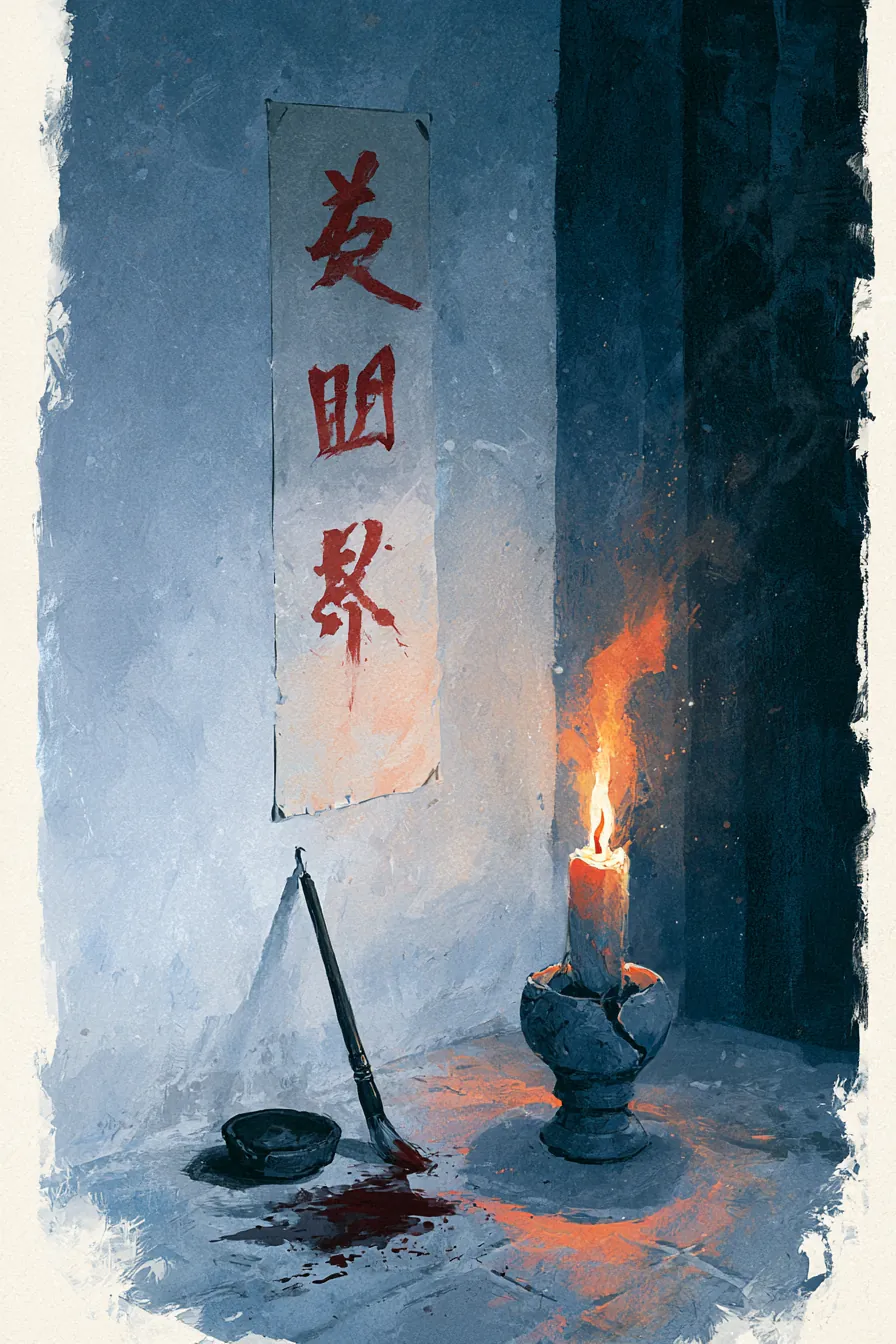
The cedar box of the bujeok-paper was open on the low table.
The hairpin was beside it.
The inkstone was beside the hairpin.
He sat at the north of the table, in the white linen hanbok of a Bukchon han-yak clinic and the charcoal-grey wool overcoat I had walked beside him the seven minutes from. He did not, in the sitting, lay the overcoat aside. The overcoat was, on the cushion under him, the last piece of the discipline that the choosing was still inside of.
He looked up. He bowed forty-five degrees on the cushion, held it three breaths, straightened.
I sat at the south of the table the table's width from him. I bowed forty-five degrees, held it three breaths, straightened. I set both palms flat on the wood the way he had set his. The wood was warm. The brazier under the corner of the table was, by his discipline of seventy-three years of pine-brazier maintenance, the kind of warm a low table in a Joseon-coded anbang on a Monday afternoon at five-oh-three was, by the patient accumulation of a thousand and forty-three years of an older creature's care for the heat of a room, going to be.
At five-oh-two on the Monday afternoon of March the thirtieth of 2026, on the low table of the anbang of the middle hanok of the Bukchon compound, the chairman — whose own four-hundred-year discipline had ended — took, from the inner pocket of his charcoal-grey wool overcoat, three objects: a square of mulberry paper, a cinnabar inkstone, and a silver hairpin. The hairpin had been given to him on the lower shrine of the south path of Inwangsan, in the autumn of nine hundred and eighty-six, by Sanshin-nim, against some Korean year not yet come.
He laid the mulberry paper at the center of the table. The inkstone he set beside it; the hairpin beside the inkstone. He sat on the bangseok cushion at the north. I sat at the south, the table's width between us, and set both palms flat on the wood the way he had set his.
The mulberry paper was the paper of an Andong-coded paper-maker whose own discipline at the small workshop on the slope above the Yeongnam main road was the discipline of a paper that took ink across centuries without fading. The paper was the size of a man's palm. It was thicker, by my palm's measure, than the mulberry paper my own great-grandmother in Chungcheong-do had — by the only sheet I had ever seen of hers, in the upper drawer of the low pine desk of the Bong-myeong-dong anbang — left behind. The thicker paper was the paper an older creature whose discipline had ended chose for a bujeok he was, by his own choosing, going to leave hanging on a west wall for the length of his own mortal lifespan and afterward.
The hairpin was the hairpin of an older mountain god of nine hundred and eighty-three years, given on a lower shrine in the autumn of nine hundred and eighty-six against a Korean year not yet come. The metal was the soft old silver of the lower-shrine workshop of the Goryeo era. It had on its head the small carved shape of a magpie. The carving was so worn that only the curve of the wing — one small clean line — could now be read.
I looked at the magpie. I looked at the curve. I did not speak. He waited.
"Han-ssi. The bujeok," he said.
I waited for it.
"This one is the choosing. By the hairpin Sanshin-nim gave me on the lower shrine, the creature whose discipline has ended will give the paje-line elder daughter the one piece he was told, on the Monday morning, he might choose for himself. I will let you choose. So I have chosen."
"It will be inked in the blood of my own right hand, drawn with the hairpin. It will carry, in the old Joseon-prior Korean, the calligraphy of the name Geo-rin — the name the elder of nine hundred and eighty-three years gave a white-furred mountain fox on the east shoulder, in the autumn of his own first century. By that name, on the morning at the Seonbawi rocks — by the marble transfer, by the loom, by the paje line, by the four hundred and three years — the creature whose discipline has ended will be pinned, with the silver hairpin, into the west wall of this room."
I held his gaze.
"The bujeok is the one piece of the choosing. And the choosing is this." He looked at the paper, not at me. "I lay down the ascension count."
I breathed once, and twice, and a third time. I did not weep. The reservation — carried from the strip under the Banpo Bridge, from Min-ji's one-room in Mapo, from the Tuesday-and-Thursday rehearsal room, from this anbang, from the pine maru in Bong-myeong-dong, from the Chief of Staff's low table at the Cheong Wa Dae annex, from the maru on Sunday morning — held.
Held the way an old Korean grandmother's meju block, on the upper kitchen shelf of a Bong-myeong-dong hanok in February, holds at the temperature it has agreed to hold at for the count of weeks the room has agreed to give it.
I had spent the bath of the early afternoon thinking about that meju. My grandmother had taught me, on the pine maru of the herb garden on the third day of the four days of teaching, that the paje-line elder daughter's body across the four hundred and three years had been, by the loom, a meju the line had been letting come to. The line was the room. The fermenting was the carrying. The taste at the end was the work. She had said: Granddaughter. The taste at the end is not a sweet taste. It is the taste of the body of a Korean woman who has agreed not to weep on the days the line is asking her to hold. The reservation was that taste.
I was, on the cushion at the south, the meju.
"Sajangnim," I said. "Say the rest of it. Plainly."
He inclined his head. "The ascension count is the alternative discipline of a creature who refused his own thousandth liver, on the morning of the seventh of the fifth month of King Injo's first year, on the slope above the willow grove. He has carried it ever since — the cold marble, the seventy-three years of the empty cedar box. He is laying it down. At the Seonbawi rocks, by the marble transfer, he will let it go to the mountain, and take the mortal aging in its place."
"That is your choosing," I said. "The deciding is mine."
"Yes, Han-ssi."
"And I have decided. By the two warms that became three at the back of my own tongue — by the small body I am carrying — when the marble passes between us tomorrow at the sixth hour, the surrender to the mountain will be the surrender of your four-hundred-year discipline, and the marble will come from your tongue to mine."
"Yes, Han-ssi." He breathed. "Ink."
He bowed — forty-five degrees, on the cushion — held it a moment, and straightened. He took the silver hairpin from beside the inkstone, took the index finger of his right hand, and pressed the point to the pad. He drew a slit, two millimeters deep, three wide. It bled.
I had, on the third day of teaching at the pine maru in Bong-myeong-dong, asked Halmoni what the bujeok-blood of a creature whose discipline had ended would, on the mulberry paper, look like in the cinnabar. She had said: Granddaughter. The blood of a four-tailed creature whose four-hundred-year discipline has ended looks, in the cinnabar of an Andong-coded paper, like the cinnabar. Cinnabar and the blood are, by the new arithmetic of the line, one color. She had said this with the careful interior smile of a Daejeon herbalist of seventy-nine years who had spent her own seventy-nine years grinding cinnabar for the bujeok-paper of three generations of the paje-line and knew the color of cinnabar better than any creature in Bong-myeong-dong.
I watched.
The blood and the cinnabar met on the stone, and they did not, in the meeting, change. The cinnabar took the blood the way a winter river takes the small additional water of a spring branch — without remark, without color change. The two were the one red.
He set the hairpin down, pressed the finger to the inkstone until the stone took the blood, then dipped the finger in the wet cinnabar and drew, on the mulberry paper, three Joseon-prior characters:
巨 — the great.
隣 — the neighbor.
狐 — the fox.
The hand that drew them was the hand whose brushstroke had, on the third panel of the eight-panel folding screen in this anbang, set down a fox in one stroke I had recognized the morning he had carried me from the Genesis to the floor without yet knowing whose recognition it was. The curve of the back of 狐 was the curve of the screen-fox. I watched him draw it. He drew it without looking at the paper. He looked, in the drawing, at the back of his own right hand, in the patient way a man whose hand had drawn the same curve in different inks across nine centuries looked at a hand that was, by its own choosing on a Monday afternoon, drawing the curve for the last time.
The name a white-furred fox had carried in his first century, when he became the first of his kind on the east shoulder whose ascension count had begun. It was his name, eight millimeters into the paper in his own blood.
He set the bleeding finger down. He lifted the paper, held it the table's width away for three breaths, then laid it face-down beside his right hand to dry. The ink darkened and set. Tomorrow at the fourth hour it would be pinned to the west wall.
He looked, then, at the fold of the silk-wrapped bridal chima of my grandmother's, set by Halmoni at the north-west corner of the low table on the Sunday morning and not, in the twenty-eight hours since, moved. The silk was the cream silk of a Bong-myeong-dong wedding-cloth merchant of nineteen-sixty-four. The fold was the paje-line fold a paje-line grandmother knew. The two ends of the cream silk met at the south end of the bundle in a small flat seam, the seam at the angle a Bong-myeong-dong grandmother of seventy-nine years had folded the bundle in the spring of nineteen-forty-seven and had folded the bundle in every spring since.
He looked at it three breaths.
He did not, in the looking, touch it.
The not-touching was the courtesy a creature whose discipline had ended gave a bridal chima that was, by the morning, the chima the paje-line elder daughter was going to wear on her own discipline at the seventh hour of his Monday evening.
He looked at me.
"Han-ssi," he said. "When the bujeok is pinned and we walk through the east door tomorrow morning, this will no longer be the anbang of a creature whose discipline has ended. It will be the anbang of the paje line. Yours."
I held it — held the bujeok face-down beside his hand, and the wall it would hang on, and the morning it pointed toward.
I held also the silver hairpin. The hairpin in the autumn of nine hundred and eighty-six had been given on a lower shrine by an older mountain god of his own three centuries to a younger creature of nine of his thousand and forty-three years against a Korean year not yet come. The Korean year had been this Korean year. I held the hairpin a moment in my own palm. It was light. It was the careful working of an old Goryeo silversmith whose name was on no record, and whose hand had, in the careful curve of the magpie's wing, put down the small line a paje-line elder daughter of 2026 would, on a Monday afternoon in the anbang of a middle hanok of a Bukchon compound, recognize. I had not, in my twenty-six years, learned the small Goryeo-silver curve. The body knew it.
I set the hairpin back beside the bujeok.
I bowed forty-five degrees, held it, straightened.
"Then we walk back down the east shoulder tomorrow on the same side of the path," I said. "Together."
"Together," he said.
He breathed once. He looked, briefly, at the cedar box that had — since the autumn of nineteen-fifty-three on the upper shelf of the low pine cabinet of the western wall — held the white linen mourning ribbon of Yun Da-eun of the paje line of Chungcheong-do. The box was, this afternoon, on the upper shelf where Halmoni had set it after the marble's first crossing. He looked at it three breaths. He did not, in the looking, weep. The cedar of it had been the steady cold of seventy-three years. By the Sunday afternoon of February the twenty-second, it had been the steady warm. By this afternoon, by the choosing of the bujeok and the marble at the back of my own tongue, the cedar had become only cedar.
He said, very quietly:
"Han-ssi. The seventy-three years."
"Yes, sajangnim."
"The seventy-three years were — by the empty box and the silent shelf and the careful sweeping of the anbang floor on every Saturday morning at the third hour — the discipline by which the creature whose own four-hundred-year accounting at the lower shrine of the south path had been the discipline of carrying the wrong knife, made of the anbang of the middle hanok of the Bukchon compound a room a paje-line elder daughter could, four hundred and three years on, walk into."
He paused.
"I am, on the Monday afternoon at five-twenty-three, telling you the seventy-three years because the seventy-three years are, by the bujeok on the table, ended. The cedar box is — by the white linen ribbon now on the upper shelf and the bujeok of Geo-rin on the paper between us — done. The discipline of cedar-box keeping is done."
I held three breaths.
"Sajangnim," I said. "The seventy-three years were the discipline by which the anbang became a room I could walk into. The seventy-three years are mine to hold. Not as forgiveness. As inheritance."
He bowed forty-five degrees, held it three breaths, straightened.
"Yes, Han-ssi," he said. "Thank you."
"You are welcome."
It was twenty-eight minutes past five. The bridal chima waited ninety-two minutes off. The marble transfer at the Seonbawi rocks was twelve and a half hours away. He stood — the slow folding-up at the knees — gathered the inkstone and the hairpin, and left the bujeok where it lay.
He stood at the east door three breaths before he slid it. The light in the anbang had, in the twenty-six minutes of the bujeok, gone from the warm trapezoid of the late-afternoon sun to the long pale rectangle of dusk on the western wall. The western wall was the wall on which, in the morning, the bujeok of Geo-rin would hang. He looked at the wall, and at the spot the bujeok would pin into — a meter above the heated ondol, the point the carpenter in Hongseong had, in 1953, by some grammar the carpenter had not, in 1953, known he was applying, marked with a small flat circle of darker stain. The carpenter had set the mark at the request of an older creature in a black overcoat who had not, in 1953, told him why. The carpenter had taken the small additional copper for the mark and had not asked. The mark was, on the western wall, the spot the silver hairpin would, in the morning, find.
He turned.
"Seven," he said.
"Yes, sajangnim."
He bowed, fifteen degrees. I bowed back. He crossed to the east door, slid it, stepped through, slid it shut. The room was mine.
I sat at the south side for the count of seven breaths. Then I stood, crossed to the north side where the silk-wrapped bundle of my grandmother's bridal chima — Bong-myeong-dong, the autumn of nineteen-sixty-four — lay beside his hand, and took it up. The silk was cool against my palm. The bundle was lighter than I had expected. Halmoni had said, on the pine maru on the second day of teaching: Granddaughter. The bridal chima of the paje-line is, by the loom, a chima that has, in its weave, only the weight the line has asked it to carry. On the day of your own wedding it will weigh what it weighs. On the day of the ascent it will weigh almost nothing. The almost-nothing is the loom's permission. The bundle was, by the loom, the almost-nothing.
I held it three breaths. I bowed to it, fifteen degrees. The bowing was not, by my own count, the bowing of a paje-line elder daughter to the chima. It was the bowing of a Stanford-trained gyopo on the south side of a low table at five-twenty-nine on the last Monday afternoon of the four-hundred-and-three-year discipline, to her own grandmother who had — at thirteen on a Bong-myeong-dong kitchen floor in nineteen-fifty-eight — first folded a chima of the line.
I slid the east door, crossed the maru, and went to the bath of the east hanok.
The east hanok was the smaller of the three hanoks of the compound. The bath was at the western end of the east hanok, a small flat room with a cypress-board floor and a copper basin set in the corner above a low pine bench. The basin had been brought, in 1953, by an Andong-coded carpenter whose own father had, in the late Joseon, set the copper baths of three of the four major yangban households of Hanyang. The copper had been polished, every Saturday at the third hour, for seventy-three years. It held, on its inside curve, the steady warm of a kettle of boricha and the cold of a winter morning and the not-quite-warm of a Monday afternoon in March at five-thirty-two when a paje-line elder daughter was, by the grammar of her grandmother's bridal chima, about to bathe in it.
There, by my grandmother's grammar of the paje line, I was to bathe, and to dress in the five layers, and to come back to this room at seven, where the creature whose discipline had ended would be waiting.
I went. I bathed. I dressed.
The bath water was warm. It was the warm of a copper basin in an east hanok in Bukchon on a Monday afternoon in March of 2026, drawn from the small cistern Mr. Kang had filled at half past four from the boiled kettle of the kitchen of the east hanok and left, with a folded white linen towel, beside the basin. Mr. Kang had not, in the leaving, spoken. He had set the kettle down, set the towel, set the small lacquered comb of my grandmother's — which Halmoni had given me on the maru on Sunday morning — beside the towel, and gone out and slid the door without a sound. The not-speaking was the courtesy of a Hongdae-coded dokkaebi of one hundred and three years who knew, by some quiet count of his own, what the courtesy of the Monday afternoon of the paje-line elder daughter's bath was.
I let the warm water find the small places it found. The back of my left shoulder where the gray Theory coat had, in fifteen months of Seoul tenure, pressed a small persistent ridge. The hollow at the back of my throat where the long high note had been living since the spring of my ninth year. The center of me, where the Korean girl was — by twelve weeks and three days I did not yet know I was carrying — small and warm and listening.
I bathed in the slow grammar of a Stanford-trained gyopo on the last Monday afternoon of the four-hundred-and-three-year discipline of the line. I did not weep. The reservation held.
I dressed in the five layers in the careful sequence Halmoni had taught me on the pine maru. The sokgot first, against the skin. The sokchima over it. The pale-blue jeogori with the three persimmon-blossoms at collar and sleeve. The bridal chima — the persimmon-colored skirt, the seven phoenix-feathers worked in gold thread at hem and shoulder and sleeve and collar. The jade norigae pinned at the right of the chima. I tied the otgoreum below my right collarbone in the one-loop knot. I let my hair down. I did not put on makeup.
I looked at my own face in the mirror on the west wall of the bath. The mirror was the small old pine-framed mirror of an Andong-coded carpenter's wife, brought up in 1953. It held, by the slight wave of the cypress-wood backing, a small unfaithful curve at the edge. I had, by sixteen baths in the east hanok over the last weeks, learned the curve. The curve made my own face, at the left side, a face slightly older than the face I knew.
The face at the left side was, on this Monday afternoon, the face of a Korean woman in the bridal chima of her own grandmother who had agreed, by the loom, to the carrying.
I bowed to it. Fifteen degrees. The bowing was the bowing my grandmother had taught me on the pine maru.
The night was getting ready to fall — the last one. The bridal chima, the bujeok, the marble at the sixth hour, the small body at the center of me: by all of it, the last night before the ascent.