Chapter Thirty-Three
The Genesis was in the driveway of the east hanok at half past four on the morning of Tuesday March the thirty-first of 2026. The driver — the unsleeping JL man of twenty-six years — bowed fifteen degrees.
"Sajangnim. Sajik-dong trailhead."
"Yes," the chairman said. We got in.
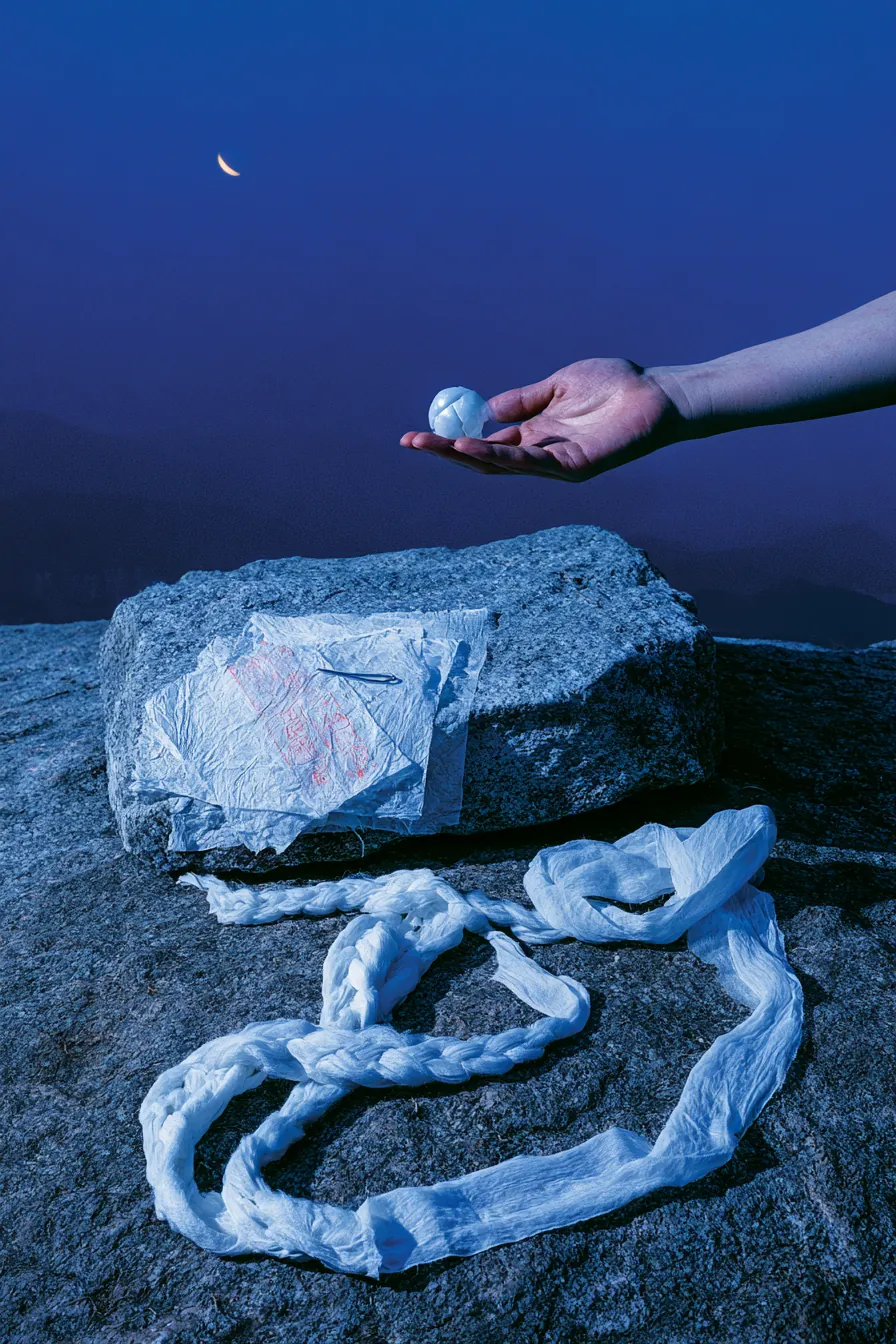
He sat at the back-right with the bujeok of Geo-rin in the inner pocket of his charcoal overcoat, the silver hairpin beside it, and the braided four-strand white linen mourning ribbon — folded into a thirty-two-fold square he had taken up from the low table at a quarter past four — laid in beside them. I sat at the back-left, an arm's length away, in his charcoal sweater over my own black cashmere, the gray Theory coat over that, and carried in me the three warmths: the marble at the back of my tongue, the long high note under my collarbone, the one body of the line at my center. Min-ji rode in front, the jang-gu drum at her side — my grandmother had given it to her on Sunday morning, taken down from the upper shelf of the Bong-myeong-dong anbang after seventy-nine years. Hae-ri sat between the chairman and me in her black down jacket.
The Bukchon hill at four-thirty-three was the dark hill. The cobblestones of the Gye-dong slope were still in the last of the night's cold. The Genesis's headlights threw two narrow tubes of warm yellow at the persimmon-colored gate of the compound next door — the gate I had walked past on the first of March, on the second of March, on the seventh of March, on every Sunday morning of the seven Sundays since. The gate would, by the new arithmetic of the line, be one of the small ordinary objects of the rest of my own Seoul tenure: a thing seen from the back seat of taxis, a thing passed on foot in a coat, a thing the small Korean girl at the center of me would, in some Korean year of her own seventh or eighth, ask the name of and be told.
The Genesis ran down the Bukchon hill and along the empty Line 3 access roads and reached the Sajik-dong trailhead at fifty-three minutes past four. The driver bowed in his seat; the chairman bowed back.
"Mr. Kim. Twenty-six years," the chairman said. "By tomorrow, the chairman you have driven will have surrendered the chairmanship at the Seonbawi rocks. The one piece I have kept on the ledger across those years is, today, done." He paused. "Go home. The Genesis is yours."
The driver bowed forty-five degrees in his seat, held it a moment, straightened. "Sajangnim. Thank you."
"You are welcome."
We got out. The Genesis pulled away down the access road and did not slow.
I watched the rear lights two breaths, three breaths, four. The lights took the curve of the Sajik-dong road at fifty-five minutes past and were gone. The road was the road. The trailhead was the trailhead. The cold Tuesday morning of March was the cold Tuesday morning of March.
Halmoni Yun was at the trailhead. She had taken the east hanok with Min-ji and Hae-ri and Mr. Kang for the night, and walked down the hill with Mr. Kang in the dark. He stood at her right shoulder in the quilted vest the color of a winter river and a black cap with no logo, a pewter cup of cold boricha in his hand. The Yamazaki 18 had been gone since Saturday; the Hongdae dokkaebi had been sober since Monday afternoon, by a two-minute phone call my grandmother had made to the Sangsu-dong bingsu place.
Halmoni bowed fifteen degrees; the chairman bowed forty-five and held it.
"Sajangnim," she said. "The line is, this morning, the nine-instrument arrangement. Walk up."
We walked up the east shoulder of Inwangsan under the clear cold winter sun of a Tuesday in March, in the twenty-three minutes my grandmother's old Daejeon ascent-calendar said the walk would take. The cold sun was not yet up, but the eastern sky above Inwangsan was the pale pre-dawn grey-blue a Seoul March morning had at five-oh-two. The pine of the trail at our feet was still in the night-cold. The pine smelled of pine. The cold smelled of cold. The slow patient smell of an Inwangsan ascent at five-oh-two on a Tuesday in March of 2026 was the smell of the line going up.
The order was: Halmoni at the front, the Daejeon carry-bag at her hand, holding the paje-line gut-cup of my great-great-grandmother, the cinnabar ink, and the mulberry sheets for the twelve geori. Min-ji a half-step back, the jang-gu at her side. Mr. Kang behind her, in the vest and cap. Hae-ri behind him. Then me, in the gray coat over the charcoal sweater, carrying the three warmths. Then the chairman, the bujeok and hairpin and folded ribbon in his pocket. And at the rear, Detective Park Yu-na in a black wool coat, the Glock-19 holstered under it on her left.
The elder daughter walked at the center of the line. The elder of nine hundred and eighty-three years was ahead of us all, at the rocks, waiting. He was the eighth. With him the arrangement was whole.
We walked. The trail at four hundred meters was the trail. At six hundred meters the eastern face of the slope opened and the pines thinned and we passed, on the left, the small flat granite outcrop where the jeotgal-woman's great-granddaughter's great-granddaughter still — by the careful Bukchon record-keeping of the Bukchon han-yak clinic — laid out a single wrapped jeotgal at the seventh of every fifth month at six in the morning. The granite outcrop was empty, this morning. The day was not the seventh of the fifth month by the lunar calendar. The granite outcrop was, by the line, a marker. The chairman, a half-step behind me, did not, in passing, look at it. The not-looking was the courtesy.
At eight hundred meters the trail turned and the willow grove opened on the left, a hundred and forty meters below us — the small dark mass of willows in the pre-dawn that were, by the line, the willow grove. I did not look at them either. The body knew.
At a thousand meters the trail rose more steeply and Halmoni, at the front, set the carry-bag from her left hand to her right and slowed the pace by half a beat. The slowing was the slowing the paje-line grandmothers had agreed on for the last hundred meters of an ascent. The slowing said: Granddaughter. The rocks are up. The breath you carry the marble in is the breath the slowing is for. I breathed slow and even. The marble at the back of my tongue was warm. The Korean girl at the center of me — I did not yet know the count of weeks — was, by some grammar I had not been taught, awake.
We reached the Seonbawi rocks at twenty-four minutes past five. The cold sun was not yet up.
The Seonbawi rocks were the cluster of three granite outcrops at the upper east shoulder of Inwangsan — by the lower-shrine record, the rocks the paje-line had been ascending to since the autumn of the third year of King Seonjo's reign, and by the lower shrine's older record, the rocks the white-furred mountain fox of nine hundred and eighty-three had, in the autumn of his second tail, been instructed at by the old Korean man whose own discipline at the lower shrine of the south path was the discipline of giving names to creatures the slope had agreed to hold.
The largest rock — the granite cap — was three meters by four, the flat top above the slope at the height of a kitchen table. It was the cap the paje-line had performed the twelve-geori on for seventeen generations.
The elder of nine hundred and eighty-three years sat on the granite cap, on the low pine bench he had carried up from the lower shrine, in the grey hanbok and white beard and black wide-brimmed gat of an old Korean man, his bare feet on the stone. We bowed fifteen degrees; he bowed back.
"Halmoni. Junior. Han-ssi. Min-ji-ssi. Hae-ri-ssi. Mr. Kang. Detective Park," he said, naming us in the old Joseon-prior Korean. We answered him: "Sanshin-nim."
"There is one coming up the north path," he said. "Bukhansan-sanshin — the mountain god of the north slope. In 2026 he wears the body that has, for seventy-three years, kept the village butcher's stall at the foot of the east path, and kept its discipline. By the first geori at the annex on Saturday, he has decided to come — alone, his own kind no longer with him, since the four-tailed creature of the north slope broke with him at the second pillar of B3 on Saturday morning. And he is bringing the one instrument his line still keeps."
"Yes, Sanshin-nim," Halmoni said.
"The wrong knife. The wrong notch. By it he means to repeat the morning of the seventh of the fifth month of King Injo's first year. The line is going to refuse the repeat." He looked at Halmoni. "Begin."
She stepped forward and set the carry-bag at the center of the rocks, and took out the gut-cup of my great-great-grandmother and set it a meter from the bench, and the cinnabar ink beside it, and the mulberry sheets beside that. She looked at me.
"Take the gut-cup, granddaughter."
I took it, held it a hand's breadth away, and breathed, slow and even, and said the second sentence of the twelve-geori she had taught me on the pine maru:
The line, on this cup, begins — by the braided four-strand ribbon of the granite cap, by the breath without a vowel on the slope at eleven-oh-three, by the loom of Samshin halmoni, by the four hundred and three years, by the first geori at the annex, by the marble at the back of my own tongue and the one body of the line at the center of me. It begins.
I drank — clear water from the Cheongju grave of my grandmother's mother, brought up in the carry-bag. The water was cold. It was the kind of cold that, on a Tuesday morning at the granite cap at twenty-eight minutes past five in March of 2026, registered at the back of the throat as the small flat clean signal of a thing the line had agreed to receive. The marble at the back of my tongue warmed by one degree. I held three breaths and breathed it out. That breath was the first geori, here at the rocks.
Min-ji began the jang-gu — the one-strike deong-deok of the line, the heart of the rite, at the steady gut-ritual pace. The drum's voice in the cold pre-dawn air of the Inwangsan summit was the voice of every paje-line jang-gu that had been struck on the granite cap since the autumn of the third year of King Seonjo's reign — the same low deong, the same higher deok, the same one-beat pause. Min-ji's hands had been taught the pattern on the Sunday morning by my grandmother on the maru of the middle hanok. The hands had taken to it in three minutes. Halmoni, on the maru, had said: Granddaughter Min-ji. The hands of the line know the line before the hands have been taught.
The chairman stepped up beside me, took the bujeok of Geo-rin from his pocket, held it, breathed once and twice and a third time, and laid it on the granite cap before me. He bowed forty-five degrees, kept hold of it, straightened.
"Sanshin-nim," he said. "The bujeok of Geo-rin is the one piece of the choosing — the surrender of the ascension count. The surrender of the marble. To the mountain."
"Yes, junior."
The elder rose from the bench and walked the meter to the bujeok on his bare feet and picked it up and held it there. He looked at the chairman.
"Junior. The marble is, since last night, at the back of the elder daughter's own tongue. By the fated-mate biology of the line, it cannot be surrendered by you. The surrender is hers." He turned to me. "Han-ssi. Will you surrender the marble?"
I held the gut-cup the small distance between us and took a slow breath, and looked at the chairman. He inclined his head, five degrees.
"The deciding is the elder daughter's," I said. "And by the marble at the back of my tongue and the one body at my center and the long high note under my collarbone — by the four hundred and three years — yes. I will surrender the marble. But not all of it. The surrender is the ascension half — and the keeping is the mortal-life half. By the loom, both."
He smiled — the clear smile of the inner courtyard.
"The surrender-and-keep," he said. "By nine hundred and eighty-three years of my discipline at the lower shrine, it is the one thing a paje-line elder daughter of the loom, carrying the mortal-life half, can do to a marble. It is the first piece of the new arithmetic of the line." He bowed fifteen degrees; I bowed forty-five, waited, straightened. He set the bujeok back on the granite cap before me.
Boots on the north path. The sound came at forty-nine minutes past five, under the deong-deok and the slow breath of nine creatures — one creature, coming. He rounded the north corner of the rocks at fifty-one minutes past: an old Korean man, the body of a mountain god of Bukhansan, grey hanbok and white beard and black gat, a winter river-stone in his right hand.
The stone was the wrong knife of the wrong notch — the village butcher's blade, kept dull for seventy years on purpose. In the 2026 body of a mountain god it had taken the shape of an old Joseon-prior weapon, a river-stone with the wrong notch eight millimeters from the wrong tip.
The river-stone was the color of a stone the Cheongju river had been polishing for nine centuries. It carried, by some grammar of the body of a mountain god, the small dull patient signal a knife that had been kept dull for seventy years carried at the eight-millimeter point. The signal was, by my own body that had — through the line — been carrying the patient counter-signal of that dull notch for four hundred and three years, recognizable. I held the gut-cup an inch steadier. The body knew.
The two mountain gods bowed to each other, fifteen degrees. We did not bow.
"Inwangsan-sanshin," the newcomer said. "The east shoulder. The one whose ascension count I broke, on the morning of the seventh of the fifth month at eleven-oh-three on the slope above the willow grove — is, this morning, by the elder daughter at the center, going to have that count kept. By the surrender-and-keep." He paused. "And I am going to refuse it."
"Yes, Bukhansan-sanshin," Inwangsan-sanshin said.
Bukhansan-sanshin lifted the river-stone and stepped toward me. The chairman stepped between us, in the white linen and the charcoal overcoat, the slow careful step of a creature whose discipline had ended. And Hae-ri stepped in too, between the mountain god and me, in the clean banmal of a four-tailed creature of the north slope whose own discipline had decided.
"Bukhansan-sanshin," she said. "The fifty-two days of liver-removed corpses in the Han River tributaries were mine. And at the second pillar of B3, at seven-sixteen on Saturday morning, I decided to refuse you."
"The ascension count of the one on the east shoulder is the one piece of my seventy-three years, daughter."
"And the refusal is mine."
He lifted the stone and stepped toward Hae-ri at a meter's distance. Detective Park, behind the chairman, drew the Glock-19 from the holster under her coat. She did not fire. She held it, a hand's breadth from her own body, and pointed it at the mountain god.
"Bukhansan-sanshin," she said in the clear jondaetmal of a thirty-eight-year-old detective. "The fifty-two days — by the file in the Seoul Metropolitan Police Major Crimes office — were the four-tailed creature's. As of nine-fourteen yesterday morning, on the maru of the Bukchon compound, that file is closed. There will be no fifty-third day. Not on the ethics of my office."
"Detective. The Glock at a meter."
"The Park-lineage discipline of seven generations of the paje line," she said. "Pointed."
He held the river-stone a hand's breadth from himself and breathed once and let it out, and looked at Inwangsan-sanshin. "The Park-lineage. And the Mun-lineage."
The chairman, between us, did not blink. "Bukhansan-sanshin. The Mun-lineage is the line of the Joseon-court fisherman whose own thousandth—" he caught it, and said it plainly — "the one liver of my four hundred and eighty-fourth kill, on the boat at the estuary of the Han River, on the second day of the fifth month of King Seonjo's twenty-fifth year. Four hundred and thirty-four years on, that is the one hunter-lineage left in 2026. And by your own seventy-three years of cedar-box discipline, the Mun-lineage is on the north path this morning, with you. Send him up."
Bukhansan-sanshin held seven breaths, then turned to the north corner and called one name: Tae-oh-ya.
The man who came around the corner at the sixth hour was twenty-eight, in the black wool coat of a Seoul private investigator, the traditional hunter-lineage knife of the Mun family of the Imjin War on his left side under the coat — the one knife, by four hundred and thirty-four years. He bowed fifteen degrees; the elder of nine hundred and eighty-three years bowed back. The chairman, Hae-ri, Detective Park, and Halmoni did not bow. Min-ji kept the deong-deok. I held the gut-cup.
The Mun knife under his coat carried, in the inner pocket of the line, a thin silver chain — the Mun-lineage carrying-chain by which the knife had, for four hundred and thirty-four years across eleven generations of the Mun hunters, been kept close to the body of the hunter-of-the-day. The chain made a small soft sound when the man moved.
"Bukhansan-sanshin," Mun Tae-oh said. "The wrong knife you kept these four hundred and three years at the village butcher's stall — the dull blade that did the slow cut on the morning of the seventh of the fifth month — by the hunter-lineage discipline of the Mun family, by the line going forward and the first geori at the annex and the elder daughter at the center of these rocks — the Mun-lineage refuses it."
The mountain god held seven breaths. He looked at the nine instruments arrayed against him — the Glock at a meter, the Mun hunter at his back, the four-tailed daughter who had broken with him, the elder daughter at the center — and his own discipline broke. The river-stone in his hand was, by then, only a stone. It was no longer, by the line, the wrong knife.
He set it on the granite cap before him, bowed forty-five degrees, held it a moment, straightened.
"Inwangsan-sanshin. The one piece is surrendered." He paused. "Forgive me."
"The forgiveness is not mine, Bukhansan-sanshin," Inwangsan-sanshin said. "It is the elder daughter's."
He turned to me and bowed forty-five degrees, held it, straightened. "Daughter. The four hundred and three years. The one piece. Forgive me."
I held the gut-cup and steadied the breath, and did not weep.
The not-forgiving — by the slope above the willow grove at eleven-oh-three on the seventh of the fifth month of King Injo's first year, and by the breath without a vowel, and by the braided four-strand ribbon, and by every Sunday afternoon under the collarbone of every elder daughter of the paje-line across seventeen generations — was, at the granite cap at five-fifty-eight on a Tuesday in March, on the back of my own tongue.
It was the size of the marble.
It was the size of a thing that, by the loom, could be set down.
"The not-forgiving of four hundred and three years," I said, "by the first geori at the annex and the surrender-and-keep here at the rocks, is converted. I do not hand it to you, and I do not keep it. It goes to the mountain — by the two warms become three become four. The mountain is the mountain, and the forgiveness, if it comes, is the mountain's. Take the wrong knife back. Put it in the river. The river will keep it."
He bowed forty-five degrees, kept hold of it, straightened, took up the stone from the granite cap, held it there, and turned and walked off the rocks on his bare feet at thirteen minutes past six. He did not look back. The wrong knife was going down the north slope to the river.
The line held — nine instruments, the Park-lineage and the Mun-lineage now eleven.
The marble transfer came at fifteen minutes past six — between the elder of nine hundred and eighty-three years, and me at the center of the rocks, and the chairman a half-step before me.
"Han-ssi. Open your mouth," the elder said.
I opened it. The marble was at the back of my own tongue. He reached two bare fingers in and took it, and held it close at hand — a clear white pearl, half a centimeter across, made small by the fated-mate biology and the one body at my center. He waited and looked at the chairman.
The pearl in the elder's bare fingers caught, for one breath, the first thin pre-dawn light that was beginning to reach the upper east shoulder. The light was the light of the cold sun a half-minute before its first edge. The pearl held the light cleanly. It was, by the morning, only a pearl.
"Junior. The half." He turned and held the marble toward him. "The ascension half — surrendered to the mountain by the choosing of a creature whose discipline has ended."
"Yes, Sanshin-nim."
The elder split the marble at its center. Two halves. The ascension half in his right hand, the mortal-life half in his left. He held them three breaths, then set the ascension half on the granite cap, at the center of the rocks. On the stone, by the mountain, it dissolved into the granite and was gone.
The granite took it without remark. The granite of the cap was, by the older creature's count, the same granite that had held the autumn snow of the year nine hundred and eighty-three when the white-furred fox of two tails had first been given his name. The granite knew the work. It had been doing the work for the line for one thousand and forty-three years.
"Junior. The tails," he said.
The chairman, before me, took from his overcoat the braided four-strand white linen ribbon in its thirty-two-fold square and untied it on the granite cap — the careful work of a creature whose carrying of the fourth strand, for four hundred and three years, had ended.
The ribbon, unfolded on the granite cap, was the white linen of a paje-line mother's wet ribbon of the first year of King Injo's reign. It was, by my grandmother's record of the line, the only object of the paje-line that had carried, in its weave, the four-hundred-and-three-year carrying of an older creature whose discipline had ended. It was small. Twenty-one centimeters by two. The four strands were the four strands.
"Han-ssi. The fourth strand," he said. "The strand of my own un-vowelled breath — the breath of the four-tailed creature on the slope on the fourth morning of the fourth month, whose discipline she could not, that morning, trust. By the surrender of the ascension half, it goes to the mountain."
"Yes, sajangnim."
He pulled the fourth strand from the braid. The three that remained — my mother's, my own, and the future small body's — held. He set the fourth strand on the granite cap where the ascension half had been, and it dissolved into the stone and was gone. He set the three-strand ribbon on the cap before me, bowed forty-five degrees, held it a moment, straightened.
By the surrender of the ascension half and the fourth strand, the chairman was surrendered. His tails — which I had never, in four hundred and three years, seen — were falling. They fell a half-step from him onto the granite cap: nine tails of a four-tailed creature whose ascension count had been broken on the slope at eleven-oh-three, and was now, by the line, surrendered. Eight fell and dissolved into the stone and were gone. One — the white tail of his own first century, the autumn of nine hundred and eighty-three at the lower shrine — kept. It lay a half-step from him, the one tail, by the surrender-and-keep.
He fell to the granite cap. He was dying — by the surrender of the ascension half and the eight tails.
I dropped the gut-cup and knelt at no distance from him, and took the mortal-life half from his left hand, and held it, and kissed him, and gave him the half through the kiss — the way a paje-line elder daughter gives, on the last morning of a four-hundred-year discipline. The half crossed from my mouth to his and stayed at the back of his tongue. It kept him alive. By the surrender-and-keep and the line, it would carry him, by the mortal aging, to the eighty-year mortal Korean lifespan, and then let him die.
He breathed. He opened his eyes and looked at me.
"Ji-won-ah," he said.
"Yi-jun-ah."
The elder of nine hundred and eighty-three years spoke from the bench. "Junior. The one tail."
The chairman looked at the white tail a half-step from him and bowed fifteen degrees, on the granite cap. The tail fell, and became the white-ghost tail of an old Korean man whose discipline had ended — fading, by the mortal-life half.
Then the elder of nine hundred and eighty-three years laughed. It was, across all his years, the first laugh any of the Korean humans on the rocks had ever heard from a Korean mountain god.
The laugh was the laugh of a creature who had, by his own three centuries of discipline at the lower shrine before he had become the discipline he was, learned to laugh and not laughed since. The sound was the sound of an old Korean grandfather seeing the small unexpected ordinary thing his Korean grandson had, on a Korean kitchen floor in some Korean Sunday afternoon, done that he had not, in three centuries, expected. The sound went out over the east shoulder of Inwangsan and the willow grove fourteen meters below the slope and the cold sun beginning, at thirty-one minutes past six, to come up over the east horizon, and the willow leaves at the lower slope of the willow grove — by some grammar of leaf-water the willows of the east shoulder of Inwangsan had been performing for four hundred and three years — took, at the laughing, the slightly darker shade they had taken every seventh of every fifth month of the four hundred and three years and would, this morning, take an hour earlier than the meteorology suggested.
The cold sun came up over the east horizon at thirty-two minutes past six. By the rocks, by the line, by the surrender-and-keep and the marble transfer and the mortal-life half and the not-forgiving converted and the Mun-lineage surrendering — by the new arithmetic — it was the first morning.