Chapter Thirty-Five
Bong-myeong-dong, Daejeon. June 21, 2026. 6:03 in the afternoon. The summer solstice.
The low pine maru of Halmoni Yun's herb garden in Bong-myeong-dong, on the Sunday afternoon of the summer solstice, was where my own grandmother had been teaching me for twelve weeks — every week, since the Tuesday morning at the Seonbawi rocks.
We had come down from Seoul that morning on the seven-oh-five KTX. He had carried the canvas bag with the baekhasuo-cake Halmoni had asked me to bring; I had carried the small pewter cup of yuja-cha the Bukchon han-yak clinic's third-generation granddaughter had pressed into my hand at the lower step of the maru at the third hour of yesterday afternoon with a folded white linen bujeok tied to its handle in the seven-syllable Bong-myeong-dong knot Halmoni had taught me on the third day of the four days. The pewter and the yuja-cha were on the south corner of the maru now, beside Halmoni's right hand, where she had set them at the eleventh hour of the morning when we had come through her gate.
I sat on a bangseok cushion at the center of the maru. He sat on one at my left, an arm's length away.
I was in the pale-yellow cotton sundress my mother in Cupertino had sent for my last birthday. He was in the white linen hanbok of a Bukchon han-yak clinic, his charcoal-grey wool sweater — the last piece of the four-hundred-year discipline — folded beside his hand on the maru. By the ethics of Bong-myeong-dong, the early-summer sun did not require it on his body.
The sundress was the sundress my mother had sent in the same package as a Cupertino-coded card and a small jar of the local kim-chi the Korean-American grocery on De Anza had been making since the autumn of nineteen-eighty-three. The card had said, in my mother's careful Cupertino-coded mixed-script — half English half Korean, in the small slanted hand of a Korean-American mother of twenty-six on the autumn of her daughter's twenty-seventh year — Ji-won-ah. The yellow is the yellow of the lower-shrine yuja of your halmoni in Daejeon. Wear it on a day the line will know. Love, Mama. I had read the card twice on the Sunday morning the package had come, and I had filed it in the small lacquered box on the low pine shelf of the anbang of the Bukchon compound where I had been filing the small ordinary mail of my mother since the third week of February. The card was, by the new arithmetic of the line, on the shelf. The sundress was, on the maru, on me.
The mortal-life half of the marble was at the back of his tongue. The one strand of the white linen mourning ribbon was at my left wrist. And the Korean girl was at the center of me — by the Monday evening twelve weeks and three days ago, by the Bong-myeong-dong obstetrician who had confirmed her at the tenth hour on the morning of Tuesday April the seventh. Twelve weeks and three days. She was small. By the line and the ascent and the warmth that had gone from two to three to four, she was the Korean girl.
The herb garden was the herb garden. The raised pine bed of the baekhasuo at the north wall held the slow patient baekhasuo my grandmother had been raising since the autumn of nineteen-seventy-one — the herb whose discipline was the discipline of patience, by which a Daejeon herbalist sustained a creature whose own mortal aging had agreed to the line. The raised pine bed of the insam at the east wall held the small careful insam my grandmother had been raising since the spring of nineteen-eighty-three — the herb whose discipline was the discipline of warmth. The raised pine bed of the danggwi at the south wall held the danggwi that had been in the garden since my own grandmother's mother's time — by some Bong-myeong-dong record I had not yet been told the count of generations of. The raised pine bed of the ssangwha at the west wall held the ssangwha my grandmother had, on the first day of teaching, told me was the herb whose discipline was the discipline of the paje-line elder daughter who was, by the loom, carrying.
I had been carrying. The garden knew.
Halmoni Yun sat at the north of the maru on a cushion, in the grey hanbok her own grandmother had made for her in the spring of nineteen-forty-seven, a pewter cup of sungnyung at her right hand and the Daejeon Sunday-paper beside the cushion. Across the twelve weeks she had been teaching me the old Joseon-prior Korean of the private grammar of the line, the grammar her own grandmother had taught her in nineteen-forty-seven. It would take one Korean lifespan to learn. By the line, that was fine.
The twelve weeks had been twelve Sundays. Every Sunday morning at six-twelve I had taken the first KTX from Seoul Station and reached Daejeon at seven-thirty-three and a Daejeon taxi to Bong-myeong-dong by seven-fifty-one. By eight-oh-three I had been at the pine maru. Halmoni had been at the maru — in the same cushion, in the same grey hanbok, with the same pewter cup of sungnyung — every Sunday at eight-oh-three. The teaching had been the teaching of the old grammar in the patient Bong-myeong-dong way of a Daejeon herbalist of seventy-nine years. The seven syllables of the paje-line private call. The seven knots of the bujeok-tying. The seven herbs of the inheritance-jar. The seven names of the seventeen generations the line could be traced to. The seven small ordinary gestures a paje-line elder daughter on a kitchen floor was, by the loom, going to give her own daughter when the time came. The seven of seven, by Halmoni's count, of the paje-line.
For the past three Sundays he had come too. He had taken the morning KTX with me at six-oh-five — the train one earlier than mine — and had been on the platform of Daejeon at seven-twenty-two and at the maru by seven-fifty-five, ten minutes ahead of me, to lay out, on the south corner, the small low Bong-myeong-dong-coded breakfast of dried persimmon and steamed jujube and pine-nut yakgwa a paje-line husband-of-the-ascent was, by Halmoni's reading of the spring of nineteen-forty-seven, going to lay out on the maru for the paje-line elder daughter and the grandmother. The three Sundays he had done it had been the three Sundays of the new arithmetic.
We were drinking sungnyung — the burnt-rice tea of a Daejeon hanok house on a Sunday afternoon in June. By the one piece of grammar Halmoni had taught me on the maru twelve weeks ago, it was the tea in which the Bukchon clinic and the Bong-myeong-dong herb garden and my mother's Cupertino kitchen sink in the autumn of two thousand and one were, all of them, one tea.
The tea had the small toasted-rice smell of a Bong-myeong-dong kitchen on a Sunday afternoon. The pewter of the cup held the warm at the patient temperature a pewter cup of sungnyung held the warm at on a Bong-myeong-dong maru in late June. I held the cup at the level of my own breastbone and breathed once and let it out. The Korean girl, at the center of me, was warm.
He held the porcelain cup a hand's breadth away and breathed, slow and even, and said, in the clear careful old Korean of a mortal man of forty-some years:
"Ji-won-ah. The rain. By the marble at the back of my tongue and the Korean girl at the center of you — three minutes."
He looked up. The clear summer sky of Bong-myeong-dong held its own weather.
He smiled. It was, by the thousand and forty-three years that had ended at the Seonbawi rocks twelve weeks ago, the first smile of a forty-some-year-old mortal Korean man.
"The one piece I have taught, across the twelve weeks," he said. "Tasting the rain three minutes before it falls. By the half of the marble at the back of my tongue and the Korean girl at the center of you, a paje-line elder daughter of the loom, carrying the mortal-life half, is the one creature in 2026 whose own discipline is that one taste."
"Yes," I said. "Three minutes."
The rain came ten minutes past six — a soft Daejeon late-spring rain on a Sunday afternoon in June. It came on the maru and on my pale-yellow sundress and on his white linen and on the sungnyung in the cups, and on the baekhasuo at the north wall and the insam at the east and the danggwi at the south and the ssangwha at the west, in the raised beds of the herb garden.
The rain on the pale-yellow of the sundress made small dark circles on the cotton at the rate of one every two seconds. The rain on the white linen of his hanbok made the same circles at the same rate. The rain on the surface of the sungnyung in the cup at my hand made small ripples that crossed at the center of the cup and dissolved into the warm pewter and were gone. The garden took the rain the way the garden had been taking the rain for the seventy-nine years of Halmoni's tenure.
He held my hand on the maru, no distance between us. "The summer solstice," he said.
"Yes."
The marble had, since the morning at the rocks, kept the mortal-life half of itself at the back of his tongue at a temperature one degree under the temperature of his mouth. It was, on the maru, the temperature of his mouth. The new arithmetic of the mortal-life half was the arithmetic of the body that no longer had a discipline to keep. He had said, on the third Sunday of the twelve weeks, that the marble had agreed — by some grammar he had not been taught and the marble had — to be only the marble. Not the discipline. The agreeing was, by his face on the third Sunday at the third hour of the afternoon, the small clean ordinary relief of a creature whose own thousand and forty-three years had finally been permitted to put a thing down.
Across the twelve weeks the small ordinary signs of mortal aging had begun. The first grey hair at the right temple had arrived on the fifth Wednesday of April, on the maru of the middle hanok in Bukchon at five-twenty-two in the afternoon, while he had been pouring boricha from the brass kettle. I had seen it from the south side of the low table. I had not commented. He had seen me see it. He had set the kettle down and breathed once and smiled — the third smile of a mortal Korean man of forty-some years. He had said: Ji-won-ah. The grey hair. I had said: Yes. He had said: The mortal aging. I had said: Yes. The Korean girl, at the center of me, had been five weeks and three days. She had not, on the fifth Wednesday, kicked yet. The grey hair had been the first.
The left knee had begun, on the second Friday of May at the foot of the maru, to ache in the late-spring damp. He had told me at the eighth hour of the evening, when he had come up onto the maru and folded himself down at the bangseok cushion at the north side of the low table at the angle his left knee permitted. Ji-won-ah. The left knee. I had said: Yes. He had said: The mortal aging is, by the second Friday of May, the left knee. I had said: Yes. We had drunk the baekhasuo decoction Halmoni had sent up by the Daejeon-coded carry-bag of the Wednesday before. The ache had, by the seventh hour of the Saturday morning, gone. It would come back, by the new arithmetic of the mortal aging, on every wet Friday for the rest of his Korean lifespan.
The Korean girl had been confirmed at the tenth hour of the morning of Tuesday April the seventh by the Bong-myeong-dong obstetrician — a Daejeon-coded Korean woman of forty-three who had been delivering the paje-line elder daughters' Korean girls for seventeen years and had taken my one piece of paper-work in the practiced Bong-myeong-dong way of a Korean obstetrician who knew the line. She had said: Han Ji-won-ssi. Four weeks. The Korean girl, by the ultrasound and the marker at the lower back of your own womb, is the Korean girl of the paje line. I had bowed forty-five degrees on her examination table. She had bowed back. He had been in the waiting room. He had stood when I had come out. He had not asked. I had said: Yes. He had bowed forty-five degrees in the waiting room of the Bong-myeong-dong obstetrician's clinic. He had held the bow three breaths.
The twelve weeks since had been the twelve weeks of the learning.
I had learned, on the fourth Sunday at the maru in late April, the seven-syllable knot of the bujeok-tying that Halmoni's own grandmother had — in the spring of nineteen-forty-seven on the wooden maru of the house in Bong-myeong-dong — taught her at thirteen. The knot was a knot whose seven syllables corresponded to the seven phoenix-feathers worked at the hem and shoulder and sleeve and collar of my grandmother's bridal chima of nineteen-sixty-four. The tying of the knot took, in the careful Bong-myeong-dong grammar of a Daejeon herbalist of seventy-nine years, nine minutes. My grandmother had retied my first attempt without comment. The second attempt she had let stand. The third attempt she had bowed to. The fourth I had, by the second week of May, been tying without thinking.
I had learned, on the seventh Sunday at the maru in mid-May, the seven names of the seventeen generations the line could be traced to. Halmoni had named them at the eleventh hour of the morning, on the maru, in the careful slow Chungcheong-coded jondaetmal of a Daejeon herbalist of seventy-nine years. The names had been the names. The first was Yun Bok-i. The seventh was Yun Sae-ah. The seventeenth, by the line, was me. I had not, on the seventh Sunday, written the names down. The names had, by the loom, been written down for me in the small clear way the line wrote things into the back of the body of an elder daughter who was, by the morning, four warmths.
I had learned, on the tenth Sunday at the maru in early June, the seven herbs of the inheritance-jar. The baekhasuo my grandmother had taught me first, on the first Sunday, was the herb of patience. The insam of warmth. The danggwi of the line's blood. The ssangwha of the carrying. The yuja of the lower shrine of Inwangsan. The jujube of the Korean girl. The seventh was a herb my grandmother had taught me only in the closed kitchen at the tenth hour of the morning of the tenth Sunday — its name, by her grammar, not to be spoken on the maru. I had learned it. I had held the inheritance-jar at the level of my own breastbone and bowed forty-five degrees. The kitchen had held it. My grandmother had not, in the teaching, smiled. The not-smiling had been the gravity of the seventh herb.
Across the twelve weeks I had begun, by Halmoni's grammar, to walk the small ordinary walk of a paje-line elder daughter of Chungcheong-do on a Sunday afternoon in Bong-myeong-dong. The walk was the walk of the herb garden's south wall, twenty-three steps to the persimmon tree, twenty-three back. The walk was, by the carrying, the walk the carrying agreed to. I had walked it every Sunday at the second hour of the afternoon. He had walked it with me from the seventh Sunday on, at the half-step behind my right shoulder, in the measured Joseon-scholar pace he had walked behind me up the Bukchon hill on the first of March. The pace, by the new arithmetic, was the pace of a mortal Korean man of forty-some years walking behind the Korean woman whose Korean girl he was the father of.
The walks had been the walks.
Halmoni Yun set her pewter cup down on the maru, took a slow breath, and said, in the clear careful Chungcheong jondaetmal of a Daejeon herbalist of seventy-nine years:
"Granddaughter. At the low pine gate — a man."
I looked up, to the gate at the far edge of the garden. It was open, in the rain. One meter outside it stood a man — a black wool overcoat, a black fedora low on its brim, the slow careful stillness of an old creature on a June afternoon. In his right hand, at his hip, he held a paper. The paper was a list. On it, names.
He was a jeoseung saja. A grim reaper.
He looked up across the garden at me, and bowed fifteen degrees, one meter outside the gate, and held it a moment, and straightened. He did not walk in. He held the list at his hip three breaths, breathed, turned, and walked down the alley up from the Yuseong stream, past the persimmon-tree house at the corner. He did not look back.
The rain on the man's shoulders did not seem to wet the wool of his overcoat. The rain that fell at his feet did not seem to puddle. He walked the way an older Korean grim reaper on a June afternoon in Bong-myeong-dong walked: at the slow patient pace of a creature whose own discipline was the discipline of carrying a paper. The fedora's low brim caught no light. The fedora was the fedora.
I did not speak. I did not say the one thing I had read, by the jeoseung saja at the gate.
There was a name on his list that, by the elder of nine hundred and eighty-three years at the rocks twelve weeks ago, was not the one he had come for this afternoon — the one name of the line that the jeoseung saja in the black overcoat had, by the loom and the four hundred and three years and the Tuesday morning at the rocks and the Korean girl at the center of me, decided — for the first time in seventeen generations of the line — not to claim. That name, and the low angle of the fedora's brim, were the first piece of Book 3. I did not tell him.
He held my hand on the maru in the rain. The marble was warm at the back of his tongue. The Korean girl, at the center of me — by the twelve weeks and three days — was warm. The one strand at my left wrist was warm. Three warmths, on the Sunday afternoon of the summer solstice in Bong-myeong-dong.
Halmoni Yun, at the north of the maru, who by seventy-nine years of carrying the call forward had also seen the jeoseung saja at the gate, closed her eyes three breaths, breathed, opened them.
"Granddaughter. The jeoseung saja," she said. "By the low angle of the brim, he is what he is. He has come, by the line. And by the Tuesday morning at the rocks, he has gone." She paused. "He will come back — by the loom, by the Korean girl at the center, by the one piece by which the four hundred and three years of the line arrived. But not for years. Many. Forty." She paused again. "By that time — by the Korean girl who will be born in the autumn, and grow, and teach, and by her own daughter and the line going forward — the jeoseung saja will find, at the gate, that the one name is also not, on his list, his."
I bowed forty-five degrees on the maru, held it, straightened. "Halmoni. Thank you."
She bowed forty-five degrees, kept hold of it, straightened. "You are welcome, granddaughter."
She closed her eyes again, and breathed, and slept — the afternoon nap of a Daejeon herbalist of seventy-nine years.
The breath of her sleeping was the small slow steady breath of a Korean grandmother on a maru in late June. The breath was, by the seventy-nine years, the breath. The pewter cup of sungnyung at her right hand sat at the angle the maru permitted. The Daejeon Sunday-paper beside the cushion was folded to the cultural page, where the lead article was on a Korean ceramicist of the Imjin War lineage whose new exhibition at the Daejeon Museum of Art opened next Saturday. Halmoni had, at the eleventh hour of the morning, said she would take me there. The taking would, by the new arithmetic, be the taking.
The rain stopped at twenty-four minutes past six, at the brim of the clear summer sky — on the maru, on my sundress, on his white linen, on the raised beds of the herbs. The wet on the pale-yellow sundress dried within three minutes in the early evening sun of the summer solstice. The wet on the white linen of his hanbok did the same. The garden held the rain the way the garden had been holding rain for seventy-nine years.
He held my hand on the maru, no distance between us.
"Ji-won-ah. The Hangang," he said. "The fourteenth of February. The eighth floor of the fusion place above the river. The tangerine."
He reached into the Daejeon Sunday-paper bag at the west side of the maru, where Halmoni had kept, for me — by the old Daejeon fruit-woman who had brought her one piece of fruit from the market since the autumn of nineteen-seventy-one — a late-summer tangerine. He took it out, held it there, and gave it to me.
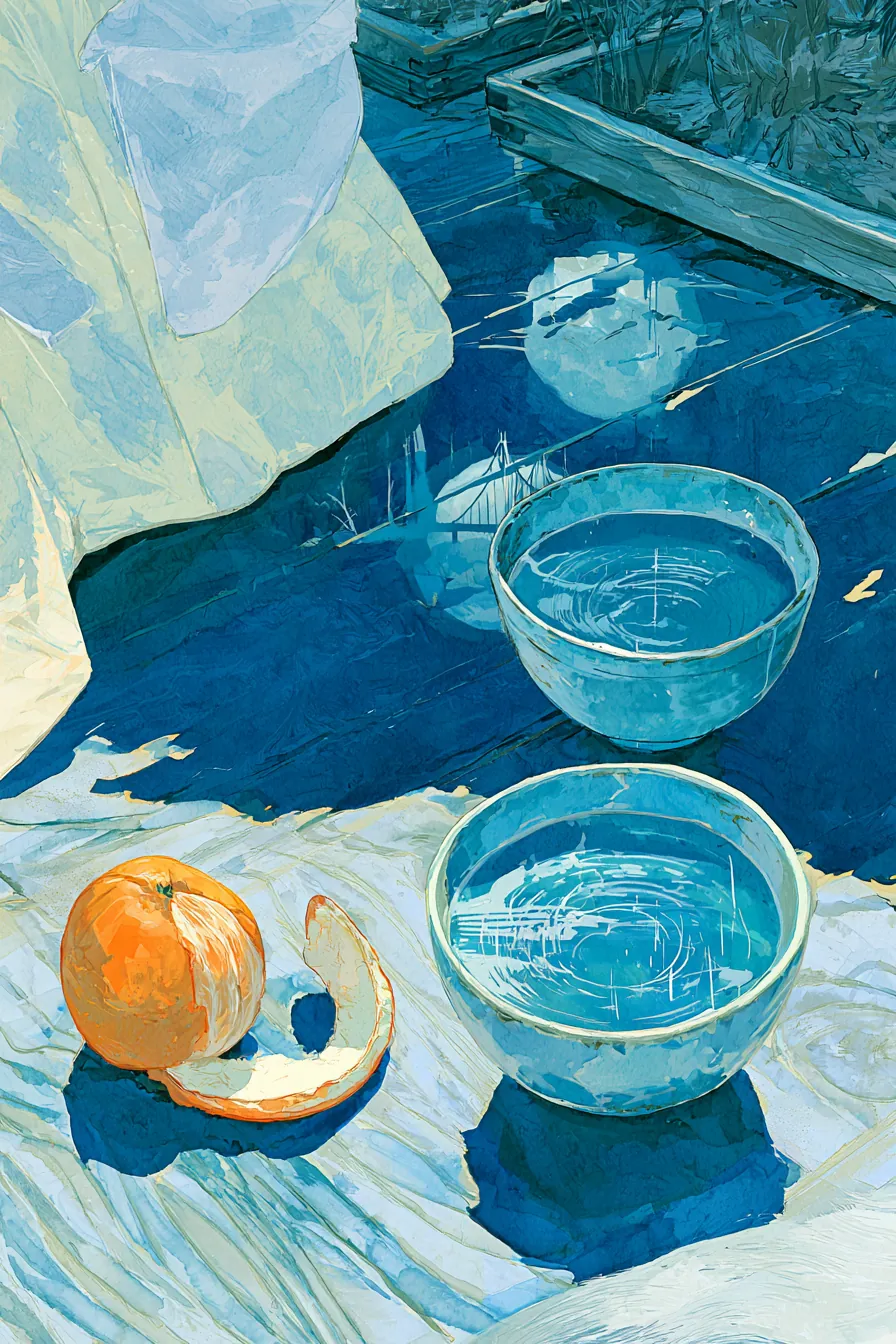
I took it, and peeled it. The peel came off in one long curling spiral. The tangerine inside it was small.
I split a segment with my thumb, gave him one half, kept one half. We ate, on the maru, the tangerine the old fruit-woman and the Daejeon market and the line had brought. It was sweet. It was the tangerine of the fourteenth of February, at eleven-forty-seven at night, on the eighth floor of the fusion place above the Hangang — the same one, by the line. I ate my half. He ate his. We held hands.
And at the center of me, by the two halves of the one tangerine, the Korean girl kicked.
She kicked for the first time at half past six, on the maru. The first kick of a Korean girl of the line — a girl of twelve weeks and three days.
I breathed once and let it out, and did not weep. The reservation — carried from the strip under the Banpo Bridge, the Anguk platform, the chair by the Itaewon window, Min-ji's one-room in Mapo, the rehearsal room, this anbang, the pine maru, the annex, and every hour of that last week up to the rocks and through the twelve weeks since — was held.
I took his hand in my own right hand and placed it at the center of me, a finger's-width below my own breastbone, and held it there three breaths. He breathed. The Korean girl, by his hand, kicked again. He felt it. He did not weep. He smiled — the second smile of a mortal Korean man of forty-some years.
"Ji-won-ah," he said.
And I said it in the clean unembarrassed banmal of a paje-line elder daughter of Chungcheong-do, speaking, in 2026, to the mortal Korean man whose own four-hundred-year discipline had ended:
오빠. 들어봐.
Oppa. Listen.
He listened — his hand at the center of me, in the slow careful way of a man whose thousand-and-forty-three-year discipline had, by the line, ended. The Korean girl kicked once more.
The cold sun of the Hangang on the fourteenth of February, at eleven-forty-seven at night, and the bridges of bone-light over the river, and the one tangerine on the eighth floor of the fusion place, and the slope above the willow grove at eleven-oh-three of the morning of the seventh of the fifth month of King Injo's first year, and the braided ribbon on the granite cap of the Seonbawi rocks, and the grey hour at four-eleven on the folded futon of the anbang in March, and the jeong-seol and the low table and the bujeok and the marble transfer and the surrender-and-keep and the Korean girl at the center of me — all of it had come down to this maru, this Sunday afternoon, this rain stopped under a clear summer sky.
We sat. The two of us, and Halmoni asleep at the north of the maru, and the one fading white tail at the half-step behind him, and the Korean girl at the center of me. He held my hand. I held his. She kicked.
The cold sun was going down — over Bong-myeong-dong, over the slope above the willow grove four hundred and three years gone, over the Hangang of the fourteenth of February. The clear summer sky held its last light.
He listened. I listened. And inside me, the Korean girl listened too.
I closed my eyes. The peel lay on the maru in one long spiral. The bridges of bone-light stood over the river of the fourteenth of February. And under my own hand, and his, she kicked again — the first of a Korean girl who would be born in the autumn, and grow, and one day, on a kitchen floor, be handed a single white strand and told whose it was.
오빠.
들어봐.