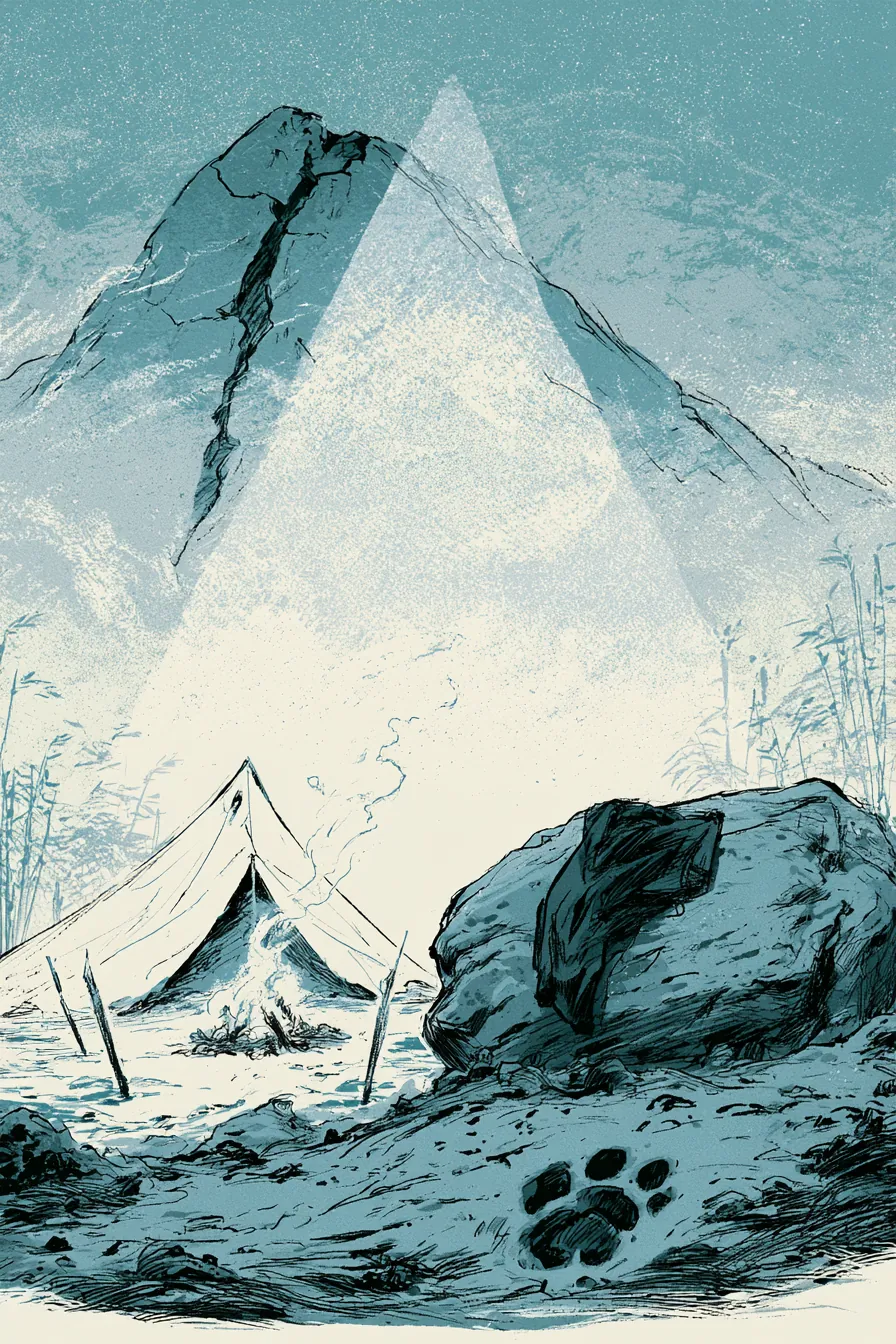
Chapter 17 — The Lintel
The lintel was lower than a copyhouse lintel.
Lin Wei, at sixteen, was not yet tall — three years of poor rice had set his shoulders narrower than the boys at the inner gate, and his head, by the standing measure cut into the south gate post of Cloudreed, rose to a hand's-breadth below the standard adult marker. He did not, at the lintel of the old library of Sundered Peak, need to duck.
He ducked anyway.
He ducked the way a copyist ducked in a stall too low for him — the small reflexive bow of the back that took the spine out of the line of the stone above. The stone above the lintel had a punch mark on its underside, the four-stroke mark of Tao Bing's anvil-shed door, cut at a slight tilt. Lin Wei, in passing under the mark, did not look up at it. He did not need to. The rib in his chest, at a quarter above gray-2, settled to root and carrying without volition, registered the mark the way it had registered the gate of the second milestone — as a thing he already knew.
He stepped past the threshold.
The library, on the inside, was not a library.
It had been a library once. The stone walls were the same pale stone as the wall the smith with the Tao surname had repaired in his thirty-eighth year, and the floor under Lin Wei's sandal was the same tone-cut flag the inner library at Cloudreed had been laid in, two centuries ago, before the floor at Cloudreed had been ripped up and replaced with a louder one. The standing tone of the floor here, under his foot, was not a tone Cloudreed taught.
But the room was not a library.
It was a single round chamber of perhaps twelve paces' diameter, with a domed roof of overlapping slate that had let, in two centuries, a single thin column of moonlight in through a missing tile at the apex, and in the chamber there were no shelves and no scrolls and no manuscripts and no boxes and no lecterns and no chairs. There was the floor. There was the wall. There was, at the center, a single low platform of the same pale stone as the wall, the size of a copyhouse stall, with a single object on it.
The object was a stone box.
It was the size of a thumb-length.
It was the same dark stone with the diagonal seam of pale gray that the stone in the waystation niche had been, except that this one was larger, and the gray seam ran the length of the lid, and the lid was, by the small clear sound the rib made at the seeing of it, banded with the punch mark of Tao Bing's anvil shed at four places along the seam.
The box, on the platform, was tuned.
It was tuned — the day was teaching him to take things in without turning them over — at a quarter above gray-2. The same quarter above gray-2 as his rib. The same quarter above gray-2 as the chord-chart in his collar. The same quarter above gray-2 as the chipped pot in the infirmary the night Yuan had laid his palm on Lin Wei's ribs and said the cracked bowl rings.
The box, on the platform, was the second tuning bowl in the room.
The first was him.
He stood three paces from the platform and did not move.
Behind him, two paces back, Mei Qi stood. Ash sat at her heel without comment.
Behind Mei Qi, four paces back, Wen stood.
At the door, two paces inside the lintel, Yongzhou — the man in the gray robe of an order Lin Wei did not know — stood with his palm flat against the inside of the doorpost, the way a watchman stood at a watch he had stood for fifteen years and was, this morning, finally stepping away from.
Yuan had not, so far as Lin Wei could tell, come through the lintel.
Yuan had stopped at the threshold.
Yuan, on the threshold, was breathing the breath of a Qi Condensation 7 elder who had walked three days on a hurt he had taken in a four-breath read at a gatehouse and had, at the tenth switchback of Sundered Peak, found it to be a hurt he had named wrong in the closet office. It was not in the rib. It was somewhere lower. And by the small flat line at the corner of Yuan's mouth, it was a hurt that did not want him to cross the lintel of an old library.
Yuan said, "Boy."
"Master."
"Wen will read for you. I will sit at the threshold."
Lin Wei did not turn.
"Master."
"I am not, in this room, going to be helpful. The standing tone of this room is at a depth my fundamental, at green-4 corrupted, dampens. If I step in, the dampening will read as a presence. Wen will, in the dampening, lose half a bar of her own carry. Yongzhou will, in the dampening, not be able to test you cleanly. The test is, in this room, the thing you came for. Sit at the platform. Do not, in the sitting, hold on to anything you do not have to."
Lin Wei understood.
He understood the small sentence under the sentence, which was the sentence a master said to a student on the morning the master understood that the master's presence had become, at last, a thing the student was outgrowing the use of. Yuan was not, at the lintel, refusing to enter. Yuan was, at the lintel, refusing to be the source of the rib's carry. The rib was, this watch, to source from the box.
"Yes, Master."
Yuan sat.
Yuan sat against the inside of the doorpost opposite Yongzhou, on the threshold stone, with his shoulder against the dark pine of the replaced door, and he closed his eyes, and he anchored. The settling was not to the half. It was to the root. It was the anchoring he had taught Lin Wei in the closet office at the second bell, and Wen had taught Lin Wei at the cairn flat at the sixth switchback, and Lin Wei had now done in two pieces, and Yuan, on the threshold, did it whole. The chamber, at his banking, did not dim. The chamber, at his holding, did not change in any way Lin Wei could read by ear. Yuan, at the threshold, became a small flat absence the way a stone became a small flat absence when the stone had been carried out of a wall.
Wen stepped past him.
She stepped at the smaller, dryer angle of a peer who did not require a peer's acknowledgement at the crossing of a threshold neither peer had crossed before, and she walked, in the chamber, to the platform.
She did not, at the platform, touch the box.
She turned. She looked at Lin Wei.
"Boy."
"Yes, Wen."
"Yongzhou will, in this room, test you. The test is not Iron Tongue's test. The test is not the test the Cloudreed inner library tests its inner disciples with at the year of their Foundation. The test is the test that was used, in the years before the Tuners, on the bodies the Yellow Bell Manuscripts were written for. The test will, by my read of the floor under my sandal, take one watch. You will, in the watch, do three things. You will read the chord-chart at the second half. You will source the rib at a quarter above gray-2 for the full count of the chart. You will, at the count's end, ring the box."
"And if I do not ring the box."
"You will not ring the box on the first watch. My order's records show no body has rung it on a first watch in two centuries. For two centuries it has served to read a body for the rung above the one it stands on. You will ring as much as the body is at this dawn, and the box will tell Yongzhou and me which rung you stand at the lintel of. The rest you will climb over the next twelve years. That is what the body is for."
"And the seventh hunter."
Wen looked, for a count, at the column of moonlight at the apex of the dome.
"The seventh hunter is on his mat at the trailhead, and he is no longer alone — I can read it from here. The boss he picked has reached him this watch: a Foundation 9 elder of the Inner Sect of a third sect, not Iron Tongue and not Cloudreed and not in any net Tao Lin's slips have ever named. It is the Inner Sect Hai himself bowed to at the year of his own promotion — that is the read I will give Yuan in the second watch this morning." She paused. "Fifteen years that slip has been in the seventh hunter's pocket, the name a clerk on a mat knew stood above Hai. Fifteen years he has been the clerk who could pick that name. Now he has picked it, and in picking it he has opened the road — a road Hai has not yet been told is open. The third sect's elder will read the lintel of this ruin within the hour. He will not be able to enter. My order's seal and the smith's punch close the lintel against the third sect's standing tone."
"And Yuan, on the threshold."
"Yuan, on the threshold, is the lintel."
She said it small and dry, and Yuan, on the threshold, with his eyes closed and his banking at root, did not flinch at the saying, because he had — Lin Wei understood it now — taken a hurt at the gatehouse on the morning Wen had appeared at the gate, and the hurt had been the cost of a thing Yuan had agreed, in the four breaths of the woman's reading at the gate, to be at the lintel of this ruin two days later. He had agreed, in four breaths, to be the door.
The chord-chart, in Lin Wei's collar, was not the technique.
The door was the technique.
He stepped to the platform.
He sat on the stone floor in the small flat seat of a copyist at his stall, with his knees folded and the cracked-iron sword laid flat across his lap and the splinter in his left sleeve and the tooth in his right sleeve and the chord-chart, folded in oiled cloth, on the stone of the platform in front of him. He did not yet open the cloth.
He looked at the box.
The box was three paces from him.
The box's seam was, in the column of moonlight from the dome, the same gray as the seam of the stone in the waystation niche, the same gray as Mei Qi's fox, the same gray as the cracked-iron blade on his lap, the same gray as the standing tone Yongzhou's gray robe answered with at the doorpost. The gray, in the chamber, was the chamber's standing tone. The chamber was — and Lin Wei let himself form it once, deliberately, on the private tally he had begun at the cairn — a tuning chamber set to the body the Yellow Bell first note had been written for, and the body in the chamber is mine. He held it once and set it down. That was one.
He unrolled the oiled cloth.
The half-page Tao Lin had copied at twelve sat at the top of the cloth.
He laid the half-page on the stone.
Below it, in the cloth, the second half of the page — which by Tao Lin's own slip had been buried by a sixteen-year-old apprentice's box in this ruin sixteen years ago — would lie when he opened the box.
He did not yet open the box.
He read the first half.
He read it the way he had read it last evening at the foot of the trail by the fire, except that this morning, in the chamber, the reading was not a reading he did with his eye. The eye scanned, in the way a copyist's eye scanned, the dots and small inflections and the inflections of curl. The body sourced. The rib carried. The throat went silent under the carry. The breath went under the rib. The meridian sat at the root.
The chord-chart's first half taught the carry, as it had taught last evening — but in the chamber, in the standing tone of the chamber, the carry deepened. It deepened by half a bar in the count of three breaths. The rib, in the carrying, went from a small clear bell at a quarter above gray-2 to a small clear bell at a quarter above gray-2 that the chamber answered. The slate of the dome did not, by Lin Wei's eye, vibrate. The stone of the platform did not, by Lin Wei's eye, ring. The chamber answered in the way Wen's step had answered the trail, by taking. The standing tone of the floor, under his folded knees, lowered. The wall behind him, the pale stone at a quarter above gray-2, settled.
The chamber became, at seven breaths, a room that sat at the same root the cairn at the sixth switchback had sat at when Lin Wei had banked there at Wen's word.
He let it form — the chamber is built to bank with the body that rings at the chord-chart's tone — and as it formed he understood it was the second of his four for the watch, and that the watch might run longer than four would forgive, and he set it down before it could grow a second clause. Call it one and a half. He let it be one and a half.
He turned to the box.
He looked at Yongzhou.
Yongzhou, at the doorpost, did not look back. Yongzhou was watching Yuan's answering at on the opposite post the way a man who had been the second of a pair of doorposts for fifteen years watched the new first doorpost settle into the rhythm. Yongzhou would, Lin Wei judged, intervene only at the moment Wen named. Until then, Yongzhou was post.
Lin Wei picked up the box.
It was, in his hand, lighter than the chipped pot had been.
It was lighter, he understood in the holding, because the box had been tuned to be light in the hand of the body it had been waiting for. The stone of the box did not, by any law Yuan had taught him at the south gate or any law Tao Bing had taught him at the forge, weigh less for a body that resonated to it. The box was not, by Cloudreed physics, a thing the world allowed to weigh less. But the chamber was not a Cloudreed chamber. The chamber had been built before Cloudreed, by an order that had not yet been broken into the Cloudreeds of the world, and that order had built it on a rule older than Cloudreed physics: the highest rung is the rung that listens. The box, in his hand, weighed what it weighed once the listener at the lintel had become the listener.
He set the box on the stone in front of him.
The lid, at the seam, did not have a hinge.
It had four punch marks, two at each long edge, at the corners — Tao Bing's four-stroke mark, the same mark on the third pine on the right of the eighth switchback, the same mark on the underside of the lintel — and the four marks lay along the seam in a count Lin Wei had now seen three times in two days. He knew, in the looking, what the count meant. He did not file it. He let it sit.
He laid his right thumb on the first punch.
The rib answered.
He laid his left thumb on the second punch.
The rib answered louder.
He laid his right index on the third.
The rib's note doubled — not in volume but in width, the way a bowl that had been ringing alone began to ring alongside another bowl in the room, the second bowl half a bar lower, the chord forming.
He laid his left index on the fourth.
The seam opened.
The lid lifted, in the chamber, of its own weight — which by the chamber's rule was the weight of being unlocked by the four punches of the body the box had been waiting for, and which by the standing physics Lin Wei had been raised in was no weight at all. The lid rose half a finger. He did not move it further. He let the air at the seam tell him what was inside.
What was inside was the same paper as the half-page on the cloth.
It was rolled.
It was the size of a finger.
It was the second half.
He took it out, very gently, the way Mei Qi had laid the splinter on his palm at the privy garden, and he laid it on the cloth alongside the first half, and the two halves, when the second was unrolled, made a single chord-chart, and the chart, on the floor in front of him in the column of moonlight from the dome, was the complete page Tao Lin had not been able to copy at twelve and the sixteen-year-old apprentice had buried at the chamber sixteen years ago.
He read the second half.
The second half was not the technique.
The second half was the test.
The test was a single instruction. It was written in the same dots and small inflections of curl as the first half, and Lin Wei's eye, for the count of three breaths, did not read it, because his eye had been trained for three years to read characters and the second half had no characters. He sourced. The rib answered. The chord-chart taught the body what the body needed to know, and the body, in the chamber, understood.
The instruction was: match the chamber's silence at its quietest bar, and the box will tell you who the chord was written for.
He did not, in the reading, move.
The chamber, at the chord-chart's first half being read, had took to the quarter-above-gray-2 of his rib. The chamber, at the second half being read, would need to go further. It would need to go to the tone below the bar. He had been banked to root by Wen's word at the cairn. He had been held to root by Yuan's word in the closet office. He had not, in either, been answered at to the bar below the root. The chord-chart taught the register below the root.
He sourced.
He sourced as the chart taught — by the rib, not the throat, with the meridian seated and the breath running under the rib's carry the way a stream ran under a frozen surface. The rib carried at a quarter above gray-2. The carry held. He let it hold. He listened, with the part of his hearing that was the rib and the part that was the body and the part the chamber was answering, for the bar below the root.
The bar below the root was a silence.
It was not, in the chamber, an absence of sound. It was a silence that had a tone. The tone was at the gray-2 the cracked-iron sword had been tuned to at the forge. The tone was the tone Ash had been keyed to since the year of the fox's birth. The tone was the tone of the stone in the waystation niche, the tone of the smith's anvil-shed lintel, the tone of the apprentice's box, the tone of the chamber. The tone was gray-2, the dead tone, the tone the Cloudreed Sect had three years ago looked at his spirit-stone reading and called no tone, and the tone had not, in the saying, been dead. The tone had been the tone of the chord below the bar Lin Wei had been built to listen at.
He matched it.
He matched it not by sourcing it but by being a silence at it.
He went quiet. The rib carried the quarter above gray-2 in the upper register. The body, below the rib, went to gray-2 in the lower. The two tones, in the body, made a chord. The chord was the chord of the chamber.
The box rang.
It rang at the same chord. It rang at the same chord the cracked-iron sword had rung when Tao Bing had said that's the cleanest ring I've put on iron in eight years. It rang at the same chord Ash's fox had been keyed to since the year of her birth. It rang at the same chord the chamber had been built to ring at when the body the chord was written for sat at its center. The box was, on the floor in front of him, a tuning bowl that had been waiting two centuries for the body in the chamber.
The chord, in the chamber, was now three things ringing at gray-2.
Lin Wei, in his folded seat, felt his rib do a thing he had not, in three years of being unable to defend himself, felt his rib do. The rib widened.
It did not crack. It did not shear. It widened the way a meridian widened at the breakthrough Yuan had described in the closet office on the night he had given Lin Wei the cracked-iron sword, when Yuan had said Body Tempering 1 is the layer you reach when one channel widens enough to hold a single tone without shattering, and Lin Wei had thought, then, the layer I will not reach in three years. The rib, in the chamber, widened. The single channel under the rib widened to hold the carry. The carry settled into it. The chord, in the body, held.
He breathed.
He breathed the breath of a boy at Body Tempering 1, at sixteen, in a tuning chamber two centuries old, with a chord-chart on the floor in front of him and a box ringing the chord he had been built for, with his master at the threshold banked to root and a senior of an older order three paces behind him and a Foundation 9 elder of a third sect arriving at the trailhead below the ruin within the hour.
Wen, behind him, said: "Good."
She said it the way she had said good at the cairn flat at the sixth switchback. The chord, in the box, held.
Yongzhou, at the doorpost opposite Yuan's, said: "The lintel is sealed."
He said it the way Yuan had said the trail is banking under her at the third switchback — not a sentence to the room, a sentence into the air of the chamber, a thing the chamber needed to be told. The lintel, at Yuan's settling, was sealed against the pitch of a Foundation 9 of the third sect. The third sect's elder, at the trailhead within the hour, would, by Wen's read, find a lintel he could not cross.
He would, by Wen's read, find a thing else.
"Wen."
"Yes, boy."
"What will he find."
Wen looked, very slowly, at the column of moonlight at the apex of the dome.
"He will find," she said, "that the lintel is sealed and he cannot enter the chamber this morning. He will find that the seventh hunter, by the slip in his pocket, has sent for a second elder of his own sect to bring a tone-key that breaks the seal. That second elder reaches the trailhead at the noon bell of tomorrow, Yongzhou reckons, and against the smith's punch his tone-key will take a half watch to break the seal. By the time it breaks we will not be in this chamber. We will be down the cliff path on the west face that the seventh hunter does not know is a path — on the road back to Cloudreed by tomorrow's third bell, at the south gate by the second sundown of the day after." She paused. "The road back is the one the third sect cannot read fast enough to put hunters on. Tao Lin told it to us this morning, by the slip the fox has just laid against my sandal at the chamber wall. It is the road the smith forged the niches for."
Lin Wei did not, by training, look down at the fox.
Mei Qi looked.
Mei Qi, very quietly, picked up the slip the fox had laid against Wen's sandal at the chamber wall.
She read it.
Her face did the small thing it did under emotional pressure. Twice in the count of one breath. She did not, this time, control it in two breaths. She controlled it in three.
She handed the slip to Yuan, on the threshold.
Yuan, with his eyes still closed and his banking at root, opened his eyes.
He read the slip.
He closed them again.
He said, into the air of the threshold: "The smith's shed was raided at the third bell this morning. Tao Lin's slip from the third niche on the south wall says the smith is in the woodshed cells of the Cloudreed inner discipline ward, and the Copyhouse was closed at the fourth bell. The sect closes the Copyhouse like that for one reason only — when the discipline ward has taken an elder within the watch. The elder, by that protocol, is me."
He said this with his eyes closed.
He said it the way a master said a thing he had, in the closet office at the second bell, predicted he would have a week to outrun, and had, in the chamber at the noon bell of the third day, found out he had three days less than that.
The fox lay flat at Mei Qi's heel.
Outside the dome, at the trailhead a quarter watch down the trail, a tone-keyed crow lifted off a small dark mat with the dry clap of a wing that had not yet been trained against silence.
It was not the seventh hunter's crow.
Yongzhou, at the doorpost, said: "He is at the trail. He is at the head."
He said it the way a man said a thing he had been the second doorpost of for fifteen years and was, this morning, calling out to the first doorpost across a chamber the first doorpost had agreed, in four breaths at a gatehouse two days ago, to become.
Yuan, on the threshold, did not open his eyes.
He said: "Hold the seal."