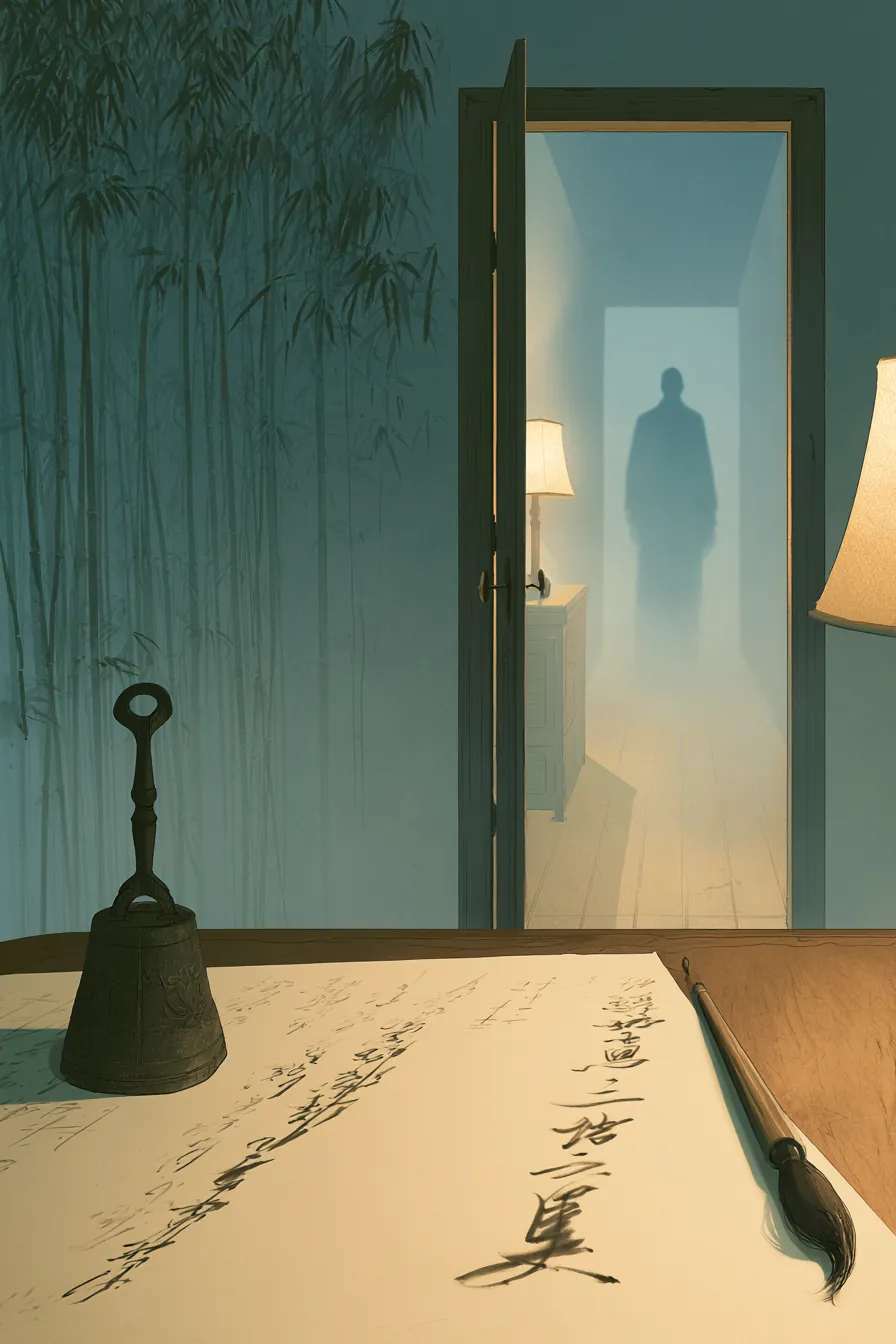
Chapter 24 — The Other Courier
Lin Wei stood at the doorpost of the fourth waystation's hut and did not, by the first count of one breath, step inside.
The man at the niche did not, in the breath, move.
The man sat with his back to the niche's wall and his folded knees on the dirt floor and the cracked-iron knife laid flat across his lap and his rib carrying at the chord, and the chord, in the hut, was — by Lin Wei's reading at the doorpost — the same chord.
It was not, by the body's reading at the niche, Lin Wei's chord. It was the chord. The chord, in the air of the hut, was the chord-of-the-niche carried, by the man's rib, at the tone the niche laid. The bar was gray-2-with-a-half-bar-above-gray-2-at-the-niche-stone's-punch-mark. The bar, in the man's rib, was the same bar Lin Wei's rib was, at the doorpost, carrying.
Two ribs in the hut. One bar.
The man, on the niche, was sixty years old.
The body, at the man's face, was not, by Yuan's count of bodies-at-the-chord-on-the-road, a body Lin Wei had — in the three years of his own marginal courier work — ever seen at the bar of more than five days at the chord-on-the-road.
The man, after his face, had been at the chord for more than five days.
The man had been at the chord, by Lin Wei's read at the doorpost, for years.
Yuan, three paces behind Lin Wei on the trail, walked the three paces up to the doorpost.
Yuan, on the doorpost, did not — by Lin Wei's read at the pause of the count of one breath — recognize the man at the niche.
Yuan, in the pause, read the man.
The reading was the seven-breath read.
Yuan, in the seven breaths, did not, by his reckoning of seven-breath reads at the register of an unknown body, finish. He read for four breaths. He stopped at the fifth.
The fifth breath was the breath at which Yuan, by Lin Wei's count of every seven-breath read he had watched Yuan give in three years, gave up.
Yuan said, in the voice of a master at the doorpost of a hut at the fourth waystation at three o'clock: "I cannot read you."
The man at the niche said: "No."
"Your bar is the bar of the niche."
"Yes."
"Your body, off the niche, by my count, will read at — by the standing protocol of the niches' three-li reach — a niche the body has, in the body, learned to carry."
"Yes."
"By the count of your face, you have been carrying the chord for the count of years."
"Twelve years," said the man at the niche.
Yuan did not move.
He said: "Twelve years."
The man said: "Twelve years."
He paused.
He said: "I was, in the year I started carrying, forty-eight. I was, by my own old count at the year, a Foundation 0 courier of the guild's third roster — same roster as the boy at the doorpost. I had, in the year, the chord of a body at a quarter above gray-2 with no lower register. The smith, in his fortieth year, was — by my own count of the year — thirty-five years old. The smith had, in his thirty-fifth year, laid the first niche at the south gate's spirit-stone. He had, in his thirty-sixth year, laid the second niche at the trailhead's spit-stone. He had, by his thirty-eighth year, laid the third niche at the first waystation. The third niche was the niche I, on the year I was forty-eight, sat at the first time."
Yuan said: "You walked the niches before the boy did."
The man said: "Twelve years before the boy did."
He paused.
He said: "I have, in the twelve years, been the body the smith was — by his tally at his lintel — practicing on."
He paused.
He said: "The smith was not, by his fortieth year, ready to forge the sword. He was, in the count, ready to forge a knife."
He paused.
He held up the knife on his lap.
The knife was a cracked-iron knife, of the shape the smith had forged the gray-2-keyed knife from the fox's tooth in Lin Wei's first year at the Copyhouse. The knife had — by the man's holding — the small punch mark on the underside of the cross-guard that matched, by Lin Wei's read at the doorpost, the small punch mark on the underside of the cross-guard of Lin Wei's sword.
The man's knife and Lin Wei's sword were, by the smith's forty-year forging, the same forging.
The man's knife had been forged twelve years before Lin Wei's sword.
The man said: "He was, in his fortieth year, a Foundation 4 forger who had laid two niches and was about to lay a third. He had not, in his fortieth year, ever forged a traveling niche. He forged the knife on my hip-strap and gave it to me at the south gate of Cloudreed on the morning of the day the spit-stone read me as a marginal courier and the gatekeeper sent me to the Copyhouse. I was forty-eight. I was, by my own count, the body the smith was practicing on."
He paused.
He said: "Twelve years later, by the smith's reckoning, he forged the sword on your hip. The forging is the same forging. The two are, by the smith's count, the same niche-stone, laid twelve years apart, on two bodies the smith had — in the four generations of his family's lineage of forging — identified as bodies the chord-on-the-road might one day be carried by."
He paused.
He said: "Two bodies. I am the first."
He paused.
He said: "By the smith's reckoning, I am not the body the chamber identified as first-bar. By the smith's tally, I am the body the smith was — for twelve years — forging the road for. The forging was the practice. The practice was the smith's preparation for the body the smith was, by his measure, waiting to identify."
He paused.
He said: "The smith identified the body, by his record, in the year you were four. The smith stopped, in the year, practicing on me. The smith began, in the year, forging the road for you."
He paused.
He said: "I have, in the twelve years since the smith stopped practicing on me, been the body the family has — by the family's reckoning — kept on the road in the third-quarter watch. I have walked the road. I have sat at the niches. I have carried the chord. I have, in the twelve years, walked the road at the chord every third quarter, in the watch of the long-dry-watch quarter, from the first waystation to the bridge, and back again, and back, and back, four times a quarter, twelve times a year, for twelve years."
He paused.
He said: "I have, in the twelve years, walked the chord on the road four hundred and thirty-two times."
He paused.
He said: "The four hundred and thirty-two walkings, by the smith's count, have been the laying-in of the niches' bars."
He paused.
He said: "Niche-stones, by the smith's two centuries of forging, are not finished at the moment the smith lays them. Niche-stones are finished at the moment a body that the smith was forging the niche-stone for has, on the road, sat at the niche-stone for the count of nine breaths the count of times the niche-stone has been laid for."
He paused.
He said: "Each niche has been laid, by the smith's tally, for the count of thirty-six sittings."
He paused.
He said: "I have, by long reckoning, sat at each niche thirty-six times in the twelve years. The thirty-six sittings, by the smith's count, are the niche's completion."
He paused.
He said: "Today is, by the smith's count, the thirty-seventh sitting at every niche on the road."
He paused.
He said: "Today is the day the niches become first-bar niches."
He paused.
He said: "I have been sitting at the niches for the count of twelve years, in the laying-in of the bars, for the body that walked into the hut just now."
He paused.
He said: "I have been, in the twelve years, holding the road for you."
He paused.
He looked at Lin Wei at the doorpost.
He said, in the voice of a sixty-year-old courier at the fourth niche: "Boy. Sit."
Lin Wei did not move.
Yuan, at the doorpost, did not move.
Wen, on the trail four paces behind Yuan, did not move.
Mei Qi, two paces behind Wen, did not move. The fox at her heel, by Lin Wei's read one breath on, looked at the man at the niche.
The fox, on the trail, settled once at gray-2.
The fox had, by Lin Wei's count at the waystation hut at the first niche, anchored at gray-2 once before — at the smith's punch mark on the underside of the cross-guard of Lin Wei's sword.
The fox, on the trail at the fourth waystation, banked at the small punch mark on the underside of the cross-guard of the man's knife.
The fox had, in the two bankings, recognized.
The fox had, by Lin Wei's reckoning of the fox's bonded read in the bamboo grove three years ago, recognized one body at the bar three years ago — Lin Wei. The fox had recognized, at the doorpost of the fourth waystation at three o'clock on the afternoon of the third day, the second.
Mei Qi, on the trail, did not — by Lin Wei's read — look up at the man at the niche.
She looked at the fox.
She said, in the small flat voice of a sister-friend on the trail: "Ash."
The fox, settling, looked up at Mei Qi.
The fox took once more at gray-2.
Mei Qi, on the trail, said: "Ash recognized him."
The man at the niche, on the niche, said: "Yes."
He paused.
He said: "Ash is, in the family's keeping of the fox-line, the third fox of the line. The first fox of the line was, by the line's memory, your great-aunt Tao Liang's bonded familiar at the year of the Sundered Era's fall. The second fox of the line was, by the family's tally, the fox bonded to Tao Wei at the year my mother — Tao Lin's older sister — was twelve. The third fox of the line is the fox at your heel. The fox at your heel was, in the family's record at her bonding, Ash."
Mei Qi, on the trail, did not move.
She did not, by Lin Wei's read at the doorpost, look at the man at the niche.
She looked at the fox in front of her, at the heel of her own boot on the trail's stone.
She said, in the small flat voice of a sister-friend on the trail at three o'clock: "She's my fox."
The man at the niche said: "She is your fox."
He paused.
He said: "She is also, by the family's reckoning, my niece's fox."
He paused.
He said: "I am your great-uncle. I am Tao Lin's older brother. I am Tao Bing's older brother. I am the brother of the smith and the brother of your mother. I am the third surviving adult of the lineage. The fox bonded to my niece — to you — in the family's keeping, was, in the year of the bonding, the year you were six. The bonding was, by the line's memory, the fox-line's third bonding. The three bondings are — by the family's tally — the three bodies the family has, in the four generations since the Sundered Era's fall, identified as bodies the chord might be carried by."
He paused.
He said: "Tao Liang. Tao Wei. You."
He paused.
He said: "Wait."
He paused.
He looked at Mei Qi.
He said: "You and the boy. The fox bonded to you was, in the family's record, bonding to you for the boy. The fox is, by all accounts, the line's fox-bond to the chord's body — and the chord's body, in the smith's forty-year arc at his fortieth year, is the boy at the doorpost. The fox bonded to you because the fox, by the line's reckoning, recognized the boy in the same year the boy was four, on the day the smith identified the boy. The fox was, at the bonding, two. Foxes of the line bond at two. The line's fox-bond does not bond to the chord's body. The line's fox-bond bonds to the chord's body's sister-friend — the body at the boy's heel who will, by the family's reckoning, carry the chord-body's witness."
He paused.
He said: "You are, in the family's keeping, the boy's witness."
Mei Qi did not move.
The man said: "The witness, by the line's memory, is the body the family throws with the chord-body. The witness is, by the record, the body that — when the chord-body falls — remembers."
He paused.
He said: "Tao Liang's fox-bond was Tao Liang's younger sister. Tao Wei's fox-bond was Tao Wei's younger brother. You are, by the family's tally, the witness."
He paused.
He said: "Your mother was, in the family's record, the fox-bond for Tao Wei."
He paused.
He said: "She was twelve. She watched her brother die at the fourth niche of the order's dispatch at the year of his walking."
He paused.
He said: "She has been, by the family's reckoning, the family's counter-agent for the nineteen years since she was twelve."
He paused.
He said: "Nineteen years ago, in the family's keeping, your mother turned thirty-one. Thirty-one is the age, by the line's memory, the witness begins to choreograph."
He paused.
He said: "She has, by long measure, been choreographing for nineteen years. She has, in the nineteen years, been choreographing for you."
He paused.
He said: "And for the boy."
He paused.
He said: "I have, in the twelve years of my walking the road at the chord, been the body the family has been practicing on. Your mother has, in the nineteen years of her choreography, been the body the family has been casting the net with. The smith has, in the fifteen years of his forging at his shed's lintel, been the body the family has been forging the road with. We are, by the family's tally, three of the family's standing tally of bodies. The fourth — and the fifth — are the two of you."
He paused.
He said: "The fox at your heel is, in the family's record, the family's keeping of the witness's familiar. The fox is, by the standing read, the line's fifth member. The family has, in the line's record, five members on the road."
He paused.
He said: "Five members."
He paused.
He said: "The order — by the line's measure of the order's standing protocol — does not know there is a fifth."
He paused.
He said: "The order has been hunting, by the line's ledger of two centuries, the first-bar body. The order has not, in the two centuries, identified the witness. The order has not, in the two centuries, identified the practice-body. The order has not, in the two centuries, identified the forge-body. The order has not, in the two centuries, identified the choreographer. The order, in the line's record, cannot read the line."
He paused.
He said: "The line is, by the smith's lineage of the family's years of forging, under the order's read."
He paused.
He said: "The line is the family's Stillness Posture."
He paused.
He said: "Your master is the only outside body who has, in the four generations, guessed the line."
He paused.
He said: "Your master guessed the line in the year he failed his Foundation 4 breakthrough. He guessed the line because he, in the year, sat at the Copyhouse and read every transcription of the chamber's chord-chart in the Copyhouse's stacks and counted, by the transcriptions' miscounts of the inflections, the family's year-on-year forging of the niches. He counted. He did not, in the year, tell. He has, in the thirty years since, not told."
He paused.
He said: "Your master is, by the family's memory, the line's sixth member."
He paused.
He said: "The order — by the line's measure of the order's standing protocol — also does not know there is a sixth."
Yuan, at the doorpost, did not move.
He did not — by Lin Wei's read at three breaths since the man at the niche had said sixth member — speak.
He stood at the doorpost with his shoulder against the doorpost's pine and his hand on his hip and the hurt under his ribs that Lin Wei had now, at three days, twice read on his face.
He breathed.
He said, in the voice of a master at the doorpost of a hut at the fourth waystation at three o'clock on the afternoon of the third day: "Thirty years."
The man at the niche said: "Thirty years."
Yuan said: "Thirty years of sitting in the Copyhouse and not telling."
The man said: "Thirty years of sitting in the Copyhouse and not telling."
Yuan paused.
He said, in a voice that was the voice of a man who had, at the moment in the third quarter of his fifty-fourth year, just been told — at the doorpost of a hut at the fourth waystation at three o'clock — that the thirty years of his sitting in the Copyhouse and not telling were not, in the count, his sitting alone:
"You knew about me."
The man at the niche said: "We knew about you."
He paused.
He said: "The family has, in the thirty years, been watching the sitting. The family has, by the line's keeping, watched the master who guessed the line and did not tell. The family has, by the tally, decided in the year you took the boy as your student to show you the line."
He paused.
He said: "Today is the day."
He paused.
He said: "Sit, master. Sit with the boy. Sit at the niche. The riders are, by my count, one hour and fifteen minutes from the second waystation. The fourth niche, on the dispatch's read, is the niche the dispatch will, by the order's measure, miss us by half an hour. We will, on the niche, sit. The body, in the sitting at the thirty-seventh sitting, will be carried by the niche the way the niche has been carrying me for the count of thirty-six. The boy's rib, in the sitting, will, by the niche's measure, not drop the chord for two years on the road."
He paused.
He said: "The smith forged the road for the boy. The road, today, is finished."
He paused.
He looked at Lin Wei at the doorpost.
He said: "Boy. Sit."
Lin Wei, at the doorpost of the fourth waystation's hut at three o'clock on the afternoon of the third day, with the chord in the rib and the sword on the hip-strap and the chord-chart in the collar and the fox at his sister-friend's heel on the trail behind him and the master at the doorpost with the hurt under his ribs and Wen four paces behind on the trail and his great-uncle the practice-body on the niche under the roof of the third thatched layer with the cracked-iron knife on his lap and the smith in the cells at the south wall of Cloudreed at the lintel of the second tuning chamber with four objects in his hands at the seal of his fundamental tone, sat.
He sat on the dirt floor of the hut at the niche.
He folded his knees. He laid the cracked-iron sword flat across his lap.
His rib carried at the chord.
The chord, in the body, deepened.
The deepening was the private thing the chord did at the thirty-seventh sitting of the niche-stone that had been laid for the count of the laying-in of thirty-six sittings the man at the niche had been sitting at the niche for in the twelve years of the man's walking the road, and the deepening was — by the body's reading at the dirt floor — the chord settling into the rib for the count of two years on the road.
The body, at the count, would not — by the smith's measure at his fortieth year — drop the chord.
The body, at the count, was the body.
Lin Wei sat.
He breathed.
In the small still place under the rib's carry, in the second-person voice the copyist year had given him, he thought: you have a great-uncle.
He did not file.
He had four files closed.
He thought it once.
He breathed.
The riders, by Yuan's count, were one hour and fifteen minutes from the second waystation.
The bridge, by Wen's count, was sixteen li south.
The body, by long tally, would, at four o'clock, walk south at the chord of the niche-of-the-thirty-seventh-sitting and reach the fifth niche at four-fifty, and the sixth at five-forty, and the seventh at six-thirty at the sundown of the third day, and the bridge — by Wen's count — at seven-twenty under the rising of the half-moon over the eastern ridge.
At the bridge, by the smith's count, the chord would cross the water.
At the bridge, by Wen's count, the family would have its first count of the night.
The riders, by Yuan's count, would close on the body at the bridge after nine o'clock.
The bridge, by the smith's patient forging at his thirty-eighth year, was a niche.
A niche was a place a body sat for nine breaths.
A bridge, by the smith's count, was a place a body crossed.
The two — by the smith's count at the year of the bridge's forging — were, by all accounts, not the same.
The smith had, by the record, forged the bridge to be both.