Chapter One
The Wolf in the Orchard
The night before I rode out as my father, my mother held the shears in two hands and could not make them close.
She had been a steady-handed woman for forty-six years. She had pulled a breech lamb out of a ewe in lantern-light without breaking the cord. She had threaded a needle by feel after dusk when the oil ran low. She had once, with the heel of her palm, set my brother's small dislocated finger straight while he laughed because he thought she was tickling him. Her hands did not shake. They had never shaken.
They shook now.
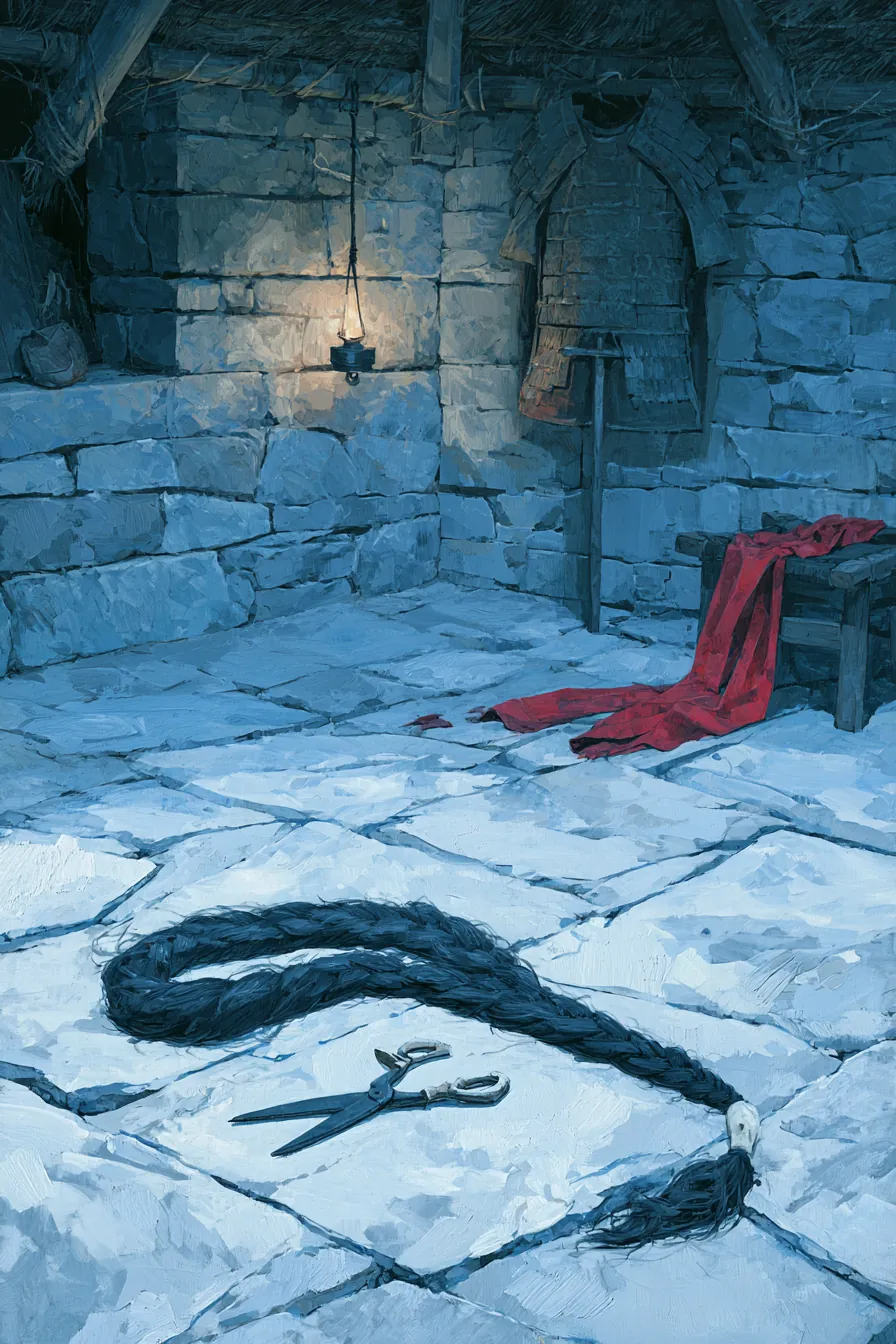
I knelt on the kitchen flagstones with my braid in my lap. It lay across my thighs like a sleeping black snake, heavy from the weight of nineteen winters of comb and oil and the bone-bead my grandmother had tied into its end before she died. My scalp prickled. I could feel my mother's breath on the crown of my head — short, quick, careful — and I could feel the iron of the shears hovering an inch from the back of my neck and not coming down.
"Mama," I said.
"Yulan."
"Mama. The hour."
The cook-fire's last embers spat. Beyond the lattice of the window-paper, the cock had not yet called. There were perhaps three hands of dark left before the road would be light enough to see, and perhaps four hands before the village headman walked his rounds. If I were going to be a son when he passed our gate, I needed to be a son by then.
"Yulan," she said again. Not Arsulan. She had not said the other name aloud since I was four, and she would not say it tonight. The other name was a thing under a stone, and a stone, once you started lifting it, would not go back exactly the way it had been. She knew. I knew. We were both pretending the stone was not there. "Yulan. Are you certain. Are you certain. Are you certain. Are you —"
"Mama."
She pressed her palm to the flat top of my skull and held it there as if I were a pot of water she meant to keep from boiling over. Then she set her teeth, and the shears bit.
The first cut was loud. Iron on iron, hair like cordage parting strand by strand, and then a release as the weight came off. The braid fell into my lap with a soft, animal noise. I made a noise I had not planned to make. Some sound out of my throat I did not recognize — half a hiccup, half the cry a dog makes when it is too proud to whine.
She made the second cut without speaking. And the third. And the fourth.
When she was done, my head felt cold the way a fence-post feels cold. She combed the cropped ends out with her fingers, blunt and businesslike, and I understood she had done this for my father on his army morning, once, and for her own father before that — that this was a thing women in this house had done in the dark for men they loved, in a country whose roads ate men and gave back nothing — and that there had not, until tonight, been a daughter in our line for them to do it to.
"There," she said. Her voice was perfectly steady now. It was only her hands that had not been steady. "There. Now stand."
I stood. The braid stayed on the floor. We both stepped over it as if it were a body.
The lamellar was my father's. He had not worn it in nine years.
It hung on its peg by the door — lacquer dark with old smoke, the leather thongs between the iron plates stiff with the salt of a younger man's sweat. My mother and I had taken it down at dusk and laid it across the threshing-trestle and worked at the straps by lamp-oil for half the night, taking it in at the shoulder, taking it in at the waist, threading new gut where the old gut had cracked. My aunt the saddler had taught me the stitch when I was nine. I had not known then I was being taught to dress a corpse.
I lifted the cuirass over my head. The weight settled with the particular bite of metal that has lived long enough to remember other backs. My mother stepped behind me and laced the shoulders tight, top to bottom, her knuckles knocking once against my spine. My chest, bound flat with strips torn from her wedding-cloth, did not give the armor anywhere to lie wrong. The red silk under the plates would chafe me bloody by the third day. I had already decided, in my head, that I would not care.
The trousers were already on, his, cinched with twine. The boots, his, wax-stiff, two pairs of footwraps to fill them out. The kitchen-knife at my hip for a saber — my brother had wrapped the hilt in red thread for me when I was twelve and convinced I would die a heroine. The bow, his, horn and ash, the recurve he had bought after the salt-foundry took his lungs and the only thing he could still do well was kill a hare at sixty paces from a sitting horse. He had taught me on it. He had said, In case of bandits, child, and we had both pretended we believed him. I had been better than he was by the time I was fifteen. The quiver was my grandmother's. Twenty arrows. Sparrow fletching.
"This," my mother said.
She had been holding it behind her back the whole time. A small bamboo tube, hollowed and lacquered and worn smooth at the lip from use. About as long as my hand, about as thick as my thumb. I knew what it was before she pressed it into my palm because every woman in our village over forty knew what it was, even though no one ever said so out loud. A piss-funnel. My grandmother's, from the year she had spent driving sheep alone across the southern hills after her brothers had been conscripted. My mother's, from the journey she had once made on foot to her dying father's bedside in a place where she had not dared be seen as female on the road.
Now mine.
"My grandmother's," my mother said. "My mother's. Mine. You. You will bring it home."
I closed my hand around it. It was warm from her body. I put it inside my deel against my belly, where the binding would hold it close.
"Mama," I said. "If I do not —"
"You will."
"If I do not —"
She slapped me.
She had never slapped me. Not for any of the things I had earned a slap for — not for the dog I had let into the seed-loft when I was seven, not for the porcelain dish I had broken at seven and lied about at eight, not for the wolf I had not told her was following me through the orchard since I was eleven. She had not slapped me ever, and she did it now with the flat of her hand against the meat of my cheek, and the sting filled my eyes more thoroughly than any of the night's other arguments had filled them, and she said, very quietly, "You will. You will. You will. Now go and see your father."
He was awake. Of course he was awake. He had not slept since the scroll.
He sat on the kang with the quilt across his lap and his hands folded over it as if he were holding the small body of a sleeping animal. The lung-rot had taken his height; he had been a tall man, and he was a stooped one now, and you could see in the line of his shoulders where the cough lived. There was a brown cloth folded under his right hand. He had stopped trying to hide that he carried it.
"Father," I said.
He nodded. He did not speak. Speaking made him cough, and coughing made him bleed, and we had had our share of bleeding this week.
I knelt. I pressed my forehead to the back of his hand. It was a son's gesture — the gesture a son made to his father before riding out on his father's behalf, on his father's name. We had never spoken of which of us would do it, and we had never spoken of which of us would not. We had only spoken around it for three days running, and on the third night I had walked into the orchard alone, and the wolf-shadow had been waiting for me by the largest apple tree with its tongue out of its mouth as if it had been waiting nineteen years, and I had walked back into the kitchen, and I had said, Bring the shears.
My father lifted his other hand and put it on the back of my cropped head. He did not say I am sorry. He did not say Come home. He held his palm flat against my skull and breathed through it for half a minute, and then he took the hand away.
I stood. I bowed. I went.
Behind the kitchen curtain, my brother Anshi was awake on his pallet and pretending he was not. I saw the wet on his eyelashes through the lattice. I did not stop. If I had stopped, I would not have gone.
The bay mare did not know yet that she was going to war. She nickered when I came into the yard and lipped my elbow because she thought I had brought her the apple-cores from supper. I gave her instead a strip of mutton-fat from the kitchen jar, and she made the small private throat-noise she made for me alone. I tied my father's saddle on her. I knotted the quiver to the cantle. I checked the girth twice, then a third time, because checking the girth was something I could do with my hands while my hands shook and my face stayed correct.
My mother brought out the deel and the cloak. She tied the deel at my waist with a length of red cord that had been my grandmother's — real grandmother, the one whose name was in the family scroll, not the one who had whispered Arsulan, little lion over my cradle. She knotted it three times. The third knot was a journey-knot — three loops, a tucked end, a finger-tap for the road-spirit. I had not seen her tie it on anyone since the spring my father went to the salt-foundry.
She did not let go of the cord.
"Mama. The hour."
She closed her eyes. She let go of the cord. She did not look up.
"Your name on the roll is your father's," she said, to the dirt of the yard. "Your name in the saddle is your father's. Your name in the tent is your father's. Your name —" and here her voice almost left her, and she pulled it back from wherever it had tried to go, and finished steady — "your name in your own mouth, when no one else is listening, is whatever you need it to be. Do you hear me."
"I hear you."
"Whatever you need it to be."
"I hear you."
She stepped back. She put her hands behind her back the way she did at the New Year's altar — palms hidden, posture formal, the body of a woman who has been a wife and a daughter and a mother in a country that does not let her be anything she did not earn through silence. She was forty-six years old. I was not going to see her again for a long time.
"Mount."
I mounted.
It is only three li from our gate to the village gate, and I had walked it twice a day every day of my life, and I knew the names of every stone in the path, and that morning I did not see any of them. I rode the bay mare slow, slow, the way a man rides who does not want to be seen leaving — not because he is fleeing, but because he is afraid of how thin his hold on the leaving is, and that going fast will break it.
The headman was already up. I had counted on him being up — the headman of Qiaojia village was a coward but a punctual coward, and a punctual coward will sign a man through his gate at first light without lifting his eyes.
He lifted his eyes. He looked at me.
I looked down at my hands on the reins. Knuckles wider, hold the reins lower in the palm. I had practiced this in the kitchen with a length of rope.
"Qiao Yansheng," he said.
I did not nod.
"Reporting." My voice came out of my belly the way I had been practicing in the orchard since the scroll went up — a half-octave lower than my own, no melody to it, the words sat down at the end like rocks.
The headman could not afford to look at me again — he had drunk in my father's house, he had married off his second daughter on the loan of my mother's silver pin, he had held me as a baby. If he looked at me, he would have to see. So he did not look. He read the name. He held out the brush. I made my mark — three downstrokes, a slash through the second, no flourish on the bottom; the way my father drew his name when his hands were tired. I had been practicing in the orchard. The headman watched the brush and not the brush-holder, and he grunted, and he rolled the scroll back up, and he put a seal of red wax under the mark, and he said, without looking at my face, "Yulin Garrison. Three days. The empress watch the road for you."
"The empress watch the road," I said.
I went.
I did not look back. If I had looked back, my mother would have been standing in the orchard gate with her hands behind her back. My brother would have been on top of the kitchen roof, where he was not supposed to climb. My father would have been at the doorway, half-falling, half-standing, watching. The cloth at his mouth would have been red.
If I had looked back I would have stopped.
So I did not.
The orchard ended a li outside the village. I knew the line of it without lifting my eyes — eleven rows of sour-apple and three rows of pear, my grandfather's bride-price to my grandmother, the trees older than my father, the trees older than the wall, the trees that had been the last thing I saw before sleep every night of my life. They thinned at the road's edge. They went from rows to scattered to one solitary crab-apple at the boundary stone, and then the empty winter fields began, and the road climbed a low ridge and bent north.
The wolf-shadow had been pacing me along the orchard since the gate.
I had not turned my head. I never turned my head. We do not look at the wolf. We do not name the wolf. If we do not name the wolf, the wolf is not there. If the wolf is not there, the priest does not come. If the priest does not come, the fire is not lit. If the fire is not lit, the village does not hear my mother weeping at her own daughter's burning.
I had been ten years old when the peddler from the north passed through our yard with his pack-string of sheep and his fur cap and his smell of woodsmoke, and he had taken my hand to count out my mother's coppers, and he had let go of it as if I had bitten him. He had gone white to the lips. He had said, in our southern speech with a steppe man's burr, Child. Child, you've a wolf in your chest. And he had backed out of our yard without finishing the sale and ridden out of the village by noon, and my mother had burned juniper that night and made me swear on my grandmother's name. Real grandmother. Not the whispering one.
I had kept the swear for nine years.
The wolf-shadow paced me to the boundary stone. I drew rein. I did not mean to. The bay mare drew up under me as if she felt the same thing I felt — animals know the smell of other animals — and I sat there with the empty road in front of me and the orchard at my back, and the wolf at my left stirrup.
It was the first time in nine years I had let myself see him.
He was the size of a yearling deer and the color of a winter sky. He had no breath on the cold air — that was what I noticed first, even before his eyes — because the wolf was not breathing the way a body breathes. His eyes were yellow at the rim and dark at the center, the way an old coin is gold at the edge and bronze in the worn middle.
I felt — and I had not let myself feel before, not with so little to hide it behind — the second heartbeat. It had been in me always. It beat slower than mine. Tonight, with the binding tight across my ribs and my own heart kicking inside it like a thing under a quilt, it was suddenly very easy to find. I felt it the way you feel a hand in the dark.
Where are you going, the wolf did not say. The wolf did not have a voice. The wolf had a weight. I felt it at the front of my skull, the way you feel a man standing too close behind you in a market crowd.
"North," I said, aloud, on the empty road, with my mare snorting and my breath white. I had not meant to answer. "I am going north."
The wolf-shadow's tongue came out of his mouth and his ears canted forward — a creature interested, the way a dog is interested when a child says its name. He was not a dog. He looked, for a moment, as if he were almost amused, and the amusement made him more terrible, not less.
With me, the not-voice said. Not a question. A weight.
"You cannot follow me to a legion camp. They will see you. They will burn me. They will burn my father in his bed for sheltering you, and my mother, and my —"
With me.
I closed my eyes. The wolf-shadow took two steps closer and pressed his head, his incorporeal head, against the side of my calf. Cold. Warm. Both at once. The way snow burns when it has fallen on a wound.
I opened my eyes. The ridge above the road climbed gently to a stand of leafless birch, and the sun, somewhere behind the morning fog, was beginning to make the world grey instead of black, and at the top of the ridge there was a shape watching me. The wolf-shadow had walked there in the time I had blinked. He could be in two places at once when he wanted to be. He had always been able to do this. I had simply never let myself notice.
He sat down at the top of the ridge. He was very still. He was waiting to see whether I would keep going.
I touched my heel to the bay mare's flank. She moved. The road took us forward.
I did not look back at the orchard. I had promised myself that. I did not look back at my mother under the gate, or my brother on the roof, or my father in the doorway with the cloth at his lips. I did not look back at the village or the headman or the place I had been a daughter for nineteen years. I looked forward, at the road, at the ridge, at the wolf on the ridge — and the wolf on the ridge, when I had passed him by a hundred paces, rose without sound and began to walk along the crest, keeping pace.
He kept pace for a li. He kept pace for two. He kept pace until the road dropped down into the long shallow valley of the wheat-stubble country, and the ridge ran out, and there was no high place for him to walk on.
I lost him then. Or he lost me. Or he had not been there at all, except inside my chest, where the second heartbeat went on at its own quiet pace under my mother's wedding-cloth.
It did not matter. He would find the next ridge.
He had been waiting nineteen years. He could wait a road.
By midday I had caught up with three other conscripts.
A tanner's son with a face like a closed shutter. A baker's son with a chatter on him that had probably saved his life on this kind of road already, because no man wants to murder a fool. A tinker who watched everyone's hands and said almost nothing.
I rode at the tail of their little column. I kept my voice in my belly. I kept my eyes low. I had not bled through my trousers yet — the moon was at half — but I knew I would in two days. I had four strips of cloth in the inside fold of my deel and a packet of crushed mugwort and prayers I would not say aloud.
I knew, also, that the wolf was on a ridge to our west that I could not see. He did not need to be on a ridge I could see. I could feel him the way you feel weather.
The tanner's son spat over his horse's shoulder and asked my name.
The second heartbeat in my chest hesitated with me. Somewhere over the land to the west, the wolf lifted his ears.
"Qiao Yansheng," I said, in my belly voice. "Of Qiaojia."
"Long ride for an old man," the baker's son said cheerfully, and he was looking at the cough I had not coughed and the white hair I did not have, and I understood that none of the three of them had been close enough yet to see my face under the helmet's shade.
I let it stand.
"Long enough," I said.
The road ran north. The ridge to the west of it ran north. The wolf, on the ridge, ran north.
There would be the garrison and the oath and the squad I had not yet met, and the muster-priest who would not look up from his scroll, and the river-bath day I would not survive without lying. There would be the wall, three weeks north, beyond which my mother had never been, and her mother had never been — except for the one who had whispered to me in a tongue my parents had forbidden, in a name I had kept under my tongue for nineteen years.
Arsulan.
I did not say it aloud. Not even on the empty road, with no one but the dust to hear. I held it in my mouth like a hot coal, and I rode north, and on the ridge above me, with his ears canted forward and his yellow eye-rims catching the noon light, my second heart kept pace.