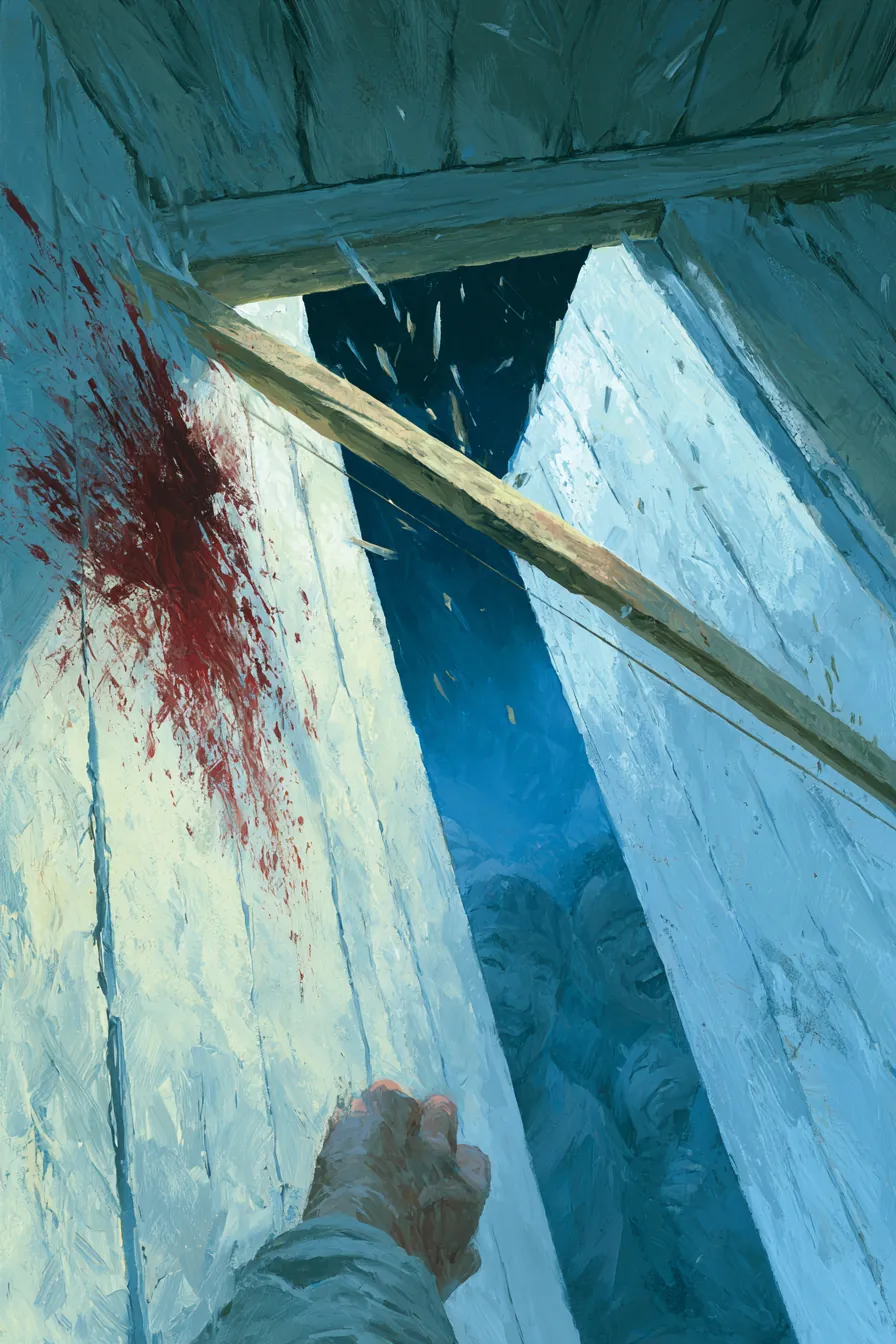
Chapter Ten
What the Bandage Knew
The orderly did not come on the ninth night.
I went to the orderly's wagon at the changing of the first watch to collect the prisoner's water-bowl and the bandage-roll the thin-handed orderly had been carrying across the trampled grass for nine evenings, and the orderly was not at the wagon. The lamp was lit. The roll was on the box. The bowl was beside the roll. A second slip of brown paper was tucked under the bowl. I lifted the bowl and pulled out the slip.
The slip was in Wei's hand. It said: Bandage. Yansheng. Tonight only. Orderly is sick.
I held the slip in my fingers and counted to eight.
The wind had dropped at the changing of the watch. The snow had stopped at second-watch yesterday. The night had gone clear and very cold. The wolf at the picket-grass, fifty paces off, was sitting on his haunches with his head up and his ears forward and his eye, not on the south side of the camp where the Bureau's wagons were, but on the orderly's wagon. He was watching me read the slip.
I put the slip into the inner pocket against my belly above the bamboo tube.
I picked up the bandage-roll. I picked up the water-bowl. I picked up the small tin of bone-paste the orderly used for the worst of the chafing at the manacle. I walked across the strip of trampled white grass to the prisoner-tent.
The two Vermillion Guard at the flap did not look at me. They had not, on any night, looked at me. One of them held the flap aside with the back of his hand. The other turned his face very deliberately into the wind. They had been told, the way men of any guard are told the things that they are not to know, that the Bureau secretary had come and sat and not asked and would come again, and they had decided in the quiet way men of any guard decide such things that the boy with the water-bowl was not their business and could go on not being their business until someone with stripes told them otherwise.
I went under the flap.
He was awake.
He was, tonight, sitting forward over his good knee in the same posture I had begun to know — hands clasped in front of his shins, bad leg out straight, head up — and the lamp was where I had set it down at the chain-side three nights ago, on the small flat stone the orderly used as a stand. The lamp-flame was steady. The smell of the tent had cleared in the cold. The fever-smell was four days gone. The bandage-smell was thicker.
His eyes came to my hands.
His eyes did not come to my face. He had stopped looking at my face on the fifth night, when I had stopped, in turn, ever looking at his — both of us, by an agreement neither of us had made aloud, looking only at the felt at the centre of the tent, or at the chain-ring, or at the small flat stone — and tonight, the moment I came under the flap, his eyes went to the bandage-roll in my hands and the bone-paste tin in my other hand and the water-bowl pinned against my forearm with my elbow, and he understood what was about to happen before I had taken the second step into the tent.
His breath went small.
He said, in clean clipped imperial, in the dry court-voice of the second night, "They sent you. With the bandage."
I did not answer.
I crossed to the chain-side at six paces. I set the bowl down. I set the tin down. I set the bandage-roll down on the felt at my own knee.
I said, in the belly voice, into the felt, "Orderly is sick. Sergeant ordered. Bandage."
He said, "You have not done this before."
I said, "No."
He said, "You know how."
I said, "I have seen it done."
He said, "Not the same thing."
He did not say it as a complaint. He said it as a piece of information passed across the felt at six paces in the imperial tongue between two people who were now, by the slow building of nine nights, accustomed to saying only the things that needed to be said. He waited a count. He said, more quietly, "Yansheng. The bandage is at my thigh. The thigh is the upper inside. Six paces will not do this."
I said, "I know."
He said, "Then come."
The second heartbeat in my chest did one slow beat.
I picked up the bandage-roll and the tin and the water-bowl, and I crossed the felt the four paces of the six I had been holding for nine nights, and I knelt down beside him on the felt at his good knee — outside the reach of the chain-loop, outside the reach of his hands if his hands chose to be hands — and I set the things down on the felt at my own knee, and I did not look at his face.
He did not move.
He held himself, on the felt, as if the felt were a flagstone. He held his breath at the small careful level of a man who had been on stable-watch all his life and knew that to move now was to spook the mare. He did not look at me. He looked at the felt between us, the way I had been looking at the felt between us for nine nights, and the bandage at his thigh was on the inside of the bad leg under the canvas trouser, and the canvas trouser had been cut at the seam by the orderly at the first dressing and re-cut twice by the orderly at the second and third dressings, and what was at his thigh under the canvas was a square of bleached cloth that had been white nine days ago and was now the colour of old straw at the rim and the colour of black millet-tea at the centre.
I did not, when I undid the strap that held the bandage, look at his face.
He did not, when I undid the strap, look at my hands.
We had agreed.
The bandage came off in three lifts. The first lift was the strap. The second lift was the dry outer wrap. The third lift was the inner pad, which had stuck. I held the corner of the inner pad between thumb and forefinger and I poured a thin stream of water over the place where it had stuck, and I let the water soften the cloth, and I did not let myself, even on the fourth count of the water, look at his face.
The smell came up.
It was, in the close air at his knee, the wet-fur-and-woodsmoke smell — his smell, the smell of the man who carried the falcon inside his chest the way I carried the wolf — under the bandage-smell, under the iron-and-rot of the salt-iron quarrel-track that had been kept open by five weeks on a wagon, under the small thin scent of whatever the orderly had been packing into the pad, and the second heartbeat in my chest did not move because if the second heartbeat in my chest moved now it would move us both into a place neither of us could afford the cost of.
I pulled the pad off. The pad came off clean.
The wound was a long pale puncture-track through the meat of the upper inner thigh, the in-and-out track of the quarrel as it had gone through. The in-mouth was on the outside of the thigh and was clean and closing. The out-mouth was on the inside and had been the slow problem — close to the great vessel, close to the small thin meat where any infection wants to go — and the out-mouth was tonight a pink rim with a yellow centre, not red, not running, not the red I had been told to be afraid of by Madam Lu over twenty-three winters of orchard-cuts and dog-bites.
The wound was healing.
I did not say so.
I took the tin. I unscrewed the tin. I dipped the small fat-pad finger of my right hand into the bone-paste — the paste smelled of mutton-bone, juniper, the huang lian bitter root my mother had kept in a black paper sleeve at the back of the cooking-shelf — and I daubed the paste in a thin even ring around the out-mouth without touching the open centre. He did not move. I worked around the rim. He did not move. I daubed the paste in a thin even ring around the in-mouth on the other side, and to reach the in-mouth, I had to bring my wrist across the inside of his good thigh, and my wrist — the wrist with the binding-cloth on it where I had wrapped the chafe-spot at my left rib three nights ago, the wrist that had not been touched by another person since my mother had tied the journey-knot at the gate — my wrist passed over his good knee at the width of one finger above the canvas, and the back of my wrist brushed the canvas of his trouser at the knee.
He did not move.
The breath in his throat went one tiny degree finer.
I did not move.
I daubed the paste around the in-mouth. I finished. I screwed the lid back on the tin and set the tin down. I took up the inner pad — a fresh one from the bandage-roll, the clean lambswool I had taken from the orderly's box — and I laid the pad over the out-mouth on the inside of the thigh. I took up the strip of clean wrap. I passed the strip around the back of his thigh.
To pass the strip around the back of his thigh I needed to slide my left wrist under his thigh between his thigh and the felt.
I slid my wrist under.
His thigh — the muscle of the upper inside, the muscle at the place where a man's thigh meets the deep heat of his groin, the muscle Bald Wei had been talking about when he had said the chain is six chi and the chain is not long enough for him to reach your bed — rested for one full count on the back of my wrist.
I did not look at his face.
He did not look at my wrist.
The second heartbeat in my chest beat one slow steady beat, and the wolf on the picket-grass, fifty paces off, did not move, and I — Yulan, Arsulan, Yansheng, the squad-archer of Squad Five — I passed the strip around the back of his thigh, and I drew the strip up, and I crossed the strip over the pad at the out-mouth, and I drew my wrist out from under his thigh as slowly as I had put it in, and I tied the strip at the in-mouth with the small clean square knot Madam Lu had taught me at six years old, and I sat back on my heels.
He breathed out.
He breathed out one long slow careful breath.
He had been holding the breath, I now understood, for the length of the bandage.
I screwed my hands together at my own knee.
I did not look at his face.
He said, in a voice that was not the imperial-court voice and was not the steppe-tongue prayer voice but was a third voice, the voice he would later use, in the snow-blizzard ger on the ridge above the Iron Gates pass, to say a thing in steppe-tongue I would understand without a bond's help — a voice low and clear and only a little hoarse: "Thank you."
I said, in the belly voice, into the felt, "Don't."
He said, "All right."
He did not say it again.
We sat there. The wolf on the picket-grass, fifty paces off, lifted his head very slowly and looked at the prisoner-tent for one count and put his head down again. The lamp burned. The wind, outside, did its small ticking against the felt at the south-east corner where the seam had not been laced down. I did not look at his face. He did not look at my hands.
He said, after a long count: "There is a Bureau secretary who comes to my tent at second watch. He has come three times. He sits opposite me with a wax tablet. He has not asked me any question. He looks at me. I look at the felt. After half a watch he stands up and leaves."
I said, "I know."
He said, "He will ask, eventually."
I said, "I know."
He said, "He will ask the questions in three sets. The first set will be questions to which he knows the answers, to calibrate me. The second set will be questions to which he does not know the answers, to learn from me. The third set —" He stopped. He did not finish.
I said, "I know."
He said, "He will ask about the soldier with the water-bowl."
I said, "I know."
He said, in the third voice, the new voice, into the felt at the centre of the tent: "Yansheng. I will not have the soldier's name to give him."
I said, "I know."
He said, "I will not have any name to give him."
I said, "I know."
He said, "And if he asks me about the steppe-tongue, I will say that the prince mutters in his sleep, and I do not know if the soldier hears, and I do not know if the soldier understands, and I will say it as a man who has been chained to a centre-pole for nine nights and has had nothing but a wall of felt to talk to, and who at second watch on the third night decided to give the wall a piece of his own tongue because the wall would not give him back his own. The Bureau secretary will write that down. He will not believe it. But he will not be able to use the disbelief, because what the prisoner has said is — technically — also what the soldier will, if asked, also say. Do you hear me, Yansheng."
I said, in the belly voice, "I hear."
He said, "Then say what the soldier will say."
I said, "The prince mutters in his sleep. I do not hear barbarian. I am from a millet village. My ear is a millet-ear."
He waited a count.
He said: "Slower."
I said, slower, "The prince mutters in his sleep. I do not hear barbarian. I am from a millet village. My ear is a millet-ear."
He said: "Good."
He said: "Say it again on the morning the Bureau secretary calls you to his tent, and say it the way you said it now — without insisting. The secretary is a man who hears the insistence of an answer before he hears the answer. Do not insist. Say it as a man who has been asked a question that has nothing to do with him."
I said, "I hear."
He said: "Good."
There was a quiet.
There was the quiet that comes between two animals at first watch when the first animal has set down a thing for the second animal to carry, and the second animal has picked the thing up, and both of the animals have understood that the carrying is now a thing they share, and that the sharing is, for the first time, a thing.
He said, in the third voice, into the felt: "Yansheng."
I said, "Sir."
He laughed.
It was the smallest possible laugh. It was a half-breath through the nose, with the corners of the mouth — I knew without looking, I had not looked, I refused to look — with the corners of the mouth pulled up at one side, the side away from the bruise. It was the laugh of a man who has been told by a soldier who has just bandaged his thigh in the inner upper meat of it that the proper form of address from the soldier to him is sir. It was the laugh of a man who would, three weeks from now in a snow-blizzard on a ridge above the Iron Gates pass, sit cross-legged on a fur-bed across from me with his hands cupped around a tin of black tea and ask me what my mother had called me at the cradle, and not get an answer for another hour.
I made, in my own throat, a small sound that was not a laugh.
I made it in the belly voice. It came out as a low huh. It was the same sound I had made at the squad-fire when Pock-faced Liu had told me, on the night the wagons came in, not to make my mother explain to the squad why they had come home without me.
It was, I thought, the kind of sound I would, before this campaign ended, have to learn how to make in two voices.
He said, into the felt: "Yansheng. May I ask you a thing."
I said, "No."
He said, "All right."
The second heartbeat in my chest beat one beat.
He said, into the felt: "It would have been a thing in two parts. The first part — never mind. The second part —"
The flap of the tent went up at the back.
It went up without warning. It went up the way a flap goes up when a man with the right to come into a tent without announcement comes into a tent — slowly, with one wrist at the hem, with the second hand free for whatever the tent has inside it that he was not expecting.
A man stood in the flap.
He stood in the flap with the lamp behind him so that the lamp lit the felt of the tent and not his face, and the man's robe at the cuff was the cinnabar-stripe of the junior Bureau secretary, and his hand was not on the brush-pouch at his belt where he kept the stylus but at the hem of the flap, and his eyes — I saw them, before I had moved, before I had even turned my head — moved across the tent in one long sweep that took in the water-bowl, the tin of bone-paste, the bandage-roll on the felt at my knee, the strip of clean wrap drawn tight at the in-mouth on the inside of the prisoner's thigh, the prisoner's bad leg out straight on the felt, the prisoner's hands clasped in front of his shins, the prisoner's face turned not toward the flap but toward the felt at the centre of the tent, and my own face — my own face, which was the face of Qiao Yansheng of Qiaojia, kneeling at the chain-side of a prisoner-tent on the ninth night of a Bureau column's residence with a fresh-tied bandage at the meat of the inner thigh of the empire's most valuable prisoner.
The secretary said, in the soft clipped Bureau-court tongue: "Soldier."
I rose.
I rose in the belly voice. I stepped back to the six paces. I bowed at the small clipped angle a conscript bows to a junior secretary, with the chin not quite to the lamellar and the back held very straight, and I did not, at any count of the bowing, let my eyes leave the felt at the centre of the tent.
The secretary did not look at the prisoner.
The secretary looked at me.
He looked at me for a count of three. I held the count. I did not raise my eyes. I did not, in the count, let my face do anything that the cinnabar-stripe at his collar would read.
He said, in the soft court-tongue, "Soldier. You are not the orderly."
I said, in the belly voice, into the felt at his sandal: "The orderly is sick. Sergeant Wei ordered. Tonight only."
He said, "Show me the bandage."
I said, "The bandage is tied."
He said, "Show me the bandage."
I stepped forward. I knelt at the chain-side at the four paces I had knelt at to tie the bandage. I lifted the canvas of the prisoner's trouser at the seam the orderly had cut. I showed him the strip of clean wrap and the small clean square knot at the in-mouth. I did not, on any count, look at the prisoner's face. I did not, on any count, look at my own wrist where it had been under his thigh. I held the canvas back for the count of three the secretary spent looking at the wrap, and then I let the canvas fall, and I rose, and I stepped back to the six paces.
The secretary said, "The knot is military."
I said, "It is a square knot, sir. My mother taught it to me."
He looked at me.
He held the look for two counts longer than he had held it on the night he had come down the line at the squad-fire and looked at my hands and my boots and my plate riding too high at the second rib. He held the look the way a fisherman holds a hook with a small fish on it that he is debating throwing back.
He said, "Your mother taught you a military knot."
I said, "She taught me the knot, sir. I did not know it was military."
He held the look.
He said, "Out."
I bowed. I gathered the bandage-roll, the tin, the water-bowl. I did not, in the gathering, let my eyes leave the felt. I crossed to the flap. I lifted the flap. I went under it.
I did not look back.
I crossed the trampled white grass to the squad-fire with the bandage-roll under my arm and the tin in the pocket of the lamellar and the water-bowl in my left hand and the second heartbeat in my chest beating very slow and very even, and the wolf on the picket-grass, fifty paces off, was on his feet, and his head was down between his shoulders, and his lip was lifted from his teeth, and his eye, this time, was on the prisoner-tent.
He did not move from the picket-line.
He did not need to. The man inside the tent had not yet had the third set of questions asked. The man inside the tent had not yet had the first set of questions asked. The man inside the tent had only — across nine nights — been looked at by a junior secretary with a wax tablet, and the look itself had been the question, and the look had now begun to make a shape, and the shape was a shape I would, until the morning Möngke-Dam called me anda in three weeks, carry under my tongue the way I carried the bamboo tube against my belly: a hard thing, given by a mother, that I had not been told all the uses of.
I came up to the squad-fire.
Bald Wei was at the fire.
He looked at my hands. He looked at my face. He said nothing.
He poured a tin cup of millet-water. He gave it to me. I drank it. He took the cup back.
He said, "Tomorrow at first watch."
I said, "Yes, sir."
He said, "The orderly will be back tomorrow."
I said, "Yes, sir."
He looked at the fire.
He said, "Yansheng."
"Sir."
"The knot was your mother's knot."
I said, "Yes, sir."
He said, "Good."
He drank his own cup. He looked at the fire. The fire was four coals. Pock-faced Liu came out of the squad-tent half-dressed and squatted on his heels beside the fire and said, "Fresh fish. You look like a man who has bandaged a prince."
I said, "I bandaged a prince."
He laughed. He laughed in the small barking way Pock-faced Liu laughed when a thing was funny and also not funny. He laughed long enough that Wang Erlang, at the far edge of the firelight with his back to us, lifted his head and looked once over his shoulder and put his head down again, and the laugh of Liu went on for one more breath and then stopped.
Liu said, "Tell me you did not let him say a word to you."
I said, in the belly voice, "He did not say a word to me."
Liu said, "Good. Good. Good." He elbowed me in the ribs. The elbow went into the binding-cloth at the chafing-ring, and I did not flinch.
He said: "You'll do, fresh fish. You'll do."
I sat at the fire and ate my millet, and the second heartbeat in my chest beat the slow steady beat of the wolf on the picket-grass with his teeth lifted, and inside the felt of the prisoner-tent across the trampled grass, the cinnabar-stripe secretary sat down opposite the chained man on the felt at six paces with the wax tablet on his knee, and he opened the tablet, and he set the stylus to the wax, and he asked, in the soft clipped Bureau-court tongue, the first question of the first set.
I did not hear it.
I knew it had been asked.
I held Toghrul under my tongue. I held the brown square of the requisition slip against my belly. I held the back of my wrist, where his thigh had rested for one full count, against the hem of the lamellar so that no man at the fire would see how lightly I held it.
The wolf on the picket-grass kept his teeth lifted until the secretary came out at the changing of the watch.
Then the wolf put his head down.
Tomorrow at first watch. Again.