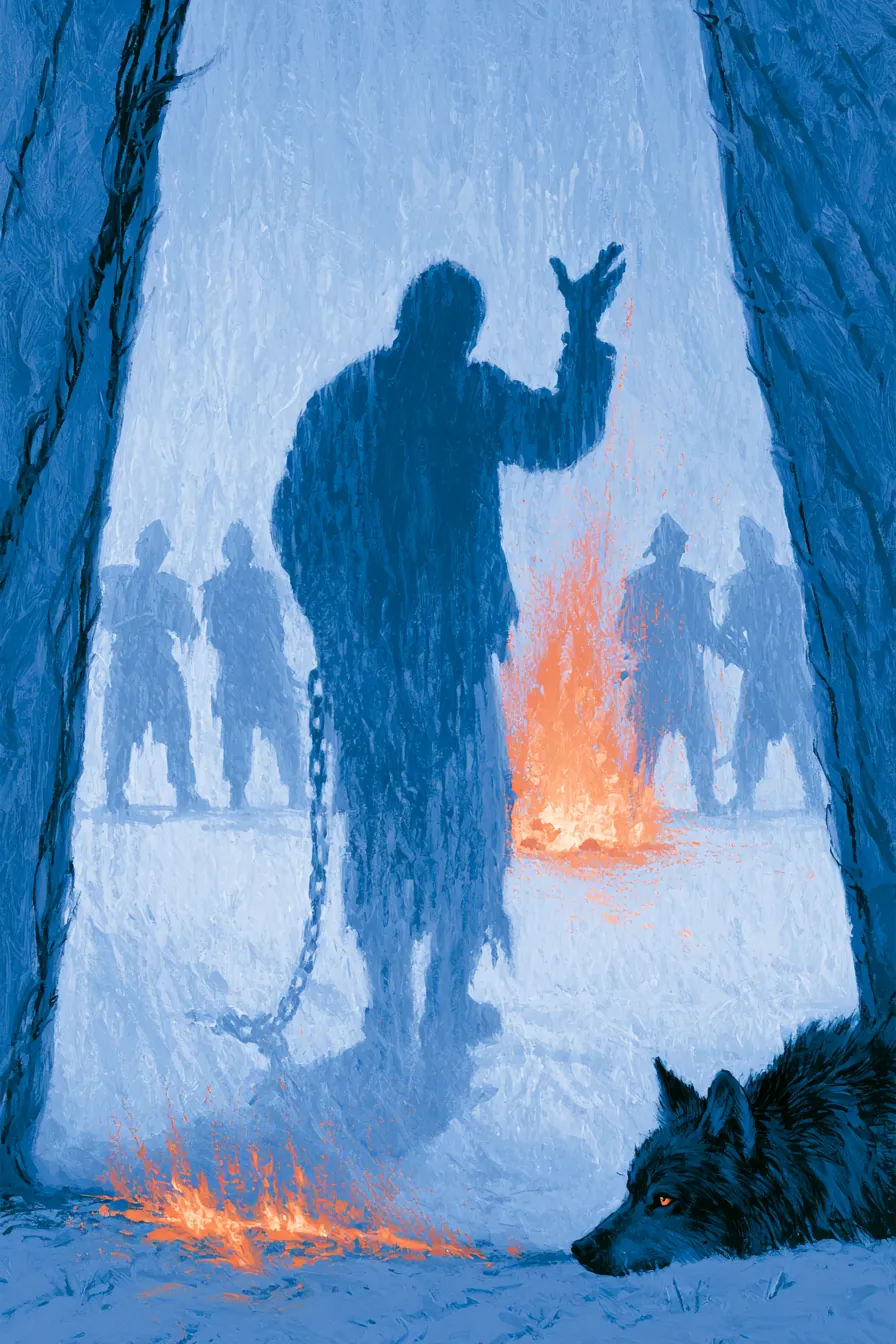
Chapter Twenty-Two
The Iron Gates Chase
The bay mare took my weight without a sound.
She took it in the trampled snow at the lee of the smith's wagon, at the second watch of the seventeenth night — the wagon-master gone to the latrine for a half-watch, Wang Erlang at the south picket with the back of his hand cold against his neck — and at the saddle-blanket, at the cinch of the girth, at the boot set in the steppe-stirrup Toghrul had cut from the wagon-master's spare leather that afternoon, she made no noise at all. She had been told. Old Crow had gone to her in the morning watch, in the slow speech of a man who pegs lambing-felt at eighteen-inch depths, and given her the same low syllable he had once given the sable he bonded at his eleventh kurultai. The mare knew. The mare kept still.
Toghrul was up on the chestnut — a long-shouldered gelding of nine years, broken to the southern bit but trained to the steppe-rein, from the string the wagon-master had been hiding. He had not sat a horse in thirty days. He took the pommel and the wither and pulled himself up the way he had once pulled himself off the centre-pole, hand over hand, and the gelding bore him in silence. Möngke-Dam was up on a small grey jenny no bigger than the bear's shoulder. The bear himself stood at his full height behind her in the lee of the supply-wagon, the malgai off the old woman's head now and laid across his back, and by the third watch he had grown to the size he had been at the door of the yurt — and he was running.
Khaghan-bürkii scouted the north-east, three li out, the moon at the first quarter, the snow at the thumbnail. The bird made no sound on the march. Belegt loped three paces off my boot, knee-high, easy — a bonded animal on the first night he had ever run beneath his anda's stirrup.
We went east.
Past the smith's wagon, past the orderly's wagon, past the empty lambing-felt with its cot bare and the brown-paper square gone, past the south picket where Wang Erlang did not turn his head, past the corner where the wagon-master would come back from the latrine to find the key gone from its hook and the mare gone from the line and his ledger's seal unbroken. We crossed the trampled grass to the lip of the camp. We crossed the lip. The white grass took us.
At the first pace beyond the lip the bay mare lifted her head and let out a long-held breath — the breath of a horse that had been holding it eleven days in a hostage-camp — and broke into a slow lope. The chestnut followed, and the jenny, and the bear at the rear, and Belegt ran three paces off the mare's right shoulder at the slow lope of a working dog at his master's heel.
The white grass took us, and the white grass changed everything. I had crossed it south to north in the spring as a conscript in a column of three thousand, a body in a roll-book, my braid cut and my breasts bound and my fear of being found a thing I carried under the binding-cloth at every muster-bath and every latrine and every shared blanket. Now I crossed it north to south as a thing the steppe had a word for, with a wolf at my stirrup and a prince at my left and an old shaman at the rear, and the same grass that had carried the column's dread carried, this hour, something I had no name for in any of my three tongues — not joy, the night was too sharp for joy, but the thing under joy, the thing a creature feels the first time it does the work it was shaped for. The mare knew it too. She had been a southern remount, grain-fed and bitted and broken to a salt-wagon, and at the first lope on the open grass she ran the way a horse runs when it remembers it was once a horse, her ears forward, her breath a clean white plume, the snow coming up off her forehooves in small soft fans. I sat her at the steppe-seat Old Crow had drilled into me in the dark, knees soft, weight in the heel, and let her run, and the cold went past my face clean and hard and tasted of iron and salt and the dry far smell of snow that had not yet fallen.
I did not look back. I made myself not look back, which is a different thing. Behind me at the lip of the camp was the lambing-felt with its bare cot, and the squad-fire with its seven held tongues, and Bald Wei at the centre of the line who had chosen the count of twenty-eight strokes and would, in two days, give a Bureau secretary the sergeant's true answer and mean it. I had a whole life at my back that I had borrowed under a dead man's name, and the borrowing was over, and the lender would pay for it at a flogging post in the eleventh-month cold. I owed Wei a letter set at a threshold-stone south of the Yellow River. I owed the squad the small clean angle of the beak. I owed Liu a duck I could not pay for. I carried the debts the way I carried the brown-paper square in my cuff and the bear-tooth I did not yet have and the apple-piece I had not eaten — at the warm place against my belly where a daughter keeps the things she means to set down, one day, at the doorstones of the people she has left. I did not look back. I rode.
The bell rang at the changing of the second half — the high brass note of the orange-peel man's own bell, off the command-pavilion behind the cinnabar curtains, and the salt-pan air carried it the two li clean across the white grass to our backs.
"He felt it," Toghrul said, low, on the bond.
"Möngke-Dam said he would."
"Now we run."
We ran — the mare and the chestnut and the jenny at a long lope, the bear shifting to his heavy gallop, Belegt no longer three paces off but tight at the mare's right knee, ears flat, his eye fixed on the ridge to the north-east where, on the bird's eye, the willow at the head of the frozen creek was the first marker. We made it in half a watch and did not stop.
Khaghan-bürkii lifted off the upper bough and went three li ahead, and old Berke was at the willow — my father's master-falconer, in the wolf-skin coat of a steppe outrider, eleven days without a roof — and he set his thumb to the bird's empty perch and bowed in the saddle as the chestnut passed, and Toghrul raised his hand to his heart at the bow. Berke fell in at the rear behind the bear. He had four spare horses on a string, a bow at the saddle, a quiver of grey-fletched arrows, a skin of mare's-milk.
I had not known a man could wait eleven days at a frozen willow with nothing but a bird and a string of horses and the cold, and come up out of it with his eye clear and his hands steady and a small dry courtesy in him that did not waste a breath. He was old — older than Möngke-Dam, I thought, though the steppe carved age into a face the way wind carves a rock and you could not always read the years off it — and his beard had gone the white of the grass, and the wolf-skin at his shoulders had the worn shine of a coat slept in. He smelled of horse and cold tallow and the particular tannin of a hide cured by a man who had cured a hundred. He had been my father's falconer since before my father was Khan, and he had spent eleven nights at a willow at the edge of the empire's reach to ward a bird that carried the prince's eye, and he had done it the way Old Crow pegged lambing-felt at eighteen-inch depths and the way my mother set mutton-fat at a doorstone — as a thing that did not need saying, a thing the hands simply did because the bowl of the chest had decided, long ago, that it would.
"My prince," he said.
"Berke."
"The Khan's outriders are two days east at the salt-fork. The Khan doesn't yet know you're off the chain — he'll know at the second of the falcons, at the willow on the second creek. We reach them by the third quarter."
"Good."
"My prince. The girl." He looked at me on the mare — the long careful look of a man who had spent eleven days at the willow with the prince's bürkii on his thumb, and had been told by the bird's eye what I was. "Daughter."
I looked back at him a moment before I answered. "Berke."
He bowed in the saddle. "I've been told, my prince. The wolf is at her right boot."
"He is," Toghrul said.
"Then we ride."
We rode.
The Vermillion Guard came up at the first quarter — a wedge of six out of the south-west, southern cavalry at a heavy grain-fed gallop across the white grass, the wedge-captain at the point on a black gelding, five Guards on bays at the wings, salt-iron quarrels glinting at the saddle-bows. Witch-iron, forged at a Bureau furnace at the cost of a witch.
They had been on our line since the bell. The orange-peel man had felt the bond knot at the third watch of the fifteenth night, and like a man who has been counting animals for thirty days he had quietly posted six Guards at the south picket of his own black-canvas wagon, bays unsaddled at the lee and quivers full, told to wait for his bell. The bell had rung. The Guards had ridden. Now they were two li off our rear in the dark before moonset.
Berke turned in the saddle, nocked, and read it. "Six. Salt-iron. Wedge of three-two-one."
"How long," said Toghrul.
"Half a watch to the lee of the pass, three-quarters to the throat. They won't have the lee at the throat. Salt-iron closes at two hundred paces."
"Then we make the throat."
We rode hard — mare and chestnut and jenny at a long flat gallop toward the lee of the pass, the bear at his heavy gallop behind, Belegt loping wide off my boot — and the Guard rode harder behind us. The lee of the pass took us at the third quarter. The throat took us at the changing of the fourth.
The throat was a narrow place between two grey shoulders of the Iron Gates — four horse-widths at the entry, three at the bend, two at the exit, the floor packed by three weeks of caravans coming the other way. We were not the first to come up it. The Guard were two hundred paces behind us at the lee.
Berke set the spare horses at the wide entry, turned, nocked, and sat his horse the way an old steppe-archer sits it with the wind on his right shoulder. "My prince. Take the girl through the bend. I'll hold the entry."
"Berke—"
"Three of them at a hundred paces, three at fifty behind those. The bear comes up the lee at the third — he won't be slower than two hundred. Go."
Toghrul did not move. I did not move.
At the bend, Möngke-Dam turned the grey jenny, and her voice came down the throat with the small dry laugh she had used over the boots in the yurt. "Berke. Get out of the entry."
He turned in the saddle.
"This is mine," she said.
She had the drum at her left knee. She struck it once. At the entry, the bear set his right paw on the snow and came up the lee at a heavy gallop — past Berke, past me at the bend, past Toghrul on the chestnut — and stopped at the wide entry where the spare horses stood, and turned into the wind, and set his head to the south-west.
The Guard came up the lee.
The bear rose to his full height at the throat of the Iron Gates pass, his muzzle gone the colour of a cradle-blanket, and set one paw forward, and the other, and opened his mouth.
He did not roar.
He sang — the long deep khoomei note out of the bottom of his throat, the trance-voice the old woman had taught into him — and the wind on his right shoulder took the note and laid it into the saddles of the Guard, and the bays bolted. Three at once, then the other three, and inside a few breaths all six Guards were down in the snow with their salt-iron spilled from their quivers at the lee.
Berke loosed. The first arrow took the wedge-captain in the gap of throat above the shoulder-plate; the second took the second Guard the same way; the third took the third Guard through the wrist as he reached for a quarrel in the snow. He loosed the way he did everything, without hurry and without waste, the old steppe-archer's draw that comes from the back and not the arm, three shafts in the time a southern crossbowman cranks one — and each found the one place a man's lamellar leaves him to the cold, because Berke had spent fifty years learning where that place is on every kind of armour the empire forged. Then the bear put his head down and went forward over the three of them — the heavy unhurried pass of a four-ox plough turning at the end of a furrow — and the snow at the lee went the colour of a bruised apple at the core.
Three Guards down. Two bays running south. The captain's black gelding stood riderless over its rider in the snow. And one Guard had got behind a boulder at the south of the entry with a salt-iron quarrel on the string. He rose and loosed — at Toghrul on the chestnut.
I made no sound. I reined the mare in, drew, loosed — and the grey-fletched arrow Berke had set in my quiver took the Guard in the shoulder-gap, and he fell, and his bow fell, and his loosed quarrel went past Toghrul's right ear and cracked against the rock-wall of the bend in a bright spit of breaking salt-iron and fell into the snow. The chestnut shied; Toghrul held the rein and brought him back.
It had taken the length of one breath, and in it I had not thought at all. That was Old Crow's gift to me, given across fourteen nights of dark practice when he had stood at my shoulder and made me draw and loose at a felt-bale until my hands forgot they were mine — that when the man behind the boulder rose with the quarrel on the string aimed at the one man on the white grass I could not lose, my hands did the drawing and the loosing without asking the rest of me, and the rest of me was free, in that one breath, to be only afraid, and only for him. I had felt the fear arrive whole the instant I saw the quarrel-tip catch the moon — not for myself, never once for myself, the wolf had taken the fear for myself away on the blue snow — but for the man on the chestnut, the warmth I had carried at the rim of my own rib for fifteen nights, who had said Arsulan across four paces of squad-felt and could be a cold weight in the snow before the breath was out. The hands loosed before the fear could close my throat. The Guard fell. The fear stayed, with nowhere to go. I held it the way the wolf had taught me to hold the warmth, under the back of my own ribs, and rode.
He looked at me across the bend, and did not speak, and breathed in, and breathed out — the long look he had given me on the seventh night when I had said into the felt you don't have to say anything, the longest he had given me at four paces in fifteen nights.
"Arsulan," he said, on the bond.
"Toghrul."
"Move."
We moved.
We came out of the throat at the dawn-drum, in the grey light at the lee of the pass — the bear at the rear, Berke fifty paces behind the bear, Möngke-Dam at the jenny by the bend, Toghrul at my left, Belegt wide off my boot.
The bear was slower now. He had taken two salt-iron quarrels at the entry — one in the right shoulder, one in the left flank — and Möngke-Dam had come down off the jenny to draw them after he passed over the third Guard, and left them in the snow where the captain lay. His right shoulder was wet. His flank was wet. His muzzle was the colour of a cradle-blanket. He ran a heavy gallop a half-watch more, and at the lee of the second ridge, where the white grass opened north-east and the willow on the second creek showed grey in the distance, he stopped — on his four paws, the way a plough-team stops at the furrow's end.
Möngke-Dam came down from the jenny. She did not look at me, or at Toghrul, or at Berke. She walked to the bear at the slow pace of an old woman who had pitched forty yurts in forty hostings and would not pitch another, and laid the back of her left hand at the wound in his right shoulder and the back of her right at the wound in his flank, and set her forehead in the small space between his ears where the great head was lowered, and said, into him, in the steppe-tongue:
"Brother. Lie down."
The bear lay down. On his right side, muzzle on his forepaw, the left paw folded over his belly, eyes closed. His ribs rose, and rose, and then the rising slowed.
Möngke-Dam lay down against the lee of his belly, where the malgai had slipped from his back, and set the malgai in the small space between his head and her own, and laid her left hand on his right paw, and closed her eyes.
Daughter. Go, she said, on the bond, into mine.
I held still as long as I dared, and longer.
"Mother," I said, into the wind, in the smallest voice I had.
"Go."
I went. I went past the bear and the old woman at the lee of the second ridge — Belegt three paces off my boot, the bird at the north-east, Toghrul at my left, Berke fifty paces back on the spare string — and behind me the bear let out one long breath, and the old woman let out one long breath after his, and the snow at the lee of the second ridge held them both.
We rode east into the grey light of the eighteenth dawn, the wind off the pass carrying the clean small call of a duck at the end of a furrow, and the bird lifted on it, and the wolf did not slow, and the mare did not slow, and the chestnut did not slow.
I did not look back.