Chapter Twenty-Four
A Memorial to the Throne
The following is preserved in the imperial archive at Changlin as Memorial 4,711 of the third year of the Tianxuan reign, with the cinnabar seal of the Master of the Cinnabar Bureau at the foot of the third sheet and the secondary seal of the secretary of the black-canvas wagon at the corner of the first.
To His Imperial Majesty, the Son of the Black Dragon Beneath the River, may his reign extend to nine times nine thousand years, may his shadow be the shadow of the wall and his breath be the breath of the river.
This your servant, Su Wen-yan of the Cinnabar Bureau, writes from the black-canvas wagon at the lee of the supply-train of the Tenth Legion, at the foot of the Iron Gates pass, at the third quarter of the lamp on the morning of the eighteenth day of the eleventh month.
Your servant has, at the second watch of last night, felt the disturbance.
It arose at the third watch of the fifteenth night past: the dry interior weight of a soul-knot taken by a candidate who had not been brought to a yurt at the proper cost of a senior shaman and a senior bond-beast.
The senior shaman is identified. She is the woman called Möngke-Dam of the Black Banner clan, taken with the prince at the seventh day of the Ash Forest engagement, held eleven nights in a single felt-yurt at the eastern edge of the squad-line with the brown bear Bujir-noyon at her door — as the secretary of the prisoner-tent has confirmed in three separate notations of the wax-tablet. As of last night she is no longer at the eastern edge.
The senior bond-beast is identified. He is that same brown bear Bujir-noyon. He too is gone.
The candidate is identified. She is in this column. I have not yet recovered her name.
I have recovered this: she is in the squad-rotation that drew the prisoner. By the wax-tablet of the prisoner-tent she is signed in at the third quarter of the lamp on every one of the eleven nights of the prisoner's holding, with the orderly's counter-seal at every entry. One soldier, eleven nights of eleven, without rotation.
I asked the squad's sergeant why one soldier of seven should hold the long quiet watch eleven nights running. He gave me a sergeant's answer — that the soldier is the squad's quiet good soldier, that he never comes to the fire smelling of millet-beer or the camp's whores or the dice in the orderly's wagon, that the long quiet duty does not break him as it breaks other men. "That boy is a clean cot at the lambing-felt, sir," he said. "I do not give him any duty he cannot do." He did not lift his eyes from the wax-tablet.
I have read the sergeant. He is lying in the manner of a sergeant of the Tenth Legion lying to a Cinnabar Bureau secretary about a soldier of his squad who is a woman. He is a man who has been given a thing the chronicles will not name.
In the cuff of the wagon-master's secondary ledger I found a brown-paper slip dated the dawn-drum of the fifteenth morning, in the sergeant's clipped hand, the orderly's counter-signature beneath: Stomach-flux. Three days. Lambing-felt at the eastern edge. The orderly says the slip stands in the name of the squad-archer. The squad-archer is the soldier of the third quarter of the lamp.
The squad-archer's roll-name is *Qiao Yansheng of Qiaojia, conscripted at the Yulin muster of the first month of this year, age fifty-one, occupation orchard-keeper, son of Qiao Eldest, two mu of land at the Yellow River, third creek south of the third county of the Yan-Hua province; brother-name Qiao Anshi, mother-name Lu*; dependents, one wife, one twelve-year-old male child.
Under the inquisitor's writ I have sent two memorials south to the Bureau outriders of the directorate: Detain the household. Take the eldest male child and the mother. Search the house. Burn what you find. Bring them south to Changlin under Bureau seal.
The first courier returned at the second watch of last night, with this: the father, Qiao Yansheng, died on the second day of the household's transit — the cough in the lung he had carried since the salt-foundry at the second county in the third year of the Yongchang reign — with the brown cloth at his hand and the cup at his cot and a small prayer to his grandfather's ancestors, with the dignity, my majesty, of a southern subject who said nothing against the Bureau's writ.
The mother is at the Bureau wagon on the salt-fork, two hundred li south of the Wall, en route to Changlin. The child is with her. On the recommendation of the senior outrider the child has been spared the question of the inquisitor's writ. He has said nothing. He wrote one letter, on the second day, in the hand of a twelve-year-old who attended his village schoolroom six months and never finished the third primer.
The letter is on my table at the black-canvas wagon. I have read it. It says, in a child's hand:
Sister. The wolf-shadow at the orchard has not come back since the day you rode out. I have been counting since the first night. It has been a hundred and ninety-six nights. Mother is not eating. Father has — Father has —
It does not finish. The senior outrider has noted at the foot of it that the child set the brush down at the second Father has and did not pick it up again.
I have placed the letter at the corner of my table, beside the lacquered box where I keep the bond-animal teeth — one hundred and forty-three of them, ranked by the years of my service — and tonight I opened the box and added the letter to the count.
The count is now one hundred and forty-three teeth and one letter.
By the Bureau's protocols of evidence, the letter is the ground on which I will demand the candidate's name at the kurultai of the Tenth Legion's officers at the third hour of this afternoon.
The Marshal will not give the name. The sergeant will not. The squad will not. The orderly is not the man to ask.
The wagon-master is the man to ask — by his own ledger, which last night was not at his wagon. I will ask him this afternoon. He is presently at the latrine of the orderly's wagon with a dysentery I myself arranged, by way of the orderly's water-bowl, which I sealed at the third watch of the seventeenth night, having smelled the third watch coming at the second.
By the second watch of tonight, the wagon-master will have given me the name. By the third watch, it will be in the ledger. By the dawn-drum of the nineteenth, it will be in the imperial post-rider's saddlebag on the salt-fork, my secondary seal at the corner. By the dawn-drum of the twenty-second, it will be in your majesty's hand. By the dawn-drum of the twenty-third, the household — mother, child, and the candidate herself, if she can be retaken — will stand at the public execution-ground at Changlin under Article 19 of the Yellow Scrolls.
This your servant will, at that dawn-drum, light the fire himself.
In eighteen years of service I have lit one hundred and forty-three. The hundred-and-forty-fourth — by the symmetry of a man who has counted in fours — will be the white-wolf shaman the astrologer dreamed of, the dream he set on the imperial wax-tablet at the second hour of the third night of this year. I have been seven years on that dream.
Tomorrow I have the name.
May the river not still and the dragon not sleep and the empress watch the road for your servant.
I lay this memorial at the imperial step.
— Su Wen-yan, Master of the Cinnabar Bureau, on the eighteenth day of the eleventh month of the third year of the Tianxuan reign, at the lee of the Iron Gates pass.
The black-canvas wagon was quiet at the third quarter of the lamp on the morning of the eighteenth day.
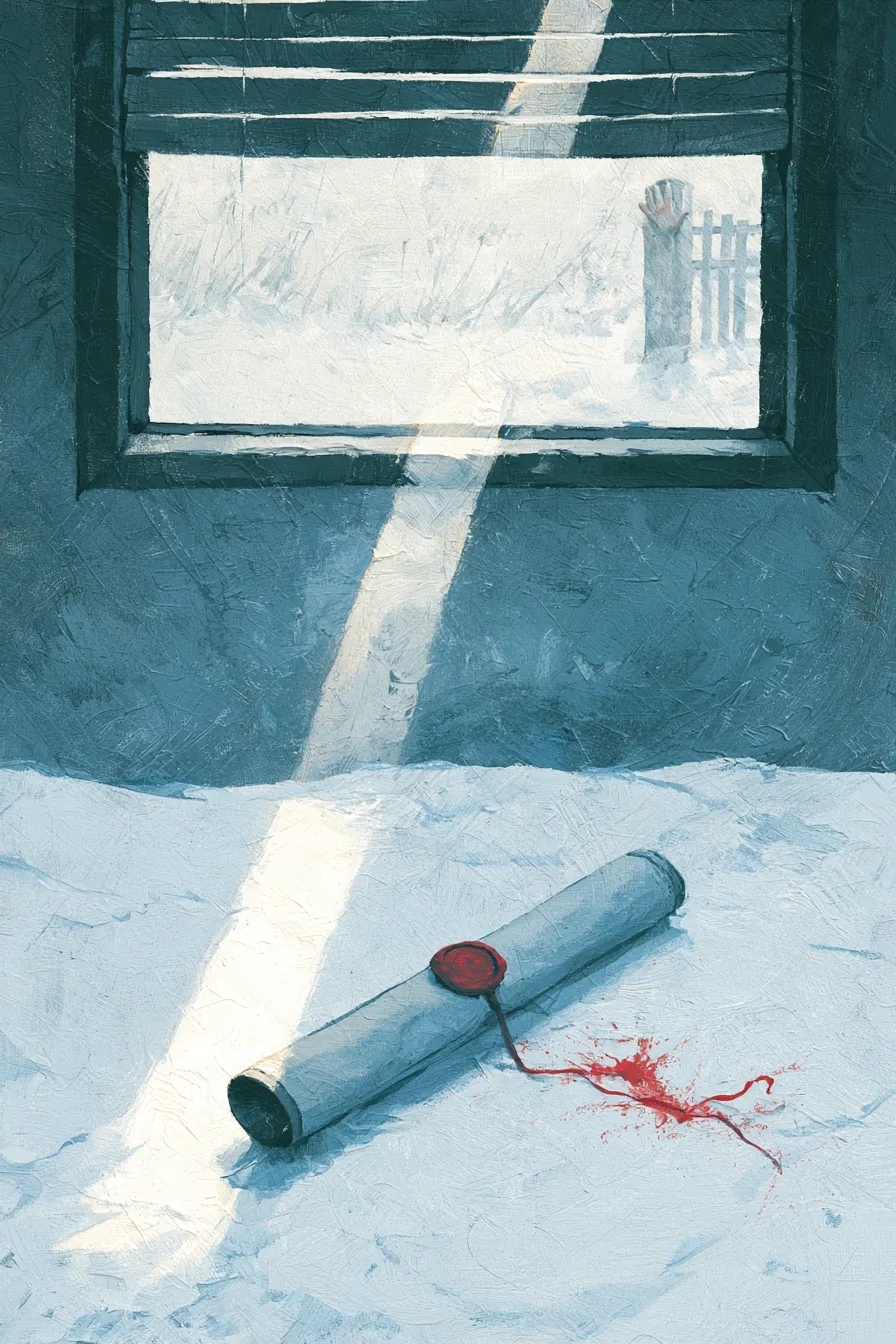
The orange-peel man set the brush at its rest, pressed his seal at the foot of the third sheet, and folded the memorial in the practised fold of a man who had folded a hundred and forty-three at his own table over eighteen years. He slid it into the small lacquered post-tube at his right hand and sealed the tube and tucked it inside his under-sleeve, over his heart. He drank from the porcelain cup of orange-peel tea his secretary had brewed at the changing of the second watch, and set the cup down, and smiled — the small clean smile of a man who has been counting animals for thirty days and has, this morning, been told the count.
"Wolf-girl," he said into the cup, once, and did not say it again.
Three thousand li south, on the salt-fork two hundred li below the Long Wall, in the dark inside of a Bureau wagon at the second watch of the eighteenth night, a woman of forty-six sat against the wall on a folded blanket with her left hand around her son's right wrist and her right hand at the lacquered tube on the thong at her neck.
The tube was the size of a finger-joint. It was the same size, on the same length of thong, as the tube her own mother had given her at the spring sowing of her tenth year, and the tube her grandmother had given her mother at the same age — and the same tube, Madam Lu thought (and her breath caught once), that she had given her own daughter the morning of the kitchen-floor and the shears. Inside it was a small folded square of brown paper. In twenty-three days she had not once taken it out.
The wagon was a box of cold dark that smelled of the things a Bureau wagon carries: pine-tar at the seams, old straw gone sour at the wheel-well, the iron of the door-latch, and under all of it the close animal smell of two people who had been twenty-three days without a wash. Madam Lu had learned the wagon the way she had learned every cage of her life — the orchard at Qiaojia she had chosen, the marriage she had chosen, the silence of nineteen years she had chosen — by feeling for its edges in the dark and finding where the give was. There was give in the north wall, where a board had warped from the wheel-well and let in a finger of cold air and, on it, a smell of the steppe so faint that a southern nose would have called it nothing. She had set her son against that wall. She had set herself beside him with her hand at his wrist and her face to the warped board, and three days into the wagon she had understood why the cold from it did not frighten her: there was a wolf at the other side of it, on the windward, and the wolf was hers, and the wolf had come because her daughter was alive.
She held her son's wrist and said nothing, and the boy said nothing. He had stopped writing on the eleventh day of the wagon, stopped speaking on the twelfth; on the seventeenth he had set his head to the wall at the wheel-well and shut his eyes and not opened them for two watches. She had watched him stop, the way she had once watched her husband's cough deepen across fifteen years and known each new depth for what it was and been able to do nothing — and she had made herself a promise, in the dark of the wagon, that she would not lose this one to silence. She had lost the husband to the salt-foundry's slow iron. She would not lose the boy to the wagon's. So she had begun, on the night the wolf came to the warped board, to talk to him in the smallest voice, in the kitchen-tongue, about nothing — about the rice-pond in the third month, about the way the ducks went in their line, about his sister at six over the New Year cup — to keep a thread of sound running between them in the dark so the boy would have something to hold that was not the silence and the cold and the road south to the Changlin fire.
He opened them at the changing of the third watch that night, and said, in the smallest voice, in the kitchen-tongue of Qiaojia, in the voice he had used at six over the New Year rice-cup: "Mama."
"Anshi."
"The wolf-shadow has been at the wheel-well since the second day."
She waited. "I know."
"He hasn't been at the lee. He's at the windward."
"He has."
"Mama. The windward is the side the wind comes from. The wind's at the north. He's at the north of the wagon — on the side the wind's coming from — and the wind comes off the steppe."
"I know."
His voice went small and certain. "Mama. The wolf-shadow doesn't have a body. He's never had a body. The peddler said the wolf was in her chest. He said it the way you said it to me when I was four and asked you where my sister went at night in the orchard. You said: In her chest, Anshi. The wolf is in her chest. We do not speak of it. I haven't spoken of it in eight years. I'm speaking of it now — because the wolf at the windward wheel-well has a body. He's had a body since the second day. And he's had a body, Mama, because—" He stopped, and made himself finish. "—because my sister has gone into the wolf in her chest, and the wolf has come out of her chest onto the windward side of our wagon, and the wolf at the wheel-well isn't a shadow any more. He's a wolf. He's hers. And he's here for us."
Madam Lu held his wrist and steadied her breath and said, into the wood of the wall, in the kitchen-tongue: "Anshi. Sit. Don't move. Don't speak. Listen."
"Yes, Mama."
"The wolf at the wheel-well is your sister's wolf, and no one else's, and never will be. His being here does not mean she is here. His being here means she is alive. Do you hear me, Anshi?"
"Yes, Mama."
"He will watch — the way a wolf at the orchard watches the daughter who set mutton-fat on his doorstone nineteen years. He'll watch us, every watch, and at the third night past the salt-fork, when our wagon crosses the bridge at the South Fork, he'll be at the windward — and when the wagon is on the south side of the bridge, the wolf will be on the steppe side. Do you hear me?"
"Yes, Mama."
"The bridge at the South Fork is the place — three days from tonight — where the daughter and the wolf will be at the windward of this wagon together. Do you hear me?"
"Yes, Mama."
She lowered her voice further, into the voice her own mother had used at the spring sowing of her tenth year, teaching her the soldier's knot of the binding-cloth at the rib: "The shears are at the kitchen at Qiaojia, Anshi. Not in this wagon. They're at the threshold-stone of the door, and there they will stay. Your sister will come to the wagon at the bridge with a wolf at the windward and a man at her side and a bird at her shoulder. She won't have shears. She'll have what your father had when he set the brown cloth at his hand on the cot the second day — the quiet, ordered thing of a person who has decided. What your sister has carried at the wolf in her chest nineteen years, and what your father carried to the cot. Do you hear me, Anshi?"
"Yes, Mama."
She held his wrist and did not move, and did not open the tube, and did not — as she had not since the morning of the kitchen-floor — say the name aloud.
She had carried the name nineteen years and four months and eleven days, the same as the wolf, the same as the bond, and she had carried it in silence because silence had been the only roof she could build over it. To say it aloud in the empire was to hand the empire the thing it would burn. She had said it once, low, into a cradle-board, with her own mother's hands on the wood beside hers — and her mother had said it after her, Arsulan, little lion, wait — and then she had folded the name into the bowl of her own chest beside the wolf and the steppe-tongue and the bend of the Onon and thirty-one years of a country that had taken her at fifteen, and she had not let it out again. Not when the daughter asked, at four, where her sister went in the orchard at night. Not when the peddler took the daughter's hand in the yard and went white at the lips. Not when the conscription-clerk's drum came up the third creek in the first month and she stood at the kitchen door and watched the only thing she could do unfold, which was to cut the braid and bind the chest and send the daughter north under a dead man's name, into the empire's war, away from the empire's fire. She had not said the name through any of it. The name had been the one thing of the steppe she had kept whole, intact, unspent, against the day it would be needed.
She said it now. Into the wood of the wagon-wall, in the kitchen-tongue, in the voice that had been her own mother's at the spring sowing of her tenth year:
"Arsulan."
She waited, and said it again: "Arsulan. Come."
And a third time: "Arsulan. Come to the bridge."
The wagon was still. The wolf at the windward wheel-well breathed. The boy at her wrist did not move. The folded square of brown paper hung in its tube at her neck. The north wind — the windward wind, the steppe wind, across seven hundred li between the salt-fork and the Iron Gates — held quiet.
She closed her eyes and slept the short shallow sleep of a mother in a Bureau wagon, her hand at her son's wrist, the wolf at the windward, the half-watch passing.
It held to the changing of the third — and at that changing, on the morning of the nineteenth, three thousand li north at the lee of the third frozen creek, in the ger at the lee of the long grey ridge, in the grey light past dawn, a daughter who had not in her first night off the chain said the name of the man asleep one pace from her on the felt said it now, in her sleep, the way her mother had said it three thousand li south into the wood of a wagon-wall:
"Mama."
The man at one pace did not wake. The wolf at her ankles did not lift his head. The bird at the rafter did not shift. The old man at the windward of the fire breathed no differently. The ger held the saying, and the saying went out of the smoke-hole on the wind off the higher plateau, and went south — the slow steppe-wind of the eleventh month, seven hundred li from the ger to the wagon — and laid the daughter's Mama at the windward wheel-well of the Bureau wagon on the salt-fork, the way the bond carries a word across white grass and black sand and the Yellow River and the kitchen-tongue and the steppe-tongue and the eighteen years between a mother and her daughter.
The wolf at the windward lifted his head, and set it down on his paws, and waited. He did not leave the wagon. He had been waiting nineteen years. He could wait three days.