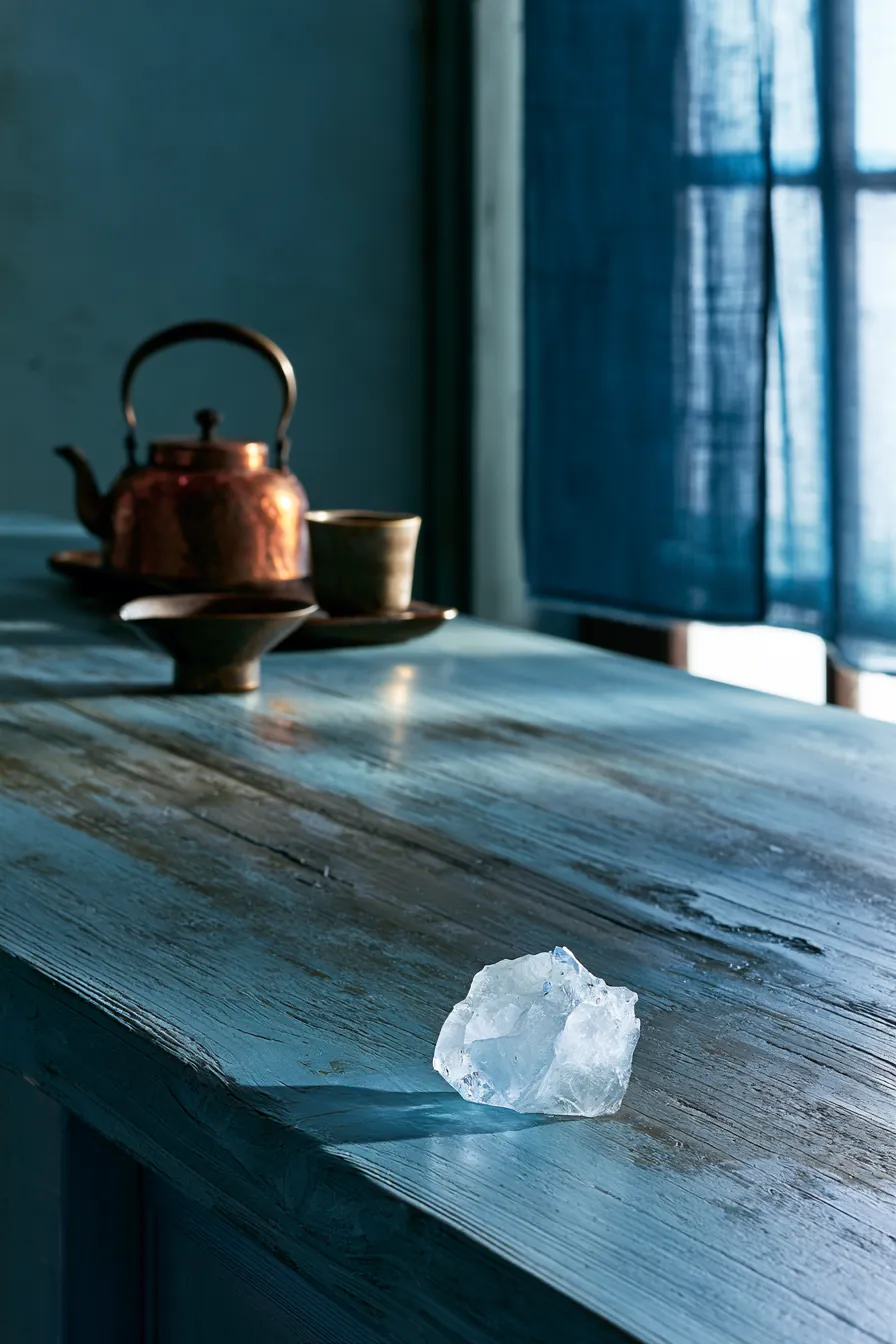
Chapter 6 — Be Careful What You Pour Him
Tuesday came in dry, which in Kyoto in late May was its own kind of weather. The stones in the alley had the matte look of a thing that had been promised rain and not given any, and the air over the tiles smelled of dust and cedar resin and, faintly, of something burning two streets east — somebody's grandmother thinning the wisteria with a charcoal pail. I unlatched the noren at six fifty-eight. I tied the apron. I lit the irori.
The kettle, today, did not sing.
I noticed this, and then I noticed that I had noticed.
Pip arrived from upstairs in a yellow under-kimono I had not seen since Sumire's wardrobe came down out of the attic in 2024 — the bruised-pollen yellow of silks dyed before chemical mordants existed. Pip had paired it with a straw hat the size of a teacup saucer and was, when Pip caught my eye, holding the hat with both fists in front of Pip's chest like a tax inspector.
"Pip."
"Pip is dressed for receiving."
"Receiving whom."
"Today is a Tuesday. Yuki-san comes on Tuesdays. He sometimes comes on Tuesdays."
"He has not come on a Tuesday."
"He has not come on a Tuesday yet. Pip is preparing."
I poured the morning thimble. Pip sat on the till and drank ceremonially and did not say anything else about hats. The rotary phone, on the wall, did not ring. The notebook, in the apron pocket, weighed exactly what a notebook weighs. The kettle, today of all days, kept its mouth shut.
I made the inari-zushi.
I made twelve, which was an unreasonable number for a Tuesday and which I justified to myself in the small careful way one justifies the absurd: Tanaka-san liked one with lunch, sometimes two; Yuki would refuse hers and watch me set the plate down anyway; the Korean girl from yesterday had said she might come back; a tourist might stumble in. Twelve was sensible. Twelve was, by the way, the number you would prepare if you wanted to leave four on the counter at closing without anyone counting.
I was not, today, making them for anyone in particular.
I had begun to grade my lies by produce weight, and a twelve-inari Tuesday was, I had to admit while folding the last rice triangle into its tofu pouch, a three-eggplant lie minimum.
Tanaka-san came at noon. He sat at the second stool, which was his stool, and asked for the usual, which was hojicha and one inari-zushi and the small ceramic dish of pickled myoga that lived in the cooler below the till. I poured. He drank. He looked at the plate of inari-zushi on the back warmer and counted, with the deliberate sleepiness of a tanuki, to twelve.
"Hana-chan."
"Tanaka-san."
"Twelve."
"Twelve."
"On a Tuesday."
"On a Tuesday."
He drank his hojicha. He did not, by the kindness that he had decided years ago was his policy with me, look up. He set the cup down. He turned it a quarter-clockwise. He set it down again.
"Hana-chan, my cousin's wife —"
"The one in Otsu."
"The one in Otsu, yes. She made twenty-four mochi for a New Year's at which only her husband attended."
"Tanaka-san."
"She wrapped them. She wrapped them in cling film and she labeled them with the date and she put them in the freezer and she ate one every Wednesday for six months and she told no one. Hana-chan, the unwrapping of a frozen mochi on a Wednesday alone is a thing I would not, by my own preference, wish on you."
"I am not freezing the inari, Tanaka-san."
"You will eat them."
"I will eat them."
"With genuine appetite."
"With genuine appetite."
"Hana-chan."
"Mm."
"It is a good twelve."
He ate his one inari. He paid in coins. He left a folded thousand on the till that I would, by the small private rule between us, pretend I had not seen until after he left. The bell rang on his way out. The bell, today, was behaving like a bell.
At three Yuki came.
She did not, today, take her usual table. She took the stool at the far end of the counter, the one nearest the genkan, from which she could see the door. She wore the pale-grey yukata with no obi — Yuki's yukata was its own knot, tied somewhere none of us were ever permitted to see — and her hair, today, was loose. I had only seen Yuki with her hair loose once, in a snowstorm in February three years ago, and that had been because she had walked from somewhere near Yase and the wind had argued with her braid the whole way.
"Yuki-san."
"Hana."
"Tea."
"Yes."
I poured. The cold-bowl ice flower bloomed once, drifted, settled. Yuki, today, took the bowl with both hands. This was also new. Yuki ordinarily took the bowl with one — a courtesy, she had explained once, to spare me the suspicion of her cold.
"Hana."
"Mm."
"You have made twelve inari."
"It has been observed."
"You are expecting a great many friends."
"I am expecting the friends I have. The number is an act of optimism."
"Hana."
She rarely used my name without the -san. I set the warming pot down. I sat on the lower step of the genkan, because this was, I knew already, going to be the kind of conversation in which sitting upright would make me a worse listener. Yuki watched me, blue-grey, mountain-still, with her hair down and her hands wrapped around a bowl of tea like a woman warming herself at someone else's hearth.
"Hana, I am going to ask you to do me a kindness."
"All right."
"I have not asked you for a kindness in three years."
"All right."
"Today I am asking. Today I am going to come to closing. Today, when he comes, I would like to be at the third table by the back wall, with my back to the rear curtain, and I would like to drink one bowl of the midnight blend, and I would like to leave a thousand on the counter, and I would like, on the way out, to say one thing to you. And I would like for you not to ask me, while I am here, why I am asking."
I held very still. The yuki-onna at the third table during closing was a thing that had not happened in three years. The yuki-onna had a route — six fifty-eight to seven, ice flower in the cold bowl, three lines per visit, gone before sunset. Yuki at the third table at eleven o'clock was an act outside her grammar.
"Yuki-san."
"Yes."
"I am not going to ask you why."
"Thank you."
"I am, however, going to ask you whether you are well."
She looked at her bowl. The ice flower had not, this afternoon, melted. It had clarified — the way still water clarifies when nothing disturbs it for a long time — and was now a thing the size and shape of a winter plum blossom, with five small petals and a single seed-bead of frost at its center. Yuki ran her thumb, very gently, around the bowl's rim.
"I am not unwell. I am old, Hana, in the small private ways snow is old, and I have seen this stillness before. I am here to drink tea in a room where I have seen this stillness before. It is, on balance, the only useful thing I have to do today."
"All right."
"Hana."
"Mm."
"Do not, today, change your inari recipe."
"It is not going to change."
"Mm. Good."
She set the bowl down. The ice flower stayed whole. She rose. She went, with the small drifting precision of a woman who had been keeping her form together since before the Edo period, to the third table by the back wall, and she sat with her back to the curtain, and she folded her hands in her lap, and she became — by a degree of stillness I had not seen in any of my regulars before — invisible without disappearing.
It was, by the small private mathematics of yuki-onna ceremony, an oath.
Pip, who had been on the highest beam through Yuki's whole counter scene, now slid down onto the second beam and arranged the yellow under-kimono with both small hands. Pip looked at me. Pip did not say anything. Pip understood, in the way Pip understood everything, that today was not a day for Pip's commentary.
I made the midnight blend at ten forty-five with the part of my brain that was still pretending I did not know what I was doing. Sencha base, three pinches of kawara hojicha, two threads of toasted brown rice. The pot was warm. Yuki's cup with the chipped lip was at the third table. The unmarked cup was on the counter at the third stool from the left.
Goro came at ten fifty-six.
This was unscheduled. Goro on a Tuesday at ten fifty-six was a Goro who had decided, on the lower riverbank, that the river had told him something. He came in wet, of course — he was always wet — but he was also breathless in the way a kappa is breathless, which is to say his sara was tipped two degrees toward his temple, which on Goro indicated emotional weather.
"Hana-chan."
"Goro."
He took in the room in one of his quick lateral glances. He clocked Yuki at the third table, registered the loose hair, registered the stillness, and his sara tipped two more degrees.
"Yuki-san."
"Goro-kun."
"You came."
"I came."
"It is, then, today."
"It is today."
Goro did not, ordinarily, address Yuki directly. There was an old kappa-yukai standing arrangement about who acknowledged whom first, and Goro had been on the losing end of it since 1840. He nodded to her. She nodded back. He pulled out the fourth stool — not the third — and sat heavily, with the wet small thud of a kappa whose linen was reaching saturation.
"Hana-chan, cucumber."
"You can wait three minutes."
"I cannot, hana-chan, wait three minutes. The river is in my throat."
I gave him a cucumber. I gave him a glass of water with a slice of cucumber in it as well, because the river-in-throat language was Goro at his most strained and I had learned not to argue. He drank the water. He held the cucumber the way other men hold rosaries.
"Goro."
"Yes."
"You are here because the river told you to be here."
"The river told me to be here. The river told me that Yuki-san would be here. The river did not, hana-chan, tell me whether he would be here. The river is, on the matter of him, becoming reticent. I would like the record to show that the river was, for sixty years before this month, a chatty river."
"Noted."
"I will sit at the fourth stool. I will not interrupt. I will drink my cucumber. I will say one thing if I am asked."
"You are not being asked."
"Yes I am, hana-chan. I am being asked by everyone in this room who has the decency to not ask in words."
He folded his arms over his sara. He set his cap, the wet brown cap, on the counter brim-up. The wet ring it left was not, today, his signature ring. It was a hostage.
The teahouse had three regulars in it. The teahouse had — by the small private mathematics that had been doing its sums under the floorboards since 1962 — quorum.
The bell rang at eleven oh-two.
He came in with his hand already on the noren, which meant he had paused at the entry stones for the small breath he had paused at every night for seven nights, the breath I had not, until tonight, named to myself as his asking. The charcoal coat had a faint shine of mist on the shoulders. The mist had come, evidently, from somewhere east of here that had decided to be wet after all. His shoes were dry. He had walked the alley flat-footed, with the small disinclination of a being who did not, today, want to leave prints.
He saw Yuki before he saw me.
He bowed. It was, by my best read, the same bow he had given to Pip in Ch03 — a tilt of the head deep enough to acknowledge presence, not deep enough to claim acquaintance. Yuki, in her grey yukata with her hair down, returned it. Her bow was, by my best read, two degrees deeper than his. I had never seen Yuki give two degrees to anything in her life.
He saw Goro. He gave Goro a half-bow over the counter, which was the kappa-courteous register. Goro tipped his sara. The water ran into his collar. He did not flinch.
He turned to me.
"Hana."
"Kuzunoha."
His brow flicked. I had not, until that moment, said the name aloud. I had been turning it over in my mouth for a week the way a child turns a hard candy, and the candy had now, by my own decision, come out. He set his hand, briefly, on the counter beside the third stool. He sat.
"Good evening, Hana."
"Good evening."
"You have new company."
"They came, on consideration, because they are friends of the house."
"They came at this hour."
"They came at this hour."
He absorbed this. He did not, by his small visible care, look back at either of them. He set his shoes square. He folded his hands. He did not, by the rule we had developed without speaking it, look at the koi door. The midnight blend was, by then, on the warming pot. I poured. He took the cup with both hands. He set it on the counter. He did not, yet, drink.
"Hana."
"Mm."
"I will not stay long tonight."
"You do not have to explain."
"I would not explain. I would, however, like to be respectful of the company."
Yuki, at the third table, said nothing. Goro, at the fourth stool, said nothing. Pip, on the second beam, said nothing. I poured myself a quarter-cup, which was the first time in seven nights I had poured myself anything in his company. I did not, by my own grace, drink. He drank, once, slowly. He set the cup down.
"The koi is well."
"He is well."
"You have not given him a name."
"He has not, on consideration, accepted any."
"Wise of him."
This was the third time he had said wise of him about the koi, and I noted, with the part of myself that I had been keeping in the lacquer chest, that he was using the koi as a small safe ground we could both stand on while the rest of the room watched us. I appreciated it. I did not show that I appreciated it. I refolded the apron string.
He drank the second sip. He did not finish the cup. He stood.
"Hana."
"Mm."
"Thank you for the tea."
"Of course."
"I will return tomorrow if the company permits."
"The company permits."
He bowed to Yuki — same depth, returned at the same depth. He bowed to Goro — kappa register, half. He looked, for half a beat, at Pip on the second beam. Pip held very still. He inclined his head to Pip in the way of a man acknowledging a senior in a corridor. Pip's small fists, on the yellow kimono, loosened by precisely one knuckle.
He left. The bell rang behind him. The bell, tonight, was sober.
Yuki rose.
She came to the counter with the cup with the chipped lip in both hands, and she set it down beside Kuzunoha's half-drunk midnight blend, and she set, beside that, a folded thousand-yen note. She did not put on shoes; her shoes were already by the threshold, the small white sandals she had worn since 1973. She tied no obi because she did not, by her nature, require one. She looked at me.
"Hana."
"Yuki-san."
"I will say my one thing now."
"Yes."
"Be careful what you pour him."
A long beat. The kettle, on the irori, sang once and stopped.
"Yuki-san."
"Yes."
"Why."
"Because I have seen this stillness before. Not this man. This kind of stillness. The last woman who poured for it was kind, and she was clever, and she was kind to me on a winter night in 1949 when I had nowhere to go, and she paid for her kindness across the back half of her life in a currency the rest of us do not, in this room, owe."
"Yuki-san."
"Yes."
"Was she my great-aunt."
A long beat. Yuki at the counter with her hair down looked, for the first time in three years, every one of her four hundred years.
"I did not, on consideration, come here to say. I came here to say be careful. The other matter is yours to find."
"All right."
"Hana."
"Mm."
"He is not the one to be careful of. The stillness is. He is, by his nature, a man who would let the stillness take you. He would, by his nature, mistake that for restraint."
"Yuki-san."
"Hana."
She lifted her hand. She did not, by her nature, touch me. She let her hand hover, white as paper, an inch from my cheek. The cold came off her palm in the small honest way a winter window radiates cold. She lowered her hand. She bowed.
"Goro-kun."
"Yuki-san."
"Walk me to the alley."
"I will."
He stood. He put his cap back on. He took the empty cucumber glass with him — Goro never left a glass — and he went, with the small kappa-grave courtesy of a man who had been invited, after a hundred and eighty years of being not-quite-invited, to a yuki-onna's elbow.
The door closed behind them.
The teahouse, for the first time on a Tuesday night, was quiet in the way it had not been quiet in three years. It was the quiet of a room that had just been used for an oath.
Pip slid down from the second beam, dragging the yellow under-kimono behind. Pip sat on the counter beside Kuzunoha's half-drunk cup. Pip did not touch the cup. Pip put both fists in front of Pip's small chest in the tax-inspector pose. Pip looked at me.
"Pip."
"Pip."
"Pip has been listening."
"Yes."
"Pip is, on consideration, frightened."
"What of."
"Pip is frightened of the stillness."
I sat on the lower step of the genkan. I let myself, for one minute, sit. I refolded the apron string. I refolded it again. I refolded it a third time, because the third was the one in which my hands stopped wanting to do anything else.
I went to the third table. I picked up Yuki's bowl. The ice flower, on the bottom, had not melted. It was still the winter plum blossom, five petals and one seed of frost. I set the bowl on the counter beside Kuzunoha's half-drunk cup.
I knew that Yuki had sat at the third table for three hours and had said five sentences, one of them an oath. I knew Goro had walked her to the alley with his cap on. I knew the ice flower had not melted, and the kettle had stopped on its own, and Pip was, in the matter of stillness, frightened.
I poured the last of the cold midnight blend into the koi pond. The koi surfaced once. He looked at me with his one good eye, the brown one, and went down again.
I closed the noren. I hung the wooden plaque. I slid the outer door three-quarters shut.
I took the notebook from the apron pocket. I opened it to a fresh page. I held the brush. I did not write I do not want to forget what Yuki said. I did not write I do not want to forget that Goro walked her home. I did not write I do not want to forget the way he looked, half a beat, at Pip.
I wrote, in the smallest neat hand the brush would give me:
The stillness is not him. The stillness is what would happen if he were not careful.
I closed the notebook. I put it back. I went upstairs. The kettle, on the irori, did not sing.
At three in the morning, in the dark of the upstairs room, I lay with my hands folded on my stomach and considered what it would mean to be careful for two.
The cicadas in the wrong week kept on rasping their thin papery rasp.
I did not sleep. But I did, for the first time in three years, lie awake on purpose.