Chapter 7 — Drone
Wednesday was a Wednesday.
I am putting it like that on purpose. Wednesday was the name of the day Akiko and I had set for coffee at a kissaten near Yasaka, and so the day arrived already wearing the name of a place I would have to go to, and the rest of it had to be done in the spaces around the appointment.
I lit the irori at seven. I set out two cups: Tanaka-san's and Yuki's. The unmarked cup I left on the shelf, face down.
Pip noticed.
Pip is a six-year-old who has been six for a hundred and seventy years; one learns, after the first few decades, to notice cups left face down on a Wednesday. Pip arrived in the unfaded red kimono and climbed the till and looked at the shelf and looked at me. Pip's restraint had limits.
"Pip."
"Pip is not asking."
"Pip is hovering at the precise distance from the shelf at which Pip would be asking, if Pip were asking."
"Pip is not asking loudly."
"Pip is going to be told nothing."
"Pip will, then, fold a fox out of the receipt for the cabbage."
"You will not."
"It is a Wednesday, hana-chan."
I gave Pip a thimble of genmaicha. Pip drank it, gravely, and went to the back garden to explain to the koi that the household was off-kilter today and the koi was not, by the household's rules, allowed to mind. The koi surfaced once. He minded. Pip ignored this.
I tied the apron. I retied it. I retied it a third time. Three knots is not, for the record, a good Wednesday morning.
Sarutahiko had a brass plate by the door that said est. 1957, a hand-painted notice that said no laptops, please, and a smell — coffee, beeswax, an old man's tobacco the shop's grandfather had refused to let leave — that arrived at the door before I did.
Akiko was already there, at the small table by the window. She had her hair down, the grandmother's grey clip on her saucer where I could see it. She was wearing the oatmeal cardigan she had worn in our second year at the Library — two missing buttons, the elbows reinforced in her own hand in 2017 with thread from the dye-house lane at Nishijin. She had not, in eight years, replaced the buttons.
I sat. She did not stand. We did not embrace. We had not embraced at twenty-five, when her father died, or at twenty-six, when my exile was filed, and we had — by an agreement we had never spoken aloud — kept that practice. She lifted her cortado. I ordered nothing, and then, because the master behind the counter had been watching me the way old kissaten masters watch any woman under forty who orders nothing, I ordered a cortado as well.
"Hana."
"Akiko."
"You came."
"I came."
She looked at her cortado. She did not lift it again. She put her hands flat on the table — clean unpolished nails, two thin silver rings on her right hand, one of which I had given her on her twenty-third birthday and which she had not, in seven years, put away.
"Hana."
"Yes."
"I am going to tell you three things. None of them is in my brief. I am telling you because you are the person who taught me to bind a paper crane, and because the alternative would be a thing I would not, on balance, survive."
"All right."
"One. The third operative — the one who unhappened at the alley mouth on Friday — did not unhappen. He has been moved. By somebody who knows the river. He is alive. He is in a temple on the lower slope of Higashiyama, in a binding-induced sleep, with the small note pinned to his collar saying please feed him soup. The temple priest has been feeding him soup. He has been alive since Friday. We were not told. We were not told because the person who moved him does not want us to send another one."
"Akiko."
"Two. The two who did die at the bridges — at Sanjō, at Shijō — were not killed by the being whose drones have been turning up dead. They were killed by somebody else. The throats are right. The cuts are wrong. The throat-tearing on a Hand operative leaves a particular vibration in the kotodama-bound collar tag; the two collar tags we recovered are humming the wrong frequency for a kitsune kill. They are humming, very specifically, at the frequency of a being with no clan."
A long beat.
"Akiko."
"Three. The guild knows this. The guild has been deciding, for eleven days, whether to tell him. The delay is at the request of an Elder who has reasons of his own. The man who is most not on the list of people permitted to know is the man drinking your midnight blend, and I would rather end my career than let him not know. The Hand is in the wrong on this."
I held the cortado. I did not drink. I looked at the small clip on the saucer.
"Akiko."
"Yes."
"You have not put your hair up."
"I have not, no. I will not."
"You came without a binding tag."
"I left my phone in a friend's mailbox. I have, by my counting, two more such Wednesdays in my life. I will spend them well."
The kissaten master ground beans for somebody else. The window let in the light two friends who had been twenty-two together had been waiting for.
"Akiko."
"Hana."
"Thank you."
"Do not thank me."
"I thanked you."
She drank the cortado in one swallow. She set the clip on her saucer. She did not put it back in her bag.
"Tell him."
"I will."
She bowed three degrees deeper than she had bowed in eight years and went, in the cardigan with the elbows mended, into the lane where her phone was not.
I drank the cortado. It was good. I had forgotten that a cortado, properly made, could be good.
I walked home along the Kamogawa. The herons were on the book-shaped stone. They did not look at me. They never did. I noted, today, that I had not counted to anything once.
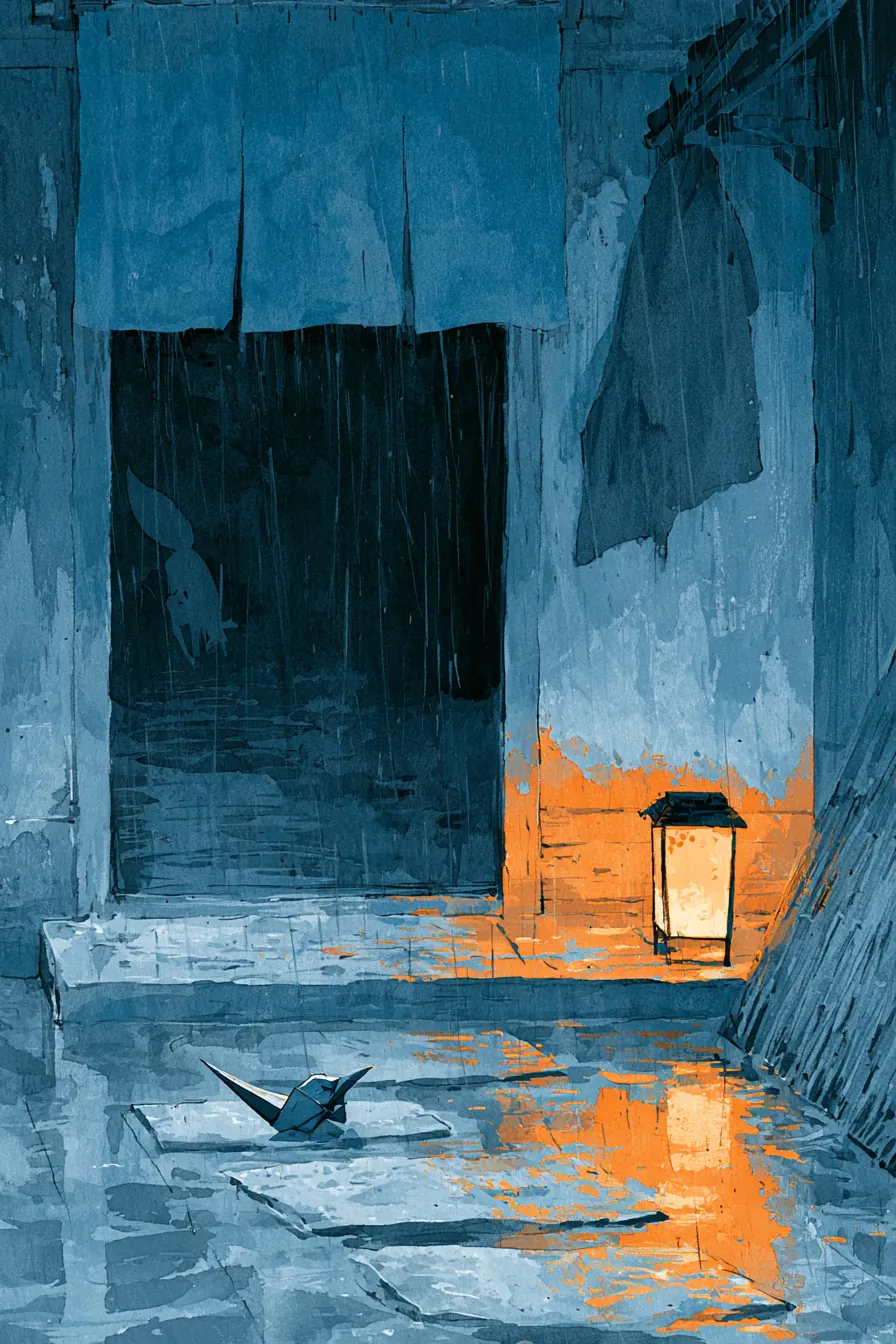
It rained at four. By eight the noren was heavy with it. By ten the wrong-week cicadas had finally agreed to be quiet, and the only sound at the back of the teahouse was the koi pond taking raindrops and giving them, at intervals, back.
I made the midnight blend at ten thirty. I made it because I was ready to admit to myself I would make it whether he came or not, and because admitting things to oneself, in a small chamber of oneself, was the only honest accounting available to a witch in exile.
The bell rang at eleven oh-three.
He was wet. He was, by my reckoning, wetter than a being whose nature included an old courtesy with water should have been; the charcoal coat had darkened across the shoulders into the black-brown of soaked wool, and his hair, when he ducked the noren, was beaded along the part. He did not, tonight, pause at the entry stones. He came in fast and turned at the threshold and looked, for half a beat, back at the alley.
I had never seen him look back at the alley before.
"Kuzunoha."
"Hana."
"You are checking."
"I am checking."
"For what."
"For something that should not be here."
I poured. I did not pour the midnight blend; I poured him a cup of plain hot water with two threads of brown rice, which was the thing I poured for a man who needed to put a cup against his hands and not have his attention asked for by tea. He took it. He set it on the counter. He did not, tonight, sit.
"Hana."
"Yes."
"I am going to ask you to do something I have not asked. I would like you to step away from the counter and stand beside the irori. I would like you to keep Pip behind you. I would like to remain at the threshold until I am certain we are alone."
A long beat. The kettle, on the irori, sang once and stopped.
"All right."
I stepped to the irori. I called Pip with the small clucking sound I had used when Pip was very young — a sound I had not used in two years. Pip came down from the second beam without a word and went, with the grave economy of a child who has been told to be quiet in a room where adults are doing adult things, to my left ankle, where Pip pressed itself against my apron and went still. The unfaded red kimono trembled. Pip was, in fact, frightened.
He stood at the threshold for a long minute. He listened. He listened in the way he had listened, the first night, to the kettle — head tilted three degrees, the focus of a being for whom hearing was an act of governance. The rain came down. The plane trees three streets over kept their counsel. The koi pond surface kept on taking and returning rain.
Then he stepped forward, sharply, and slid the outer door home, and turned to me, and said, low, "It is in the alley. Do not go to the front."
A long beat.
"Kuzunoha."
"Hana."
"What is in the alley."
"A guild drone. The third generation. It has been following me for the last fourteen minutes. It is, by its programming, going to attempt to crest the noren at the entry stones and photograph the back of my head."
The air went out of the room.
The air went out of the room the way air goes out of a room when a witch in exile, who has not cast in two years, suddenly hears in her own kitchen the specific kotodama-bound mechanism of a Hand sparrow at the door of her wards. I felt it. I felt it the way one feels a paper edge against the back of the hand — fine, definite, present. The sparrow was at the entry stones. I felt its small bound heartbeat. I felt, as you only feel from inside a properly tuned ward, the precise pitch of the binding seal on its breast: an Elder's brushwork, ninth century, the same kanji Goro had put on my table the day before.
"Hana."
"Mm."
"Do not, please."
"Kuzunoha."
"Hana. I will leave. I will go out the back. It will follow me. It will not photograph you. It will not photograph Pip. It will, however, follow me, and the river will, at four o'clock on Friday afternoon, deliver it to Goro. This is, please, the arrangement I have."
"It is not, tonight, the arrangement I have."
He looked at me.
He had not, in seven nights, looked at me without the small filter of his composure between us. The filter was, by my best read, ninth-century brushwork; it had been put on him before he had been alive long enough to know to set it. Tonight, in the wet at the threshold of a teahouse that had been mine for three years and Sumire's for sixty before me, the filter was — for half a beat — off.
He was 1,200 years old, and he was afraid for me.
"Hana."
"Step inside. Close the inner curtain. I am going to ask you to keep your eyes on Pip, because Pip is going to be the small live thing in this room whose unfrightening matters most. I would like you, in addition, to not interfere."
"Hana."
"Kuzunoha."
"You will pay."
"I will pay."
He stepped inside. He drew the inner indigo curtain. He went, with the small held breath of a being whose nature included rivers and his own old discipline, to the second beam, where Pip's morning thimble sat empty on a cross-tie, and he held his hand out, palm up, low. Pip looked up at me. I nodded. Pip went, with the small soft step of a child who had been entrusted, to his palm. He cradled Pip in both hands at the level of his sternum, the way one cradles a moth one is going to release. He did not, by my best read, breathe.
I went to the threshold.
I drew the noren back half an inch.
The drone was on the third entry stone. It was the size and shape of a sparrow. Its eyes were the two pinpricks of glass I had held on the breast of the dead drone in my back room twenty-four hours ago. The paper seal on its breast was — by my honest read at half an inch — the same brushwork. It tipped its head once. It calibrated. It took, with the small precise motion of an Elder's bound bird, the photograph that would, in any other Wednesday of my life, have rendered me visible to the Hand for the rest of my life.
I spoke one word.
It was, on the page if I had to write it later, two syllables — the small classical verb for quiet, in the imperative familiar, with the particle that turned an instruction into a binding. I had spoken it on a Tuesday in November of 2023, in a room in the upper Library, in the company of the master who had taught it to me, and I had not, since then, said it aloud. I said it now in the small kitchen-witch voice I had been keeping for the kettle.
The sparrow dropped.
It dropped onto the third entry stone with the small flat thud of a thing whose binding had been undone from inside; the kotodama I had spoken had not broken the seal, the way Kuzunoha's claw had broken the seal in the river, but had instead — by the small old grammar I had been kept in exile from — answered the seal. The Elder's binding had said follow. I had said quiet. The sparrow, given two contradictory instructions by two voices it recognized as authoritative, had chosen the more recent. It had quieted. It lay on the wet stone with its two carbon panels folded.
The price arrived immediately.
It arrived the way a price arrives — not with pain, not with a sound, but with the small specific clearing of a shelf in my interior. Something I had been keeping somewhere just under the breastbone — a thing I had not, until this moment, known I was keeping — was taken. I did not know what it was. I would not know what it was, by the rule of kotodama prices, until somebody asked me, in casual conversation, about a thing that should have been there and was not.
I stepped back. I drew the noren back. I closed the outer door.
I turned around.
He was still cradling Pip. Pip was, in his palms, very still. His eyes were on me.
"Hana."
"Mm."
"You cast."
"I cast."
A long beat.
"Hana."
"Kuzunoha."
He set Pip down on the counter. Pip did not move. He stepped, with the small held step of a man crossing a threshold he had decided was sacred, to the irori. He stopped one tatami from me. He did not, by his own old discipline, come closer.
"Hana."
"Yes."
"I will fetch the drone in the morning. I will take it to the river. The river will, on Friday, deliver it to Goro. The drone is, by the rules of the place we now find ourselves in, a thing the Hand will not be told about. That is — that is the agreement I will make, on your behalf, with the river."
"All right."
"Hana."
"Yes."
"You should not have cast."
"I know."
"I would have led it away."
"I know."
"You cast anyway."
"I cast anyway."
A long beat.
"Hana."
"Mm."
"My name is Kuzunoha."
I looked at him. I had said the name to him last night and he had not, until now, confirmed it. He bowed. It was the bow Tanaka-san gave his mother's memorial tablet at the New Year — the four-degree bow that was, in old Kyoto grammar, the gift of a thing one is permitted to keep.
"Thank you for your tea, Hana."
"You are welcome."
He stepped past me, slowly, to the door. He laid one hand, briefly, on the doorframe — not on me, on the wood — and he said, in the low voice he had used for I have been consoling it, "If you find, in the next week, that you have lost a thing, please tell me. The price you paid was for me. I would like to bear at least the knowledge of it."
"All right."
"Hana."
"Yes."
"Lock the outer door."
"I will."
He slid the door. He stepped onto the wet stone where the drone was. He picked the drone up without looking down. He wrapped it in a piece of his coat lining — there was, evidently, a coat lining built for this — and he went, with the small steady step of a man walking through rain that had been, by some old arrangement, agreed not to soak him further, into the alley.
I closed the outer door. I slid the lock. I turned the key, the heavy old key Sumire had used, and the key bit into the cedar the way it always did.
I went to Pip on the counter.
"Pip."
"Pip."
"Pip is all right."
"Pip is all right."
"Pip."
"Pip is, hana-chan, not all right."
"I know."
I picked Pip up. I held Pip against my shoulder, which was not a thing I had ever done, because Pip did not, in seven years of co-living, request such a thing. Pip's small fists curled at the edge of my collar. Pip did not, by Pip's nature, weigh anything. But the weight of a six-year-old's fists at the edge of a collar is, on a Wednesday in late May at eleven thirty, a weight all the same.
I sat on the lower step of the genkan. I held Pip. I did not, for a long while, do anything else.
The kettle, on the irori, sang.
I lifted it. I set it back.
I had cast.
I had broken every promise I had made to myself in November of 2023, in a small upper room of the Library, in the presence of a master who had given me, the night before he filed the exile, the only true mercy he had — don't, hana, if you can avoid it, ever again, for any reason.
I had broken it in a kitchen, for a man whose name I had begun saying out loud, against a sparrow bearing an Elder's seal, on a Wednesday in the rain.
I sat on the lower step and held Pip and listened to the rain. The notebook was in the apron pocket. I did not, tonight, take it out. I knew already what I would have to write in it eventually. I knew I would not, tonight, know what to write.
At one in the morning Pip went to sleep against my collar, which Pip did not, by Pip's nature, do. I carried Pip upstairs. I put Pip in the small folded blanket at the foot of my futon. I did not sleep. I lay in the dark with my hands folded on my stomach and tried, with the part of myself that had been keeping itself in a lacquer chest for two years, to remember the dorm room at the Library where Akiko had taught me to bind a paper crane.
I remembered the room.
I remembered the long northern light. I remembered the smell of the tatami in summer, and the precise pitch of the dormitory bell that rang at six, and the chip in the lacquered side of the desk where I had, in 2017, set down a heavy book without thinking. I remembered all of it.
I could not, by any effort of my will, remember the smell of the dorm.
I had been able to remember the smell at six this morning. I had thought of it, idly, while tying the apron — the smell of warmed cedar with a thin underlayer of incense from the corridor altar — and I had had it, and now, at three in the morning, the smell was gone. The shape of remembering it was there. The remembering itself was not.
It was a kotodama price.
The price was the dorm-smell. By the rule of kotodama prices, a thing I would not in this life be able to remember again.
I had cast a binding to protect a being I had begun, against my will, to want. I had paid a thing I could not, by any later effort, take back.
I closed my eyes. I did not sleep. But somewhere under the breastbone, in the chamber I had been keeping shut for two years, the door — by an unmeasurable fraction — came further open.