Chapter 8 — Threshold
I went down to the cellar at dawn.
I had not gone down in two years and four months, which was almost exactly the time since I had stopped being a witch who cast. There was no door, properly speaking — there was the cedar trapdoor in the back room behind the second tatami, which Sumire had cut with her own hand in 1968 and weighted, on the underside, with a flat stone the river had given her one summer in exchange for, by her account, nothing in particular.
I lifted the tatami. I lifted the trapdoor.
The smell that came up had been waiting two years for somebody to come down. Paper in the dark. Cedar a long time without wind. The ash-resin tang of wardpaper hung against open earth. Not the sad smell I had braced for. The smell of a small library at the end of a holiday that had gone on too long.
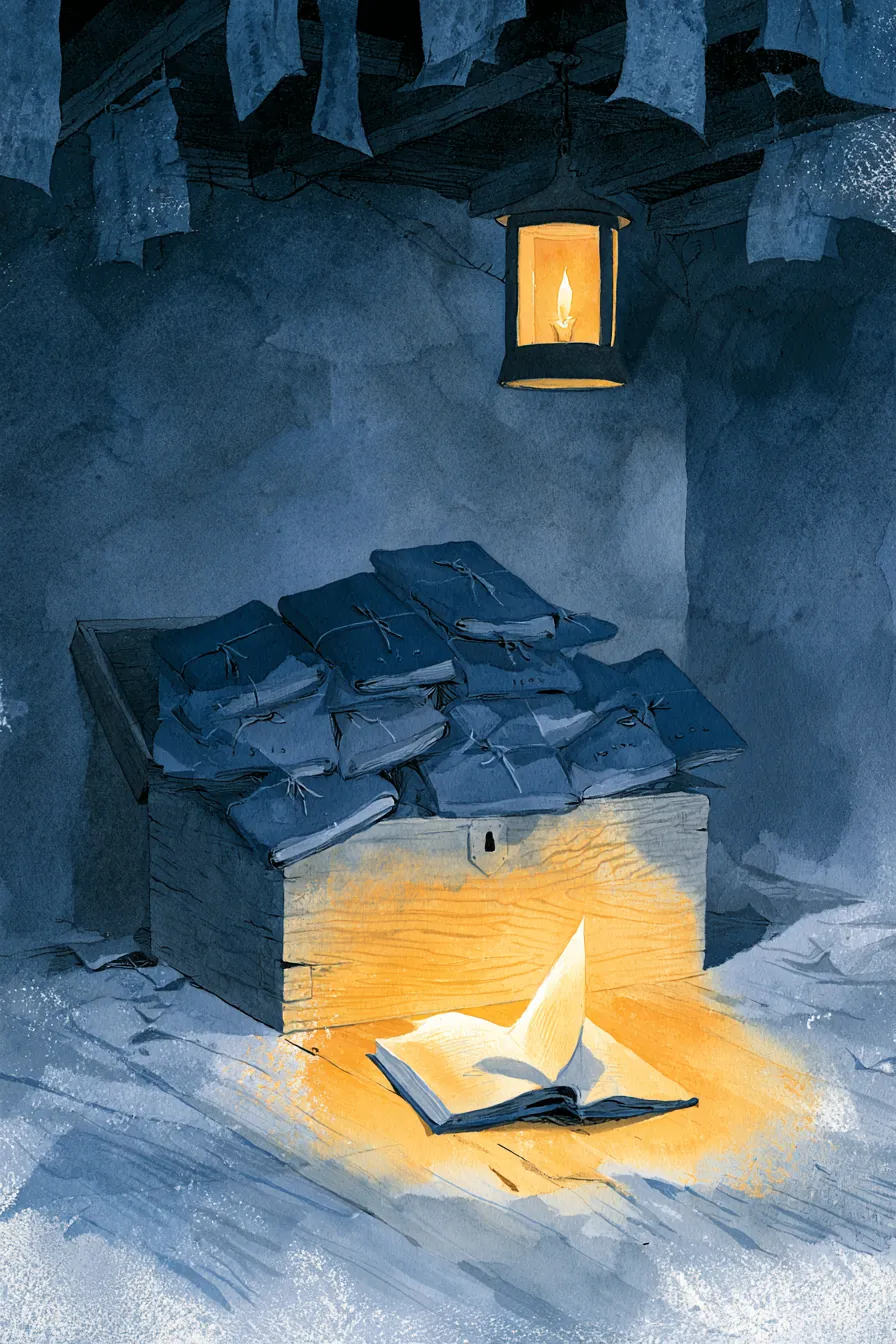
I went down the four steps with a lantern.
There were seven wardpapers, hung from the rafters of the foundation room, in the original positions Sumire had set in 1968. They were the same seven I had felt humming through the floorboards for two years. From below, I could see what I had not seen from above: that the wardpaper at the back-right — the one that had been tuning itself upward since Friday — was the only paper whose brush had not, by my own hand, been redrawn in 2023. Sumire's brush. Older ink, browner around the kanji's stem. The other six were mine, set a quarter-tone below where they wanted. The seventh was hers, set, by an old hand and an older intention, at the pitch the room had asked for.
I stood on the bottom step a long minute. I did not, in the matter of the back-right ward, do anything.
I went to the altar.
The altar held the household tablet, the framed photograph her brother had taken of Sumire in 1962, and one stick of incense I had replaced three years ago. In the photograph Sumire was thirty-eight and laughing at something off the frame, her left hand on the Sanjō Bridge railing the way one holds something one has been told to let go of.
I lit the incense. I bowed. I went to the cedar chest in the corner.
The chest had no lock. There was, instead, an old family habit of leaving the lid one careful inch off. The inch was its own password — to anyone who did not know the household, the chest would seem incompletely closed and they would, by old Kyoto courtesy, set it right. The inch had been there in 1968, in 2024 when I moved in, and was there now.
I had lifted the lid an inch further by accident in 2024, panicked, and shut it again. I had not, in the two years since, opened it.
I lifted the lid.
The diaries were inside.
Forty volumes, in the small dark-blue cloth bindings Sumire had made herself, with the slim cotton ties and the brushed labels: 1963. 1964. 1965. I had known they were there. I had known, in the abstract way one knows about a thing one is keeping from oneself, that Sumire had begun the diary the year she had taken over the teahouse and that she had ended it six weeks before she died. Forty years, give or take. The forty volumes had been one of the things the executor had said, in 2024, in the same dry voice an executor uses when he is asking you to acknowledge a fact you have not yet been ready for, and there are also, in the cedar chest below, forty volumes of — and I had said, I cannot, today, take possession, and he had bowed, and the inch had stayed an inch.
I took out the first volume.
1963.
I sat on the cedar floor with my back against the foundation wall and opened it.
Sumire was thirty-nine. The brush was firm — the firmest hand I would, across the next two hours, find in the forty. She had taken over from her aunt that spring; the teahouse, in 1963, was already a hundred and forty years old and was, by Sumire's account, in worse condition than my aunt was willing to admit. The first page was the inventory she had taken on her second day. Three iron pots, two cracked. Twenty-eight cups, of which seven are mismatched and four are chipped — keep the chipped, replace the mismatched. Six pairs of chopsticks, four of which are children's. The koi, four years old. The koi line had a small notation in her later hand: eventually he will refuse names.
I held very still on the cedar floor.
I turned the page.
The next entry was March of 1963 and was the entry I had been afraid of without knowing it. I am going to quote it.
He came in at closing. I tried to refuse him. He sat anyway. He was wearing a charcoal coat which had, on the shoulders, a faint dampness even though there had been no rain in two days. He paid for a single cup of hojicha with a coin which I did not, by the lantern, examine. He asked the koi's name. I said the koi did not have a name. He said wise of him.
I read the entry twice.
I did not, on the cedar floor, do anything else for one long minute.
The brushwork was Sumire's. The brushwork was Sumire's in the firm thirty-nine-year-old hand. There was no ambiguity. There was no possibility of misreading the date. The entry had been written in March of 1963, sixty-three years and two months before the entry I had not, yesterday, written in my apron-pocket notebook about a man in a charcoal coat who had asked the koi's name.
I turned the page.
He came again at the second Tuesday in April. He came on Tuesday because Tuesday is the night the cabbage man brings the second cabbage. He had not, by any sign I could read, met the cabbage man before. He bowed to him. The cabbage man, who is a tanuki by the river-stones at Demachi and who you have not met yet, also bowed. They did not, in my presence, exchange names.
I closed the volume.
I sat with it in my lap. The lantern in the foundation room moved one degree on its hook in a draft I could not, by any honest reading of the room, account for. Pip, who had not been allowed down here since Sumire's death and who had nevertheless, in the seven years since, asked once a season to be allowed, now stood at the top of the cellar stairs in the unfaded red kimono with the lantern light on the small fox-faced doll of its mouth. Pip did not, by Pip's nature, descend.
"Pip."
"Pip."
"Pip can come down."
"Pip cannot."
"Pip."
"Pip is not permitted by the wards. Pip has tried."
I looked up. The wardpaper at the back-right — Sumire's — was humming a half-tone louder than it had been. Pip's small hand, on the upper threshold board, was not crossing the line of the wardpaper. By Sumire's setting, evidently, the cellar was a room Pip was not permitted to enter alone. By Sumire's setting, evidently, I was the only being in the household permitted to read these volumes.
"Pip."
"Yes."
"Stay there. Talk to me."
"Pip can talk to you from here."
"Tell me what you remember about her."
"About Sumire-obaba."
"Yes."
Pip thought for a long minute. Pip's small fists were on the threshold board. Pip's hair, in the lantern light from below, had taken on the same bruised-pollen yellow as yesterday's under-kimono.
"Pip remembers that Sumire-obaba sang in the kitchen when nobody else could hear."
"What did she sing."
"Pip will not, by Pip's nature, remember the words. Pip remembers that the songs were not the songs anybody else sang."
"All right."
"Pip remembers that Sumire-obaba set out three cups at closing for forty years."
"Three cups."
"Three. Hers. Tanaka-san's grandfather's. And the unmarked one. The unmarked one was for the man with the charcoal coat. He was there for forty years, hana-chan. He was there for forty years and then he was not. He stopped, six weeks before she died. Pip thought it was Pip's fault."
"Pip."
"Pip thought, for a while, that the man stopped because Pip had been folding too many foxes out of the receipts and Pip had, in Pip's pride, frightened him. Pip has, since the funeral, understood it was not Pip. Pip has not, since the funeral, been entirely sure what it was."
I sat with this. I did not, for a long while, do anything. The wardpaper at the back-right hummed at the pitch the room had asked for. The koi, somewhere above me, surfaced once. The kettle, in the front room two floors up, sang, then stopped on its own.
I took out volume nineteen — middle of the stack, my hand reaching by instinct rather than method.
1982.
Sumire was fifty-eight. The brush was lighter — not weaker, but easier with itself, the way a brush gets easier with itself when its owner has stopped being afraid of running out of ink. The first entry I opened to was a May entry.
Twenty years tonight. I will not write the obvious thing. The obvious thing is the kind of thing one writes at year three and is too shy by year five. By year twenty the writing of it has become a thing one does inside oneself instead, with both hands, the way one folds a fitted sheet. Tonight I will say only: I learned the koi has a name. I will not write it. He told me. He said it to the koi himself. The koi accepted. I will not, on this page, say the name of the koi.
I closed volume nineteen.
I took out the last volume.
2018.
It was the thinnest of the forty. Sumire was ninety-four. The brush was the brush of a hand that was no longer reliable in the matter of fine downstrokes; the kanji wavered at their tails, and the ink had been mixed wet, in the way old women mix ink when they have decided they will not, today, struggle with dry. The first entries were short. Cabbage man. Rain. Yuki-san. Cabbage man. I read forward.
Six weeks before her death, the entries lengthened. I read three. I will give you only the last sentence of each:
He has not come since the snow.
I have not, by anyone's account, been alone in this house in forty years. I have, this week, been alone in this house.
The koi has gone to the bottom of the pond. He does this when his name has been put down for the season. I will not, by my own grace, ask him to come up.
The very last entry, written four days before Sumire's death, was a single line.
I never spoke his name. I want him to know it was never a refusal. It was the only gift I had to give.
I closed the volume.
I sat on the cedar floor. I let the lantern do its small unsteady work. Pip, at the top of the stairs, did not say anything. The wardpapers, in the room with me, hummed at the pitch Sumire had set in 1968 and which I had, by my exile-grade caution, set a quarter-tone below for two years and which my own house had, in three nights, brought back up to where it was meant to be.
I had, by all accounts I had been given since the age of seven, been told that my great-aunt died alone.
I had been told this by my mother. I had been told this by my mother's sister, who told me at the funeral and then again at the seventh-week service and then again at the first New Year. I had been told this by the executor, who had used the word alone in his dry voice during the inheritance disclosure, as if it were a category of estate. I had been told this by my own habit of repeating it to myself, in 2024, when I had moved into the teahouse and had needed to assemble — out of the materials a thirty-one-year-old has on hand — a story I could live in. She died alone, and I will not. That had been the story.
The story, as it turned out, had been the wrong story.
She had not died alone. She had spent forty years not alone. She had, six weeks before her death, become alone — for reasons the diary did not, by Sumire's own carefulness, explain — and she had died, six weeks later, the way a woman dies who has been forty years not-alone and is now, against her preference, alone.
There was a difference.
I sat with the difference. I sat with it for a long time. The lantern moved another degree. Pip, at the top of the stairs, sat down on the threshold board.
I took the first volume in my left hand and the nineteenth in my right and the last in my apron. I went up the four steps. Pip stepped back to make room. I closed the trapdoor. I set the tatami back. I bowed to the back-room altar, with the volumes against my chest, and I went up to the front room.
I made tea.
I made hojicha, because it was the tea Sumire had drunk in volume one and the tea she had drunk in volume nineteen and the tea she had not, by 2018, been able to drink because her stomach had begun to refuse roasted leaf. I made it well. I poured one cup for me and one cup for the empty stool at the third position from the left — not because I was setting a place for him at six in the morning, which I was not, but because the place by then was, by its nature, the place a cup went. I sat at the counter. I drank.
I read volume one front to back over the course of three hours. The morning regulars were not coming today; I had, before going down to the cellar, hung the closed placard on the noren. I read the first thirteen months of Sumire's tenancy. I read how she came to know Tanaka-san's grandfather (the same beige cardigan, the same cousin in Otsu, the same naa); I read how she met Yuki one snowstorm in 1964 and how Yuki had, in her one-line way, said, be careful what you pour him, and how Sumire had, in her diary, written, Yuki said the thing I am going to spend my life thinking about; I read how Goro's father had brought her cucumbers across the river for two years until the day Goro himself, then twelve, had brought one in his father's place because his father had been consigned to the deep pool, which I would later learn meant kappa funeral.
I read about the man in the charcoal coat.
I read about him in fifteen entries spread across that first year. He came every month or two. He did not, by Sumire's account, give his name. He bowed to Pip's predecessor — there had been a zashiki-warashi before Pip, named Toki, who had retired in 1971 — and the predecessor had blushed. He drank hojicha. He paid in old coins. He did not, by Sumire's own account, sit for more than half an hour. By the December of 1963 he had begun coming every week. By February of 1964 he had begun coming twice a week. By April of 1964 he had begun coming, weather permitting, on Tuesdays and Fridays.
I closed the volume.
I sat with my forearms on the counter. I let myself, for one minute, sit.
He had been doing this for sixty years.
He had been coming to this teahouse, in his charcoal coat, at closing, for one cup of hojicha or one cup of the midnight blend, since the second year of Sumire's tenure. He had been doing it for sixty years and then he had stopped, six weeks before Sumire died, for a reason the diary did not give. He had not come back for seven years. He had come back, in May of 2026, to the teahouse he had been coming to for sixty years before that, to a woman who was not Sumire but who was — by every account he had not yet given me — close enough to her, by blood, that he had asked the koi's name on the third visit because he had needed to verify, on the koi's terms, that the koi was the same koi.
The koi was the same koi.
The koi had refused names with Sumire. The koi had then, in 1982, accepted one name. The koi had, after Sumire's death, taken the name back down to the bottom of the pond and refused to surface for a season. The koi had then, in 2024 when I moved in, surfaced — not for me, but for Pip — and had begun the daily routine I had thought, until this morning, was the koi routine, and which was, in fact, the koi waiting for the man in the charcoal coat to return.
I stood up. I walked to the back garden.
The koi was at the lily pad. He was at the lily pad in the way he had been at the lily pad every morning, which was — I now understood — not at the lily pad for me. He was at the lily pad because the lily pad was the place from which one could see the back-room threshold, and the man in the charcoal coat, the one or two times in any given month he had come during daylight, had always — by Sumire's diary record across forty years — come in through the back. I had not, in two years, seen him come in through the back. He had been coming in, since the catalyst night, through the front.
He had been coming in through the front because, to a man in a charcoal coat who has been coming through the back since 1963, the front is — to a stranger — the front, and I had been the stranger.
I had been the stranger for nine days.
I had begun, in nine days, to not be.
I sat by the koi pond. The koi looked at me with his good brown eye. I looked back. I did not, in the matter of the koi's name, ask him anything. I had read the diary. I knew, now, that the koi had a name; I knew that Sumire had known the name; I knew that the name had been spoken aloud, once, by the man in the charcoal coat to the koi himself in May of 1982; I knew that I did not, by any right I had earned, get to know the name.
The koi blinked his good brown eye at me.
I bowed to him. He did not bow back; koi do not, by their nature, bow. He went, by his own grace, down to the lily pad's underside, and he stayed there, and he let me sit by the pond a long minute longer.
I went back inside. I shut the back garden door. I sat at the counter. I had been sitting at the counter at intervals all morning. I sat at the counter now in a different way.
I took the notebook out of the apron. I opened it to a fresh page. I held the brush.
I did not write I do not want to forget that he has been here sixty years. I did not write I do not want to forget that the koi has a name. I did not write I do not want to forget that she did not die alone.
I wrote, in the smallest neat hand the brush would give me:
I had been told my whole life that my great-aunt died alone. I am beginning to suspect she had not.
I closed the notebook. I put it back. I lifted the noren plaque from the inner hook and turned it from closed to open and stepped back. The plaque, on its small cord, swung once.
I went to the irori. I lit it. The kettle was already half-full, because I had not, this morning, emptied it; this morning had not, as it turned out, been a morning in which I emptied kettles. I set the kettle on the coals. The kettle, after a long careful minute in which I had, by my own decision, not lifted it once and set it back, sang a clean small phrase of three notes.
The phrase was a sequence I had never, in any previous day, heard the kettle sing.
I noted it. I noted that I had noted it. I did not, today, address it.
The bell rang at seven oh-four.
It was Tanaka-san.
He had, evidently, walked up the alley as he always did and had paused, by his own old habit, three stones short of the entry to see whether the noren was up and whether the lantern was lit and whether the woman who ran the teahouse was, by his careful old read of windows, in a posture that would permit a regular at his usual hour. He had been doing this six days a week for three years. He had been doing it, by his diary-confirmed predecessor's account, with his grandfather, six days a week for the forty years before that.
He came in. He sat.
"Hana-chan."
"Tanaka-san."
"You read."
"I read."
A long beat. He did not, by the kindness of his policy, look at the volumes still on the counter beside the till. He looked at the kettle. He looked at the koi door, beyond which the koi was at the underside of the lily pad. He looked at me.
"Hana-chan."
"Mm."
"My grandfather, may he rest, used to say a thing about reading old books at one's own counter."
"What did he say."
"He said it was the only honest reading. Other reading you do for school, or for an exam, or to seem clever. The reading at one's own counter you do because you can no longer pretend you have not been wondering."
"Tanaka-san."
"Mm."
"Your usual."
"My usual."
I poured. He drank. He set the cup down a quarter-clockwise turn from where I had handed it to him. He did not, by the kindness of his policy, say a single thing more about the volumes on the counter or the kettle's three-note phrase or the small change in the pitch of the wards under the floor.
He left, at nine fifteen, the kind of folded thousand on the till that I would, by the rule between us, pretend I had not seen until after he left. The bell rang on his way out.
I stood at the counter with the three volumes and the cooling cup of hojicha and the notebook closed in my apron, and I thought — with the part of myself that had been keeping itself in a small lacquer chest for two years, the door of which had, this morning, come further off its hinge — that the cost of refusing to want anything had been, by Sumire's own example, a price one paid not in absence but in the specific, careful, daily silence of a woman whose only gift, in the matter of her love, had been to leave it unspoken.
I had been told this was wise.
I was beginning, this morning, to suspect it had not been.