Chapter 10 — The Tuesday Inari
It rained Saturday and Sunday and Monday, and by Tuesday morning the river smelled the way the river smells when it has been told for three days to keep its mouth open.
I went down to the Kamogawa at five. The herons on the stones at Demachi were two — not the usual three; the third, by the wet print on the upper stone, had been there earlier and had, by some grace I did not ask after, decided the morning was sufficient and gone. The sky was the colour of an ironed sheet.
I had been awake since three forty because of a sentence in Sumire's volume seven.
The sentence was: the kitsune does not, by any custom I have ever heard of, refuse the inari. He says he has never tried. He asks if I would, by my own seven-year evidence, like him to try. I tell him I would not. He says he thought so.
I had read it at one in the morning, and then I had read it again, and then I had, by three forty, gotten out of bed and gone to the kitchen and started rinsing rice. The rinsing of rice at three forty in the morning was not, by any reading of my own behaviour over the last two years, characteristic. I let myself do it anyway.
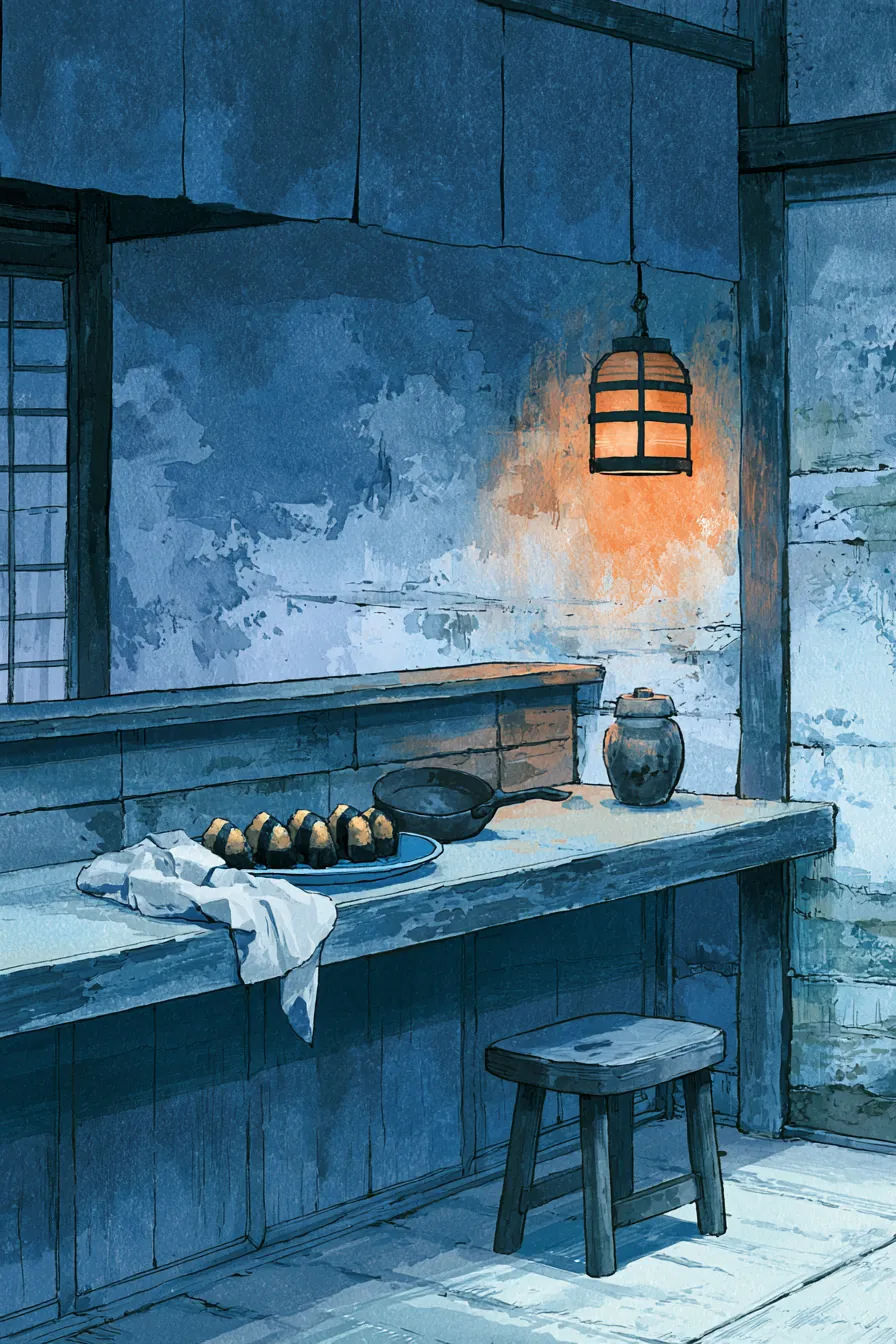
I made the aburaage from scratch — the deep-frying I had not done in two years, on a small iron pan I had bought from Goro's mother's stall in 2024 and put in the highest cupboard because I had not, in 2024, been the kind of woman who deep-fries. Six pieces, drained, simmered in kombu broth with the dashi I had cold-brewed overnight from kelp the tofu woman had given me yesterday at Nishiki — for the man who has been ordering the eggplant. I had not, in the matter of her three-eggplant lie, corrected her.
Six pieces of inari-zushi on the plain blue plate Sumire had used for inari in volume seven. I covered them with a clean cloth and set them on the back of the counter. I did not, all morning, look at them.
Tanaka-san came in at his usual. He looked at the cloth on the counter, looked at me, looked at the cloth again.
"Hana-chan."
"Tanaka-san."
"You are baking."
"Not baking."
"You are frying."
"Mm."
"This is a development."
"It is a Tuesday."
He bowed his head a single degree in the manner of a tanuki who has decided not, by his policy, to ask the question. He drank his usual. He left at nine, with a thousand-yen note folded in the way he folds them when he wants me to find them after he is gone. I did not, this morning, sweep the entry.
Goro came at ten-twenty. Wednesdays were his usual, but he had, of late, been coming Tuesdays as well by an unstated arrangement.
He was wet from the river. He set on the counter a cucumber, a slice of newspaper folded around something that did not, by its outline through the newsprint, look like a cucumber, and a small green stone the colour of the lily-pad underside.
"Hana-chan."
"Goro-kun."
"The stone is from the river. It has been sitting at the bend by the Nakaragi dōjō for, by my best read of its underside, eight months. It is, this morning, sitting on the counter."
"Why."
"Because I thought you might like it."
I bowed. He bowed. I poured him hojicha, which is the tea he drinks when he is going to ask a question.
"The newspaper-bundle," he said, "is also a thing I brought. It is, by the smell, dead."
"Dead is fine."
He unfolded the newsprint with the patience of a kappa who has been folding wet things into dry papers all his life. Inside was a second drone.
Identical to the one he had brought me four days ago. Sparrow body, slim talisman script along the wing-spine, small ceramic chip where its eye should have been. Identical also in the manner of its disabling: the ward on its wing-spine undone in the same direction, by what I could only describe — and had no professional vocabulary for describing — as a hand older than the paper.
"Goro-kun."
"Yes."
"Where."
"Pond, at the south end of the Pontocho stones. Half a metre under. It was floating in the way a thing floats when whatever made it float has, by yesterday, stopped working."
"How long."
"By the kelp on its underside, two days. By the bird that had been pecking at its eye, this morning."
I sat with the drone on the counter a long minute. Two drones, four days apart. The undoer, whoever the undoer was, had been working in my alley twice a week — more attentive to it than I had been.
I did not, on the counter, address this.
"Goro-kun."
"Yes."
"Tell your river that I am, by this gift, in a debt."
"My river will, by my reading of his mood, not call the debt in the matter of a drone."
"All the same."
"All the same."
He drank his hojicha. He took two more sips than he usually takes, which in Goro is a signal he has noticed I am not, this morning, my usual self. He bowed. He took the cucumber back — for the koi, he said, not for you, because you have made yourself something already today, which I can smell — and tossed it into the koi pond with the underhand throw a kappa uses when the koi is at the lily-pad underside. The cucumber bobbed. Goro grinned. He left.
I cleaned the drone with the brush I keep for the lanterns and set it on the back-room shelf, next to the first one. The two of them were, by the symmetry of their arrangement, beginning to look like a small uncomfortable shrine to a question I had been refusing to ask.
I asked it. Aloud. To the back room — the part of the teahouse that had been here longest and was, in any matter of the last sixty years, the part most likely to know.
I said: whoever is undoing these is not me, and is older than the paper, and is working in my alley at a rate of twice a week. Who are you.
The back room did not answer. It had, however, by Sumire's diary evidence, answered Sumire — the May 1968 entry, the back room said, when I asked it: be patient with what is being patient with you, and below it, in old-woman hand from 1990: the back room was right. I noted the not-saying. I did not, this morning, address it.
Yuki did not come. The teahouse moved through its afternoon at the pace a teahouse moves through an afternoon on a Tuesday after a three-day rain. I poured for the Nara woman, who left as always a single white camellia at the third stool from the left in a manner that had nothing to do with the man in the charcoal coat and everything to do with a habit she had inherited from a mother of her own. Two university students. I read volume eight.
By six, six pieces of inari-zushi under their cloth on the counter had begun, by the absence of the person they had been made for, to look like six pieces of dinner.
I lit the entry lantern at six-thirty. I lit the irori at seven. I made the midnight blend in the small clay pot Sumire had made at a workshop in Tanba in 1971, the pot will, I think, outlast me. The pot will, I think, be used by a woman whose hands are smaller than mine. The woman has not, in 1971, been born. The woman had been born in 1995.
I poured myself the first cup at ten. I did not, this evening, set out the third-stool cup. I did not, by the new accounting I was keeping with myself, want to be the kind of woman who sets out a cup for a man who had not, for four nights running, rung the bell.
I sat at the counter and drank the first cup myself.
The bell rang at eleven oh-two.
I had, by every interior thermometer I owned, been refusing for the last hour to admit I had been listening for the bell. The bell rang the way a bell rings when it has, by its own quiet decision, decided to be a bell. I did not move. The bell rang a second time, by which I understood — by the bell's policy — that the bell wanted to be sure I had not, by my own pretending, missed it.
I rose. I went to the entry.
He was at the door in the charcoal coat. The shoulders, by the four days of intermittent rain, were the dampness shoulders are when one has been walking for some hours in a way that does not, by its grammar, account for whether the coat is being protected by anything. His face was the face of a man who had not, by his own clock, slept. The face was a face I had not, in the eleven days I had known him, seen — which was to say it was the face the face had been doing the work of, all along, holding off from showing me.
"Are you still serving."
"We're closed."
"I know."
I stepped aside.
He came in. He took off his shoes. He sat at the third stool from the left.
I made the midnight blend in the pot, poured one cup, set it in front of him. Then I went to the back of the counter, lifted the cloth on the blue plate, and brought it forward.
He looked at the plate a long time.
He did not, by any expression I had a name for, give me a face to read. The face was the face of a man being given a thing he had been, by his own custom, prepared to live without. The face was, in a way I had not yet seen him be, young.
He bowed to the plate. He bowed deeper than he had bowed, in eleven days, to me.
"Hana-san."
"Yes."
"This is — "
"It is inari. It is Tuesday."
"I — "
He stopped. He had stopped at the same point in the sentence Sumire had said he stopped at, in volume seven, in the second occurrence: he stopped at the word for I. He stopped at the word for I because the word for I, in his register, is also the word for the small confession one is about to make and is not, by one's nature, yet ready to make.
He started again.
"I cannot, by any custom of my line, refuse them."
"I know. I read it."
He looked at me.
He looked at me, for the first time in eleven days, the way a person looks at another person to whom they have, by the look, given something away.
"You read it," he said.
"I read it in volume seven."
"Volume seven."
"My great-aunt's volume seven."
He did not, for a long minute, say anything. He took up the first piece of inari-zushi between two fingers. He ate it the way one eats a thing one has not, in some long span of time, eaten. He took up the second. He ate it in two bites. He took up the third. He ate it in one. He stopped.
He laughed.
It was a small laugh. It was a laugh of the kind I had not, in eleven days, heard from him, and it was a laugh of the kind I had read, in volume seven, that Sumire had once heard from him in March of 1965 — he laughed a small laugh, and the kettle, in the laughing, sang on its own. The kettle, in this evening's irori, sang on its own. I made a note of this in the part of me that takes notes in lantern light. I did not, by my own discipline, address it.
He drank the cup of midnight blend.
He set the cup down.
He said, very quietly: "It is unfair."
"I know."
"It is an unfairness Sumire used, in 1965, when she had decided I had been coming for too long without saying anything I could be held to. It is the unfairness of an inari that has been made by hand. It is the unfairness of a Tuesday."
"I know."
"You — "
He stopped again.
The stopping, this time, was different. The stopping was the stopping of a creature that had, in his own interior, just heard the thing he had not, by his own discipline, intended to say next. He had been about to say something. He had heard, in his own next breath, what the something was. He had stopped.
I sat with the stopping a beat.
"Kuzunoha-san."
"Yes."
"What were you going to say."
"I was going to say that you make the inari very nearly the way she made the inari, and that the very nearly is, on balance, more interesting than the same."
"That is not what you were going to say."
"It was, in part, what I was going to say."
"Kuzunoha-san."
"Mm."
"What were you going to say."
He looked at the plate. He looked at the kettle. He looked at me. He looked, in the matter of looking at me, the way a man looks at a woman he has just understood he has known about for longer than he has admitted.
"I was going to say," he said, "that you make the inari very nearly the way she made it, and that — I had not expected this."
"You had not expected what."
"I had not expected to be sitting at the counter of Kogitsune-an, in May of this year, eating inari made by a woman with Sumire's hands. I had been — "
He stopped.
I waited.
"I had been," he said, "told you would not, in the matter of casting, return to the trade. I had been told this in 2024. I had it on — good authority."
I sat very still.
It is hard to describe, accurately, the way a small clean fact lands in a room. The room was not different — the kettle, the lantern, the rain on the door-stone, Pip on the rafter. Only the air, in the half-foot above the counter, was different. The air had become the air of a teahouse in which a man had, by his own next breath, given me a piece of information he had not, by any plan he had brought through the door, intended to give.
I had moved into Kogitsune-an in October of 2024. I had not, outside of Akiko and Master Saitō and the executor, told a living person — yokai or otherwise — that I had decided, after the binding, to stop casting. I had not put it in a letter. I had not announced it to the guild. The decision had been, by the discipline of my own grief, a private one.
He had been told. In 2024. Before he had ever, by either of our reckonings, met me. By someone who had known well enough to communicate it, that same year, to a kitsune who had been visiting this teahouse, by his own admission, for sixty years.
I tied the apron string. I tied it twice, neither time tighter than was necessary.
"Kuzunoha-san."
"Yes."
"Who told you."
He did not, for a long moment, answer. The face he had brought in tonight — the face I had not seen him wear in eleven days, the young face — had gone, by his own discipline, back to the face he had been keeping all along. The retreat, in him, was a careful one. It was not the retreat of a liar; it was the retreat of a man who had been doing a kindness, by withholding, for some larger grammar I had not yet been told.
"Hana-san."
"Kuzunoha-san."
"I would prefer, by the courtesy of an old hour, to not say."
"I would prefer, by the courtesy of my own kitchen, that you did."
He bowed his head.
"I would," he said, "ask you to give me a Friday. By Friday I will know whether I can, by the obligations I am under, tell you. If I can, I will. If I cannot, I will tell you that I cannot, and I will leave the asking to you."
"Friday."
"Friday."
"That is three days."
"That is three days."
I looked at him.
I had, in the last hour, set out a plate of six pieces of inari-zushi for a man who had not, in four nights, come. I had, in the previous hour, decided that I would not be the kind of woman who set out a cup for a man who had not come. I had been, by this morning's account, in retreat. I had been, by the four nights of his absence, preparing to retreat further. I had been, on the cedar floor of the cellar at four in the morning yesterday, looking up at the bottom step and thinking — for the first time in earnest — whether the simplest answer was to close the teahouse for the summer and go to Akiko in Osaka, the way I had been told, as a child, witches in trouble had gone to other witches.
I had been preparing to run.
I sat at the counter with my forearms on the wood. The kettle sang one phrase a half-step above the phrase it had sung yesterday. The rain on the door-stone was steady. Pip, on the rafter, was watching the inari plate with the eyes of a small creature who would not, by the dignity of her station, ask after a piece of inari but who was — visibly — willing to be offered one. The drones, on the back-room shelf, sat in their small uncomfortable shrine to a question that had stopped, by tonight, being a question I could decline to ask.
I was not going to run.
I understood this with a clarity I had not had all week. The teahouse was not closing for the summer. The diaries were not going back in the cedar chest. The inch was not staying an inch. I was going to find out who had told a kitsune, in 2024, that I had stopped casting; who had been undoing drones in my alley twice a week and was older than the paper; what had happened in the six weeks before Sumire's death that had caused him, after sixty years, to stop coming. I was going to do it from the cedar counter of my own teahouse, with the apron on, in the company of the regulars who had been quietly, by their own discipline of not-asking, holding the question for me.
I did not say any of this aloud.
I said: "Friday."
"Friday."
"Eat the rest of the inari."
"Hana-san — "
"Eat the rest. They were made for you. I do not, by the rule of my kitchen, take inari off a plate that has been set."
He bowed. He ate the fourth, the fifth. He looked at the sixth.
"Hana-san."
"What."
"Pip is — "
"I see Pip."
Pip, on the rafter, in a posture that was a perfect imitation of a creature not asking for anything, was nevertheless undeniably the posture of a creature who was, in the matter of the sixth piece, available.
He held the sixth piece up to the rafter. Pip descended one beam, took it in both small hands, bit it cleanly in two. Pip ate the smaller half and held the larger down to the kitsune, who did not, by his nature, refuse. The plate was empty. The kettle sang a clean small phrase of two notes — not the three-note phrase, not yesterday's phrase, but a new one. I noted it. I did not, tonight, address it.
He bowed.
"Friday," he said.
"Friday."
He left at midnight. The bell rang on his way out. The lantern at the entry stone — which Sumire had not, in her diaries, ever managed to keep lit through a steady rain — kept itself lit.
I took the notebook out of the apron, opened it to a fresh page, and wrote in the smallest neat hand the brush would give me:
Someone told him, in 2024, that I had stopped. I am going to find out who.
I did not, by any rule with myself, scratch the line out.
I turned the noren from open to closed. The third-stool cup, which I had not set out, was on the counter at the third position from the left. I picked it up. I rinsed it. I set it back on the shelf with the other cups. The shelf, by the small accounting of objects in their proper places, was now in order.
I went to bed.