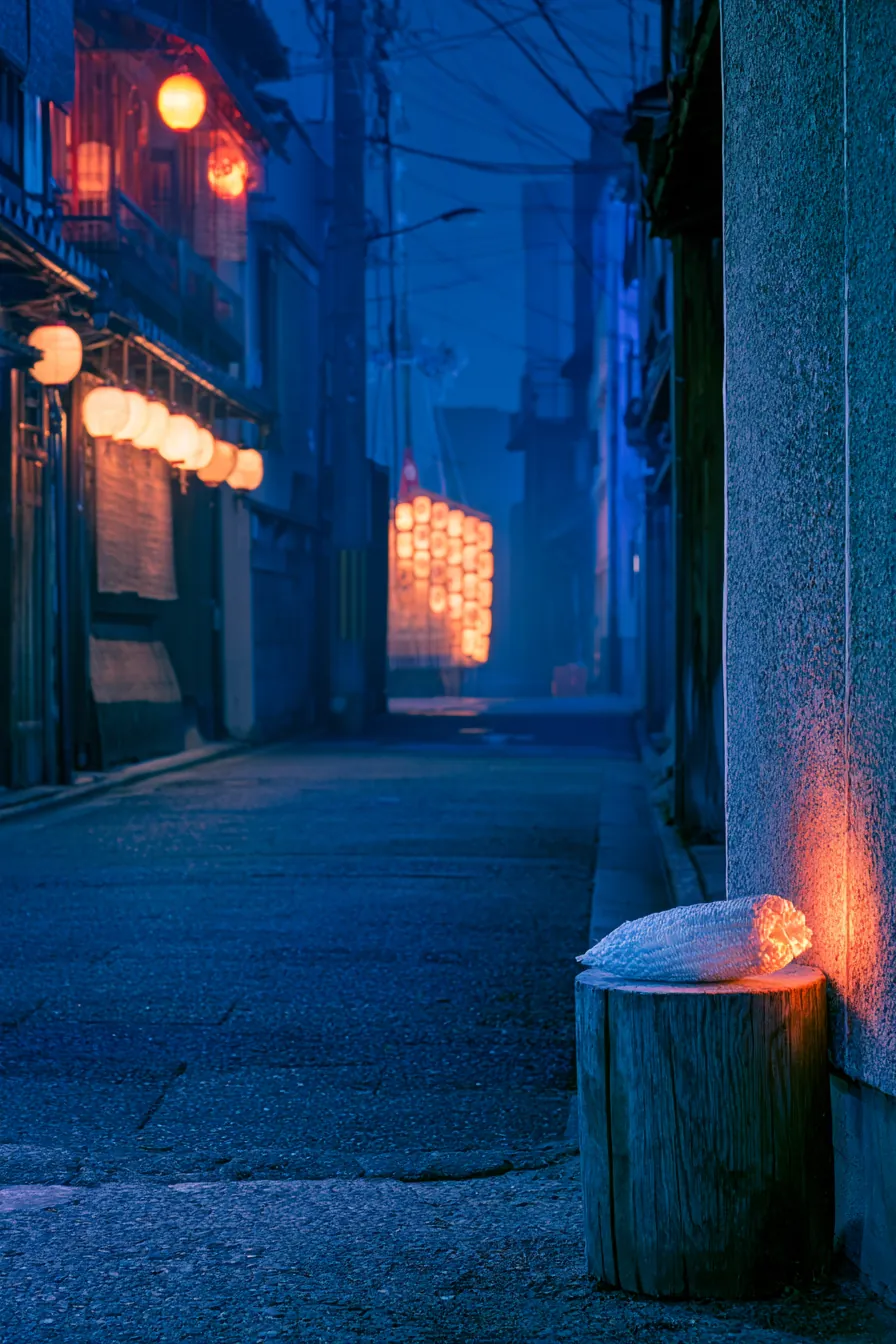
Chapter 12 — Yoiyama
I had not, in two years, closed the teahouse on a Wednesday.
The sign on the inside of the noren said Closed for Yoiyama, and below it, in a hand smaller than my own ought to be: back Thursday at the usual. I had hung it at noon. I had hung it because Saitō-sensei's reply had come back at the post by ten, hand-delivered by a young temple novice whose face was the face of someone who had been told not, in any matter of his own day, to look around. The reply was the length of a temple bell-rope.
It said: Hana-chan. The telling did not come from my house. It did not come, by any door I have, from this temple. I have asked Tōzō and the small altar at Kifune. Neither knows it. Come to Kibune, by your own clock. I would prefer not to put more on paper. — Saitō.
I read it three times. I folded it. I put it in the kitchen drawer where I keep the things I am not yet ready to act on, which is a drawer that has, in the past two years, become very heavy.
Saitō was off the list. That left, in formal order: Akiko, Tōru, Kawasoe, and a niece of a numismatist named Eri.
The reply had also done something to my Wednesday I had not expected. It had made me — by removing one weight from the balance — light enough to remember that the world had, in the calendar of things that were not my list, a festival in it. The mikoshi were going through Shijō tonight. The yatai had been setting up at dusk. The whole city had been smelling, since Tuesday, of grilled corn and yuzu and the very particular wet-paper smell of folded paper lanterns being hung from balconies that had not, in a year, been dusted.
I had not been to Yoiyama since 2022. I had not, in 2024, even noticed the floats going by. I had heard them from the back room and made tea.
This year I closed the noren and went out.
The crowd at Shijō was the crowd of every Yoiyama I remembered, plus ten years of demographic change and a great many more umbrellas than there ought to have been on a dry night. Tourists, locals, families, a teenage couple holding hands so tightly their knuckles had gone white, three women in cotton yukata of three different ages and the same blue, a young man with a small ferret on his shoulder. The lanterns of the Naginata-boko stood at the end of the street under a sky the colour of an inside of a sleeve.
I walked slowly. I had forgotten how walking with a crowd works — how one yields a half-step in the rhythm of the breath of the person beside one, how one's elbow learns the elbow of strangers. I bought yuzu-ade in a paper cup from a stall whose old man recognised me and did not, in the manner of an old man in Kyoto, say so. He handed me change with the back of his hand against the back of mine, a half-second longer than the change required. Aoba-san, he said, the kettle wants a kelp. I bowed. The kelp was a code Sumire had used with him in 1979 for I see you. I had not, by any record I had, used the code in twelve years. I was surprised to find I still knew it.
The yuzu-ade was so cold it had a piece of grit at the bottom that was, by the third sip, the syrup. I drank slowly. The Naginata-boko, when I came up to it, was a great wooden vehicle of music — a small group of musicians at the upper deck playing the konchikichin on flutes and bells, the bells coming through the flutes at the angle the flutes wanted, the boys at the ground holding the ropes the way boys hold ropes at Yoiyama: as if it were a thing they had been born holding and would, by morning, have to forget.
I stood and listened. The cicadas had been arguing for two weeks now and would, by tonight, lose the argument to the bells. The cicadas would, by tomorrow, be quieter than they had been in June. This is a thing the city does to itself in July. I had forgotten this too.
When I turned to walk back up the alley toward Pontocho — the back way, behind the stalls — he was at a corn yatai talking to the man who sold the corn.
I did not, by any rule with myself, hurry.
He saw me first, from over the man's shoulder. He did not, by any expression I had a name for, change his face. He bought a single ear of grilled corn — the yakimorokoshi with the dark soy crust — and gave the man a coin I could not see from where I stood. He turned. He came to me. He held the corn out at the angle one holds a thing one is sharing.
Aoba-san.
Kuzunoha-san.
The corn, he said, is, this year, a little under-salted.
I had not been told that.
It is, however, well-charred. I have, by the seven years I have watched this stall, a complaint with the kernels at the base, which the old man will not, by his own rule, char.
Seven years.
Seven years. The yatai has been in this position since 2017. Before that he was at the Yamaboko on the south side, which is, by my long opinion, a better corner for grilling.
I took the corn. I tore a small section off the top — three rows of kernels — and ate them. He had been right about the salt. He had been right about the char.
I handed the cob back. He ate two rows. He handed it back. We did this, very slowly, walking northward through the crowd, until the cob was gone. He held the stripped cob a moment, looked for and found a wooden waste-bin at the edge of a stall, and disposed of it with the small unobtrusive bow Kyoto men of a certain age give to waste-bins. (Younger men do not bow to waste-bins anymore. Tanaka-san does.)
We walked, after the corn, in silence. The crowd kept yielding. It kept yielding in a particular way — a half-step to the left, a half-step to the right, never more than was necessary — and after three blocks of walking with him I realised, the way one realises a thing one ought to have noticed at once, that the crowd was not, on its own, yielding.
I looked at him.
Kuzunoha-san.
Yes.
You are doing a thing.
Yes.
With the crowd.
Yes.
Why.
He looked, briefly, at his own hands as if they had been caught at the cookies. You are not, of late, used to crowds. I did not wish you to be uncomfortable. I have, on the other hand, taken nothing from anyone. I have only —
Asked them, in a register they do not, in any conscious matter, hear, to give us half a step.
Yes.
I walked another twenty paces in silence. The crowd kept yielding. He kept not, by any visible muscle in his face, doing it. It was the way Tanaka stands in a doorway. It was the way Pip is the most exciting thing in a room and does it by being still on a rafter. It was not, in any sense Akiko would have entered into a report, a casting. It was a nature. I had been, in the matter of natures, a fool to think I could tell the difference.
It was also the most tender thing anyone had done for me in some long span of time.
I did not, at the next yatai, take his arm. The not-taking was a kind of taking. He felt it. He did not, by any expression I had a name for, reply.
At the bottom of the Tominokōji alley, where the lantern of the Hōka-hoko hangs low and the children in the inner courtyard of the float-house were practising the bells, he turned and said:
Aoba-san. I would like, for one beat, to ask after a thing of yours which is not the list.
Ask.
Your mother's tea.
I went still.
The blend she gave the teahouse, he said. Sumire wrote of it in 1989 — your mother brought, then, a small pouch of a blend she had made with a tea master in Uji. Sumire used it for the autumn equinox tea for many years. The blend had hojicha, and a little kuki-cha, and —
He stopped.
He stopped because he had been about to name the third ingredient and had seen — by something in my face I had not, by my own clock, intended to put there — that I did not, at that moment, know the third ingredient.
I knew there had been a third. I knew it had been the one my mother had refused to write down, because if you write it down it stops being a gift. I knew it had been the one she had only ever spoken to me, with her own hands holding mine, in 2015, the year I had been twenty and had been a difficult daughter. I knew it had been a flower-ingredient, of the kind one does not, in tea, expect.
I did not know what it was.
I did not, for the count of one breath, know that I did not know. I had known yesterday. I had known last Wednesday. I had used it — I knew this with the certainty of a body — when I had made the autumn equinox tea in 2022, the year my mother had died, the year I had used it because it was the last batch of it that would, by anyone's hand, exist in the world.
I did not know what it was.
Kuzunoha read the not-knowing in my face. He read it before I had finished reading it in myself. His own face did, for the first time since Tuesday, the thing it had done at the inari plate. The youngness. The grief at the underside of the youngness.
I have asked the wrong question, he said.
No.
Aoba-san —
Kuzunoha-san. I have, by your asking, found out a thing. The price came. I had been told it would, and I had been waiting, and it came.
Tell me what it took.
The third ingredient of the blend.
Aoba-san.
It was the one she would not write down. It was the one she said only once, with her hands on mine. I have, by the binding of the drone, lost it. I have, by your asking the question, found out I have lost it. I will, in a week or in a month, lose the second thing on the list. I will, by Saitō's reading, lose three more before the year ends.
His face did a thing I would, in the days that came, replay to myself by lantern light. It was a face I had not, in twelve days, seen on him.
I am sorry, he said.
Do not be sorry, I said. I cast. I knew the price would come. I did not, by any contract I have with myself, expect not to pay it.
I am sorry, he said again, that the question was the question that made you see it.
Better that I see it.
Yes.
Better that I see it tonight.
Yes.
I held the not-knowing in my chest a little while. The not-knowing felt like a small empty drawer in a piece of furniture I had inherited. The drawer had had, in it, a name that smelled of the inside of a paper packet that had been in a kitchen in Uji in a summer in which my mother had been alive. The drawer was empty. The drawer was still mine. I would not, in any matter of the rest of my life, fill it.
I sat down — I had not noticed I was standing — on the edge of the wooden bench at the float-house, with my hands on my knees. He did not sit. He stood three paces off, with the particular respectful distance of a fox who has just been told he has, by a question, taken something. Pip, who I had not noticed had come with me — Pip had come, in the apron, the whole evening — climbed out of the pocket and onto my knee and put both small hands flat on the back of my hand.
Pip is here, Pip said.
I know.
We sat that way some while. The children in the inner courtyard, working on the bells, did not, in any matter of their own concentration, know we were there.
We walked, eventually, the rest of the way back along the inside lanes — by the back of the Hōka-hoko, behind the Niwatori-boko, and down into Pontocho the way one goes when one is not in a hurry. The crowd kept yielding. He kept not-doing it. I let him. I had stopped objecting at the second yatai.
At the head of my own alley he stopped.
Aoba-san.
Kuzunoha-san.
I will not come in tonight.
I know.
The reasons, he said, include the reason you have correctly inferred, and a second reason which is mine, and a third which is the inner courtesy of my line.
The second reason.
Is that I have not, since 1989, been at a Yoiyama with a person. I would like, by the discipline of an old hour, to sit with that for one night.
The third reason.
Is that on Friday I have an answer to give you, and I would like the giving to be done in your teahouse, with the noren turned, and not in your alley at midnight with a stripped cob in the bin and a Yoiyama wind in my coat.
I bowed.
He bowed deeper than he had bowed at the inari plate, which was deeper than he had bowed in eleven days. The bow was, I knew now, a thing he did the way some men shake hands: as a statement of a contract that had not, by any agency of mine, yet been written.
He took, from his right coat pocket, the silver coin he had — I now knew, by Sumire's diary — been turning over in that pocket since 1965. He held it up. He did not give it to me. He let me see it. The coin, in lantern light, had the look of a thing that had been held by one hand for sixty years.
By Friday, he said.
By Friday.
He turned. He walked back up the alley toward Shijō, not looking back, with the particular straightness of a man going to do a thing he has been, by his own discipline, avoiding for sixty years.
I stood in the alley a long while.
Eventually I went in. I lit the irori. I made midnight blend. I did not, this evening, set out a cup at the third stool, because the third-stool cup was for a man who was, on the agreed terms, not coming. I drank a cup myself, at the counter, in the dark.
I took the invoice-back out of the drawer — the list. I uncapped the brush. I added, in the deliberately half-degree-larger hand:
Saitō: cleared by reply, hand-delivered Wed 10am. Tōru: back room reacted on second pass. Kawasoe: still no reply. Eri: walk to Teramachi on Friday morning. There may be a fifth person who is not yet on the list.
Then, below it, in the same hand:
Second price has come. The third ingredient of mother's blend, named by mother in 2015, used in the 2022 autumn equinox tea. Gone, as of approx. 9:40pm Wednesday Yoiyama, at the lantern of the Hōka-hoko, with Kuzunoha asking.
I capped the brush.
I sat at the counter a while longer. Pip climbed up onto the counter and sat at three handspans, watching me with the seriousness of a small creature who had ridden, all evening, in an apron pocket and was now too tired for whimsy.
I said, aloud, to the back room and to Pip and to the kettle:
I have lost a thing. I am still here. The teahouse is still mine.
The kettle, which had been singing a small quiet phrase to itself for an hour without my having put it on the heat, sang the two-note phrase from the Tuesday inari, and then it sang it half a step lower, and then it stopped.
I went up to bed.
In the apron pocket, the silver kan'ei tsūhō from Chapter Two — which Kuzunoha had spent in this teahouse and which Mochizuki had bought back from me — was not there, because I had spent its proceeds. I had been, in 2024, a woman who spent old coins on the second-month rent. I would, by Friday, be a woman who had been given another one. I did not, yet, know this. I went to bed thinking of the drawer in myself the third ingredient had been in, and how it was empty, and how the drawer was still mine, and how this was, for a kotodama witch, what it meant to be in the choice. Saitō had said it. He had been right. The cost of being in the choice was — among other things — that one knew, by lantern light, what had been taken.
The kettle, behind me, sang one note, very quiet, on its own. I did not, tonight, address it.