Chapter 14 — The Top of the Mountain
I walked to Teramachi at seven on Friday. The shutters were already up, which they had not, in my three years of watching Mochizuki-sensei, ever been at seven. He had been waiting since Wednesday.
I climbed the wooden stairs. On the long table where the loupes were laid out he had placed a small dish of salt, a small dish of rice, and a wooden cup with one sip of clear sake. These are the things a man of his generation sets out when he is preparing to apologise for a thing his line has done.
Aoba-san.
Mochizuki-sensei.
He bowed lower than he had bowed in three years. I let him.
Eri, he said, was weeping in the doorway of your teahouse in March 2024. You gave her hojicha. You told her, on a slow afternoon, the one thing you had not told another adult in the trade. She told me. I told one customer of mine, a very old gentleman of Fushimi who had been my customer for forty years, and whom I had reason to believe was no longer in the trade. I was wrong about that. His correspondence with a member of the trade who is not, by my reading, retired has been continuous since 1987.
He bowed again. I will give you the name of the gentleman of Fushimi. I will not give you the name of his correspondent. I have a guess. I will not say it.
He told me the name. It was a name I knew from a list in Sumire's diary, volume four, an exchange of poems in 1968 — a man I had thought to have died in the nineties. On Akiko's transcript map he was, plausibly, the courier between Aunt and Tōru.
He put the cup of sake on the corner of the table. Take it. Pour it on the threshold of your teahouse at sundown. The threshold will know what to do.
Eri, he said, leaves Kyoto for the Osaka shop tomorrow. She has asked me to tell you that the tea, on that March afternoon, was the kindest thing she had been given by a person in her trade, and that she has, on every day since, regretted what she said over the cup.
Tell her the telling was hers to regret. The tea was — the tea.
I left at seven-twenty. The sake-cup rode in my apron pocket, where Pip had been on Wednesday.
I went up at four.
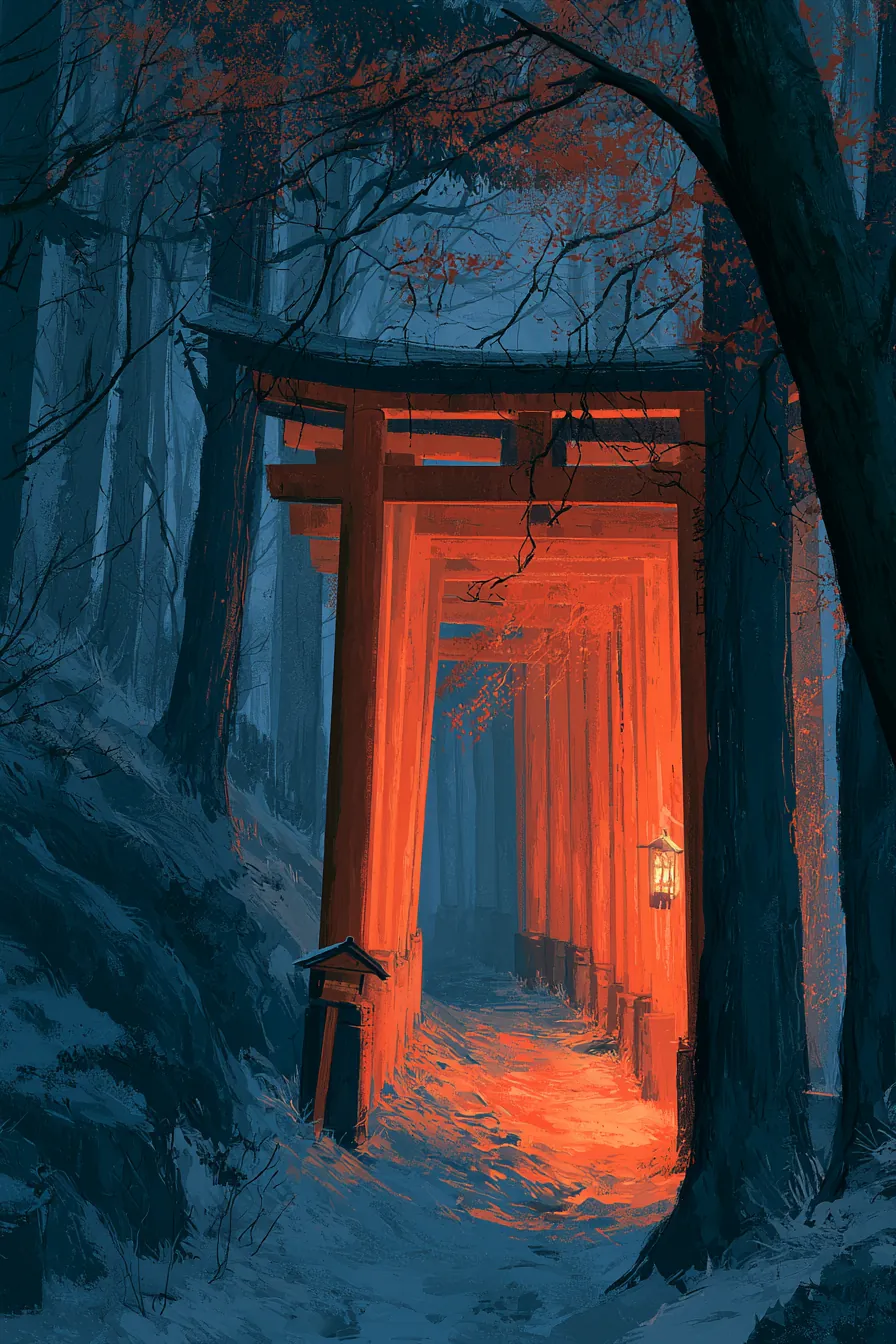
The Inari line at Fushimi is not, in late afternoon on a Friday in July, the line of the dawn or of the lower vermillion stretch. The crowds at four are the late tourist surge and the office-workers on a half day; by five they are thinning; by six, past the third or fourth gate-cluster of the upper path, they are gone. I had timed the climb to be at the upper shrine — the small one, the one past the bamboo grove, the one that is, by clan reckoning, the inner courtyard of his own line — by dusk.
I wore the indigo apron under the cotton jacket because the apron was not, today, a thing I was going to take off for a visit. I wore the small black pearl earrings my mother had given me at seventeen. I had not, in two years, worn them.
I climbed.
The torii path is, for the first kilometre, busy and bright. The vermillion is at the violent end of vermillion for the first hour; by the third or fourth hour, the wood is older, the paint is browner, the carved donor-names on the back of the gates are in a hand of the 1970s and not of last year. I read the names as I climbed. Nakamura Hardware Tokyo, Hashimoto Sake Shiga, the family of the late Itō. Sumire was on one of these gates, somewhere up here. I had been told by Saitō when I was twenty. I had never, in fourteen years, gone to find it. I would, on the way down — by the rule I had been keeping with myself since 2018 — not look for it. I would, by Saitō's old reading, let the gate find me.
The gate found me at the third bend after the fox-pair shrine. Aoba Sumire — May 1965. It was a small gate, knee-high, a senbon torii the size a private donor on a private occasion would have given. The vermillion had gone, by the long shading of sixty years, the colour of an old persimmon at its dry edge. I touched it with two fingers, the way I would have touched a hand. I went on.
By the upper shrine, dusk had begun. The cedars on the slope past the inner courtyard were the colour of the inside of a closed eye. The path was empty. The cicadas were not, today, what they had been on Wednesday. They had been thinned by July.
He was sitting on the second step of the inner shrine.
He was not in the charcoal coat. He was in a dark grey kimono of a kind I had not seen on him, of a weight a man of his line wears when he has come to a place he was — on the day he put the kimono on — likely to stay overnight. The kimono had no crest. The kimono was, by the slant of its tie, a kimono of one of the older sleeves. He was looking, at the moment I came around the last bend, at his right hand in his lap.
He looked up.
He did not stand. He did not bow. He did the thing he had done on Wednesday at the inari plate, which was to be — for a half-second — young.
Aoba-san.
Kuzunoha-san.
You came up.
I came up.
You were not, by my own count of the day, expected here.
I was not, by my own count, expecting to come up. I am here.
Yes.
I sat down on the third step, two steps below him, with the apron in my lap and Pip — who I had not invited and who had, at the third torii, climbed out of my pocket and ridden the slope of my collar — sitting now on my shoulder with both small hands in the loose hair at the back of my neck.
Kuzunoha-san.
Yes.
The three operatives in Pontocho.
He went very still.
The first two, he said, were mine.
Yes.
The third was not.
No.
You have spoken with Akiko-san.
Yes.
Yesterday at three p.m. at the kissaten on the south side of Yasaka with the geraniums.
Yes.
I know, he said, because Akiko-san sent word to a member of my clan at four-fifteen with her three-folder summary. I read it at six. I read it again at midnight. I read it a third time at three. I have, since three, been on this step.
Kuzunoha-san.
Yes.
The first two.
Yes.
Why.
He did not, for one beat, answer. He looked at his right hand in his lap. He had — for the first time in fourteen days that I had been near him — the silver kan'ei tsūhō in the open palm of that hand. He had stopped, at some point, putting it back into the pocket.
They were going to take you, he said. On the night of the first one — the twelfth of May — the operative had, by an order signed by Tōru on the third of May, a writ for the binding and recovery of a witch of the Aoba line. The writ was for use at the discretion of the operative in the field. The operative would, by his own custom, have used it at the discretion of the field on the night of the twelfth, in the alley behind Pontocho-dōri at two-twenty in the morning, after closing. I was at the end of the alley. I considered it a courtesy not to interrupt your work.
Kuzunoha-san.
Yes.
The second.
The second was, on the night of the thirteenth of June, a Hand operative in the matter of the same writ. The writ was not on his person — it had, by Hand procedure, been amended after the first incident — but the order was on his earpiece, which I heard, at twelve-thirty, from the river. I considered it a courtesy. The same.
Kuzunoha-san.
Yes.
Why did you not tell me.
Because if I had told you, he said, you would, by every reading of yourself I had, have closed the teahouse and gone to Akiko or to Saitō or to Osaka, and the wards would have shifted in such a way that the third operative would, on the third of July, have found the alley empty, and the third operative would, by then, have been a Hand attached to a man older than the paper, and the man older than the paper would have, on the third or the fourth, taken the alley back. I would, by the courtesy of an old hour, not have allowed it. But I would have lost the alley by the lie. So I did not tell you.
I sat with this.
The dusk had moved by some half-degree of the sky. The cedars on the slope had begun to give off the smell cedars give off when the day has finished with them. Pip's small hands in the loose hair at the back of my neck had, by the steadiness of their small grip, given me my first measurable physical comfort of the day.
Kuzunoha-san.
Yes.
The third.
He looked up at the lantern at the corner of the inner shrine. The third, he said, was not me. I have, since the third, been asking by the inner courtesy of my line who. I am, by this afternoon, at the third of three roofs. I have a name. I will not, in this place, say it. I will say it at the cedar counter of your teahouse, in the form one says a name at a cedar counter, by midnight.
Tell me anyway.
Aoba-san —
Tell me.
He did not, for one beat, speak. He looked at the kan'ei tsūhō in his open palm. He closed his hand over it.
The third party in the November transcript Akiko-san called Aunt, he said. I had, in 2024, been told by her. I had been told by her on the second of November at four-twenty in the afternoon in a doorway in Gion. I had not, before that, been in correspondence with her. I have not, since that, been in correspondence with her. She told me. She said: the line has, by the binding of June 2023, gone silent. The line will, in October 2024, be back at Kogitsune-an. The line is, by my own reading, recoverable. I asked her by what right. She said: by the right of an Aunt to the line. She bowed. She left. I did not, in any subsequent week, seek her out. I have, in the seven months since, suspected — but only suspected — that she has been working in the alley in my name.
Her name.
Aoba-san.
Her name, Kuzunoha-san.
He looked up.
Ono no Mariko, he said.
The name landed in the upper shrine the way a small clean stone falls into the bottom of a deep well.
Ono no Mariko had been, since 1971, the senior witch of the Inland Sea route. She had been Sumire's binding witness at the 1963 ascension exam, which I had known. She had been the appointed senior of the Aoba line by Sumire's standing instructions, which I had not until yesterday known. She had, since 2002, been retired to a small house on Naoshima Island, where she kept bees and a single old crane (the bird) that had been with her since the late eighties. I had been told, in the trade gossip, that she had not, in twenty years, cast on the mainland.
I had been told this by Tōru, when I was twenty-three. Tōru had been, I now realised — by the long, level, lantern-light reading I would do all the way back down the mountain — the person who had, in 2002, arranged the retirement. Tōru and Ono no Mariko had been, since at least 2002, in the relationship of a Hand and an Aunt who had agreed to be retired so that the Hand could, by the long arithmetic of a non-witnessing senior, hold the line.
She had, in the last twelve years, not been retired. She had been working.
Kuzunoha-san.
Yes.
She has been undoing the drones.
Yes.
And she has been killing the operatives in your name.
Yes.
To force a confrontation.
Yes.
To force me to cast.
Yes.
To recover the line.
Yes.
I stood up.
I did not know I was going to stand up. The kimono of him on the step did, in the half-second of my standing, a small inward gesture toward not-yielding, and I saw that — that he had been prepared for me to be angry, that he had been prepared for me to walk down the mountain and never come back to the alley, that he had been prepared by his own discipline for every thing I had been about to do.
I slapped him.
It was an open palm. It was the back of his cheekbone. It was not, in any matter of the slap, intended to hurt him; I do not, by any reading of myself, have a hand that could hurt a kitsune of his rank. The slap was a punctuation. It was the punctuation of the sentence I had been writing for fourteen days at the counter.
He let me. He let me with the stillness of a man for whom the slap had been, by his own arithmetic, the lighter price.
I stood with my hand stinging.
Aoba-san —
Be quiet.
I kissed him.
I did not know I was going to kiss him. I did not, by any reading of myself I had in the kissaten yesterday, intend to kiss him. I had walked up the mountain to slap him. The slap had been the plan. The kiss was the thing that had been sitting under the slap since the inari plate, since the Tuesday at midnight, since the koi in the back garden refusing all the names. The kiss was — furious. It was furious in a way I had not been allowed, by my own contract with my own grief, to be furious for two years. It was a furious kiss because I had been lied to by omission, and because the omission had been a kindness, and because the kindness had been worth more than my anger, and because the cost of the kindness was that the man I had been kissing had been, for fourteen days, sitting on the inside of an arrangement he had not let me into.
He kissed me back.
For exactly one breath he kissed me back. The breath was the longest breath I had taken, by my own clock, since 2022. His mouth was — cool. His mouth was the cool of cedar in a closed room.
He stepped back.
He stepped back with the stillness of someone holding back a sea, exactly as the outline of my own thinking had — in some far-off planning room — said he would.
You should not have done that, he said.
I know.
Aoba-san.
I know.
I cannot, by any clan custom I am under, kiss you back tonight.
I know.
I have, on the table at midnight, your teahouse, and a name, and a coin, and a folder of three deaths. I have not, on the table at midnight, anything else. I cannot —
Kuzunoha-san.
Yes.
I am asking you nothing past tonight. I am not —
He looked at me a long beat.
You are not asking, he said, and that is, on balance, why I cannot kiss you. If you were asking, I would, with my whole hand, refuse. You are not asking. You are, by your own discipline, only standing on the second step. The standing is what I will not, by tonight, be able to bear the kissing of.
I bowed my head.
He bowed his.
We stood like that for some span of time I did not measure.
Eventually I went down off the second step. Pip in the hair at the back of my neck had not, by the kiss or the slap, moved.
Midnight, I said.
Midnight.
The teahouse.
The teahouse.
You will come in.
I will come in.
You will tell me at the counter what you will not, on the step, tell me.
Yes.
And the silver coin.
Will, by tonight, sit on the counter.
I turned. I walked back down the path. I did not, by any rule with myself, look back.
I came off the mountain at eight-twenty.
I did not go home. I went by the long bridge route to the Kamogawa and walked north along the east bank. The river at eight-twenty on a July Friday is the Yuka dining platforms above the water, the heat-glasses-down-the-throat couples, the boys with skateboards at Sanjō. I walked through all of it without seeing any of it.
I walked to Demachi. The two herons on the stones were, this evening, three. The third had returned. I walked on, north past the running-track and the cricket-ground willows that hang at the angle of an arm one is dragging at one's side.
At three a.m., by the small fox shrine at the bend Sumire had used as her measure for too far, I turned.
I had, by the willows in the dark, decided. I would do it tonight. I would let Tōru come, by the equinox or by morning, and I would tell him at the counter, in the form of address that was not the form of binding, what Aunt had done in his name. I would name Aunt — not to bind her, but to call her into the room.
I came home at four-twenty.
The teahouse was dark. The bell did not ring. The third stone at the alley mouth was empty. The threshold lantern, which I had not lit before leaving, was lit.
I went in.
The cedar counter, at four-twenty in the morning, was the cedar counter at four-twenty in the morning. The midnight blend, in the small clay pot, had been poured. One cup. At the third stool. There was no man.
There was a silver coin on the counter at the third stool, in the centre of an empty bamboo coaster.
He had been. He had come at midnight. He had waited. He had, by four, left, because at midnight I had not been there to be poured for. He had poured the tea himself. He had set the coin on the coaster. He had gone.
On the inside of the noren, in his black-ink hand, on a folded page: I will return when you ask. — K.
I sat at the counter.
The kettle sang once — a small phrase I had not heard before — and did not sing again. The drawer in myself the third ingredient had been in was still empty. The drawer of the willows at three a.m. was, for the first time in two years, full.
I had not, on the mountain, asked. I had been right not to ask. I had been wrong, by the willows, to come home at four-twenty. The night had had its appointment and the appointment had not, in the matter of two hands of a clock, met itself.
I took out the notebook. I did not use the small hand. I used the half-degree-larger one.
Ono no Mariko. I have her name. He came. I was at the willows.
I closed the notebook.
The bell did not ring. The teahouse did not, at five, open. I sat at the counter with my forearms on the wood and watched the silver coin at the third stool and thought, for the first time in earnest, I have lost the thing I had not yet asked for.
I did not know that, by six, Akiko in her college sweatshirt would be at the back door. I did not know any of what was about to happen. I knew only this: that there is a kind of cost — which the kotodama also tracks, by Saitō's reading — for the choice one makes that is not a casting, but is, in the long arithmetic of a witch's life, a price all the same.