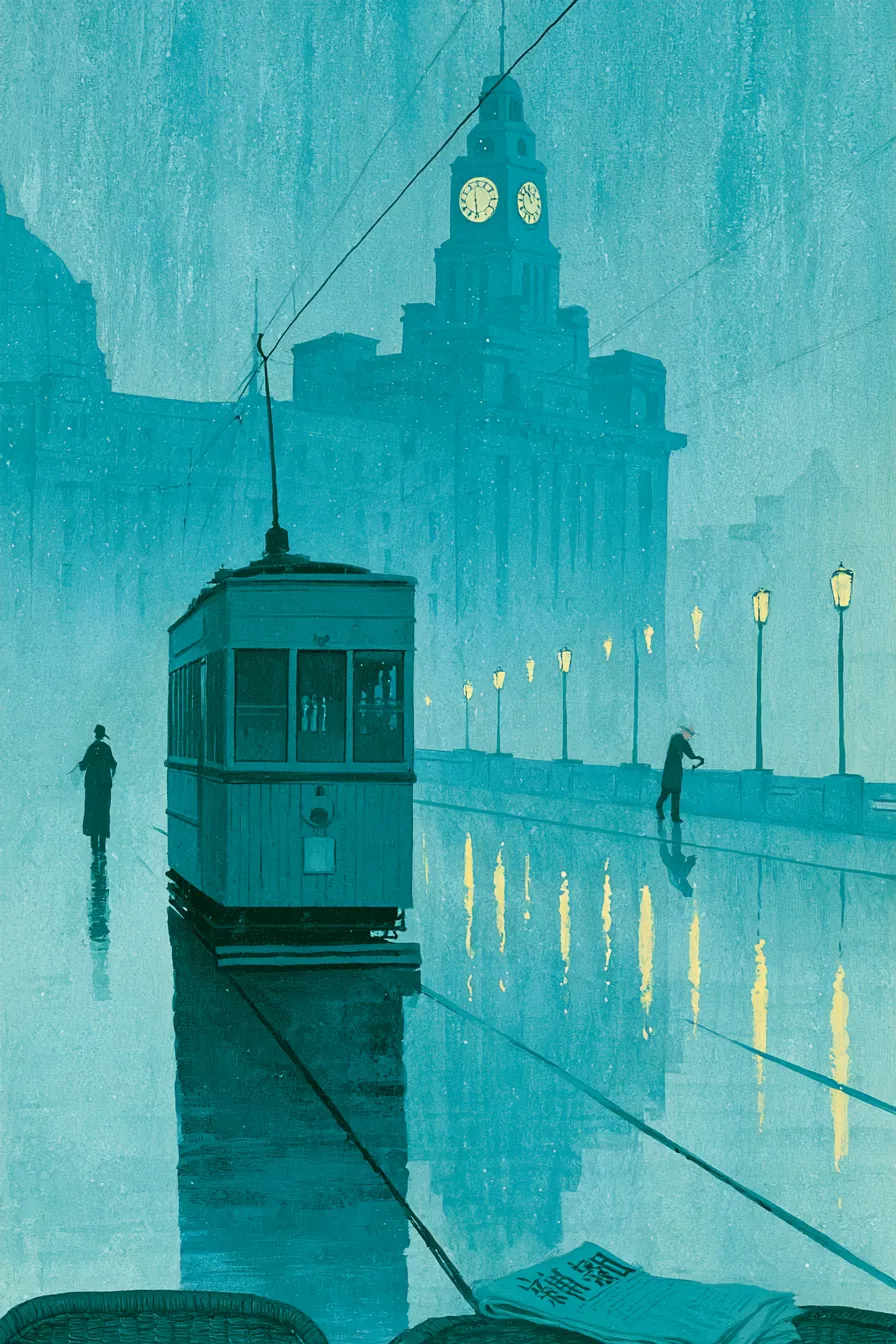
Chapter One — The Tram at Dusk
The doorman calls me Miss Su. The bandleader calls me Wanyin. The men at the gallery tables call me whatever syllables their tongues are loose enough to manage by midnight, and I answer to all of them, because none of them is my name.
Tonight I am late because the tram from the Bund stopped for ten minutes at the corner of Sichuan Road and Beijing Road and would not say why. We sat in the heat with our hats in our laps. A British engineer in white linen, two Chinese clerks from the Customs House, an old woman with a basket of leeks, and me, in the navy crêpe-de-chine I am allowed to wear in the street because no one would believe it belongs to a singer. Out the window, the Customs House clock — Big Ching — chimed seven, and the men on the seawall below were lighting the gas lamps in series, the way they have done since I was a child. A small chain of yellow flames, walking themselves up the Bund.
A boy on a bicycle threaded down the line of stopped cars selling the late edition of Shenbao. I bought one through the window for two coppers. The headline above the fold: NEGOTIATIONS RESUME IN BEIPING. Below the fold, smaller: Marines Reinforced at Hongkou Garrison. I folded the paper twice and put it in my handbag. The British engineer looked at me as if he were about to say something kind and changed his mind. The tram started again with a lurch that threw the leeks against my knee.
I got off at the Wanhangdu Road stop at twenty-seven minutes past seven. The lamp-lighter was already on Yuyuan Road; he tipped his cap to me without looking up, because we have been on the same schedule for two years and he no longer requires my face for the gesture. From the corner I could see the glass column of the Paramount lit blue against the dimming sky — a twenty-meter neon needle they say can be seen, on a clear winter night, from the Avenue Joffre. The tower changes color at eight, at ten, at midnight: blue, rose, amber, ice. By midnight all four colors will have run through it twice, and the city will be very loud, and I will be on stage.
I went in through the service door on Wanhangdu Road. The cook was smoking on the step, talking to a Sikh constable in his red turban; the Sikh nodded at me without breaking his sentence. The corridor smelled of grease, cigarette, and the white jasmine the doorman keeps in a jar of water under his coat. Two flights up: the third-floor dressing-room corridor — linoleum, a long crack running from Miss Zhou Xuan's door to mine, a Filipino trombone propped against the wall outside the band room, the boys' laughter through the door. I waved at the trombone as if it were the man, which is what they like. Then I went into my room and closed the door and locked it, because locking it is the only privacy I am allowed to perform.
The mirror is large. Eight bulbs around the frame; six work; two are dim. The lamp was already lit; Anya, my Russian dresser, comes in at six. On the vanity, in their accustomed positions: a powder compact, a tin of carmine, the silver hair-comb that was a tip from a Cantonese banker in March, a half-bottle of jasmine eau de toilette from the Sun Sun department store, and a stack of Pathé record sleeves with my name printed on three of them. A small framed picture of my foster-mother Auntie Lin when she was young and could still smile without thinking about it. No picture of my brother. There has never been a picture of my brother.
I sat down. I undid the pin in my hair. I looked at the woman in the mirror.
This is the part of the evening I keep for myself. The slow assembly. Before the audience, before the band, before Yao Sanye comes into the gallery with his lieutenants and orders his Maotai, before the chandeliers swing on their long brass chains, there is the woman who looks back at me from the mirror and I look at her and we agree, for the next nine hours, to be the same person. We have done this for nine years. She is twenty-two and she is on every album sleeve in the city and she has a small mole below her left collarbone she is paid to cover. I am twenty-two and I am a girl named Shen Aliang from a riverbank in Wuxian where the boats came in at dusk and my mother sang me to sleep in a voice that is gone now from every place on earth except the inside of my own throat, where I keep it locked behind two doors. The woman in the mirror picked up a pencil and began to draw the thin eyebrow we are wearing this season. I watched her hand. The mole below the collarbone is hers. The hand is mine. Somewhere in between, we are the same animal.
That was when I saw the paper.
It was tucked into the lower right corner of the mirror, half-hidden by the powder compact. I had learned over the years to register the placement of every object on this vanity within four seconds of sitting; it is how I know when the cleaning girl has stolen something, when Anya has moved my brush, when a man has been in here. The paper had not been there at six.
I took it out. A single quarto sheet of manuscript paper, the cheap kind Pathé sells in pads of fifty, the staves drawn by hand with a ruler and ink that had bled into the laid texture. On the first staff: eleven measures of the bridge of "Drizzle of May" — the Li Jinhui standard the band opens our second set with — and on the seventh measure, above a note I did not even particularly consider when I sang it, two characters had been written in red ink in a brushed cursive I did not recognize.
压三字.
You are pressing the third syllable.
I read it twice. Two words. A diagnosis. No signature, no salutation. Whoever had written this had used the kind of stroke a man uses when he is correcting a student's exercise and does not have time to be polite about it.
I am not pressing the third syllable. I am leaning on it because Jimmy King, in our first rehearsal in March, told me to lean on it. The row of bankers at the second-floor gallery want a catch in the throat on the word xiāng — fragrant — and the catch comes from the lean. I have been giving the bankers their catch for four months. The Pathé scouts called me good at it. A Spanish brandy importer at table fourteen has been good for thirty silver dollars a week, in part, because of how I lean on that word.
A man had been in my dressing room. He had been here, on a night between Anya's six o'clock and my seven-thirty, and he had written on a sheet of music paper, in a cursive I did not know, that I was lying about the third syllable. And then he had left, and locked the door behind him, and gone.
I went to the door and tried it. The bolt slid in and out of the strike-plate with the small dry sound of a competent mechanism doing the small dry thing it was designed for. Anya had a key. The housekeeper had a key. Yao Sanye, by way of the housekeeper, theoretically had access to a key — but Yao would not stoop to come into my room when I was not in it. That is for boys, and Yao is not a boy. I went back to the vanity. I touched the ink. It was dry.
I should have torn it up. Instead I folded it twice and tucked it into the inside pocket of my handbag, behind the Shenbao, where I keep things I am not yet ready to look at twice. I have been told my whole working life that one of the things one cultivates, on this side of the curtain, is the ability not to react. To file. To make a polite face. To consider a thing later, in private, where no one is being paid to watch what one's eyes do.
I finished my face. I unhooked the silver qipao from the wardrobe and put it on behind the folding screen, and Anya knocked once and let herself in. She is sixty-one and she fled Petrograd in 1919 with two daughters and one suitcase and she has never asked me a question about myself. She combed me out. She fastened the small pearl drops to my ears. She turned me toward the mirror and said, in her Russian-accented Shanghainese, "You look like a woman tonight, not a girl," which is what she says on Fridays when she is bored.
She left at five to nine. I sat alone for one minute, which is the discipline I have given myself.
In the silence, before the band started, I heard the floor.
I should explain. The Paramount is built on a sprung floor — the maple boards of the main ballroom rest on hidden coils of spring steel so that two thousand dancing feet feel as if they are dancing through air. Underneath the ballroom: the basement — kitchen, laundry, the dormitory where the Filipino musicians sleep on Saturday afternoons. Underneath the basement, the boiler. Underneath the boiler — Mr. Patel, the engineer, told me this once at the bar — there is an older sub-basement, dating from a 1920s warehouse the construction syndicate built over, that the architects "couldn't be bothered to clear out."
I have not, in four years of working here, thought about the sub-basement. But every now and again, in this minute alone before the second hand has come round, I hear what I have called, in my own private grammar, the floor. A long slow vibration. A note. The way an old building hums at one's ankles when the boiler is firing two floors down. Sometimes a small high counterpoint, not metallic. Almost a melody. I have always assumed it was steam pipes settling, or a tram on Yuyuan Road shaking the foundation in a way the building remembers.
Tonight, in the minute before I went down, I heard it again. It was a long slow note. It lasted, perhaps, four seconds. Below it, a smaller note, half a tone lower. They settled into a third — a minor third — and held there for another two seconds and stopped.
It was the seventh measure of "Drizzle of May."
I sat on the chaise with my hands in my lap. I told myself I had imagined it because I had just read the note. The brain hears what it has been told to hear; I have known this since I was thirteen and the Bright Moon's voice teacher used to play a chord and ask me what note I had heard, and what I had heard was whatever I had been expecting to hear. I had read you are pressing the third syllable fifteen minutes ago and now I had imagined the third syllable through the floor. That was all.
I stood up. Out in the corridor, Pearl was already waiting at the top of the gallery stair with two cigarettes lit, one for each of us. "There's a Japanese officer at table seven," she said, putting one in my mouth without asking, "who wants you to know in advance he speaks Mandarin. Eyebrow him, would you, sweetheart. The maître d' put him there to see what would happen." She had on the pale green qipao with the silver dragonflies that she wears on Fridays, and her lipstick was very dark and her eyes were tired. "And the boys say the chandelier on the east side is wobbling. Don't stand under it on the second chorus." She took the cigarette out of my mouth and put it in the brass ashtray. "You look like death warmed over." I said, "I just rode the tram in this heat." She said, "It's not the heat. Something's eating you. Tell me later."
Below us, Jimmy King's clarinet ran a chromatic up to a high D-flat and back down. The chandeliers were coming on in series, a ceremonial brightening, as if even our light were a curtain rising. Jimmy said into the bandstand mike, "Ladies and gentlemen, the Paramount is pleased to present —" and Pearl gave me a small push between the shoulder blades.
I descended. I sang.
I will not write down what I sang. You can buy the records; Pathé prefers it that way. I will tell you that the Japanese officer at table seven did not look up during my entire first set, which is its own kind of insolence; that Yao Sanye, in his usual gallery seat above the bandstand, lifted two fingers to me on the bridge of the second song; that I covered the mole below my collarbone with concealer because I am paid to cover it; that the chandelier on the east side did, in fact, wobble during the second chorus, and the band saw me see it, and the second clarinet shifted half a step to his left, and Jimmy King grinned at me over the music stand because we had become, the three of us, the kind of professionals who notice and do not falter. The set ended at ten-forty. I bowed twice. I came up the stair.
I went back to the dressing room.
The paper was where I had left it, in the inside pocket of my handbag, behind the Shenbao. I checked. It was there. I drank a small glass of water from the carafe Anya leaves on the vanity and sat for the obligatory minute alone before the second set, and again I heard it.
Four seconds. A long held note from somewhere underneath the floor. Below it, the minor third. The same notes. The seventh measure of "Drizzle of May."
The second time, it could not be steam pipes.
I went to the window of the airshaft, which is painted black on the inside, and put my ear against the cold glass. Nothing. I opened the dressing-room door and stood in the corridor and listened. Nothing — only Pearl two doors down laughing with her dresser, only the Filipino boys arguing in Tagalog about a card game, only the muffled brass of the band below, only the sprung-floor rumble of a hundred dancers doing the foxtrot above. The note was not in the corridor. The note had been in my room, or beneath my room, or in the geometry of bone behind my ear in which I was building it from nothing.
I went back inside. I locked the door.
There is a particular shame in being a woman in this city who hears things. We are mocked for it. The English ladies in Sun Ya say Oh, you Chinese girls, you are so sensitive, you hear ghosts in the curtains. The bandleaders say Honey, that was a nail in the wall, that was a rat, that was nothing. I have learned to disbelieve my own ears as a professional courtesy. I sat on the chaise and sang the seventh measure aloud, quietly, on a single open vowel — ah — without leaning on the third syllable. I let the note sit where the composer had put it, where Jimmy King had not. I felt my throat go cooler. I felt my breath drop a hand's-breadth lower in my chest. The note had wanted, the whole time, to be longer. Someone four months ago had decided I should crowd it; I had agreed; the bankers had agreed; the brandy importer had agreed. The note had not agreed. The note had wanted the four seconds it took an old building to hum a minor third up through the floor.
I stopped singing. I sat very still.
In my handbag, behind the paper, I keep a folded brass key the carpenter Mr. Hu gave me in my first year because he said a girl should be able to get into a coal cellar if a coal cellar is between her and trouble. "It opens the service stair past the cold-storage room," he had said. "You will probably never use it. But if you ever do, do not say I gave it to you." I have not used it. In four years I have not gone below the second floor.
I am not a person who descends into basements. I am a person who climbs into the spotlight, opens her mouth, gives the bankers their catch on the word fragrant, accepts forty silver dollars on a tray, and goes home in a rickshaw before dawn to a foster-mother who is dying slowly and a brother who has been dead for nine Aprils. I have made my peace with the third syllable. I have not, in nine years, gone looking for any other version of myself.
But I had heard the note. And it had been the right note. And someone in this building had written it down for me in a hand I did not recognize, and was, perhaps, still here.
Pearl knocked twice on the door. "Five minutes, baby, get those legs out here." I went down to the second set. I sang for fifty minutes. I did not lean on the third syllable of fragrant, not once, and the bankers did not get their catch, and table fourteen did not raise its head, and Jimmy King looked at me sidelong on the bridge and his eyebrow went up half a centimeter and stayed there, and Yao Sanye in his gallery seat set down his glass for a measure and a half. No one applauded any harder than usual. No one applauded any less. The chandeliers swung. The dance floor floated on its springs.
The Japanese officer at table seven, who had still not looked at me through any portion of either set, lifted his head exactly once, on the seventh measure, and looked at me — quickly, the way a hunter glances at a bird he has not been hunting and now intends to. Then he looked away.
The band ran out the song. I bowed twice. I came up the gallery stair, past Pearl with her fresh cigarette and a question on her mouth, and I held up one hand and went into my dressing room and locked the door behind me.
Then I took Mr. Hu's brass key out of my handbag — heavier than I remembered, the teeth worn shiny — and I picked up the beeswax stub Anya keeps for emergencies when the bulbs blow, and I lit it from the lamp, and I went out the back of the dressing room into the service corridor and walked, in my qipao and stage slippers, past the band room, past the linen closet, down the back stair to the kitchen level, past the boiler, to the door of the cold-storage room.
The cold-storage room was unlocked. It is always unlocked at this hour because the kitchen is in and out for ice. I went inside. Hams hung from the ceiling. A draft of cold air. On the far wall, behind a stack of crates I did not remember being there in any version of this kitchen I had walked past, was a low service door I had not known existed, with a brass plate, with a lock that matched my key.
I stood in front of it for a long time. The candle moved a little in my hand. From below the door, very faintly, I could hear it again — the long note, the minor third underneath, the seventh measure of "Drizzle of May" — and this time I could also hear, beneath the notes, the soft mechanical breath of a piano pedal being released.
I put the key in the lock. The lock was oiled. It turned without a sound.
Behind the door was a stair, going down.