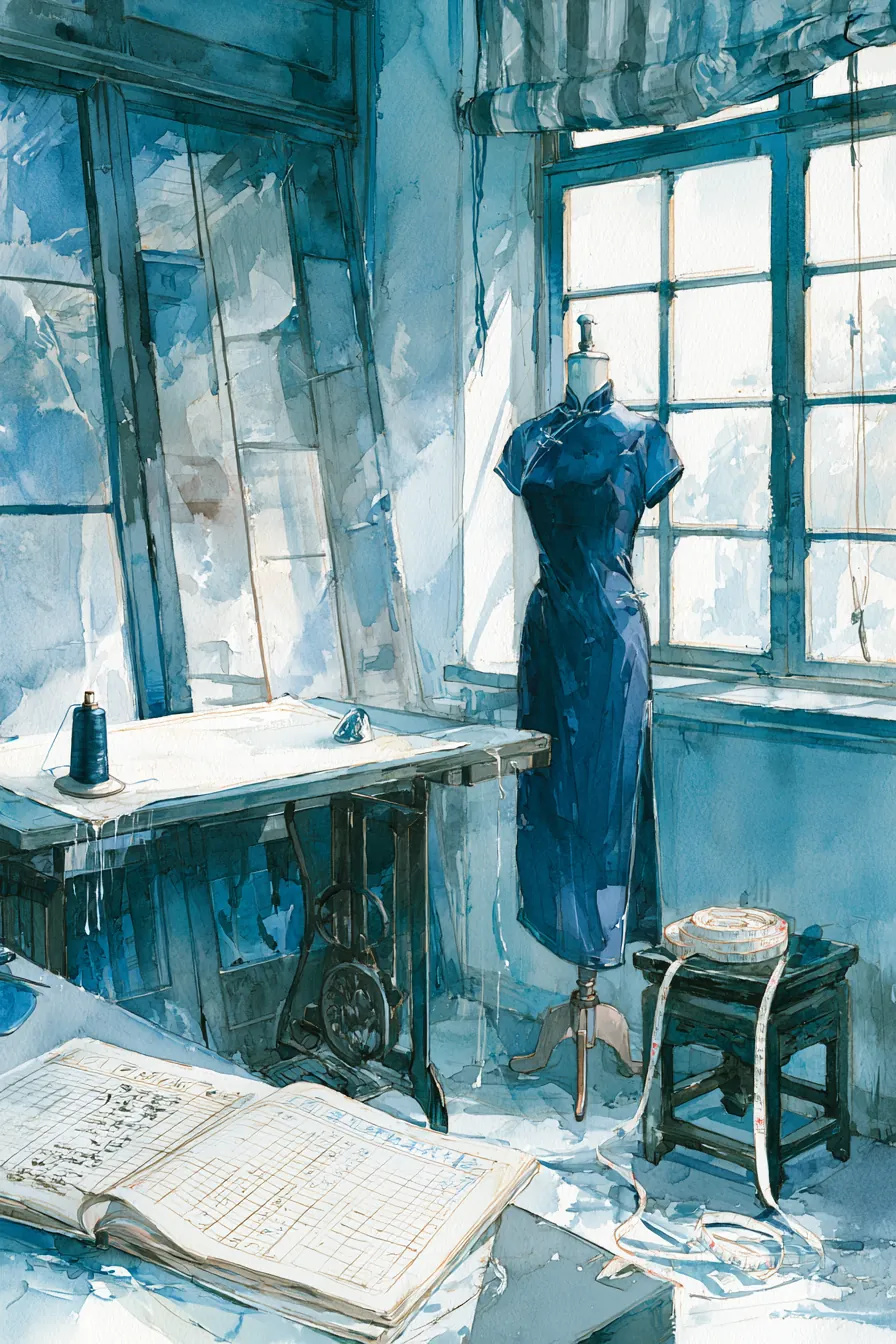
Chapter Four — Sun Ya
Teddy Harmsworth was already at the corner table when I arrived at Sun Ya. He had been at the corner table since eleven, on the evidence of two saucers and the second pot of coffee, and he was reading the North-China Daily News without much faith in it, which was a thing he had taken up in February when he had begun to disapprove of his own writing in his own paper.
Sun Ya is on Nanjing Road, between the cinema and the umbrella shop, two doors down from Chiyu Trading. It is one of three coffee shops in Shanghai where a Chinese woman can sit at a table by the window without an explanation, and the only one of those three where the cake is honest. The cake is honest because the German baker — a man named Rudolph, who had been the pastry chef at the Cathay until 1934 and had left over a salary dispute with Sir Victor's man — refused to substitute lard for butter when the silver dollar fell against the pound sterling and the management at the Cathay had told him to do it anyway. He had set up at Sun Ya for less money. The cakes had not changed. The British wives knew. They sat at the round tables in the back. They ordered the Bienenstich and the cream-cheese tart and they talked about their cooks.
Teddy stood up when I came in. He was thirty-one, six foot one, with the thin redhead's face of a man who has been told all his life that he ought to wear a hat and who never quite has. The white linen suit was the linen suit. The collar was clean. He was, I thought, getting thinner. He had been getting thinner since February and I had not, until that Tuesday, decided whether the thinness was a thing I should mention.
"Miss Su," he said. "Good morning."
"Good morning, Mr. Harmsworth."
"You are nine minutes late, which is the second time this month, which means we have a pattern, which means I am going to be insufferable about it."
"You are not going to be insufferable about it."
"I shall be insufferable in two languages. The English insufferableness, and the Chinese insufferableness, which is the more painful one because the Chinese have had more practice."
I sat down. The waitress came at once. She brought my tea — Sun Ya is the only place in Shanghai that puts a single small white plum in the lid of the pot, which is a habit Rudolph stole from a Viennese place he had worked in his youth — and a fresh pot of coffee for Teddy. The waitress was new. She did not look at me twice. I had been coming to Sun Ya for two years and had been recognized once, by a Pathé scout, and had given him a different name on the spot — I'm Miss Yang from the Sun Sun department store, I have a sister who looks like that singer — and had not seen him since. The trick at Sun Ya was the morning light. The morning light falls onto Nanjing Road through the awning of the umbrella shop and onto the window of Sun Ya at an angle that made the women at the window look like other women than themselves. It was, I had decided, the reason I came.
"How was your weekend," Teddy said.
"Quiet."
"That is a lie."
"It is a lie. How was yours."
"Tedious. I went to the Long Bar and I drank too much gin and I argued with a man from the Standard Oil office about whether the new tariff on Japanese tin is, as the man insisted, a sensible administrative measure, or, as I insisted, the second-to-last warning before war. He did not like me by ten. By eleven we had agreed to disagree. By midnight he was buying me a fourth gin and saying he had a nephew at Caius who could possibly find me a column. I have not had a column at Caius since I was eight years old."
"Did he mean a column at the Cambridge Review."
"He meant a column at the Cambridge Review and I did not have the heart to tell him I have not been in Cambridge in eleven years and that the Cambridge Review is, if I remember, edited by undergraduates who are politely told twice a term not to libel the Master of Pembroke. I let him buy me the fourth gin. I came home in a rickshaw and I dreamed of the Cherwell. I have not dreamed of the Cherwell in a decade. This morning I woke at six and I felt the Cambridge Review on my conscience as if I had been the editor and had been failing in my duty."
"That is what gin will do to a man."
"That is what gin will do to a man." He took out the small black pocket notebook he carried for our lessons. He turned to a fresh page. "Today's vocabulary is, in your usual mistreatment of my native tongue, terrible. Indemnity. Mortgage. Defalcation. You are not going to like these."
I had liked them, in fact, when he had given them to me on Sunday. They were the words that ran in the Settlement papers above the fold on Mondays. Indemnity I had heard six times in 1936 and could not yet pronounce. Defalcation I had not heard at all, which had made me curious.
We started.
I will not tell you, in any detail, about the English lesson. Teddy was a good teacher, in the cool unsentimental way of an Englishman of his class who has decided to spend ninety minutes being interested in a student. He did not flatter. He did not condescend. He corrected my consonants where they were wrong and he corrected my vowels where they were wrong, and he did not, ever, correct my grammar, which he had told me in October was already better than two-thirds of the Settlement's English population, which was a flattering thing to say but not, in his careful way of saying it, untrue. We worked through the three words. Indemnity I now pronounced with the m in the right place. Mortgage I had gotten on the second try. Defalcation I had never said aloud and I did not now.
"Defalcation," Teddy said. "From the Latin falx, a sickle — the act of cutting away. A specifically commercial cutting away, of funds entrusted to one's care."
"Embezzlement."
"Embezzlement is for sums one ought never to have had. Defalcation is for sums one was given. The man who steals from his employer is a defalcator. The man who steals from the bank is an embezzler."
"Are there enough words for stealing in English."
"There are. There are also very specific verbs in classical Chinese — 盗 dào and 窃 qiè — which the Liji distinguishes in ways my teacher could not fully explain to me in 1932. We are quits."
I drank my tea. Two British wives at the round table behind Teddy were talking, audibly, about a Russian dressmaker on Avenue Joffre who had given one of them, in March, a qipao with a crooked seam. The conversation had been going on for forty minutes. The dressmaker, by the second wife's account, had cried.
Teddy lowered his voice.
"May I ask you a thing, Su Wanyin. As your sometime friend and not your tutor."
"You may."
"You are tired."
"I am tired."
"That is not an answer."
"It is not."
He let the moment sit. He turned the pages of the notebook over, slowly, until he was at a blank page near the back. He did not write. He set the pen down across the blank page.
"My job," he said, "is to file two columns a week for the Daily News, neither of which has been printed in full in the last fourteen months because the Settlement Council has, for fourteen months, been editing out the words Japan and aggression and concession, in that order. The first time it happened I was angry. The second time I was bewildered. The third time I went home and reread Conrad and decided that anger was a small useless animal. I have not, in fourteen months, lost the small useless animal. I am thinking of writing a book. I will not tell you what the book is about." He smiled, briefly. "I am also thinking of leaving Shanghai. I do not know whether I will."
I waited.
"That is what is the matter with me," he said. "I tell you because you tell me nothing, and on Tuesdays at Sun Ya, when I am thirty-one and married to a wife I have not seen in four years and you are twenty-two and sitting across from me without a wedding ring because there is no man in this city who has yet won the right to buy you one, the least I can do is tell you what is the matter with me. Yes?"
"Yes."
"Now. Tell me what is the matter with you. If you can. In your own time. I will not ask twice."
I stirred the tea, although the tea did not need stirring. The plum in the lid had begun, in the steam, to give off the faint sweetness it gave off about ten minutes in.
"A man," I said.
Teddy did not move.
"A man," I said again, "has begun leaving me sheets of music in places he should not have access to. He has corrected a bridge of mine in red ink. He has left me three songs of his own. He has not given me his name. He has not — let me be clear — he has not touched me. He has not asked me to come anywhere alone. He has spoken to me from across a room with a piano in it. He has not lit himself."
"Where did this room have a piano in it."
"That I will not tell you."
"All right."
"He plays Schubert," I said, "and he plays shidai qu, and on Friday night when he played the Li Jinhui he played the bridge in a way that I had not, in nine years, heard a bandleader play it. He is good. He is a good musician. He is a — " I stopped. "He is teaching me. That is the word. He is teaching me. Without asking me to pay for it."
"What does he want."
"He has not yet said."
"Wanyin." Teddy did not smile. He had, in the corner of his pale eyes, the small careful concern of a man who had grown up with sisters. "You are aware that no Englishman would ask the next question I am about to ask, because the next question I am about to ask is one of the very rude questions, and I am only asking it because in 1933 you told me to tell you in advance, when I was about to be rude, so that you could tell me whether to proceed. I am about to be rude."
"Proceed."
"Does Yao Sanye know."
"No."
"Are you certain."
"Yao Sanye sent me a message through Pearl on Sunday morning that the Rue Wagner mansion was not going to wait past August. He would not have sent that message if he knew."
"And the Englishman with the songs."
"Is not English."
"No," Teddy said. "He is not. Russian, perhaps?"
I did not answer.
"I am not asking," he said. "I am merely thinking out loud. Let me think out loud. The Settlement has — let me see — twenty thousand White Russians as of last count. Half of them on Avenue Joffre. Half of those at one of three private clubs. Of those, perhaps thirty are trained classical musicians, of whom perhaps eight have at one time or another worked at the Paramount under aliases because the union does not let them play in the Settlement under their own names. The chief band librarian at the Canidrome from 1932 to 1934 was a Russian named Tsvetkov who was rumored to be a White officer's son and who is rumored to have been killed in 1934 in a fire near Zhabei. I have not, in the two years since, heard the rumor confirmed. I have also not heard it denied. There are perhaps four other men your music-correcting friend could be. I will not list them because the listing is not, particularly, my business."
"Tsvetkov."
"Don't repeat the name. I should not have given it to you. I am thinking out loud. I do not know that any of this is connected. I do not know that it has anything to do with the man you are describing. He may be — he may very plausibly be — a young Chinese composer of the Conservatory school, classmates of Chen Gexin or someone of that cohort, who has decided to drink his cabaret money and write songs anonymously. There are six of those in this city. There are six of them every year, in fact. The Conservatory turns out at least four every June."
"The Conservatory."
"The Shanghai National Conservatory of Music. Founded in 1927 by Cai Yuanpei. On Jiangwan Road. Trains pianists, mostly. The composition department is small and quarrelsome. Boris Zakharov teaches there — the Russian — and is, by all accounts, a difficult man and a brilliant one and the reason every pianist in Shanghai under the age of thirty plays Tchaikovsky like a Russian."
I filed that away.
"Teddy," I said. "I have a thing to ask you, in return."
"Ask."
"The Paramount was built in 1932 on top of a warehouse. You told me, in November, that the architects had not bothered to clear the warehouse out. Was that idle gossip or was it documented somewhere."
"It was documented in the Settlement Public Works Office. I had been there for a different story. The story was about a contractor who had bid low on the seawall and overbilled on the marble and who had been required to give a deposition. While I was there I asked the registrar for the file on the Paramount because I had been at the Paramount on a Saturday and a friend had said the floor was famous and I was curious about the engineering of springs. The registrar — a man named Hu, no relation to your carpenter, I trust — had laughed and pulled a binder. The binder said the construction syndicate had purchased the lot in November 1931 from a Cantonese rice importer who had built a two-story warehouse on it in 1922 and gone bankrupt in 1929. The syndicate had not demolished the warehouse. They had built around it. The original brick foundations and the older sub-basement remain. There was a question, in the binder, about the storm drain. The architect had not, at the time of permitting, fully mapped where the old drain went. The Public Works Office had let it pass on the assurance that the old structure was sealed. I do not know whether it was, in fact, sealed."
"How old is the older sub-basement."
"The original 1922 build. So fifteen years ago. The brick is the small red kind that the kilns at Yangshupu fired in the 1880s, so the brick may actually be older — recycled from a torn-down structure in Hongkou, possibly, the kind of thing the Cantonese liked to do in those years to save on materials. I asked the registrar why the warehouse had been built where it was. He said it had been built because there was already a horse-cart turning circle on the lot from a stable that had stood there in 1908 to 1919. So the lot has had three structures in three decades. We are paving on top of paving in this town."
I had stopped breathing for a moment. The brick is the small red kind that the kilns at Yangshupu fired in the 1880s. That was the brick I had touched on Friday night with my left hand at the bottom of the stair.
"Are you all right," Teddy said.
"I am all right. The plum is sweet today."
"It is. Rudolph has been soaking them in something. I am not asking what."
I looked at him. He had set his hands on the table on either side of the saucer in the way he set his hands, which was the way a man's hands rest when he has decided to be patient.
"Teddy," I said. "If a person — a person who is not me — wanted to read a list of the people who were killed in the 1934 raid on the Shenxin printing press in Zhabei, where would such a person look."
Teddy did not move for two seconds. He picked up the coffee cup. He drank from the coffee cup. He set the coffee cup down.
"That is a different question," he said.
"I know it is a different question."
"It is the kind of question that gets answered, in this city, by men who do not always give the names back."
"I know."
"The list does not exist in any newspaper of record in the Settlement. The Daily News ran a paragraph on November the third of 1934 saying that the SMP and the French police had cooperated on an action against an unlicensed printing operation in Zhabei and that four persons of Chinese nationality had been killed in a fire of indeterminate origin during the operation. The names were not printed. The Chinese-language Shenbao ran a similar paragraph the same day. The L'Echo de Chine in the French Concession ran no paragraph at all, which is interesting, because the L'Echo runs everything, and which suggests the editor had been told not to. There is, however, a list. The list is in a green ledger in a desk in a third-floor room at 11 Avenue Foch which is the Bureau Politique of the French Concession police. The ledger is in French. The man with the key is a sergeant named Ricard who drinks at the Cercle Sportif on Tuesdays. I have had occasion to drink with him on Tuesdays. He has not, ever, opened the ledger in my presence. I have read three pages of the ledger once in 1935, by an arrangement I will not describe, while Ricard was using the lavatory. I did not memorize the pages. I did not write anything down. If a person who is not you wanted to know what was on those pages, that person would need to be — let me see — that person would need to be a friend of mine, and that friend of mine would need to be willing to drink three gins with a French sergeant on a Tuesday at the Cercle Sportif, and that friend of mine would need to be willing to wait the third gin and not the second."
He picked up the coffee cup again. He did not drink from it. He set it down again.
"I am that friend," he said. "If the person who is not you needs the list, the person who is not you can come to me, and I will go to Ricard, and I will get the list, and I will give it to the person, and we will never speak of it. Yes?"
"Yes."
"Wanyin."
"Yes."
"Do not, please, tell me who the person is."
"I will not."
"And do not, please, tell me what you think you are doing."
"I do not know what I think I am doing."
"That is the best answer you could have given. It happens to be the answer that has kept the Daily News from firing me four years running, although for different reasons. Eat the cake. It is more honest than the conversation."
He pushed the plate toward me. The cake was the Bienenstich, the slivered almonds glassed on top in the honey-butter Rudolph caramelized in a pan he had brought from Hamburg in 1928. I ate the cake. Rudolph came out of the kitchen and shook a flour-dusted hand at Teddy and went back in.
We did not say anything for a long minute.
"Two other things," Teddy said. "And then I will let you go."
"Yes."
"The first thing. Major Itō Kensuke is — I do not know if you have noticed — a frequent visitor to the Paramount of late. Three Friday evenings, two Saturdays, one Tuesday. Always plainclothes. Never table seven, until on Friday night past, when he sat at table seven for the first time and asked for it specifically. The maître d' has told me. The maître d' has been telling me Japanese things since November. The reason the maître d' tells me Japanese things is — let us say — among the reasons the maître d' tells me Japanese things, one of the reasons is that I pay the maître d' to tell me. The other reasons are that the maître d' is from a Catholic family in Hongkou whose nephew was beaten by a Japanese sentry at the Garden Bridge in November, and the maître d' has feelings."
"I have noticed Itō."
"He has, by now, almost certainly noticed you. Which is to say, you are now on a kind of list you were not on three weeks ago, and the list is in a building in Hongkou rather than in a green ledger in Avenue Foch. The list in the building in Hongkou is not the kind of list one talks one's way off. I am telling you because I would tell my sister, if I had a sister at the Paramount."
"I understand. Thank you."
"The second thing. I have, in the inside pocket of this coat, a fountain pen that was given to me by my father in 1920 and that I have not allowed myself to lose. I am going to put it in the saucer of my coffee cup, and you are going to take it, and you are going to keep it. It is a Conway Stewart. It writes a thin line. Do not, please, sign your name with it on anything resembling a contract. Do, please, use it for things that need to be readable in twenty years. It is — what is the English you wanted last week — legible. The fountain pen is legible. Take it."
He took the pen out of his coat. He laid it in the saucer. He pushed the saucer toward me. The pen was a dark green, almost black, with a small gold band at the cap. The nib was a fine point.
I picked it up.
"Teddy."
"Take it."
"Why."
"Because I do not know what is in the basement, and I do not know what list will exist in the next year, and I do not know whether the list that will exist will need to be written down by you, in your hand, in legible ink, on a piece of paper that will outlive the people whose names are on it. I do not know any of these things. I am giving you a pen on a Tuesday at Sun Ya. That is what I am doing. The cake is, in this transaction, a coincidence."
I put the pen in my handbag, beside the brass key, beside the three folded sheets of music, beside the Shenbao I had bought on Friday and not yet thrown away. The handbag was getting heavier. The handbag, I thought, was beginning to function as a small private bureau.
"Thank you, Teddy."
"Don't thank me. It is a fountain pen. It is forty years older than you. It is a thing my father used to write postcards to my mother in 1916 from a trench he did not, in fact, survive. Use it kindly. Now eat the rest of the cake."
I ate the rest of the cake. The British wives at the round table behind us had moved on from the dressmaker to the question of a girls' school in Surrey. The new waitress had not, in the entire conversation, looked at me twice. The morning light fell on Nanjing Road in the way it always fell. The umbrella shop next door changed its window display on the hour. A small Chinese boy in a school cap walked past Sun Ya on his way to a music lesson at Mr. Mao's at the corner of Tianjin Road. He had a violin case in his hand, which he held in the careful possessive way of a child who has been told the violin cost more than his uncle's apartment.
We sat for another minute. Then Teddy paid the bill — he paid every Tuesday; he had told me, in February of 1935, that he would pay every Tuesday until I asked him not to, and I had not asked — and he tipped Rudolph's nephew a silver dollar that Rudolph's nephew did not deserve, and we went out into Nanjing Road, and Teddy walked west toward the Long Bar and I walked east toward the Bund, and we did not look back at each other, which was our agreement.
I crossed the Bund at noon. The Customs House clock chimed twelve. The gas lamps were not lit, because it was noon. The seawall was quieter than I had expected for a Tuesday — three rickshaw men resting at the foot of Fuzhou Road, a flower vendor selling jasmine at the Hong Kong & Shanghai Bank steps, a small boy fishing illegally off the steps below the British Consulate. A British naval cutter came up the Huangpu from the south with its small white wake. Behind the cutter, very far out, the Izumo sat at anchor. The Izumo was a Japanese cruiser. The Izumo had been at anchor in the Huangpu for nine months. The Izumo would be the ship the Chinese air force tried to bomb on August 14 of the following year and would miss and would hit the corner of Nanjing Road and the Bund instead and would kill, in the doing, twelve hundred civilians on the seawall I was crossing.
I did not know that, of course, on this Tuesday in June.
I knew the cruiser was there. I knew the cruiser had been there in February and would be there in August. I knew the Settlement papers had stopped, the previous autumn, mentioning where it was anchored, on the theory — the Council's theory — that not mentioning it would, somehow, make it stop being there.
I bought a small bunch of white jasmine from the vendor at the bank steps. I put it in the handbag, on top of the Shenbao, on top of the music paper, on top of the fountain pen. The jasmine smelled of the four o'clock breeze on the river.
I went up the Bund tram line to Nanjing Road and got off and walked west into the heart of the day. I had four hours before I was due at the Paramount. I walked the four hours. I did not go home. I walked into the small lanes between Tianjin Road and Beijing Road and I looked at things I had walked past for nine years — the stationers' shops, the locksmith on Henan Road who had, on his window, a brass key the size of a forearm; the brass-engraver on Ningbo Road who advertised, on his shingle, Calling cards, name-plates, presentation watches, in two languages, three days — and I tried, with each thing, to imagine the version of me who had spent nine years walking past these things without seeing them. The version of me did not entirely exist anymore. The version of me had, on Friday night at midnight, gotten on a stair that had not been on any map she had been issued, and the stair had walked away with a portion of her.
At four I bought a small bunch of red-tipped lilies for Auntie Lin from a vendor on Sichuan Road. At five I went into the lane and put the lilies in a jar on the harmonium and Auntie Lin, half-asleep, said what a kind girl, and at six I went out the back door of the lane and got a rickshaw back to the Paramount and went in through the service door and up the back stair to the dressing room.
There was no sheet of music tonight on the vanity, or behind the wardrobe, or in the lining of the dove-grey qipao I was wearing for Tuesday's set.
I felt — and I will say this honestly — disappointed. I felt the small mean disappointment of a woman who has begun, in only seventy-two hours, to expect to be addressed.
I dressed. I sang. The Japanese officer at table seven was there again. He had moved one seat closer to the bandstand. He did not look at me. Yao Sanye in the gallery lifted two fingers on the bridge of the second song. I leaned on the third syllable of fragrant for him, because he had asked for it, because he was watching, because Pearl had said we are going to keep him pleased on Tuesdays and Fridays. I leaned, and I did not enjoy the lean, and the bankers in the gallery got their catch, and the brandy importer at table fourteen lifted his head.
I came up after the second set. I did not take the cigarette Pearl held out.
In my dressing room, on the vanity, just under the powder compact in the same place the first note had been on Friday, there was a fresh sheet of paper.
It was not music this time.
It was a single quarto sheet, the same Pathé cheap kind, with a single line in the same brushed cursive in red ink:
Sergeant Ricard drinks at the Cercle Sportif on Tuesdays. Do not send your Englishman. He has been followed since Monday.
I read the line three times. I sat down. I read it a fourth time.
I put the line in the handbag, behind the other three, in front of the Shenbao, on top of the jasmine.
Then I sat at the vanity and I looked at the woman in the mirror and I did not, this time, recognize her at all. The woman in the mirror knew what I had said to Teddy at Sun Ya at half past eleven that morning. The woman in the mirror knew what Teddy had said to me. The woman in the mirror was not a person I had agreed to be.
In the wall, at the corner of the wallpaper near the bottom of the seam, the hairline was as it had been.
I did not press it.
I lifted the powder compact. I tilted the small mirror in the lid. I looked at the seam in the wallpaper through the small mirror. The seam, in the small mirror, was very clearly a seam.
"Are you there," I said, quietly, into the room.
I waited.
The room said nothing back.
After a long minute I lowered the powder compact. I went down to the third set. I sang. Jimmy King watched me on the bridge with the eyebrow at the half centimeter and let it stay. Yao in the gallery did not look up on the bridge tonight; he had set his glass down on the second song and was now reading a small slip of paper a lieutenant had brought him. Whatever the paper said, he did not, after he read it, look at me again that evening. He left at midnight without his usual nod. Three of the four lieutenants left with him. One stayed at the gallery table with the Maotai unfinished and watched, in the way of men paid to watch, the dance floor.
I came up at one. The dressing room was as I had left it. No new paper.
I did not go down.
I had not, on this Tuesday, decided whether to go down. I had decided to wait until Friday. Friday was three days. The man in the basement, if he was a man and not a building, had given me, on a Tuesday at half past midnight, a piece of information that I could not have known and that he could not have known I needed unless he had been, in some way I did not yet have the geometry of, listening to a conversation I had had at Sun Ya at half past eleven this morning, or unless someone he knew had been listening, or unless the conversation had been listened to by other people who were not him at all, and who had also passed the news to him, in a way I could not yet imagine.
Either he had a man at Sun Ya, or he had a man on Teddy, or he had a man on Ricard, or he had all three. I could not, in any of these versions, decide which made me more afraid.
I locked the door. I went home in a rickshaw. The lamp-lighter, putting out his last lamps on Yuyuan Road, did not look up.
I did not sleep until five. When I slept, I dreamed of the Izumo in the river, motionless, the small lights along its rail like the gas-lamp chain along the Bund, and I dreamed of my brother's voice singing the song of the small bridge and the flowing water and the question of where one shall ask after peace. The voice was not my brother's voice. The voice was somewhere underneath, in a room I had been in once, with a piano I had heard but not seen.
In the dream the voice held the last note one beat longer than the band would have held it, and let it go.