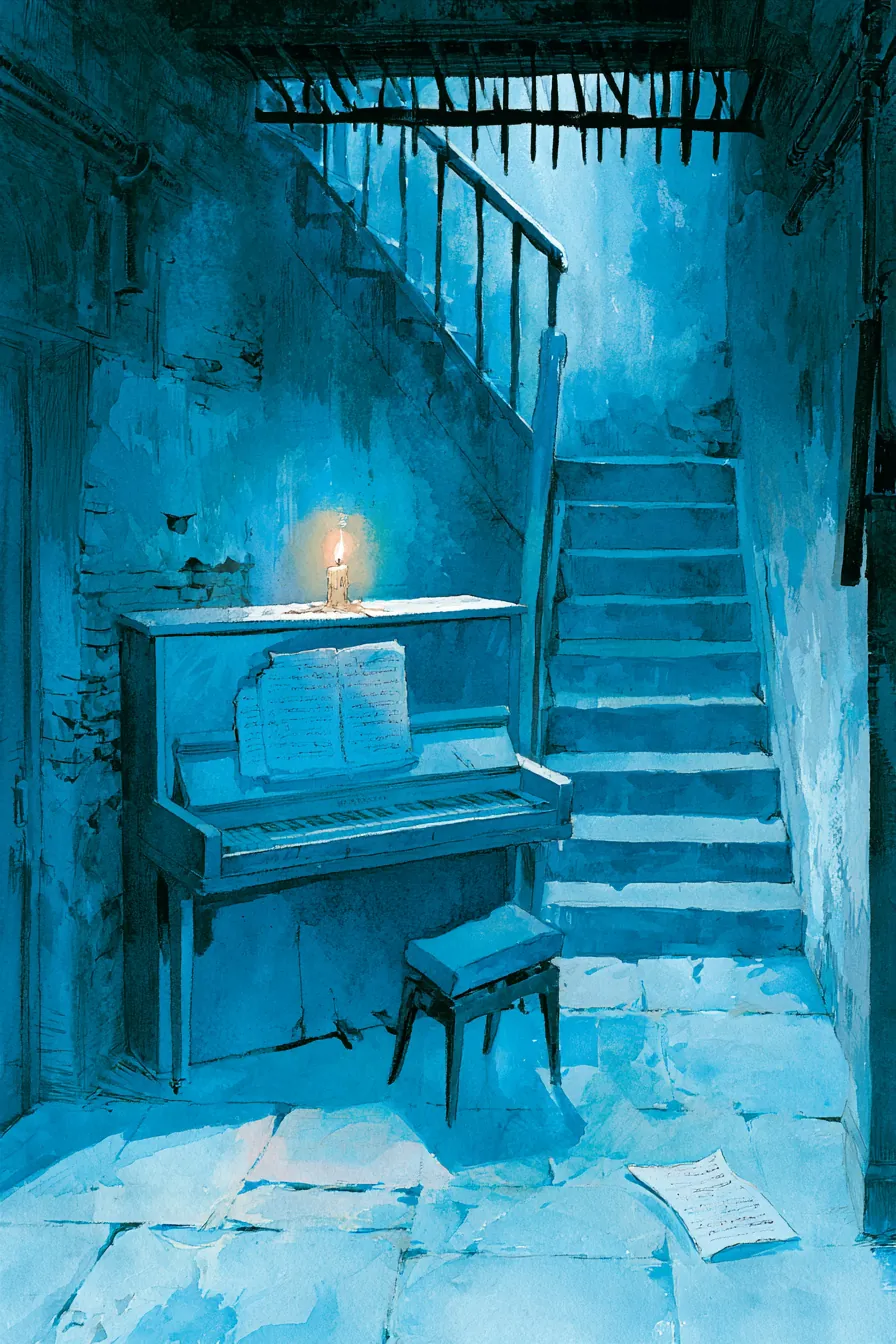
Chapter Nine — The Plum in the Lid
Tuesday in July at Sun Ya at eleven in the morning was an institution which, like most Shanghai institutions, depended on three small things for its continued existence: the British wives at the round tables at the back, the slant of light through the umbrella shop's awning across the window at the front, and Rudolph the German not raising the prices on the cake. On Tuesday the fourteenth of July, 1936, all three were still in place. The British wives were at the round tables. The light through the awning was as it had been since 1934. The cake was still six cents.
Teddy was not, this time, at the corner table.
He was at the second table from the back, near the kitchen, with his back to the window. His coffee was already on the table. He had three saucers under the cup, which meant he had been there since ten — earlier than he had ever been at Sun Ya, in two years of Tuesdays. The white linen suit was the white linen suit. The collar was clean. He had, in the chair across from him, propped against the cushion, a folded copy of the North-China Daily News on which, even from the door, I could see he had marked something with a pencil in the margin.
I sat. He did not stand. He had told me, in 1934, that he would not stand for me at Sun Ya on Tuesdays because Sun Ya at eleven in the morning was the one room in Shanghai where he wished, for an hour and a half, to forget he was an Englishman, and standing for ladies was an Englishman's habit he had not been able to break in any other room. I had not minded. I had, in fact, preferred it. Standing made the British wives turn.
"You moved," I said.
"I moved."
"Why."
"Because the corner table on Tuesday at eleven, since last Tuesday, is being watched."
I sat with this. The waitress was the older one, Mrs. Cao. She brought the tea without my asking. She had been the waitress at Sun Ya since 1929 and had not, in seven years, asked me whether I wanted the tea. The plum was in the lid. The pot was warm. I took the lid off and put it back on. The plum gave off the small dry steam-sweet of a plum that had been in the lid for a minute and a half.
"By whom."
"A small Chinese man in a grey suit. About forty. He sits at the umbrella shop on Tuesdays at half past ten and reads a magazine until twelve. He has not, in three Tuesdays, bought an umbrella. The shop's proprietor told me on Saturday, when I went in to buy an umbrella in order to have a reason to ask, that he had assumed the man was a buyer from Suzhou. We agreed the explanation was almost certainly the correct one. We were both, I think, lying."
"What is in the Daily News."
He turned the paper toward me.
He had marked, in pencil, three small items at the bottom of page four.
The first said: Sergeant E. Ricard, of the French Concession police, is on home leave until 1 August. Inquiries during this period should be directed to Lieutenant Mounier.
The second said: The Cercle Sportif Français regrets that the bar will be closed for the duration of the floor refinishing, presently scheduled for ten days.
The third said: Mr. Antoine de la Garde, sub-secretary at the French Consulate-General, will be on leave in Hanoi for the month of July.
I read the three items. I read them again. I put the lid back on the teapot.
"You read this morning's Echo de Chine also."
"I read this morning's Echo de Chine also. The same three items in French at the bottom of page three, in slightly different order. The Echo puts Ricard's leave first."
"Three persons on leave," I said.
"Three persons on leave. Sergeant Ricard, who is the man with the key to the green ledger. Lieutenant Mounier, who is therefore presumably in charge of the green ledger for two weeks and who I have never drunk with on a Tuesday. Antoine de la Garde, who is the man at the French Consulate who is, by general agreement, the friend of certain Japanese persons at the Hongkou consulate; and the bar at the Cercle Sportif, which has not been closed, in the four years I have lived in this city, for the refinishing of any floor."
"All in one week."
"All in one week. The week began on Monday. The notice in L'Echo de Chine about the tea dance was Monday. The Ricard leave notice was — let me see — yesterday morning. The de la Garde leave notice this morning. The bar closure last night. They are clearing the small inconvenient men, one by one, out of the rooms in which a certain person might wish, in August, to operate without them. The certain person, I am not in a position to name."
He picked up the cake fork. He did not yet use it.
"This is the kind of thing," he said, "the Daily News would normally have under the fold on page one. The headline does not, this morning, exist. The editor was asked to lunch on Friday by a gentleman at the Council Chambers I will not name. By the crème brûlée the editor had decided he was running three small items at the bottom of page four in the order of his choice. The order is not an order. The order is a courtesy."
"Whose."
"That is the question."
He cut a small bite of the Bienenstich. He held it on the fork.
"I am being followed," he said, "since Monday. The small man in the grey suit, and a second man — a tall Chinese in a foreign suit — who picks me up at six at the Daily News and walks behind me to the Long Bar at forty yards. I have, in two years, been followed twice before. This new following is the third. I should like, this time, to know whose it is before I have to find out by accident."
"Teddy."
"I am telling you," he said, "because you are now connected to me in the small notebooks of certain offices, and because what I do not say to you on Tuesday at Sun Ya I will not be able to say to you on Tuesday next, because Tuesday next I may have to skip and you may need to know in advance why."
He ate the bite of cake. He set the fork down.
"Eat. The cake is still honest. Whatever is going on with the city, Rudolph's butter is still butter."
I ate. I did not, today, taste it. The three items were the news under the news Pearl had described to me in 1935 over a bottle of Maotai. The news under the news, today, said that in August certain things had been arranged not to be in the way.
I said, "Teddy. I have a thing to ask you. A small one."
"Ask."
"Lieutenant Mounier. Do you know him."
"I know him. He is thirty-three, careful, drinks coffee not gin, married to a woman from Hue. He is not in any pocket. That is the thing about Mounier — he is the man Ricard's superiors chose to be in charge for two weeks because Mounier is the man who will not open the green ledger for anyone."
"Including you."
"Including me. I have never asked Mounier for anything and would not ask him now."
"Then for two weeks the green ledger is not openable."
"That is the answer I had this morning. That is also the answer your foster-mother had on Saturday night, I suspect, when she gave you whatever she gave you. I will not ask what."
"She gave me the date of my brother's death."
He was very still for a moment.
"I am sorry, Wanyin."
"You did not know."
"I did not know. I am sorry."
He drank from his coffee. He set the cup down. He did not say anything for a half a minute. The British wives at the round table behind him had moved from a girls' school in Surrey to a niece who, by the older wife's account, had married not quite the thing. I had been hearing them, in some form, for two years and could not, that morning, listen to them.
"The third question," I said, "is also a small question."
"Ask the third question."
"In the Settlement, in July, in 1936, where does a French sergeant on leave go if he is not, in fact, going home."
Teddy looked at me.
"That is a very pretty question."
"It is the question I came to ask."
"Sergeant Ricard is unmarried. He does not, when he is on leave, leave Shanghai. He goes, generally, to a Cantonese-run hotel in Wuxi, where he drinks rice wine and reads Maigret. The notice in the Echo says he is on home leave. Home is, in the notice, an English idiom translated by a Frenchman who has not lived in any of the relevant homes. Home could mean Wuxi or Marseille or, in this season, Tokyo."
"Tokyo."
"I am not saying he is in Tokyo. I am saying I do not know where he is, and the only person who could tell me, without asking, is Mounier. Mounier will not tell me. Mounier is therefore, this week, the most interesting Frenchman in Shanghai."
"Do not ask Mounier."
"I will not. You did not need to say so."
"I did not. I am saying it anyway. Auntie Lin asked me, last night, to ask you not to."
He did not move for a moment.
"Your foster-mother," he said, "is a wiser woman than her foster-daughter has yet had the wit to credit her with. Thank her, please, for me."
"I will."
"And — Wanyin."
"Yes."
"You are going to tell me, in the next minute, a thing I am not going to want to hear."
"I am."
"Tell it."
I held the tea. I did not, that morning, lift it. The cup was hot. The plum at the bottom of the lid had begun, by now, to give off the small dry sweetness it gave off when it had been in the lid for ten minutes. The waitress had passed the table again. She was a slow walker.
"On Saturday night," I said, "I was given certain information by a woman whose name I will not give you. The information is, in summary: a list exists at the Japanese consulate on which I am presently the seventh name; a Major Itō Kensuke is the official under whose authority a small private dinner is to be held in late August in a back room at the Paramount; and Yao Sanye is, in the list's adjacent column, the man who is to make the introduction. I am not asking you to do anything with this. I am telling you because, if anything happens to me between now and the third Saturday of August, I would prefer that one Englishman in this city know enough to know what to ask, if anyone, by some chance, asks him."
Teddy did not move.
"Itō Kensuke," he said, after a moment.
"Itō Kensuke."
"I will not, today, ask you the woman's name. I will, on a Tuesday in the future, ask you. I will not ask you today. I am taking the rest of the information."
"Take it."
"Wanyin."
"Yes."
"The list at the Japanese consulate is the list I named on Tuesday last."
"I know."
"You are not — let me be clear — you are not the seventh name in the lottery of any neutral civic register. You are the seventh name on a list of women whom a particular office of the Imperial Navy has identified, in the past six weeks, as available."
"I know."
"And you are not, this morning, on the gallery floor at the Paramount, because I am thirty-one and you are twenty-two and a Tuesday at Sun Ya is, for you, a small reason to be alive that you are not yet ready to give up."
"I am not."
"Eat the cake."
I ate the cake.
"I have," he said, "two further pieces of information. I will give them to you in the order in which they are perishable."
"Yes."
"First. The Izumo will receive, on Friday, a small delegation of Japanese consular wives for a deck reception. It is the kind of thing that does not, in any other year, make a paper. It will be, this Friday, on the front page of the Shanghai Mainichi. A Mrs. Tanaka — wife of a man I will not name — is to be aboard. I do not know what will be said on the deck between three and five o'clock. I do know it will not be the kind of thing one wishes to have been a junior officer's wife not present at. The woman whose name you have not given me may have an opinion, by Saturday morning, that you may wish to know."
"Mrs. Tanaka."
"Mrs. Tanaka. I have not spoken her name aloud in twenty-two months. I have spoken it now. You may forget it. You may also remember it. I am not asking either."
I sat with this. The handbag against my elbow had become, since Saturday, an indictment a careful man could read at a glance through cloth if the cloth were thin enough. The cloth, this morning, was a dove-grey crêpe-de-Chine. It was not thin enough. It was also not thick enough.
"The second piece of information."
"Is about Pearl."
I waited.
"Pearl's Portuguese was seen on Sunday at the consulate on Rua Praia Grande in Macau, asking after the procedures for an emergency repatriation visa for one Chinese national, female, twenty-six, professional in the entertainment line, residence Shanghai. He asked about the procedure. He did not file the application. I am telling you because Pearl has not, and because Pearl, knowing Pearl, will tell you on a Wednesday afternoon in August at the earliest, by way of a joke."
"Pearl."
"Pearl. The procedure is a procedure. Macau is at present accepting them. It will not, in eighteen months, be accepting them."
I drank the tea. I had not drunk it yet. The plum in the lid had given off the sweetness twice now. The third sweetness was the last.
"Teddy."
"Yes."
"You are giving me a great deal of information today."
"I am."
"I have not asked for any of it."
"You have not. I am giving it because on Tuesday next I may not be at Sun Ya, and I am giving today what I would otherwise have given over three Tuesdays. I will be a frugal correspondent for some weeks. Until the bar at the Cercle Sportif reopens, you take your coffee at Federal on Avenue Joffre. I take mine at the small Italian place behind the Park Hotel. In two weeks, when the bar reopens or the small Chinese man in the grey suit chooses not to come back, we resume Tuesday at Sun Ya. Yes?"
"Yes."
"Wanyin. I have, today, given you only words. The words are from a man whose words have not, for fourteen months, been considered words in this city. Do not, on the strength of them, place a single bet. Place bets on what you see with your own eyes and on what your foster-mother in Hongkou tells you. My job is to tell you what is in the rooms I have been allowed into. The doing is yours. Eat the rest of the cake. I am going to pay the bill."
He paid the bill. He gave Rudolph's nephew a silver dollar Rudolph's nephew did not, this Tuesday, deserve. He stood. He did not, this Tuesday, walk west toward the Long Bar. He walked east, with me, as far as the corner of Nanjing Road and Henan Road, where he tipped his hat and said, go in good health, Miss Su, in the formal Mandarin he used when he was being watched, and turned south.
I went east. The small Chinese man in the grey suit was not, as far as I could see, at the umbrella shop. The umbrella shop's proprietor was in the doorway with a watermelon. He nodded to me. I nodded back. I crossed Henan Road. I walked to the Bund.
On the Bund the Izumo was where it had been since November. It had, on its forward deck, a small awning that had not been there on Saturday. The awning was striped in white and blue. A small launch in the consulate livery was being lowered from the davits. The crew on the launch were in white. The Customs House clock chimed twelve. The lamp-lighter on the Bund had not yet, at noon, begun his rounds.
I took a rickshaw at the corner of the Bund and Beijing Road. The puller was a man of perhaps fifty whose forearms were the forearms of a man who had been pulling since 1922. He took me at the listed fare. The rickshaw was, in the heat at noon, the small choking heat of a wooden box on wheels in July; the puller had oiled the wheels at six and had been pulling since, and the lamp-oil on the axle was the lamp-oil on the axle. The smell of it came up into the qipao. I had been in rickshaws since I was thirteen. I had not noticed the oil in five years. I noticed it today. The oil smelled, this Tuesday, of every Tuesday I had not noticed it; the way a clock one has stopped winding will, after some weeks, remind one it had been working.
We crossed the Garden Bridge. The Japanese sentry today was new. He looked at me. I bowed at the appropriate angle. He waved the rickshaw through. The puller said nothing. He did not say anything about Pudong matters. He took me up Wujin Road and let me off at the corner. I went down the lane to the gate. Old Mr. Cao tipped his cap to me. I went up the lane to the house.
Auntie Lin was awake. She was at the harmonium. The harmonium lid was up. The jasmine I had brought her yesterday had opened; the small white petals had unfurled in the night and were, in the early afternoon, beginning to give off the heavy summer sweetness jasmine gave off on the second day. The pipe was on the small table. It had been lit at eleven, at the smell of it on her sleeves. The sweet bitter resin-smell of the opium had been in the lane house since I had stepped into the doorway; I had not, for two years, noticed it, and I noticed it today. Auntie Lin had taken the half-dose she took at eleven on the days when the day was going to be a long one. The pipe was, now, out. The room smelled of the opium and the jasmine and the brass of the harmonium pedals warmed by her foot.
"You are home early."
"I am."
"Sun Ya."
"Sun Ya. Teddy moved tables. He is being followed."
"By whom."
"He does not know. He has guesses. He has not told me the guesses. He gave me, in lieu of the guesses, three news items that have been arranged into a small notice at the bottom of page four of the Daily News in an order chosen by an editor over the crème brûlée at the Council Chambers on Friday last."
"What is the news."
"Sergeant Ricard, Lieutenant Mounier, and Antoine de la Garde. On leave, in charge, on leave. And the bar at the Cercle Sportif. They are clearing the small inconvenient men, one by one, out of the rooms a certain person wishes, in August, to operate without them."
Auntie Lin closed the harmonium lid. She did not press a key. She put both hands on the lid the way she did when she was thinking.
"And Pearl."
I told her.
"Pearl will not tell you," Auntie Lin said. "Pearl will tell you, on a Wednesday afternoon in August, by way of a joke about a Portuguese. The joke will be the announcement. You will laugh because Pearl will be laughing. You will not, for two hours after the laugh, understand the joke. Then you will understand the joke and you will sit down on a bench somewhere and you will not, that night, sleep. I am telling you because, on the Wednesday in August, I would prefer you understand the joke at the moment Pearl is laughing. You will understand the joke at the moment Pearl is laughing if, between now and August, you do not let your friends be brave for you. You will let them, if you let them, be alive. Yes?"
"Yes."
"Good. The jasmine is open. The pipe is, this morning, the half. I am going to sleep. You will, on Friday, go down. You will tell the man in the brick room, if you tell him anything at all, only the parts of what you were told on Saturday that he is permitted to know. Not all of them. He does not need the August dinner. He needs the list. He does not need the Persian woman's name. He needs the column. He does not need Mrs. Tanaka. He needs only that the list exists and that you are seven. The rest, you keep. The rest is yours. Yes?"
"Yes."
"Go and do the things one does in the afternoon. I will sleep."
I went into the kitchen. I drew a bowl of water from the lacquer pail. I washed my face. I rinsed my mouth. I dried my face on a clean cotton towel that had, last week, been hanging on the line in the back court, and that smelled, faintly, of the Sunlight soap Auntie Lin used in the wash. I went back into the front room. Auntie Lin was already asleep in the chair. The jasmine on the harmonium was open. The pipe was cold. The afternoon had begun to thicken. The cicadas in the lane plane trees were at the second of their three summer pitches.
I sat on the chaise. I took the velvet box out of the handbag. I did not, today, open it. I put it back. I took out the dead list. I read down the column. I had read it twice this morning between four and six and had not, until now, in the heat of the lane house at one in the afternoon with the jasmine open and the opium cold on the table, been able to look at the names without putting them down. I put them down at the seventeenth. The seventeenth was a printer named Tang Aichu. He had been twenty-three. He had been killed, by the typist Bao Lifen's marginal note, in the front room of the press.
I put the list back in the handbag.
I took out the Conway Stewart. I took out a fresh sheet from the small notebook I carried for lyrics. I wrote at the top of the sheet:
The order is not an order. The order is a courtesy. Whose.
Below that I wrote:
Ricard, Mounier, de la Garde — all three out of position for the August week. Cercle Sportif bar suspended for the same window. The certain person is, by exclusion, a Frenchman with consular authority and an arrangement at the Council Chambers. The certain person is not the consulate. The consulate is, this week, the de la Garde column. The certain person is, perhaps, above the consulate. The certain person is, in any case, the one for whom the rooms are being cleared.
Below that I wrote:
Friday, three to five p.m., Izumo, deck reception. Mrs. Tanaka aboard. Listen, on Saturday, for what M. K. mentioned at the Wednesday tea.
Below that I wrote:
Pearl, Macau, repatriation. Not yet. Watch.
I capped the pen. I folded the sheet. I put it in the inside pocket of the handbag, between the dead list and the brother's letter. The handbag, again, was heavier. The handbag was beginning to be, in its small unsanctioned way, the country of which I was the only citizen and the Bureau Politique and the post office and the lone customs officer who refused, in any season, to be bribed.
I sat with the handbag in my lap. The cicadas changed pitch. A small girl on the carpenter's stoop two doors down ran a stick along the bars of the bird cage. The myna swore softly in Shanghainese for a minute and stopped.
I closed my eyes.
In the dark behind my eyelids the Izumo on the Bund had its blue-and-white awning up and its launch lowered, and a small Japanese woman of about forty in a kimono with a navy obi was being handed up to the deck by a young officer who did not, in the handing, look at her face. Mrs. Tanaka, I thought, was the same age as Pearl. The same age as Madam Khorshid had been, in 1928, in the cheongsam photograph on the wall of the small front parlor. The same age as the typist Bao Lifen had been, in 1934, when she had typed the list. The city in 1936 was, when one looked at it in this way, a city of forty-year-old women in the rooms behind the rooms.
I opened my eyes.
The sun on the harmonium had moved an inch. The jasmine on the lid had begun, by the second day, to brown at the edge of the lower petals. By Friday it would be in the bin in the back court.
By Friday I would go down.
Three streets away a tram bell rang at the corner of Sichuan Road. The bell rang twice. The bell was the small high reliable note the trams rang at the corner where Wujin Road met Sichuan Road since 1928. I had heard it eight thousand times. I heard it, today, the way one hears a note in a song one has been singing wrong, which a man two floors below the floor one is standing on has, with a pencil, in red ink, just corrected.
I sang the note into the empty room.
It was correct.
Auntie Lin slept on.