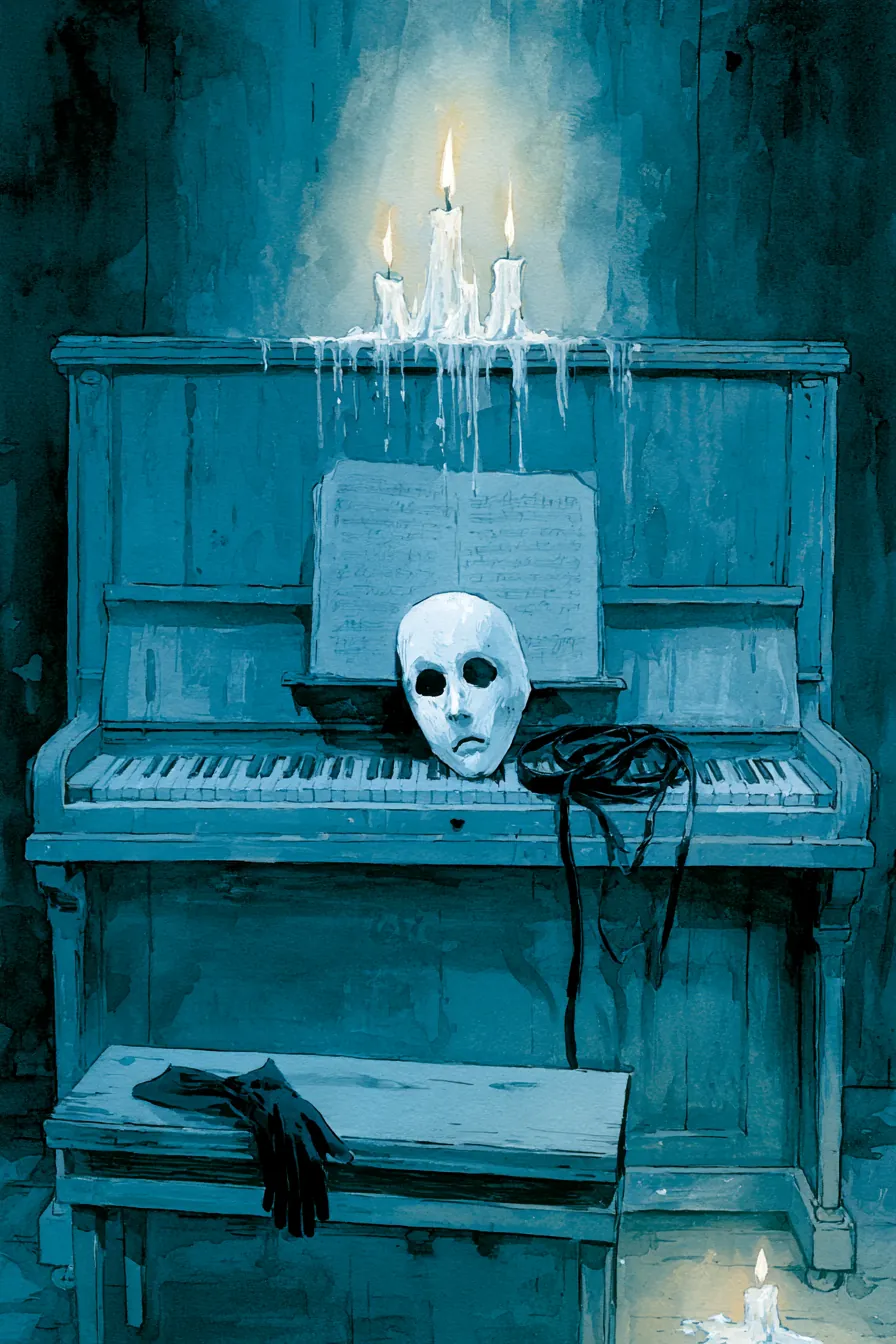
Chapter Twelve — Interlude I
Wednesday, October 28, 1936. 2:15 a.m. The basement.
After she went up the stair, he sat on the bench for a long time.
He had heard her on the second-to-last step take the bowl of barley tea the cook had set out, and the small wooden sound of the bowl set back down. He had heard the cook's pipe lifted half an inch in the cold-storage room above. He had heard the back-stair door open and close, and the corridor door, and after a longer pause the service door onto Wanhangdu, and after the service door the small descending dampening of the city eating her footsteps until there was no longer a woman in a silver qipao going home but only the building, and the basement, and himself.
The Telefunken was off. The candle on the music desk had two inches of beeswax left. The lamp at the small table held at its low. He did not, that evening, turn either of them up.
He waited an additional twenty minutes, on the bench, with his hands flat on his thighs.
This was the discipline.
The discipline was that he did not move from the bench until he had counted, on the small clock that hung above the door beside the wooden box that held the radio, twenty minutes from her ascent. The clock was a French railway clock he had stolen from a corridor at the Cercle Sportif Français in 1932 — before the burn, in the year he had still been a man who stole things from corridors. It had a French railway clock's particular tick: dry, regular, slightly heavier on the downstroke. He had set it, in 1934, to lose three minutes a day, because the Paramount's house clocks gained four minutes a day, and the average kept him roughly in step with the city.
When the minute hand passed the eight he stood.
He went, first, to the music desk. He took the score off it — the second movement, draft eleven — and laid it on the small worktable beside the cot. He capped the fountain pen. He set the pen on the desk beside the score. He took the corrector's red ink-pot and replaced its stopper. He folded the soft cloth he had been using to blot the nib and set the cloth, folded once, beside the ink.
He went, second, to the piano. He closed the keyboard cover. He laid his right hand flat on the wood of the cover for a moment, in the way a man does when he is acknowledging an animal that has done its work.
He went, third, to the small mirror on the wall beside the cot.
The mirror was the one piece of furniture in the room that had not been there when he had arrived in 1934. The carpenter Mr. Hu had brought it down in February of 1935 — a small oval glass in a brass frame, four inches by six, rescued from a dressing-room renovation. Mr. Hu had said, you do not have a mirror, and had set it on the small nail driven into the brick at the head of the cot, and had not waited for thanks. He used it for two things. He used it for shaving, on Tuesdays and Fridays, with a straight razor and a small basin of water heated on the spirit lamp. He used it for the second thing now.
He reached behind his left ear.
The strap was soft black leather, an inch wide. It had been remade twice — in 1935 by a leatherworker on Fuzhou Road who had thought he was repairing the strap of a fencing mask, and in 1936 by the same leatherworker, who had begun to suspect otherwise and had not asked. The buckle was small brass. He worked the buckle with his right thumb and forefinger. He had, in two years, made this motion six thousand times. The buckle came undone.
He held the mask away from his face on the open palm of his right hand and looked at it for a moment.
The porcelain was the porcelain. It was white. It was matte on the inside, glazed on the outside. It had three small pin-holes at the temple where the prop-maker on Fuzhou Road had installed a ventilation slot in 1935 because he had complained that the cheek was sweating. It had a half-inch chip at the bottom edge from the night in March 1936 when he had dropped it on the brick floor. He had not had the chip repaired. The chip was, in the geography of the porcelain, the only honest place on it.
He set the mask on the small worktable beside the cot.
He did not, for a moment, look in the mirror.
This was also the discipline.
The discipline was that he did not, on the first removal of the evening, look. He turned, instead, to the small basin of water on the worktable, and he wet the soft cloth, and he held the cloth against the burned side of his face for a count of thirty. The cloth came away with the small daily exudate the keloid produced — a clear thin film, salt-smelling, the consequence of having a face the body did not entirely consider closed. He rinsed the cloth in the basin. He hung the cloth on a nail.
He turned to the mirror.
The right side of his face was the right side of his face. It was the face of a man of twenty-eight with a small slack tiredness at the corner of the mouth. The hair was the hair, black, long enough at the temple to cover the strap. He had cut the hair himself, three weeks ago, with the same razor he used to shave. He had cut it badly. Mira Tsvetkova, in 1916, had cut his father's hair with a pair of dressmaking shears in their Tianjin parlor on Sunday afternoons; Mira Tsvetkova had had a steadier hand than her son.
The left side of his face was the geography. The keloid ran from the temple to the jaw — a coastline, an isthmus of healthy skin between scar and eye, the eyelid thickened, the corner of the mouth drawn upward into what looked, from the wrong angle, like a small permanent smile. He had stopped being startled by it in the second year. He was, in the third year, occasionally surprised by it on Wednesdays and Fridays in the seconds after he had set the mask down and turned to the mirror. The surprise was small. The surprise was the thing the discipline existed to manage.
He oiled the strap.
The leather oil was in a small tin on the worktable. He worked it into the strap with his right thumb and the heel of his right hand. The strap took the oil. He had learned, in two years, to oil the strap on the night he took it off and not on the morning he put it on, because the leather sat better against the skin if it had had eight hours to absorb. He worked the oil into the buckle's pivot. He hung the strap on the nail above the mirror to dry.
He took his left hand out of the gloves.
The gloves were thin black cotton. He wore them at the piano because the left hand was a slightly different temperature than the right; the carpenter Mr. Hu had brought him the gloves in 1935 with the same not-asking that had brought him the mirror. He pulled the left glove off first. The left glove came away.
The smallest finger of the left hand was, at the last joint, not there.
The joint had been there in November of 1934. The joint had been a fingernail and a small distal phalanx and a soft pad that had pressed, in the year 1933, a particular Schoenberg chord at the Canidrome at half past one in the morning on a Tuesday in October. The joint had been there on the night of the printing-press fire — he had cut it on a piece of falling lath, but the joint had been there. The joint had been removed in the French Concession hospital on the eleventh of November 1934 by a Dr. Pierre Morancy because the joint, by the fourth day, had been black, and the joint had been threatening the rest of the hand, and the rest of the hand had been the only thing about him in November of 1934 that Dr. Pierre Morancy had been confident he could save.
He looked at the hand.
This was also the discipline.
The looking, on Wednesday nights after she had gone up the stair, was a thing he did to keep himself from forgetting. He did not forget. He could not have forgotten. He looked anyway. He looked because the looking was the thing he owed.
The score on the worktable was the second movement, draft eleven. It had been written for a left hand that could not span a tenth. He had, in the past nine weeks, watched a young woman in a silver qipao on the far side of the music desk sing a bridge in C-sharp minor he had written for that hand, and he had not, in nine weeks, said a word about the hand, and the young woman had not, in nine weeks, asked. The young woman had asked, on the seventh week, about a thing he had said in passing about the cab stand at three in the morning, and he had not answered, and the young woman had not pressed, and they had, in this way, continued working on a song that was a song.
He oiled the small place where the joint had been.
There was a small oil-paste in a porcelain pot on the worktable. He had been given it by Dr. Morancy in 1935. He used it, on Wednesday nights, because the small ridge of healed skin at the end of the finger was, by Wednesday, slightly cracked from the playing. He worked the paste into the ridge with the pad of his right thumb. The paste smelled, faintly, of beeswax and almond. Mira Tsvetkova would have known the smell. Mira Tsvetkova, in 1916, had used a similar paste on her hands in the Tianjin winters.
He put the left glove back on.
He sat down at the worktable.
The diary was in the locked steamer trunk beside the cot. The trunk had been locked since 1934. The key hung on a small hook on the brick wall, beside the coat. He took the key down. He unlocked the trunk. He took the diary out — a leather-bound notebook, the leather worn at the spine, the pages cream-coloured, the writing in his own brushed cursive in two inks: black ink for the running entries, red for the names. He closed the trunk. He set the diary on the worktable.
He opened it to the entry he had been working on.
The entry was dated, in the small careful schoolboy's hand he used for the dates, 戊子年 戊戌月 廿八日 — the lunar date — and then, below, in arabic numerals, October 28, 1936. The page was half-full. The black-ink running entry began, at the top: She sang the third verse with the four breath marks held as breath. I had not been certain it could be done. She did it. She did not, after the doing, look at me. The doing had been the asking. I had not asked her to know that the marks were names. She does not know yet. She will, when I have given her the cipher. The giving of the cipher is a thing I will, at this present moment in October 1936, not be able to time.
He had written this an hour ago, before the humming.
He took the cap off the pen. He did not, that night, write any further in black. He turned, instead, to the back of the diary, where the coded list had been since November of 1934.
The list was the list of the 1934 dead. It was eleven names long. Beneath the eleven names — in the appendix, in the older red ink that had faded over two years to a slightly browner red — was the older list. The older list was the 1927 dead. It was thirty-seven names long. It was the list Lu Jiwen had given him in 1933, when Lu Jiwen had been twenty and had been making peace, in his own way, with the cell his half-brother had been killed with in April 1927. Lu Jiwen had not killed his cell. Lu Jiwen had been twelve in April of 1927. The list had been compiled by an older cousin of one of the dead, a Communist clerk at the Longhua morgue, and had been given to Lu Jiwen as a way of saying we remember. Lu Jiwen had given it to him in November of 1933, when Lu Jiwen had decided to organize at the Shenxin Cotton Mill No. 9. Lu Jiwen had said, on the giving: if a thing happens to me, do not let me be lost. Do not let me, in particular, be lost the way these were lost.
A thing had happened to Lu Jiwen.
Lu Jiwen was, on this appendix list, in his own right, name twelve.
The thirty-seven names of 1927 he had, since 1934, read every Wednesday at this hour. He had made of the reading a Wednesday discipline. He had decided, in 1934, that the dead in red ink would not become, by his hand or by his inattention, an abstract series of strokes on cream-coloured paper. The dead would be named, on Wednesdays, by him. He had read the list two hundred and forty-five times.
He had not, in two hundred and forty-five readings, until tonight, recognized a name.
The recognizing had happened in the second week of October. The name was the seventh name on the list — Shen Ahuai (沈阿淮), Longhua, April 1927, age 19, textile organizer, Yangshupu cell. The recognizing had happened because he had been told, by Madame Anya through the third party that was Mr. Hu the carpenter, in the second week of October, that the foster-mother of Miss Su the singer had had — and had withheld for nine years — a letter from a brother of Miss Su the singer who had died in April 1927 in the Longhua trench. The brother's name had been on a small slip of paper Mr. Hu had brought down, and the small slip of paper had been 沈阿淮.
He had, on the receiving of the slip, set the slip on the worktable and not picked it up again that evening. He had, on the following Wednesday, opened the diary to the appendix and read the seventh name and seen, for the first time, what it had said for two years.
He had, on the night of the receiving — the Wednesday two weeks ago — written nothing in the diary. He had sat on the bench for an hour. He had gotten up. He had walked to the trunk. He had walked back. He had not opened the diary. He had thought, for the first time in two years, that he had been wrong about a thing.
The thing he had been wrong about was the year.
He had thought, since 1934, that he had been brought into the basement by Dr. Morancy and Mr. Hu in 1934 to be hidden until he was strong enough to die elsewhere. He had thought the song he had been writing since 1935 was a song he was writing for a singer who would, in some future month, be the right singer for the song. He had thought the singer he had been listening to through the sprung maple floor since 1935 was the singer for the song because of her voice. He had thought the building over his head was the only place in the city of Shanghai where the song could be safely written.
He had been wrong about the year.
The year was not 1934 or 1935 or 1936. The year was 1927. The song had been waiting, since 1927, for a singer whose brother had been on the same trench list as his own half-brother had been on, eleven years later, in 1934 and 1927 alike. The brother in 1927 had been a textile organizer at Yangshupu. The half-brother in 1934 had been a textile organizer at the Shenxin Mill in Yangshupu. The two of them had walked the same district. They had not, in this lifetime, met. They had been on the same list because they had been killed by the same gang in the same kind of April for the same kind of reason. They had been killed by men who had, in both Aprils, been paid by Du Yuesheng — a man who, on Wednesday evenings at this hour, was at his Spanish-style mansion on Rue Wagner in the French Concession eating a small bowl of Huaiyang noodles and listening to the wireless.
He took up the pen.
He wrote, in red ink, at the seventh name on the older list, a small thing he had not, in two hundred and forty-five readings, allowed himself to write.
He underlined it.
He underlined it a second time.
He put the pen down. He looked at the page. He looked at the underlining. The double underline was, in the small private grammar of the diary, the strongest mark. He had used the double underline three times — for Lu Jiwen, for An Wenjing, and now for Shen Ahuai. The first two had been his own dead. The third was hers.
He turned, then, to a clean page in the front of the diary. He took up the pen in black ink. He wrote, in the brushed cursive that was the entry hand:
She is the voice. I knew this two years ago. I am not allowed to want anything.
He read it.
He underlined the third sentence once, in black. He did not, that night, double-underline it. He had decided, in 1934, that the doubles were for the dead.
He closed the diary. He set the pen on the worktable beside it. He sat with the diary closed for some time.
The candle had three-quarters of an inch left. The lamp at the small table held. The French railway clock above the door said it was three minutes after three. The wireless above the box at the wall was off. Manila was, at this hour, broadcasting Bing Crosby; he would, on Friday at one a.m., turn it on for her if she came. She had come, on the second Friday in October, at midnight and stayed through the third measure of the bridge. She had not, on the second Friday in October, asked him whether he was Russian. She had heard the two bars. She had, on the second-to-last step of the stair tonight, also heard them. She had not said so. She had, in the moment after the humming, said I did not hear it, in the way a woman says she did not hear a thing she has, in fact, heard, when she has decided to make a gift of the not-hearing.
The gift was a thing he had not been given by anyone since 1934.
He put the diary back in the trunk. He locked the trunk. He hung the key on the hook. He turned out the lamp at the small table. He left the candle on the music desk for last.
He took the mask off the nail above the mirror. He held it on his open palm again for a moment. He did not put it on. He sat on the cot, with the mask on his thigh, and he looked across the room at the piano and the empty chair beyond it, and he thought, for some unknown duration, of a thing he had not thought of in a year.
The thing he had not thought of was a Sunday afternoon in May of 1929, in a small concert hall on Bubbling Well Road, where the Conservatory had put on a student concert and his Pushkin opera had been performed in front of an audience of approximately ninety people, of whom approximately fifteen had walked out before the second movement, of whom approximately three had wept during the third — for reasons that had nothing to do with the music — and of whom one, a German émigré named Mendelsohn who had been visiting Schoenberg's circle that year, had come backstage afterward and had said, in a clipped Hamburg German that was the second German he had ever heard, young man, this was — let us say — the second-most interesting hour I have spent in Shanghai. You will, in some other lifetime, write a better one. I look forward to it.
He had been twenty-one.
He had not, in the seven years since, written a better one.
He was, on this Wednesday in October of 1936 at three in the morning in a brick room two floors below the floor a young woman in a silver qipao had been singing on three hours earlier, beginning to suspect that the better one was being written.
He put the mask down on the cot beside him. He blew out the candle on the music desk. He lay down in the dark with his right hand flat on the porcelain and his left hand, the glove on, against his chest. He listened to the small night noises of the basement — the small drip of the unmapped storm drain, the small wood-tick of the French railway clock, the small far-off hum of the lamp at Wanhangdu being put out by the lamp-lighter four stories above his ceiling.
He did not sleep at once.
He thought, for some additional time, about whether he was allowed to want a thing.
He decided, as he had decided in 1934 and 1935 and on every Wednesday since, that he was not.
He did not believe his decision.
He had stopped, in the second year, believing his decisions. He kept them anyway. The keeping was the discipline. The discipline was — he had told himself on the night of November ninth, 1934, in the French Concession hospital with his face under a sheet — the only thing he could give the dead. He had been giving it to the dead for two years.
He had not, in those two years, suspected that the dead would, at some point, send him a singer.
He slept.
In the morning, at six, he would wake to the cook in the cold-storage room above him beginning the boil for the breakfast porridge. He would do, at six-fifteen, the breath exercise — four in, six out. He would, by seven, be at the piano. He would, by eight, have written the fourth measure of the third verse the way he had heard her sing it at one in the morning the night before. He would, by noon, be the man under the floor again, in the discipline, in the gloves, in the mask, in the song he was writing for a singer he had decided not to want.
The singer, at noon, would still be asleep in a lane house in Hongkou with the brother's letter on the small table beside the bed and the harmonium's lid closed and the cicadas already begun for the day. She would not know that the man under the floor had, three minutes after three in the morning of the twenty-eighth, double-underlined her brother's name in red ink in a diary in a locked trunk in a brick room she had been told, the previous evening, to keep the threshold of.
She would, in time, know.
The knowing would be a thing they did, when the song had been sung, together.
The man under the floor was not, at three in the morning on October twenty-eighth, ready to call this hope. He called it, in the diary's running black ink, a thing he was not allowed to want. He underlined the not-allowed once. He kept the doubles for the dead.
He slept.