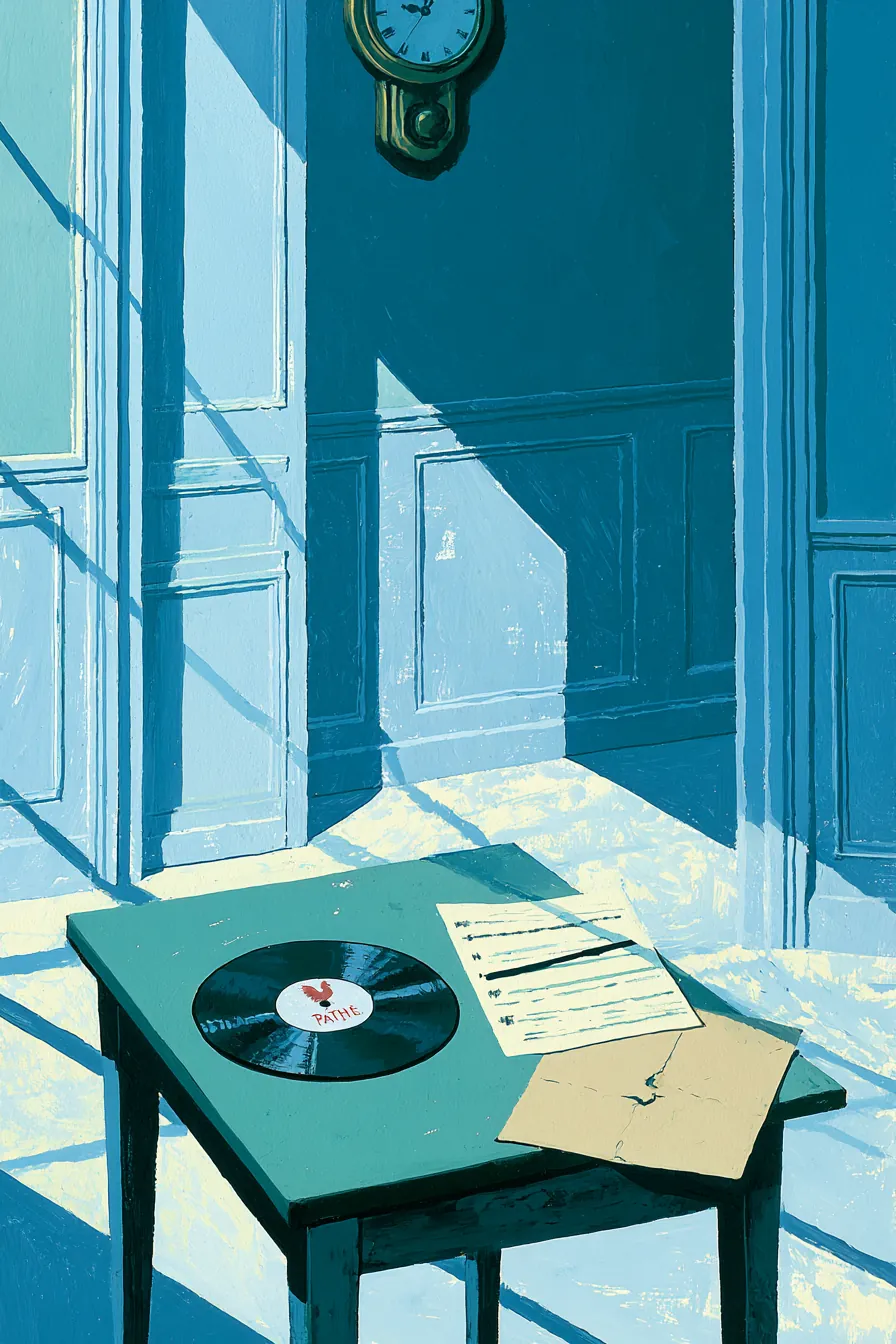
Chapter Fourteen — Pathé
Late January.
The Pathé studio was on Avenue du Roi Albert at the corner of Rue Lafayette, in a yellow stucco building with the EMI dog and the name 百代公司 set into the brickwork above the door. The recording rooms were on the third floor; the pressing plant ran in the back yard on Tuesdays and Thursdays. Saturday afternoons the third floor was empty by arrangement, for the two artists Mr. Sá was personally producing that month.
I was the second of the two. The first was Yao Lee, who was fifteen and had finished at quarter past three because she had, at fifteen, the kind of throat that did not require a second take.
I had been at Pathé the previous Saturday — the eighth — to sign the contract for two sides.
The two sides were not Phantom songs.
The two sides were two of the Pathé canon — a 1934 Li Jinhui called 南屏晚钟 (Nanping Evening Bell) and a 1936 Liu Xue'an called 何日君再来 (When Will You Return). Mr. Sá and I had agreed, sitting in his small office with the model of the EMI dog on the desk and a tea-tray on the credenza, that the two sides would be cut on the seventh of February, that I would be paid fifty silver dollars a side against future royalties, that the contract would run two years with two options on Mr. Sá's side and one option on mine. We had signed.
We had also agreed, in a sentence Mr. Sá had inserted late in the conversation and that I had let him insert because I had not understood, in the moment, that I should have refused, that I would come back on the fifteenth — that is to say, this Saturday — for a small additional session of voice-test recordings, on Pathé equipment, off the books, "for the engineer's calibration." Mr. Sá had said for Mr. Mendelsohn, and Mr. Mendelsohn had been at the door of Mr. Sá's office when he said it, and Mr. Mendelsohn had nodded the small slow nod of a man who was, in the small back office of a Concession recording company on a Tuesday at four, agreeing to a thing he had not entirely been asked.
I had said yes.
I had said yes because I had not yet, at the moment of the saying, told Feng Sheng about the second Saturday. I had told Feng Sheng about the contract. He had asked me, the Friday after, what I would sing for the two sides. I had told him Nanping and When Will You Return. He had said: the right two. You will sing the Liu Xue'an in the lower register. You will not lean on the third syllable of the first verse. You will sing the bridge of the Li Jinhui in your own breath and not in the breath the Li Jinhui sheet asks for. You will be back on Saturday at midnight to tell me how the engineer responded. I had said yes.
I had not, on that Friday, mentioned to him the second Saturday.
I had not mentioned it for a reason I did not, until I was on the stair to the third floor of Pathé on this Saturday afternoon, examine. The reason — when I examined it, on the third step from the top, with my hand on the banister and the small smell of resin and rubber from the pressing plant rising up the stairwell — was that I had wanted, for one Saturday afternoon, to be a singer in a Pathé recording studio without the man under the floor of the Paramount knowing I had been there. The wanting had been small. The wanting had been the small wanting of a woman who had, since the eighteenth of September, been singing under someone else's correction, and who had, on the eighth of November, sung in front of Mr. Sá and Mr. Mendelsohn for the first time in her own voice and had been asked to come back. The asking had been the asking of an audience that was not the man under the floor. The wanting was the wanting of a singer to be asked.
I had not, by the time I reached the third floor, decided what I would sing.
Mr. Sá met me at the door of Studio Two. He was a Portuguese-Macanese man of fifty, in a navy double-breasted suit, with a habit of holding a fountain pen as if the pen had said a thing to him that morning he had not yet decided whether to reply to. He was, Pearl had told me, one of perhaps three men in Shanghai who had recorded the singers people would in a hundred years remember of this decade.
"Mr. Mendelsohn is at the console," he said. "We will, in the hour, do three tests. Nanping. When Will You Return. The third — " he held the fountain pen at the small angle he held it at when he had decided a thing — "is at the engineer's discretion."
I went into Studio Two.
Studio Two was the small studio. It had a single microphone on a fixed stand at the center of a small carpeted square, a vertical piano against the left wall — a Bechstein upright, the same maker as the basement piano, which I noted without saying — a chair, and a small table with a glass of water. The walls were hung with grey acoustic felt. The ceiling was hung with felt. The window into the control booth was a small rectangle of glass at chest height. Through the glass I could see Mr. Mendelsohn at the console — a slender German man of perhaps fifty, with grey hair brushed forward at the temple, and a pair of metal-rimmed spectacles he had pushed up onto his forehead — and behind him Mr. Sá with his pen.
Mr. Mendelsohn turned a small dial.
"Miss Su," came his voice through the speaker. It was the voice of a man who had taught at the Hochschule für Musik in Berlin in 1928 and had not used Mandarin in public for more than three minutes at a stretch since 1934. "We will do Nanping first. The pianist is Mr. Cheng."
A man in a grey suit came in from a side door — Mr. Cheng, twenty-six, a Conservatory man — and sat at the Bechstein upright and played me the chord.
I sang.
I sang the first verse and the bridge of Nanping in the lower register Feng Sheng had drilled me in. I sang it in the breath the Li Jinhui sheet did not ask for. I did not lean on the third syllable. Mr. Cheng played the bridge cleanly, with a small rubato at the second couplet that was, I thought, the small accommodation a Conservatory pianist made to a singer's breath he had not yet, in this room, learned. I came out of the bridge into the second verse and Mr. Mendelsohn, in the booth, lifted one hand and the small speaker said stop, please.
"Good," said Mr. Mendelsohn. "The microphone is correct. We will move to When Will You Return. Mr. Cheng. Yes."
I sang When Will You Return. I sang the first verse and the bridge. I sang it the way Feng Sheng had told me to sing it the previous Friday at midnight — in the lower register, in the half-breath he had been having me hold at the third measure of the bridge for nine weeks. Mr. Cheng accompanied. The bridge held. Mr. Mendelsohn, in the booth, did not move at the end of the bridge. He took his glasses off the top of his head and put them on his nose. He leaned to the talkback.
"Miss Su."
"Yes."
"That is the half-breath."
I went very still.
"It is the half-breath in the bridge of a song that is, on the page, by Liu Xue'an. The page does not ask for a half-breath. The half-breath is not in the page. You have sung the song with a breath that is the breath of a song someone else is writing. The breath does not belong to the Liu Xue'an. The breath belongs to a song I have not heard. I would, if you will permit it, like to hear it."
I looked at Mr. Sá behind the glass.
Mr. Sá was looking at Mr. Mendelsohn.
Mr. Sá had not, at the bridge of When Will You Return, been holding the pen at the angle of a man not yet replying. Mr. Sá had set the pen down. Mr. Sá had set the pen down on the small ledge beside the talkback and had clasped his hands at his sternum the way a Macanese man clasps his hands when he has decided to be a Portuguese.
Mr. Mendelsohn leaned to the talkback again.
"Miss Su. The third test is — let us say — yours. Mr. Sá and I are going to hear a song. The song is not a Pathé song. The song is the song that wrote the breath in the bridge of When Will You Return. We will not press it. We will not record it. We will hear it. The console is off. The tape is off. You will sing it for two men in a booth and a pianist who will not, in this room, mention it again. You will sing the song. I will, when the song is done, tell you a thing about it I have already decided to tell you."
I stood at the microphone.
I had, in the three minutes I had been in the studio, not decided what I would sing. The deciding had been made. The deciding had been made by Mr. Mendelsohn at the half-breath. The deciding had been made by me at the moment I had elected, on the second couplet of When Will You Return, to put the breath in the bridge that was not on the Liu Xue'an page. The deciding had been mine. I had made it without knowing I had made it. I had made it because I had wanted, for one Saturday afternoon, to be the singer the man under the floor had been making me, in a room that was not under the floor.
I did not, in the three seconds after Mr. Mendelsohn said yours, think any of this in those words. I thought it in three seconds of throat and breath. I made the throat-and-breath decision. I sang.
I sang the bridge of 夜来香未眠 — Tonight's Jasmine Has Not Yet Slept. The second movement. The version we had been working on for nine weeks. I sang the first verse and the bridge. I did not sing the third verse. The third verse — the verse with the four breath-marks that were not breath — I would not have sung in this room if Mr. Sá and Mr. Mendelsohn had been on their knees. The third verse was for the gala in July. The third verse was the only thing in my life I held more carefully than the brother's letter at my right hip. I sang the first verse. I sang the bridge. I did not sing the third verse.
Mr. Cheng, after the second measure, dropped his hands from the keyboard.
He had not been given the score. He could not play what he had not been given. He sat at the piano with his hands on his thighs and listened. He listened the way a Conservatory pianist listens, which is the way a man listens when he is, in real time, transcribing in his head.
Mr. Mendelsohn at the console did not move.
Mr. Sá at the console put one hand on the small ledge beside the talkback.
I sang the bridge.
I let the last vowel sit, the way Feng Sheng had taught me to let it sit. I let it sit until it had stopped being a vowel and had become the room. The room was a small grey carpeted square in a yellow stucco building on Avenue du Roi Albert at the corner of Rue Lafayette in the French Concession of Shanghai in January of 1937. The room had heard a song no other room had heard.
The room had now heard it.
Mr. Mendelsohn took his glasses off. He set them on the console. He did not, for some time, lean to the talkback.
When he leaned, he said: "Miss Su."
"Yes, Mr. Mendelsohn."
"The song is by a man I knew."
I did not speak.
"The song," he said, "is by a man I corrected in 1929 on a third-floor recital hall at the National Conservatory on Bubbling Well Road. I corrected, in that hall, his voice-leading at the second couplet of the second movement of a Pushkin opera in Russian. He was twenty-one. He was the most ill-tempered composition student in his cohort and the only one who, when corrected, neither argued nor capitulated but went home and brought back, on the following Friday, a revised page that was — let us say — slightly better than the correction. He was the only one in his cohort, in three years of my visits to that hall, that I have remembered. He left the Conservatory in 1930. He was reported, in 1934, dead in a fire in Zhabei.
"The song you have just sung was written, in the bridge, by him. I do not, Miss Su, know how the song came to your throat. I do not need to know. I would like, please, to take a moment."
He turned away from the talkback.
He took a handkerchief from his breast pocket and held it for a long moment against his eyes. He did not, in the moment, weep. He held the handkerchief there in the way a man of fifty who has been a German émigré in Shanghai for three years holds a handkerchief at the moment he has been told that a young man whose voice-leading he had corrected in 1929 is not, after all, dead in a 1934 fire.
He put the handkerchief away.
He leaned to the talkback.
"Miss Su. Two things. The first is that the song is not, in this lifetime, going to leave this room. Mr. Sá and I will not record it. We will not, in any year, press it. We will not tell Mr. Cheng what he has just heard, because Mr. Cheng has not, in this room, heard it; Mr. Cheng is — please look at Mr. Cheng for a moment — a man who has been correctly looking at the piano keys for the last seven minutes and who will, by half past four, have forgotten which key the bridge began on. Yes, Mr. Cheng."
Mr. Cheng, at the piano, did not look up. He said, in a small voice: "I do not, in this lifetime, remember which key any bridge anybody has sung in this studio began on. I have, in seven years, made forgetting my profession. Yes."
"The second thing," said Mr. Mendelsohn. "Miss Su. If the man whose bridge that is is alive, and is in a position to wish to be — let us say — in correspondence with an engineer at Pathé Records who has heard the song he has been writing, the engineer would like to know. The engineer would like to know because the engineer's lifetime is the lifetime in which a song like this, by a man like that, in a city like this, ought to be cut. The engineer will not press the song against the man's wishes. The engineer would like, however, to be in the room when the man decides to cut it. That is all."
Mr. Sá leaned to the talkback. His voice was, for the first time that afternoon, the voice of a Portuguese-Macanese man who was not holding a fountain pen.
"Miss Su. I would like, please, to record Nanping and When Will You Return on the seventh of February as scheduled. The contract stands. I would like, in addition, to keep the half-breath in the bridge of When Will You Return. The half-breath, on a Pathé pressing, will be the half-breath. I will not, in any letter to any man, mention the second song. I will, in a letter that has not yet been written, be willing to be — let us say — open to a third side. I am telling you because I would like you to know what is on the table without asking you for it. Mr. Mendelsohn and I will leave the room. You and Mr. Cheng will leave the room. We will, on the seventh of February, do the work the contract asks for. Yes."
"Yes, Mr. Sá."
"Thank you, Miss Su."
I went down the stairs. Mr. Cheng held the door for me at the third-floor landing. He did not look at me. He had decided, on that landing, that he had not heard a song.
He had heard the song. He would, by Monday, have written down, in pencil, in a small school notebook, the bridge as he had heard it. He would put the notebook in the drawer of his desk. He would not, in this lifetime, take the notebook out.
I went home.
I did not go down at midnight. I did not go down on the Saturday or on the Sunday or on the Monday or on the Tuesday. I sat in my dressing room on the Sunday afternoon at six, before the second set, and I did not, with the silver qipao on, lift the lid of the handbag to look at the four pieces of paper inside. I sang the second set. I sang the third set. I went home. I lay on the bed in my under-things at three in the morning. I did not sleep.
On Tuesday at six in the evening Anya, fastening the pearl drops, said: "Bárinya. There is a piece of paper that came under the door at four. I have not looked at it. I have, on the door, put it on the small table by the cot."
I looked at her in the mirror.
"Thank you, Anya."
"You may, bárinya, choose not to look at it. I would, in your case, look. The hand is the cursive."
"Thank you."
I looked at the paper after the second set, on the small table by the cot in the dressing-room alcove, in the lamplight.
It was on Pathé staff paper. The hand was the brushed cursive. The ink was the red. The paper had two paragraphs on it.
Mendelsohn telephoned the carpenter at four on Saturday. The carpenter came down at six. He told me. I did not, on the hearing, do anything for an hour. After the hour I did a thing I am sorry for. I oiled the strap and put on the mask and sat on the bench from six until midnight, listening. You did not come. I sat from midnight until four. You did not come. I sat from four until six. You did not come. On Sunday I sat from midnight until four. I did not, in this Sunday or in the two days after, sleep more than I sleep in any other Saturday. I will not, in this letter, ask you to come down. I am asking you, in this letter, to know what the half-breath was when you sang it. The half-breath was mine. I had not given it to Mendelsohn. You had not asked permission to give him the half-breath because you did not know you were giving it. I had not, by withholding the permission, made it clear that the half-breath was a thing one asked permission for. The unclearness was mine. The half-breath was, on the carpet, a thing you had every right to. I had been, for nine weeks, asking you to make it yours. You made it yours.
Come down when you would like to. The bench is the bench. The chair is at the new distance. I will, in any case, be on the bench. I have been on it since six on Saturday. I will be on it until you come. — F.
I read the two paragraphs twice. I read them a third time. I sat at the vanity with the paper on my lap.
I had expected, in the four nights between the recording and the letter, a different letter. I had expected the letter that began you took my song to a man who will press it onto a black disc. I had been writing the answer to that letter in my head since Saturday at half past five.
The letter was the other letter.
The other letter was the letter of a man who had, in the four days, decided not to be furious in the manner I had been preparing the answer for. The letter was the letter of a man who had decided, instead, that the fault was — let us say — his. The fault was not his. The fault was mine. The fault was that I had wanted, for one Saturday afternoon, to be the singer the man under the floor had been making me, in a room that was not under the floor. The wanting had been mine. The fault was mine. He had taken the fault, in the four days, onto himself. He had done it, I understood, because he could not bear, on Tuesday at six in the evening, that I had not come down on Saturday at midnight.
I folded the letter.
I changed.
I went down at twelve.
The cold-storage room was the cold-storage room. The cook was on his stool with his pipe; the bowl of barley tea on the lowest crate; the small dip of the pipe in greeting. The arch was the arch. The candle was a fresh candle. The chair was at the new distance.
He was on the bench.
The bench was the bench. He was sitting on it the way a man sits on a bench when he has been on it since six on Saturday. His hands were in his lap. The mask was on his face. The lamp at the small table held. The candle in the saucer held. The piano keyboard cover was closed.
"You came," he said.
"I came."
"The half-breath was yours."
"It was yours."
"It was mine. It became yours on the eighth of October. You sang it as yours on the bandstand from the eighth of October. I had not, until Saturday afternoon, understood that it had ceased being mine. I had been, until Saturday afternoon, requiring you to ask permission for a thing that was not, on the giving, mine to give. The fault — "
"The fault," I said, "was mine. I did not tell you about the second Saturday. I had not, the Friday before, told you about the second Saturday. I had wanted, on a Saturday afternoon, to be the singer I have been here, in a room that is not here. The wanting was mine. The not-telling was mine. I am — let me say — sorry for the not-telling."
He did not, for a moment, speak.
"Sit," he said.
I sat.
"There is, on the small table, water."
"Yes."
I drank.
"Mendelsohn telephoned the carpenter," he said, "and asked the carpenter to tell me a thing. The thing was that the engineer who corrected me in 1929 has been at Pathé since 1934. He has, since 1934, been waiting for the song to be cut. He would like to be in the room when it is. The man — let us say — will not die in this brick room. The man will live to the recording, at minimum."
"Yes."
"That is what the letter was about."
"That is what the letter was about."
"I forgive you."
"There is nothing to forgive."
"There is. I forgive it. You are not required to ask. The forgiving is in my power. I have done it. Go."
"You have asked me to forgive you also."
"I have."
"I have done it."
"Thank you."
"Thank you."
We did not, that night, work on the song. He did not lift the lid of the piano. I did not lift the candle. We sat in the brick room for an hour with the wireless on Manila at a low volume, playing American dance band music a Filipino announcer was, at half past midnight, describing in a soft Cebuano-accented English. At one I stood. He nodded. I went up.
On the vanity there was, this evening, no piece of paper.
I undressed. I hung the silver qipao. I put on my street coat. I went home. The lamp-lighter was at his fourth lamp. The second rickshaw, the older man with the wheel oiled at six, took me at the listed fare and did not, in twenty-five minutes, say anything.
In the lane house Auntie Lin was asleep on the chaise. The right-hand phrase had been practiced today; the lid of the harmonium was, by half an inch, more open than I had left it at six. The cup of weak tea was half drunk. The fan had been moved. The opium pipe was cold.
I sat on the edge of the chaise across from her. I did not wake her.
I took out the letter that had come under the door at four on Tuesday. I read the last sentence of the second paragraph.
— I will, in any case, be on the bench. I have been on it since six on Saturday. I will be on it until you come.
I folded it. I put it in the inside pocket of the handbag with the others. I went to my room. I undressed. I lay down. The cicadas had been gone since October. The lane was the lane.
In the night I did not dream of him. I dreamed of Mr. Mendelsohn — of a Berlin classroom in 1928, of a young man at a piano in a Pushkin opera. The young man was twenty-one. He had not yet been burned. He was, in the dream, playing in a left hand that spanned a tenth. I did not wake him.
I woke at five.
I went to the harmonium. I lifted the lid. I played the right hand of the bridge. I closed the lid.
The half-breath was the half-breath. By the third Friday of February it would be — let us say — the half-breath of a song that had not yet been cut, but would be.
It would be.