Chapter Seventeen — The Major's Flowers
Friday the ninth of April.
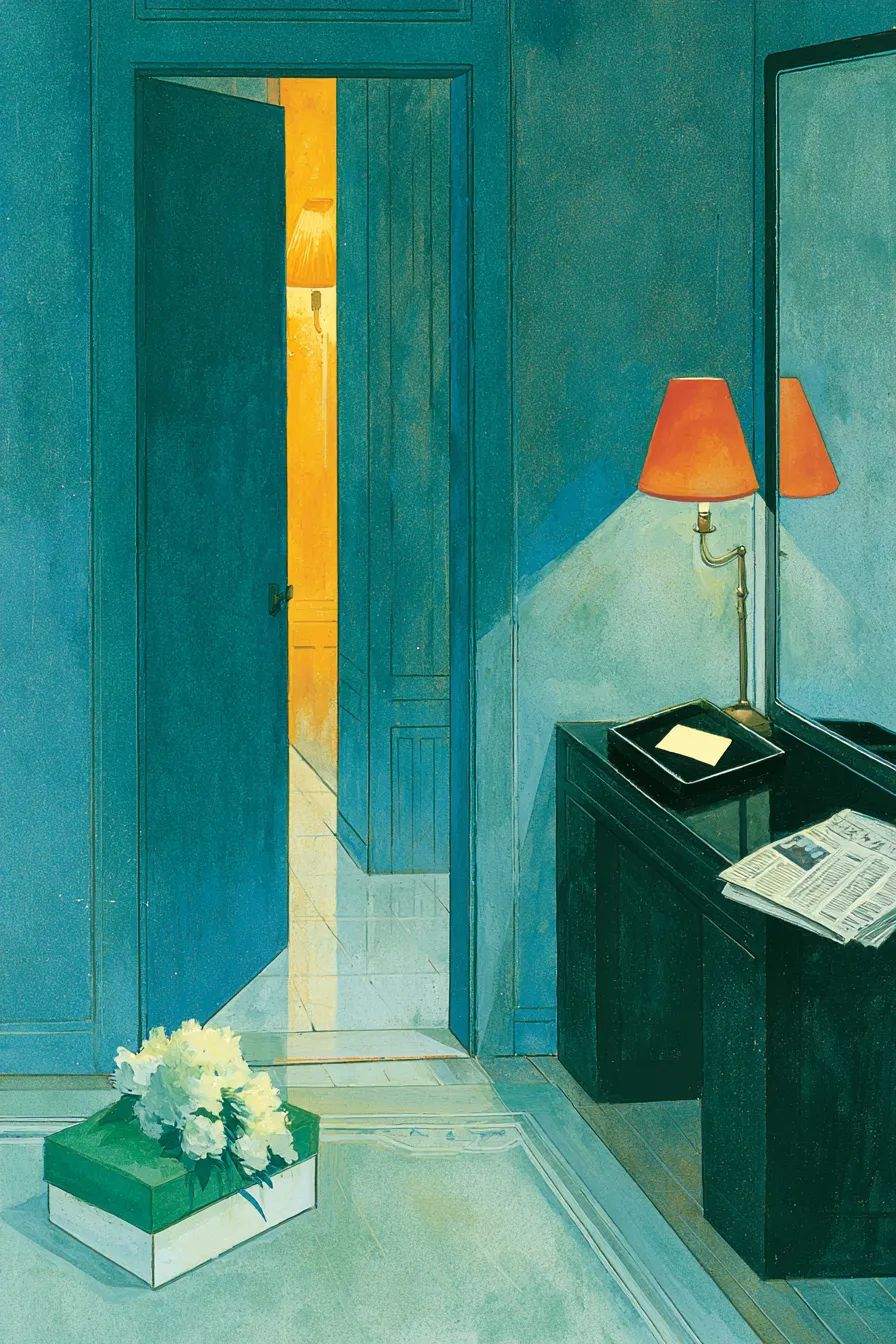
The card had come at six. It had been brought up by the maître d' Mr. Lopes himself, who had not come to my dressing-room door for the bringing of a card and who had, on this Friday in April, decided that the card required a man of his height to carry it down the corridor. He knocked. I let him in. He held the card on a lacquer tray, in the way Mr. Lopes had been trained to hold a card on a lacquer tray at the Cathay Hotel before the Cathay had moved him for a Belgian who spoke better French. The flowers were in a green-and-white box on the floor at the door. He had not, by the door, brought the flowers in.
"Miss Su."
"Mr. Lopes."
"The card."
"Yes."
"The flowers will, by your wish, come in or stay out. I have, in the box, put the box on the threshold and not inside. The threshold is yours."
"Thank you, Mr. Lopes."
I took the card.
The card was small. The card was a card of the kind a man at the Bund printers had made for a Japanese officer in the third week of March. It was thick. It was cream. It had, in the lower left corner, the black seal of the kind I had seen at the Cathay tea-dance in January on the lapel of a man whose face I had memorized at the bandstand and had filed in the inner pocket of the handbag with the brother's letter. The seal was the kanji 海軍 — Imperial Japanese Navy.
In the center of the card, in a brushed cursive that was the brushed cursive of a man who had been taught at the Tokyo Imperial University the kind of brushed cursive that was the brushed cursive of a Beijing-trained scholar, was a Chinese verse:
"In Tang Xianzu's Peony Pavilion the heroine sings the world into being. Tonight you have done a related thing. — K."
I read it twice.
Mr. Lopes did not, at the door, do anything other than stand. He had been told, by whoever had given him the card, that Mr. Lopes was to wait at the door for the reading of the card. Mr. Lopes had been told to wait at the door for the reading of a card three times. Twice the cards had been from women. Once the card had been from a Belgian banker.
"Mr. Lopes."
"Yes, Miss."
"Where is the gentleman."
"At table four. He has been at table four for forty minutes. He has, since the first set, drunk one whisky. He has, in the lapel, the pin you have seen since January. He has, in the breast pocket, a copy of the L'Echo de Chine folded twice. The folded twice is the manner of a man who has, in the reading of the second column on the second page, decided to fold the paper at the column. The column is the column about the Marco Polo Bridge. The column is the column the council has, in the second week of April, decided to begin clipping."
"You know a great deal, Mr. Lopes."
"I have, in my career, kept the door."
"Thank you. The flowers."
"Yes, Miss."
"Bring them in. Set them on the table by the screen. Do not open the box."
"Yes, Miss."
He brought the box in. He set it on the table by the screen. He bowed by half an inch. He left the room. He closed the door.
I sat at the vanity.
I had been on the third song of the first set when the Major had come in. I had seen him at the door because the man with him had been the maître d' Mr. Lopes and Mr. Lopes had brought him to table four and not to table seven. Table seven had been, for six months, the table of the Major's adjutant. Table four was the table of the Major. The Major had not been at table four before. The Major had been at the Cathay tea-dance in January and at Sun Ya in February and at the Cathay tea-dance in March. The Major had been, since November, at the Paramount, in plainclothes, in the third week of the month, in the third row of the gallery. He had been at the gallery on the seventh of November and the second of December and the eighth of January and the fifth of February and the twelfth of March. He had been on five Fridays. He had not, on any of the five Fridays, sent a card.
The card on the lacquer tray on the vanity was the first card.
I had finished the first set with the card on the vanity and the box at the threshold and Mr. Lopes at the door, and I had not, in the second set, sung any differently. I had sung the way I had sung since the eighth of October. I had not leaned on the third. I had held the half-breath at the seventh measure of the bridge. I had, in the lower register, sung the bridge of Spring Wind Autumn Rain with the quarter inch in the breath the way I had been taking the quarter inch in the breath since the Tuesday in March. The Major, at table four, had held his glass at the eighth measure of the bridge and had not, until the ninth measure, set it down.
The card said related thing.
Related to what.
To the Peony Pavilion. To Du Liniang at the abandoned garden in 1598. To a heroine who sings, in a dream, a magistrate's son into being and is, in the singing, also herself sung into being. Related.
I had not, in seven years of being on stage at the Paramount, been compared to Du Liniang. I had been compared, in the North-China Daily News in November of 1934, to a Brazilian samba singer named Carmen Miranda. I had been compared, in the Shenbao, in the Spring Festival edition of 1935, to a bell. I had been compared, by a Cantonese banker who had given me a silver hair-comb in March of 1936, to "a girl who knew what a man wanted to hear." The Cantonese banker had not known the comb had a dent in the back. He had bought it from a Pawn shop on Avenue Joffre, and the dent was the dent the previous wearer had made when the previous wearer had thrown the comb at the previous wearer's husband.
I had been, in seven years, called several things.
I had not been called Du Liniang.
The card was not a card.
The card was a recognition.
I sat at the vanity with the card on the lacquer tray. I did not, for the count of nine, do anything. The third set was in twenty minutes. I had been told, on the first set, to sing Drizzle of May in the third set. I had been told this by Yao Sanye at the eight o'clock by way of the maître d's nod. Yao Sanye had been at the gallery in the third row at the corner of the gallery rail and the brass urn that held the dried jasmine. Yao had been at the gallery in the third row for a Friday for the first time in three months. Yao had been at the gallery on the third row because Major Itō had been at table four.
I knew what this meant.
I had known what it meant since the third Saturday in February when Mr. Du said, in the parlor at Rue Wagner, that the singer the Major had heard at the Cathay tea-dance was a singer Mr. Hong Jingming's tailor had dressed since 1932. The accounts of Mr. Hong Jingming were not transferable. The accounts were Mr. Hong's. The singer was in the accounts. Yao had been told by Mr. Du that Yao's interest in the singer had been, by the holding of the chrysanthemum pin, set aside. Yao had been told by Mr. Du that the Major's interest in the singer would, by the same holding, also be set aside. Yao had nodded.
The card on the lacquer tray was the Major's response to the nod.
The Major was, by the card, communicating to Mr. Du through the parlor protocol that the Major had not, in February, been set aside by the pin. The Major had been told by Mr. Du, through the adjutant, that the singer was under courtesy. The Major's card was the card a man sent when the man had decided to test what the courtesy could and could not contain.
I did not, on this counting, decide anything.
I stood.
I went to the table by the screen. I lifted the lid of the green-and-white box. Inside the box was a single white peony, fresh, the stem cut at a long angle, wrapped in damp white cotton. The peony had been picked, by the dark spot at the seventh petal where the morning's frost had touched it, at four in the morning at the Longhua Temple Flower Market. The Longhua flower market was, at four in the morning, six miles from Rue Wagner. The peony had been at the Major's office for eight hours before it had been delivered to the Paramount at six.
The Major had not sent a bouquet.
The Major had sent a peony.
The peony was the peony of the second act of The Peony Pavilion, in which Du Liniang dreams of the man she has not met and dies of the longing and is brought back, three years later, by the man who has dug up her body in the garden. The peony, in the second act, is the flower the heroine takes from the garden in her dream and brings back to the waking world, where it does not exist.
The Major had not sent a flower of the world.
The Major had sent a flower of the dream.
I closed the box.
I went back to the vanity.
I sat. I did not put the card in the inside pocket of the handbag. I put the card on the lacquer tray. I put the lacquer tray in the drawer of the vanity. I closed the drawer. I locked the drawer with the brass key Mr. Hu the carpenter had given me in 1934.
The key was the key Mr. Hu had given me at thirteen. The key was the key to the drawer of the vanity. The drawer of the vanity had been, in my four years at the Paramount, locked twice. The first time had been on the Saturday of the second week of November 1934, when the wireless said a printing press in Zhabei had been burned down and three Communist organizers had been killed and one of the dead had been named in the L'Echo de Chine the next day in a column on the third page. I had, on that Saturday, not known any of the names. I had locked the drawer because Pearl, at the lobby door at half past one, said lock your drawer, sweetheart. Lock it tonight. Don't ask. I had, on the Sunday, unlocked the drawer and found a piece of paper inside on which Pearl had written, in her square hand: the year is starting. lock your drawer on the nights you do not know.
The second time had been the night Auntie Lin had told me about the bracelet.
The third time was tonight.
I put the key back into the inside pocket of the handbag with the brother's letter and the lock of hair and the four pieces of Pathé staff paper.
I stood.
I went to the door.
I went down to the gallery.
Mr. Lopes was at the door of the bandstand corridor. He saw me. He did not, on the seeing, indicate the gallery. He indicated, by a movement of the eyes, table four. I went, by the long route, along the kitchen corridor and past the cloakroom and to the back of the gallery and along the gallery rail to the stair that came down by table four, and I came down the stair with the dignity I had been trained to come down the stair with, and I stopped at the table.
Major Itō Kensuke stood.
He was not in uniform. He had on a grey Western suit with a navy tie, a white pocket square folded into a Tokyo-banker's three-point fold, and the black seal of the Imperial Japanese Navy on the lapel. He was thirty-four. He was not tall. He was slight, careful, with the kind of slender shoulder a piano student in 1922 had carried his Schubert exercises home on, in a leather satchel, on the way back from a Tokyo conservatory. He had hair brushed forward in the manner of a Tokyo banker who had read about the manner from a 1932 American magazine and had decided that the manner was the manner. He had the dry attentiveness at the corner of the eye of a man of thirty-four who had been a piano student and had become an officer and had not given up either practice.
"Miss Su."
"Major."
"You read the card."
"I read the card."
"You did not, in the second set, do anything other than sing the second set the way you have been singing the second set since November. I am grateful for the not-doing. The not-doing has saved us both the awkwardness of a discussion at the bandstand that would have been observed by Mr. Lopes."
"Mr. Lopes is, by trade, observant."
"He is. Sit, if you please."
I sat.
He sat.
He did not, on the sitting, summon a waiter. He had a glass of whisky at the table, two-thirds full, and a carafe of water, and a folded L'Echo de Chine. He moved the L'Echo to the chair beside him. He moved the carafe of water by a quarter inch.
"I will," he said, "have water brought for you."
"Thank you."
He lifted one finger. A waiter came. A waiter went. A waiter came back with water. A waiter left.
"Miss Su."
"Major Itō."
"You have been singing in a manner since the eighth of October that is not the manner one expects from a Paramount singer who began at the Bright Moon. The manner is schooled. The schooling is not the schooling of the Bright Moon. The schooling is not, by my hearing, the schooling of the Conservatory either. The schooling is a third schooling. I have, in five Fridays, attempted to identify it. I have not, in five Fridays, identified it. I do not, this Friday, expect to."
"You have heard me five times, Major."
"I have heard you five times. I had heard you twice before the November and I had, in October of 1936, not been the man I am, on this Friday in April, at this table. I have been other men. I am the man I am at this table because in November you did a thing in the bridge of the third song of the second set that I had not, in fourteen years of listening to women sing in nine cities, heard. I would like to ask you what you did. I will not ask you tonight. I am saving the question for the second invitation."
"There is to be a second invitation."
"There is to be a second invitation."
"Major."
"Miss Su."
"What was tonight, then."
"Tonight," he said, "was the first invitation. The first invitation was the card. The card is a recognition. The recognition is that you and I have been, since October of 1936, two people in a room where you have been singing and I have been listening. The room has been the Paramount. The room has been the Cathay. The room has been the Sun Ya. The rooms have not been my rooms. I have been a guest in them. I would like, in some other month, for you to be a guest in a room of mine. The room of mine will be the Cathay's dining room on the ninth floor, in which you have not eaten in seven years. The invitation will, in some other month, be the invitation to dinner. I am not, tonight, issuing it. I am declaring it. The declaration is the courtesy I owe you. You are not a woman who should be invited without the declaration."
I sat with the glass of water.
I had been, in seven years, propositioned by a great many men. I had been propositioned in the manner of the Spanish brandy importer at table fourteen, which was the manner of a man who put a sum of money on the linen and named a day. I had been propositioned in the manner of Yao Sanye, which was the manner of a man who put a sum of money in his coat pocket and named a season. I had been propositioned in the manner of the parlor at Rue Wagner, which was the manner of a man who put a chrysanthemum pin in my hair and named a year.
I had not, in seven years, been propositioned in the manner of a recognition.
The recognition was a different proposition.
The recognition was the proposition of a man who had decided, in the second week of November 1936, that the price of the woman across the table was not a thing he could put a number on, and that the manner of the asking would, instead of the number, be a question about the song. The man was not naming a day or a season or a year. The man was naming a register.
The register was the register a man named when he had decided that the woman he wanted was a woman he intended to take in slow motion across several years and not in a single transaction.
"Major."
"Miss Su."
"What do you do."
"I am a staff officer."
"Where."
"At the consulate on Wuhan Road. I am, by official posting, assistant naval attaché. I am, by less official posting, the man at the consulate who reads. The reading is a kind of work. The work has been increasing since the second week of March."
"Reading what."
"Newspapers. Settlement papers. Chinese papers. Telegrams from Tokyo. The careful telegrams from the consulate at Tianjin. The reading is for the consulate. The reading is not for me. I am at a table in the second-largest dance hall in the largest city in Asia, having sent a peony to a singer because the singer has taught me a thing in the bridge of a song since October."
"Major."
"Yes."
"The peony is a flower of the second act."
He was quiet.
"It is," he said.
"You are aware."
"I am."
"You sent the peony with the awareness."
"I sent the peony with the awareness."
"Major."
"Yes."
"I am not Du Liniang."
"You are not Du Liniang."
"Du Liniang dies in the second act."
"She does. She is restored in the third."
"The third act, Major, takes three years."
"It does."
"You are a patient man."
"I am a patient man."
"There is no third act in this dance hall."
"There is no third act in this dance hall. There is, possibly, a third act in some other dance hall. I am willing to wait for the dance hall."
I drank the water.
I did not, on the drinking, look at him. I looked across the floor at the bandstand where Jimmy King was, at this minute, calling the boys back for the third set. The Filipino trombonist Tony had his trombone on his knee and was running the slide oil through with the rag he kept in his breast pocket. The chandeliers were at the rose setting. The neon column at the side window was on.
I looked at the Major.
"Major Itō."
"Miss Su."
"I will, in some other month, accept the invitation to dinner."
"Thank you."
"On three conditions."
"Yes."
"The first is that the dinner will be at the Cathay and not at the consulate."
"Yes."
"The second is that the dinner will be at the public table by the window and not at the private dining room."
"Yes."
"The third is that the dinner will be conducted in Mandarin and in English and not in Japanese."
"Yes."
"I do not speak Japanese."
"You do not."
"You speak Mandarin."
"I do."
"You will speak it at the dinner."
"I will."
"Thank you, Major."
"Thank you, Miss Su."
He inclined his head. He did not stand. He let me stand. I stood. I went back along the stair to the gallery rail and along the gallery to the kitchen corridor and down the kitchen corridor to the dressing-room corridor. Pearl was at her door in the silver dragonfly qipao with a cigarette in the left hand and a fresh ashtray and the door of her room half open.
"Sweetheart."
"Pearl."
"Come in."
I came in.
She closed the door.
"Wanyin."
"Yes."
"What did he say."
"He said he would not, this Friday, ask me to dinner. He said he would, in some other month, ask. He sent a peony from Longhua. He told me he had read the second act of Peony Pavilion. He told me he is patient."
"He is."
"You knew this."
"I have known it since November."
"You did not tell me."
"I did not tell you because you were not, in November, the woman who would have heard what I would have told you. You are, on the eighth of April at the third set of a Friday, the woman who is hearing what I am telling you."
"What are you telling me, Pearl."
She did not, for a count of three, speak. She drew on the cigarette. The ash fell into the ashtray. She tapped the cigarette twice on the rim. She set it down.
"I am telling you," she said, "that Major Itō Kensuke is the man you should be most afraid of in the city of Shanghai. He is not the man you should be afraid of in the manner of Yao. Yao is a man who would, in a parlor in Rue Wagner, have you walked to a car. Itō is a man who would, in a private dining room at the Cathay in 1940, have you in a country he had made a country he was the staff officer of. Yao is a man with a season. Itō is a man with a country. The seasons end. The country he is assistant attaché of does not, in our lifetime, end. The country is the larger thing."
"Yes."
"The peony was a peony."
"Yes."
"The peony was a country. The country was a country he is, at this hour, the assistant attaché of. He sent the country. The country was Du Liniang. He is patient because the country he serves is, in his hearing, the country in which the third act can take three years. The country is the country, sweetheart. He is its peony."
"Pearl."
"Sweetheart."
"What do I do."
"You sing the third set. You sing Drizzle of May the way the man under the floor has been having you sing it. You do not, on the bridge, sing the third syllable in the manner Yao requested. You sing it the way you have been singing it since November. The Major will, by the third set, know what he knows. He will know that the manner is the manner. The manner will, by the bridge, be the manner he has heard since October. He will not, in the third set, decide anything. He will, by the end of the third set, decide a thing he has decided to decide in the second week of May."
"What thing."
"The thing he decides in the second week of May is that you will, by the third week of July, be a woman of his country. The deciding is being made, at this hour, at the consulate, by men who have been sending careful telegrams to Tokyo since the second week of March. The deciding will not, by July, be a deciding the consulate makes. The deciding will be a deciding the army makes for the consulate at a bridge on the seventh of July. You will, by the second week of July, have heard about the bridge in the Settlement papers. The Settlement papers will say tensions ease. The Chinese papers will say Japan provokes. The truth will be that a regiment at the bridge will, on a Thursday in early July, fire a shot, and the deciding the Major has been deciding to decide in May will, by the firing, be made for him by Tokyo."
"Pearl."
"Sweetheart."
"How do you know this."
"I know it because I am a singer in Shanghai who has been awake on Wednesdays at four for nine years. The waking has been the discipline. The discipline has been the listening. The Filipino trombonist Tony tells me a thing on the Wednesday morning at four when he and his cousin have, by the kitchen door of the Paramount, finished the bottle. The cousin tells him a thing the kitchen boy at the consulate has told the cousin. The kitchen boy at the consulate has been kind to me since November because in November I bought him a bowl of porridge from the Sichuan Road vendor at three in the morning when he had not eaten for two days. He has been kind to me ever since. He is my kindness."
"You knew about the Marco Polo Bridge."
"I knew, in March, that there would, in May or in July, be a bridge. The bridge had not yet been named. The bridge was named in the second week of March by a careful telegram from the consulate at Tianjin. The telegram was sent to Tokyo on the fourteenth of March. The bridge was named Lugou Qiao — the Marco Polo Bridge. The bridge is at Wanping, west of Beiping. The bridge has, since 1937, been the bridge the Japanese army has decided will be the bridge."
"Why are you telling me this tonight."
"Because tonight is the night you are sitting in my dressing room with a peony at the table by the screen and the brass key of the drawer of your vanity in the inside pocket of your handbag with the brother's letter and the lock of hair. The peony is the Major's first invitation. The Major's first invitation is the consulate's first invitation. The consulate's first invitation is, by the deciding being made in May, the country's first invitation. The country is coming for us. I am telling you so that on the night the bridge is fired, in the second week of July, you and I will not be the singers who were surprised."
"Pearl."
"Sweetheart."
"What do I do tonight."
"You sing the third set. You sing Drizzle of May the way the man under the floor has been having you sing it. After the third set you go up the back stair. You change. You take the rickshaw to Hongkou. You sleep. In the morning, at six, you tell the man under the floor about the peony and the card and the table four and the third act. You tell him in the manner you tell him a thing. You do not embellish. You do not withhold. You tell him. He has, by Friday next, decided what to do."
"Yes, Pearl."
"And, sweetheart — "
"Yes."
"You do not, in May, accept a second invitation. You accept one in June. You accept one in July. You do not, in any month, accept the third. The third will be the invitation to the private dining room at the consulate. The second is the public table at the Cathay. The first was a peony. The seconds are three. You accept two. You decline the third. The declining will, by the man under the floor, be the declining the man under the floor will know what to do with. I do not know what he will do. I know that you have not, in nine months, sent him an invitation he has not decided what to do with. He will, in this case, decide."
"Yes, Pearl."
"Now go. Sing."
I went.
I sang the third set.
I sang Drizzle of May the way the man under the floor had been having me sing it. Yao Sanye, in the third row of the gallery, lifted two fingers at the third syllable of the bridge. He had been lifting the fingers for seven years at the third syllable of the bridge. He did not — this Friday — lift them at any other measure. The Major at table four did not move. The Major at the eighth measure of the bridge held the glass of whisky at his sternum and did not, until the ninth measure, set it down.
I let the last vowel sit until it had stopped being a vowel and had become the room.
The room was the Paramount Main Ballroom on a Friday in April with a Major at table four and a Yao Sanye in the third row of the gallery and a Pearl in the silver dragonfly qipao at the kitchen corridor door and a Mr. Lopes at the bandstand-side door and a peony in a green-and-white box on the table by the screen in the dressing room on the third floor in a building two floors above a brick room in which a man at a piano had — eight months ago in October — heard a singer take, for the first time, a half-breath at the third measure of the bridge.
The room was the room.
The applause was the applause.
I bowed. I came down the bandstand stair. I went up the back stair.
In the dressing room the peony was in the box on the table by the screen. I had not, in the third set, decided what to do with it. I decided now. I lifted the box. I went to the door. I opened the door. The maître d's spare ash-pail was on the corridor wall at the corner. I went to it. I did not put the box in the ash-pail. I put the box on the floor beside the ash-pail. I closed the corridor door.
I did not, on the closing, think anything more about the peony for that hour. The peony was a thing for the morning. The morning would, by my decision at five in the lane, do with the peony what the morning did. The peony was a flower that had been picked at four in the morning at the Longhua flower market and had been at the Major's office and had been at the box and at the table and at the corridor wall.
The peony had been the country.
The country, by the closing of the door, was outside the room.
In the lane house, at half past one, Auntie Lin was awake on the chaise.
She had on the wireless above the harmonium on the Manila frequency. The Manila frequency at half past one was, this Friday, broadcasting a string section playing the Gymnopédie no. 1. She had a cup of weak tea half drunk.
"Aliang."
"Auntie."
"Sit."
I sat.
"You have a flower at the door."
"I did. I left it."
"Where."
"At the corridor wall by the ash-pail."
"What was the flower."
"A peony. From the Longhua market. The Major Itō Kensuke."
She was quiet.
She did not, for a count of nine, do anything other than look at the harmonium. The lid was open by half an inch. The right-hand phrase had been practiced today. The right hand had been mine since December.
"Aliang."
"Yes."
"The flower is the country."
"Pearl said the same."
"Pearl said the same because Pearl is a Ningbo fishmonger's daughter who has been in Shanghai for nine years and has learned the country. Auntie Lin is a former dancer who has been in Shanghai for thirty-one years and has learned, in those thirty-one, every kind of country a flower has been. I am telling you the flower is the country because the flower is the country."
"Yes, Auntie."
"You left the flower."
"I left the flower."
"You did not, on the leaving, put it in the ash-pail."
"No."
"Why."
"Because the ash-pail is the maître d's. The maître d' has a wife in Macau and two children. The wife is at present in the second pregnancy. The maître d' would, by the second of April, have lost his job at the Paramount if the maître d' had been the man whose ash-pail contained, at the half past midnight of the eighth of April, the discarded peony of Major Itō Kensuke, who had at the consulate sent the peony with the awareness that the peony was the country. The maître d' is innocent. I did not, on the leaving, want to put the maître d' in the ash-pail."
She was quiet.
"Aliang."
"Yes."
"You are a good woman."
"I do not — "
"You are. You did not, on the leaving, put the maître d' in the ash-pail. You will not, on the morning, put the man under the floor in the ash-pail. You will not, in May, put the Major in the ash-pail. You will, by July, have learned which ash-pail the Major belongs in. The ash-pail will not be yours. It will be his."
"Yes, Auntie."
"Sleep."
I slept.
In the night I dreamed of the second act of Peony Pavilion. I was Du Liniang. I was in a garden. The garden was the back lot of the Paramount where Mr. Hu the carpenter had been growing a line of tomatoes since 1934. The garden had a peony in it. The peony was not at the corridor wall. The peony was in my hair. I was sixteen.
I woke at five.
I went to the harmonium. I lifted the lid. The lacquer box on the harmonium had, in the inner partition where I had been keeping the chrysanthemum pin, an additional object since the second week of March. The additional object was a white cotton wrapper. The white cotton wrapper was the cotton the peony had been wrapped in at the green-and-white box. I had brought it home. I had not put it in the lacquer box at half past one. I had not. I had put it in the lacquer box at five in the morning, while my left hand was on the harmonium's right keyboard playing the bridge of Drizzle of May the way Feng Sheng had been having me play it, and my right hand was opening the lacquer box and laying the white cotton wrapper inside.
I looked at the wrapper.
The wrapper was a white square of fresh damp cotton with the dark spot of the seventh petal where the morning's frost had touched the peony at four in the morning at the Longhua market on the eighth of April.
I closed the lid of the lacquer box.
I closed the lid of the harmonium.
I sat at the harmonium for some count.
The doorman at the Paramount would, this evening, call me Miss Su.
The bandleader would call me Wanyin.
Major Itō Kensuke would, in May, call me Miss Su. He would call me Miss Su in the manner of a man who had been declared, in November of 1936, the country.
The man under the floor would, on Tuesday at midnight, call me Wanyin.
The country would, in some month, call me a thing the country would call me. The country had not yet decided what the thing was.
I went to my room.
I lay down.
I did not close my eyes.
I closed them.
I slept the second sleep of the morning, the dry hour of sleep between five and seven that Auntie Lin had taught me to count as a separate sleep at thirteen. I dreamed of the bridge.
The bridge was the bridge of Drizzle of May.
The bridge had a peony in it.
The peony was in the seventh measure.
I had not sung the peony. I had let the peony sit at the seventh measure.
I woke at seven.
The lane was the lane.
The peony, in the dream, had not been sung.
In the lacquer box, in the lining, in the seam, in the inner pocket of the handbag at the chair by the screen, in the white cotton wrapper, in the drawer of the vanity locked with the brass key from Mr. Hu the carpenter — the peony was, in five rooms, the country.
The country was, in five rooms, mine.
I would, by Tuesday at midnight, tell the man under the floor about the peony.
He would, by Friday, have decided.
I closed my eyes for the count of nine.
I opened them.
I got up.