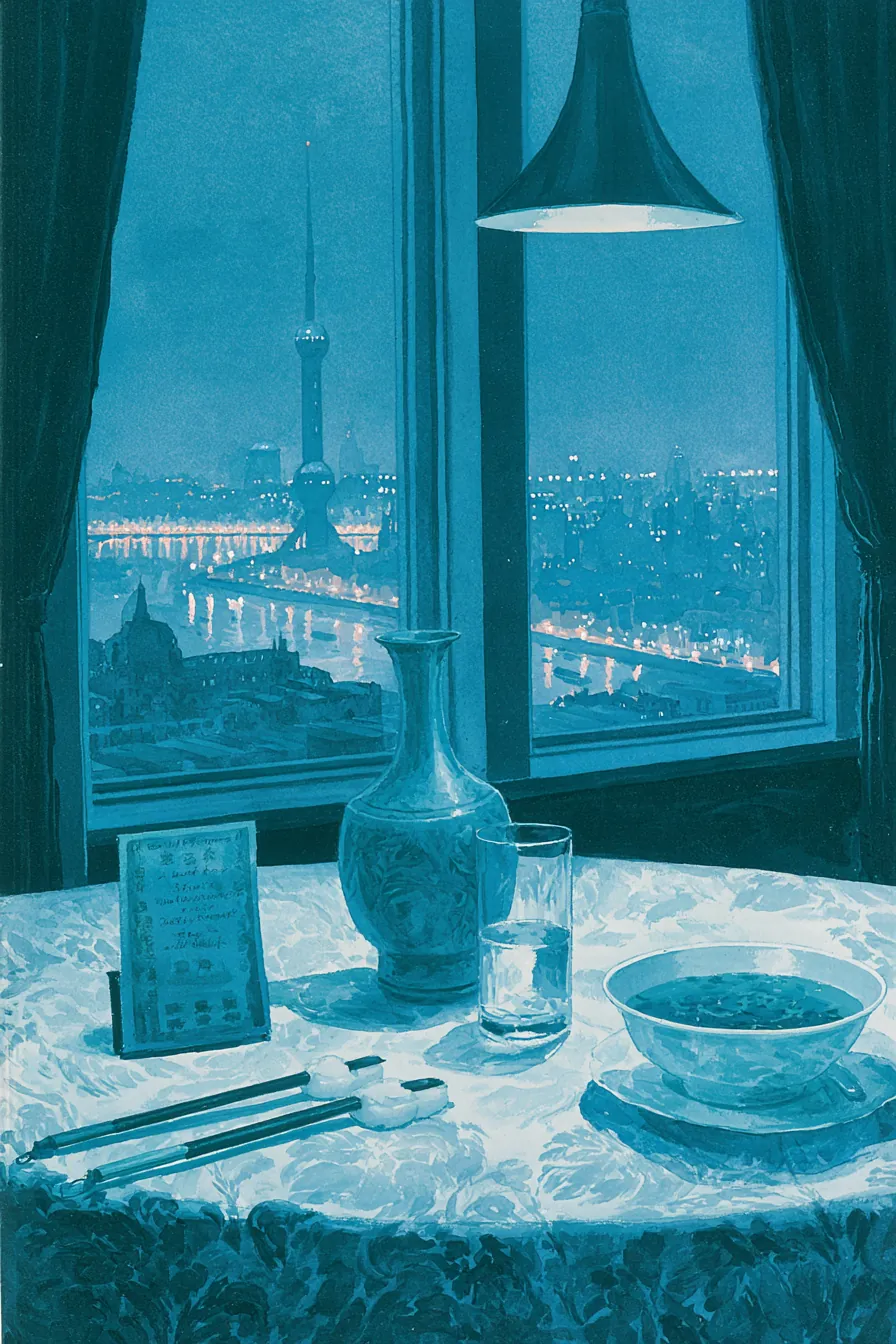
Chapter Nineteen — Dinner at the Cathay
Friday the thirtieth of July.
The Cathay had the ninth floor — by Mr. Sassoon's 1932 instruction, the floor that had the view of the Bund. In 1937 it was the floor of the dining room with the view.
The dusk on the Bund at half past seven on a Friday in late July was the dusk of a city that had heard, three weeks earlier, that the Marco Polo Bridge had been fired upon, and that Wanping had become the bridge incident. The Settlement papers said tensions had eased. The men who read the papers on the Bund at half past seven did not believe it. The dusk was the dusk of the city before.
I had told Feng Sheng about the dinner on the Tuesday at midnight in the basement, in the manner Pearl had told me to tell him in April. I had not embellished, I had not withheld. The Major has issued the second invitation. The Cathay on the ninth floor at the public table by the window, Friday the thirtieth of July at half past seven. I have accepted. The invitation is the second of three. I will, by Pearl's good counsel and your good silence, decline the third.
He had not, for the count of nine, said anything. He had been at the piano with the lamp at its low and the candle at its level and his hands on the keyboard cover with the cover closed. On the third tick of the count he had lifted his right hand from the cover, looked at the hand, and set it back.
He said: Tell me about the dining room at the public table.
I had told him: East-facing window, the one over the Garden Bridge and not the one over the Customs House. Mr. Lopes's nephew at the cloakroom said the second table from the corner — the corner being the Belgian banker's. Chair on the East. The other chair on the West.
He said: Take the East. He will take the West. You will, by the East, have the bowl of light at half past seven from the window. He will, by the West, be in the shadow.
He said — and this had been the only thing he said about the dinner that was not an instruction — I am not, on this Tuesday, the man you sit at the East side of the table for. I am at the piano. The piano will be at its level. You will, at the table, be at the level the table is. You will not be at the level of the piano. You will be at the level of the Cathay.
He said: *You will, in the second course, be asked who has been training you. He has not asked in the eight months he has been at the Paramount; he has been waiting. The Cathay is the place of the asking. He will ask at the soup because the soup is public and deniable — he will be giving you the chance to refuse the question. You will refuse it by not refusing.
You will say: A man in 1925. He was nineteen. He is, by the year, no longer at this work. That man is your brother. Your brother's letter and the lock of hair from 1925 are in the lining at the right hip — you have, by your own decision in 1936, the right to refer to him. The Major will, by the second course, understand he has been told a true thing he has not been told the answer to. He will not ask again.
I will be at the piano on the Friday at half past seven. You will, by half past ten, come back to the piano.*
I said: I will.
The Friday was the Friday.
I had been at the dressing room at four with Miss Liu and the simple chignon with no pin, since the Major had not given me a pin. I had on the pale grey silk qipao Mr. Hong Xiang had cut me in March, the plain one with the dark grey embroidery at the collar and the left hem, the one Mr. Hong Xiang had called the qipao of a woman who is in a dining room because she has been recognized for a thing that is not yet a thing. I had no jewelry except the small silver bracelet Auntie Lin had given me at twelve. The bracelet was the bracelet Auntie Lin had been wearing herself at twenty-two at the dance hall on Edward VII in 1916, and which had been the bracelet Auntie Lin had put on my wrist on the night I had told her I had taken the Paramount audition. The bracelet was the thing that was yours.
I had been at the Cathay's lobby at twenty past seven. The doorman in the long red livery had known the Major's name in his own mouth and not in writing, by his counting on the seven Fridays of our being there. Since the third Friday in June he had taken to giving me the inclination of head a Cathay doorman gave a woman he had decided, for the present hour, was a woman. He gave me the inclination. I crossed the lobby.
The lift had been on the third floor. The lift attendant had been Mr. Ng, who had been at the Cathay since 1934 and was from Toishan and had a wife in Toishan with three children, the oldest of whom was eight and was, this summer, with him at the apartment in Hongkew. Mr. Ng had taken to closing the lift gates with the soft click of the lift gates of the Cathay in 1937 when closed by a man who had not known what the singer was going to the ninth floor for.
Mr. Ng had not closed the gates with the click on this Friday in July.
Mr. Ng had closed them slowly.
He said: The Major is at the ninth at quarter past seven. He has been at the East side of the second table at the window since quarter past. He has not, since quarter past, ordered anything other than the carafe of water. He has on the navy linen suit and a different pocket square. The pocket square is, by my cousin, a folded square of the kind a man wears who has pressed it himself with his own iron on the Friday morning. The Major is alone. There is, at the third table from the kitchen, a man who is the consulate's man. The man is not in uniform. The man is, by my cousin, at the third table with a Settlement journalist whom the consulate has been buying drinks for since the first week of July. The man is not for our table.
The lift had stopped at the ninth.
The lift gates had opened.
The lift gates had opened on a carpeted vestibule with a Chinese ebony console at the center and a fresh white peony in a celadon vase. The peony — fresh, stem cut at a long angle, the dark spot at the seventh petal where the morning's frost had touched it — had not been ordered by the Major; Mr. Lopes's nephew had told me for nine months that the Cathay's house florist ordered them in season. The peony was the season's, not the Major's.
I had stopped at the console for the count of three. I had looked at the peony the way Auntie Lin had, on the morning at five, taught me to look at a peony at the eve of a war. The peony was a peony. By the country at the bandstand at half past nine in April, the peony was the country. At the Cathay on the ninth, it was the country at a console.
The country at the table was at the East side of the second table at the window in the navy linen suit.
The maître d' of the Cathay's ninth-floor dining room had been at the door of the dining room. He had not been Mr. Lopes; he had been the Cathay's own Mr. Almeida from Goa, who had been at the Cathay since 1932 and had been told at four that the singer was to be brought to the second table at the window. He had bowed.
"Miss Su."
"Mr. Almeida."
"This way, Miss."
The dining room had East-facing and West-facing windows and a Bechstein grand on a raised dais at the corner near the East-facing windows — Mr. Sassoon's 1931 gift on the hotel's second anniversary. At half past seven Mr. Markovich, the Russian piano-player at the Cathay since 1930, was playing his new arrangement of Night Shanghai at half tempo. He had heard it on the Manila wireless at the broadcast of the Mid-Summer Gala on the twenty-fifth of July. I did not look at him on the walking.
I walked across the dining room to the second table at the East-facing window.
Major Itō Kensuke stood.
He had on the navy linen suit and the new white pocket square in a flat fold and the black seal of the Imperial Japanese Navy at the lapel and a fresh white camellia at the buttonhole. The camellia was not the camellia of the Cathay's florist. The camellia was a private camellia. The camellia was, by my own counting, the camellia of a man who had clipped a fresh white camellia from a private garden at the consulate at Wuhan Road at six in the evening and had pinned it himself at the buttonhole.
"Miss Su."
"Major."
"Please."
I sat on the East. He sat on the West.
The dusk on the Bund through the East-facing window was the dusk. The river was the river. The lights on the Pudong side had not been turned on. The lights on the Bund side were on. The Customs House had its white lights. The Hong Kong and Shanghai Bank had its white lights. The Bund had the row of lights of a city that had been at peace at half past seven on a Friday in late July, 1937.
The Major did not, on the sitting, do anything.
He waited for the count of nine.
He said: Miss Su, Mr. Almeida has a fresh river fish tonight he will recommend. I will not order for both of us. You will order what you order.
Mr. Almeida had come. We ordered. We both took the fish at the second course and the veal in cream at the seventh, the green salad at the third, the consommé at the fourth, the lemon sorbet at the sixth, the mille-feuille at the ninth, espresso at the tenth, and the glass of cognac at the eleventh on Mr. Almeida's recommendation.
Mr. Almeida had bowed and gone.
The Major had — between Mr. Almeida's going and the carafe of water being brought to my side — looked at the river.
He said: You sang the bridge of Night Shanghai on the twenty-fifth of July, at the third song of the second set of the gala, in a manner I have, in fourteen years of listening to women sing in nine cities, not heard. I was at table eleven. I was, by Mr. Lopes's good sense at the door at half past nine, moved from table four. I was at table eleven because Mr. Du was at table four. I was, at the third song of the second set, at table eleven with a carafe of water and a filet of John Dory in beurre blanc and a sprig of dill. I did not, at the seventh measure of the bridge, breathe. You have been singing since the eighth of October in a manner that I have, since the second Friday of November, been trying to identify the schooling of. I have not, in eight months, identified it. On the twenty-fifth of July I stopped trying to identify the schooling. I am, on this Friday in late July, going to ask you a question. The question is the question I have been saving for the second invitation. You will, by Mr. Almeida's bow at the entry, have understood that I have been saving the question for the second invitation. The second invitation is the second invitation. The question is the question.
He had paused.
He said: Miss Su, who has been teaching you to phrase the bridge of Night Shanghai at the seventh measure with the half-breath you took on the twenty-fifth of July.
I had let the question sit for the count of three.
The carafe of water was at my side. The grey silk qipao at the East side of the table caught the dusk through the East-facing window. The Bechstein at the dais played the second movement at half tempo. Mr. Markovich at the dais was not looking at the second table at the East-facing window.
I said — and I said it the way Feng Sheng had on the Tuesday at midnight in the basement told me to say it — Major, a man in 1925. He was nineteen. He is no longer at this work.
The Major had looked at me.
The Major had set down the carafe of water by half an inch.
He said: The man in 1925. He was nineteen. He is no longer at this work. I am sorry for the year.
He had not, for the count of six, said anything.
Mr. Almeida had brought the fresh river fish at the second course.
The fish had been the fish. The fish had been small. The fish had been served with the dry white wine from the Bordeaux import that the Cathay had been importing since 1928. The Cathay had been buying the wine by the case from the importer at Avenue Joffre since 1928. The bottle on the Friday in late July had been from the case of the second week of July.
The Major had eaten the fish in the manner of a man taught at the Tokyo Imperial University in 1922 by a French professor of how to eat a fresh river fish at a French dining room. I had eaten it in the manner of a woman taught at the Shanghai American School in 1929 by Mrs. Whitford the senior music teacher at the Astor Hotel after the November recital.
The Major said, at the eating of the fish: The Marco Polo Bridge.
He said: The bridge was at Wanping. The bridge was, on the seventh of July, fired upon by a detachment of the Japanese army on an evening exercise. The firing was the firing the Settlement papers have, by the second week of July, called the bridge incident. The firing was not the firing the bridge incident. I am telling you something I have not been authorized to tell you. I am telling you because I am at a table at the Cathay on the ninth floor at the East side of the second table at the window, and the woman at the East side of the table is a woman I am not authorized not to tell.
I said: I will not repeat the telling.
He said: I am relying on the not-repeating.
I said: You are.
He said: The firing was a third party. The third party was not the Chinese army. The third party was not the regiment at the bridge. The third party was a unit at the bridge whose orders we are not yet certain of. The orders, by the second week of July, are arriving in Tokyo as the orders of the Northern Garrison Command. The Northern Garrison Command at the second week of July is, by the close attention I have been giving to the Tokyo telegrams for the eight months since November of 1936, the command of a general who has been waiting for a bridge. The general has, by my reading, decided that the bridge at Wanping is the bridge. The general has not, by my reading, been told to decide. The general has decided. The deciding by the general at the Northern Garrison Command is, by the second week of July, the deciding that has been deciding the Tokyo telegrams. The Tokyo telegrams are, by the third week of July, deciding the consulate. The consulate is deciding the staff officer at the consulate. The staff officer at the consulate is the man at the table at the East side of the second table at the window at the Cathay on the ninth on the Friday in late July. The army does not want a war in China. The consulate does not want a war in China. The Foreign Ministry does not want a war in China. The Northern Garrison Command has decided to have a war in China. The army will have the war in China the Northern Garrison Command has decided to have. The war in China that the army will have is by the second week of August or the third — a war the consulate will be the consulate of. I am at this table on this Friday in late July to tell you a thing I have, by the manner of the country I am the consulate of, no right to tell you. I am telling you because at this table on this Friday in late July I am the man I am, and not the country I am the consulate of, and not the staff officer the country has decided I will, by the third week of August, be.
I had looked at the river.
The river had carried, between the second week of July and the third Friday of July at the ninth floor of the Cathay, the dry weight of the Bund at half past seven of a Friday in late July, 1937.
I said: I am grateful.
He said: I am sorry.
I said: You are.
He said: I am.
We had eaten the fish, the salad, the consommé, the sorbet. The Major had not asked again. The seventh course was the veal in cream. We had eaten it in the manner of a Japanese staff officer trained at Tokyo Imperial in 1922 and a Suzhou-born singer trained by Mrs. Whitford at the Astor in 1929.
The Major said, at the eating of the veal: The poem.
He said: The wild geese path. I am a goose.
I said: You are not alone in the air.
He said: I am, on this Friday in late July at the table at the East side of the second table at the window at the Cathay on the ninth, in the air with a smaller flock than I was in the air with at the second Friday of July.
I said: The flock at the second Friday of July had a number of geese.
He said: It had.
I said: The flock on this Friday in late July has a smaller number.
He said: It has.
I said: Have the geese landed.
Mr. Markovich at the dais had moved, between the seventh and the ninth, from the second movement to the third. The third movement was, by his good Russian sense at the third Friday in May, the movement he did not at half past nine on a Friday play — he played Get Up instead. On this Friday in late July he had played the third movement of Night Shanghai. The Major did not look at him. The Major had looked at me.
He said: I will, in some other month, issue the third invitation. The third invitation will be the invitation to the consulate at Wuhan Road. The invitation will be the invitation to a private dining room. The private dining room will be the dining room of a man I will, by the third week of August, no longer be entirely able to refuse to be. I am telling you, on this Friday in late July at the table at the East side of the second table at the window at the Cathay on the ninth, that the third invitation will be issued. The third invitation will be issued because, by the deciding at the Northern Garrison Command, the third invitation will not be the invitation I issue. The third invitation will be the invitation the consulate issues. The consulate is issuing it through me. I am the man at the table. I am asking you to decline.
I had let it sit.
I said: I am grateful.
He said: I am not finished.
I said: No.
He said: I will, in some other month, issue the third invitation because the consulate is issuing it. You will, by my count, decline. The declining will be yours and not the country's. The declining will not be the declining the consulate can afford to accept.
I said: What will the consulate not be able to afford to accept.
He said: The declining. The consulate, in some other month, will be the consulate of a country that is at war with the country whose dining room I am, on this Friday in late July, at the ninth floor of. The consulate, in some other month, will be not the consulate. The consulate, by the third week of August, will be the army's. The army, by the third week of August, will be the country.
I said: You are the man at the table who is not, on this Friday in late July, the staff officer the country has, by the deciding, decided you will be.
He said: I am.
I said: Will you be, in some other month, the man at the table.
He had not, for the count of nine, said anything.
He said: No. I am grateful for the asking.
The mille-feuille had come at the ninth course, made by Mr. Bertrand the Cathay's pastry chef from Lyon, who had been making it on Fridays since 1928. We had eaten it.
The espresso had come at the tenth. The Lavazza had been at the Cathay since 1932, a gift from an American hotelier who had bought it after Mr. Sassoon mentioned at a private dinner in June 1932 that the Cathay had been considering one.
We had drunk the espresso.
The glass of cognac had come at the eleventh. The cognac was from the Cathay's cellar, which Mr. Sassoon had been laying down since 1929 for the hotel at the corner of Nanjing Road and the Bund.
I had not drunk it.
The Major had not drunk it.
We had let it sit.
We had paid the bill. The Major had paid the bill the way a man at the East side of the second table at the window at the Cathay on the ninth on a Friday in late July paid a bill: with the black leather wallet and the white folded note slipped into the leather binder by Mr. Almeida at half past ten and signed at quarter to eleven and the bow of Mr. Almeida at the corner of the binder.
We had stood.
The Major had let me go first.
I had walked across the dining room to the door. Mr. Markovich at the dais had stopped playing. Mr. Markovich at the dais had stood. Mr. Markovich at the dais had inclined his head at the manner of a Russian piano-player at the Cathay on a Friday in late July, 1937, inclining his head at a singer who had been the woman at the table.
Mr. Almeida had been at the door.
He had bowed.
I had bowed.
I had walked out to the vestibule. The peony in the celadon vase had been the peony. I had not looked at the peony.
The Major had come up next to me at the vestibule.
He said: Mr. Ng at the lift. I will, by Mr. Ng, see you to the lobby.
The lift had come at the ringing of the brass bell. Mr. Ng had opened the gates. Mr. Ng had not looked at the Major. Mr. Ng had looked at me. Mr. Ng said: Ninth to lobby, Miss.
I said: Ninth to lobby, Mr. Ng.
The lift had descended.
The Major and I had stood on opposite sides of the lift. The Major had looked at me at the eighth and at the seventh and at the sixth. At the fifth he had looked at the floor of the lift.
We had reached the lobby.
The lift gates had opened.
I had walked across the lobby. The doorman in the long red livery had inclined his head. I had inclined mine. The Major had walked behind me at the distance of a Japanese staff officer walking behind a Suzhou-born singer at the Cathay's lobby on a Friday in late July, 1937, at twenty-five past eleven.
The doorman had hailed a rickshaw.
I said Goodnight. He said Goodnight. We inclined our heads. I stepped into the rickshaw. The rickshaw had moved off. I had not, on the moving off, looked back.
At the corner of Nanjing Road and Yunnan Road I had looked back. The Major had been at the doorway of the Cathay. The Major had been on the second step at the corner of the long red carpet at the doorway. The Major had been looking at the corner of Nanjing Road and Yunnan Road. The Major had inclined his head by half an inch.
I had not inclined mine.
The rickshaw had turned.
I had been on Nanjing Road heading West at twenty-eight past eleven on a Friday in late July, 1937, in the pale grey silk qipao Mr. Hong Xiang had cut me in March, with the small silver bracelet from Auntie Lin at the wrist and the brother's letter and the lock of hair from 1925 and the folded square of cotton from Longhua and the four pieces of Pathé staff paper in the inside seam at the right hip and the chrysanthemum pin in the inner pocket at the phoenix at the left hip.
At the corner of Nanjing Road and Tibet Road, three blocks West of the Cathay, three tables back at a open-air café, was Yao Sanye. He sat at a wicker table with two whiskeys and a man in a grey Western suit and the Tokyo-banker's three-point fold of pocket square. I had seen that face twice — the Cathay tea-dance in January, the Major's third Friday in March at the bandstand corridor. He was the consular man Mr. Ng's cousin had been speaking of.
Yao did not see me. He sat three-quarters away from Nanjing Road. The consular man was full-face to Nanjing Road. He saw me. He did not indicate anything to Yao. He set down his glass and did not lift it again for the count of nine.
The rickshaw was past the corner.
The corner was past me.
I sat at the rickshaw for the count of nine.
I thought about the second movement and the third movement and the third invitation, about the man in 1925 who had been nineteen and was no longer at this work, and the man in 1934 at the Conservatory who was no longer at this work either, about the man under the floor and Pearl at her door at half past one and Auntie Lin at the chaise, and about the white peony in the celadon vase at the ninth-floor vestibule of the Cathay at half past ten on the Friday in late July, 1937.
The country had been at the table in the navy linen suit, and said I am asking you to decline, and I am not finished, and I will, in some other month, no longer be the man at the table.
I closed my eyes for the count of nine.
I opened them.
The rickshaw was at the lane in Hongkou at quarter to one.
The lane was the lane.
The country was, at quarter to one in the lane in Hongkou, outside the lane.
Auntie Lin was on the chaise.
She was awake.
She had on the wireless above the harmonium on the Manila frequency. The Manila frequency at quarter to one was, this Friday, broadcasting a string quartet from a hall in Manila playing Schubert.
"Aliang."
"Auntie."
"Sit."
I sat.
"You ate."
"I ate."
"He asked."
"He asked."
"You said."
"I said the man in 1925. I said he was nineteen. I said he is no longer at this work."
"Good."
"Auntie."
"Yes."
"He told me a thing."
"Yes."
"He told me the Northern Garrison Command has decided. He told me the consulate will be, by the second week of August or the third, the consulate of a country at war with the country I am the singer of."
She was quiet.
She did not, for the count of nine, do anything other than look at the harmonium.
"Aliang."
"Yes."
"He told you because he is a goose."
"Yes."
"The geese are landing."
"Yes."
"The country is coming."
"Yes."
"You did not accept the third invitation."
"He has not issued it."
"He will."
"Yes."
"You will decline."
"Yes."
She was quiet.
"Aliang."
"Yes."
"The Major is the second peony."
"Yes."
"The third peony will not be a peony."
"No."
"It will be a uniform."
"Yes."
"Sleep."
"Yes."
I went to my room.
I lay down.
I closed my eyes and opened them and closed them and slept.
In the dream the Cathay's Bechstein had been replaced by the one in the brick room under the Paramount. The man at it was the man in the mask. He was playing the second movement of Night Shanghai at half tempo. The dining room was empty except for the table at the East side. Both chairs were empty. The fish had not been brought. The carafe of water was at my place. The lights on the Bund were on, and the lights on Pudong, and the river was the river.
The wild geese path was not a path the geese had made. The path was a path the geese had remembered.
I woke at five.
I went to the harmonium. I lifted the lid. The lacquer box had, since the Friday at half past one, a second additional object in the inner partition with the chrysanthemum pin and the white cotton wrapper: the Major's card from the ninth of April. I had, without deciding to, taken it out of the vanity drawer on the Sunday after the gala and brought it home in the inside seam at the right hip. I had only just remembered the bringing.
The three objects sat side by side in the inner partition: the pin was Mr. Du, the wrapper was Major Itō, the card was Major Itō. The fourth corner was empty.
I closed the lid of the lacquer box and the lid of the harmonium. The lane was the lane. The country was, at the second and third corners of the partition, in the lacquer box. The fourth had not, by the morning, been filled.
I would, on the Tuesday at midnight, tell the man under the floor about the second movement and the third invitation and the man at the wicker café three blocks West of the Cathay. He would, by Friday, have decided.
I slept the second sleep until seven.
I dreamed of the river.
The river had been carrying the dry weight of the Bund at half past seven of a Friday in late July, 1937. The river would carry, by some later month, the country.
I woke at seven.
The lane was the lane.