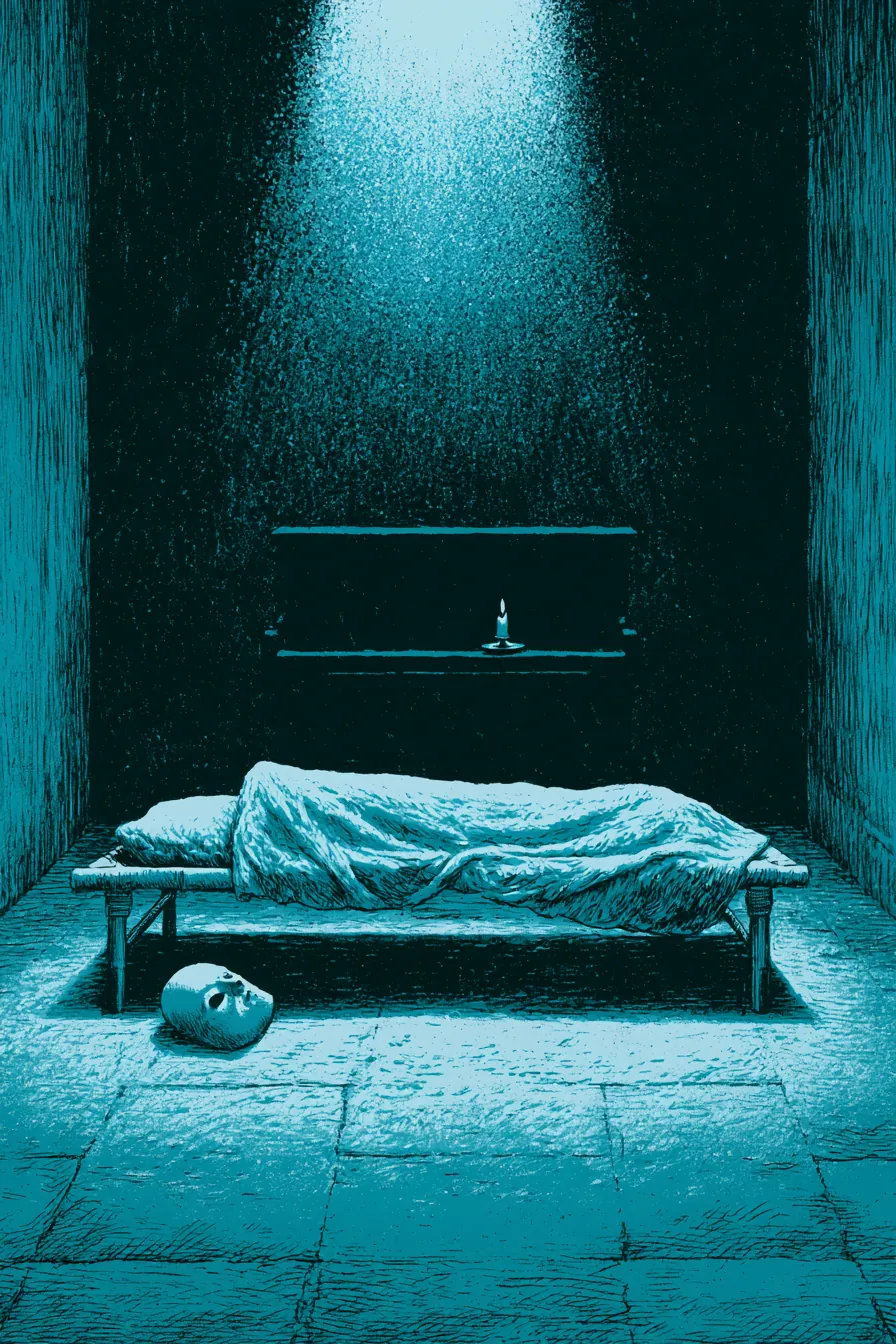
Chapter Twenty-Five — What Is Left
I woke.
The candle at the wall ledge above the second-to-last step had burned to the second mark. I knew the mark before I had opened my eyes, the way one knows the hour by the angle of a lamp's small shadow on a familiar wall. The brick room held its own dark — a soft brown dark, the colour of weak tea, the colour the cellars of the old godowns at Suzhou Creek had been the summer my brother and I had hidden from the rain there at thirteen and twelve — and the dark, this morning, had a small new substance to it. A man was breathing in it. A man had been breathing in it, beside me, for hours.
Feng Sheng was at the cot.
He had on the porcelain mask. He had on the gloves. He had not moved.
His breathing was the four-and-six he had taught me at the bandstand in February, the count one took, in singing, to open the rib without lifting the shoulder. He had been holding the count. Through it, like a low organ pedal beneath a melody, the rib of his ribcage rose against my back at exactly the interval I expected, and fell at exactly the interval I expected, and the cot — a soldier's cot, six feet long and twenty-eight inches wide, built for one man — held the two of us only because we had been arranged, by his arrangement, into the shape of two parentheses.
I set my hand at the porcelain.
The porcelain was cool. It was the cool of a thing that had been worn for the past nine hours over a man's face. Anya, who had taught him to knot the leather strap behind the left ear in 1935, had told me once, in a different context, that the prop-maker at Fuzhou Road had cut the eye-slits at nineteen millimeters from the bridge of the nose precisely because the angle of nineteen millimeters allowed a man to see a candle at six paces and a person at sixteen without ever, at any angle, allowing the person to see his face. The angle was a piece of architecture. The architecture was the cool against my palm.
I said: I am awake. I am hungry.
The voice that came back was the dry low voice he kept for the brick room. Mr. Wei will bring a meal at five from the Sichuan-Road vendor. He will bring it down the forty-two steps. He will set it at the crate. We have the brick room.
We have the brick room.
I had not, until that moment, considered that I would, on this morning, still have a room. The lane house at Hongkou — the lane house with the rosewood harmonium and the chaise where Auntie Lin had practiced the right-hand phrase for nine days, the harmonium I had bought for her at twenty silver dollars in October of 1932 with the first three sets I had earned at the Bright Moon — was, as of noon yesterday, a heap of broken brick the wrong colour at the corner of the third house. The Chinese pilot of nineteen at the Northrop had at noon dropped the stick at the wrong corner. The corner was ours.
The brick room of the Bechstein upright at the third wall, the candle at the wall ledge, the crate at the cot, the ledger at the second crate, the lacquer box at the third crate — that was what was left. The Bechstein had been Feng Sheng's piano for two years and seven months. The lacquer box held his diary. The diary was closed.
The diary, I thought, had on the second appendix the names. I did not lift the lid. I knew. He had been keeping the doubles for the dead in the diary since 1934, in a hand I had not seen but had been told about, in a pencil he sharpened on a small block of sandstone at the second crate.
I did not lift the lid.
I set my forehead at the porcelain. I closed my eyes. The porcelain warmed under my forehead by perhaps half a degree, and I thought, with the small clean part of my head that was not, this morning, drowning, that I was the heat. A living head warmed a porcelain mask by half a degree. A dead head did not. I was the heat. I was, at this hour of quarter to five on the second Sunday of August of 1937, in the brick room under the Paramount at the corner of Yuyuan and Bubbling Well, the heat of a porcelain mask.
He set his bare right hand at the curve of my cheek.
His right hand was the hand of a man who had played a Bechstein upright for two years and seven months. The pad below the thumb had the callus a pianist of twenty-nine had at the pad. The fingers were long. The skin was dry. He did not, with the hand, do anything that the hand was not already doing. He simply held the curve of my cheek. The curve of my cheek was the curve.
He said: Do not sing tonight.
I said: No.
He said: Mr. Wei has set a folded note from Mr. Lopes at the cloakroom. The note says the Paramount is, by Mr. Du's word at one o'clock, closed for the weekend. The reopening will be at the second Wednesday of August, at the second night the Settlement Council does not interfere. Mr. Du has set the calendar.
I understood, when he said Mr. Du has set the calendar, what calendar meant. Du Yuesheng of the Green Gang had decided, on a Saturday afternoon at the second hour, that a Paramount that had opened in August of 1932 on the second Friday at eight o'clock would reopen, after the city had taken its first stick of bombs at the wrong corner, on a Wednesday in the same month. Du Yuesheng's calendar was not the city's. The city's calendar had ended at noon yesterday. Du Yuesheng's continued. A girl who had sung the warm contralto on the bandstand under Du Yuesheng's calendar for five years and three months had, on this Sunday morning, three days off.
The three days were the three days. I would not, in three days, have a foster-mother to take a bowl of congee to. I would not, in three days, have a lane to come home to. I would have, after the third Wednesday at eight, a programme and a contract and a cot and a man at a piano two floors below the floor I would be standing on.
I said: Three days.
He said: Three days. The brick room has water at the kettle. I will set the water at the flame.
He sat up. He set the porcelain at the side of the cot — not removed, only no longer pressed against my forehead — and he looked at me through the eye-slits at the distance of nineteen millimeters from the bridge of the nose. I looked back. The looking-through-the-porcelain was a thing I had, in fourteen months of Fridays at the candle, come to read. The pupils were dilated this morning to a wider degree than I had seen them. He had not, last night, slept.
He stood. He took the grey wool coat from the crate beside the kerosene burner Mr. Hu the carpenter had set at the wall at three feet from the second crate, put it on over the white shirt, and went to the kettle on its iron trivet at the wall. The kerosene burner caught at the third turn of the knob. The blue ring of flame steadied. He set the kettle on the ring. The water inside the kettle, which Mr. Wei had drawn at six the night before from the cold tap in the cook's prep area and brought down the forty-two steps in a tin pail, began, after a slow minute, to make the small breathing sound a kettle made at five minutes before it boiled.
I pulled the grey blanket Mr. Hu the carpenter had bought in February of 1935 from an army surplus shop at the corner of Boone Road and the second lane up to my chin. The blanket smelled of the cold-storage room and the small mineral cold of brick at twenty feet below the street, and, faintly, of the sandalwood the cook smoked at one o'clock in the morning at his stool. The smell of the blanket was not a Hongkou smell. It was the smell of a thing I would have to learn to belong to.
I lay with the smell.
After a moment I said, into the dark, because I had to put it into a sentence before the sentence would let me carry it: Mr. Tsung set me at the rickshaw at the corner of Sichuan Road N. and Bubbling Well. He took me South. He went back North after he set me at Sun Ya. He went home to the third house because Mrs. Tsung had set a dish of pickled radish at the kitchen for him. Mr. Tsung said to me at the rickshaw at the corner of Sichuan Road N., 'Mrs. Tsung is at the dish of pickled radish for me. Mrs. Tsung does not like the dish to wait. I will, at noon, be back.' Mr. Tsung laughed at the dish of pickled radish. Mr. Tsung was at the third house at noon. Mrs. Tsung was at the second house. Mrs. Tsung had gone to the second house to take Auntie Lin the bowl of congee Mrs. Tsung had made — Mrs. Tsung had taken Auntie Lin the bowl of congee every day at noon since the third week of June, when Auntie Lin had been told not to leave the chaise. The dish of pickled radish is at the rubble. Mr. Tsung is at the rubble. Mrs. Tsung is at the rubble. Auntie Lin is at the rubble. The bowl of the congee is at the rubble.
The voice, by the end, was not my voice. It was a voice I had borrowed from the woman who had practiced, against a bathroom mirror at the lane house, three sentences I could say to a wall. The wall, this morning, was a porcelain mask.
I turned my face to the wall.
I wept.
I wept the way a Suzhou-born singer of twenty-two wept at the grey blanket of a Hongkou army surplus shop on the cot in the brick room under the Paramount on the second Sunday of August in 1937, when the dish of pickled radish at the kitchen of the third house at the corner of the lane had been at the kitchen at noon and Mr. Tsung had not eaten it. I wept without sound for a long while, the way Auntie Lin had taught me to weep when I was thirteen and our father had been taken to the East gate at Longhua and Auntie Lin had set her right hand at my back and said, Aliang. Weep without sound. The country listens for sound. We will give it none. I wept now without sound. The country, this morning, was listening.
The kettle made the small click of a kettle taken off a burner. The blue ring of flame went out at the kerosene burner. The kettle came to the wooden tray at the second crate. The tin of tea-leaves came from the ledge at the wall. A spoonful at the kettle. The wooden tray to the cot. He knelt at the side of the cot, the way a man knelt at the side of an iron-framed officer's cot. He set his bare right hand at the side of my head.
He said: The tea.
I turned. I sat up. The grey blanket fell at my hip.
He had set, at the wooden tray, a lacquer cup that was not the cup at the chip at the second quarter at the rim. The cup at the chip was at the inside seam of the silver gala qipao Mr. Hong Xiang had cut me in May, hanging on the cedar dressing-room rail two stairs above us, with its eleven other objects in the seam, of which the chipped cup was the twelfth. The cup at the chip had been Auntie Lin's. It had been the last cup she had drunk from at the kitchen table on the second Sunday of July. I had taken it from the rubble in the afternoon of yesterday, with one hand, the right, because the left had been holding a hairpin Mrs. Tsung had set, in 1933, in Auntie Lin's hair.
This cup at the wooden tray was, by contrast, only a lacquer cup of the kind Mr. Hu the carpenter bought, in three-for-a-copper lots, at the dry-goods shop at the corner of Bubbling Well and Jing'an. He poured the tea. He handed it to me. I drank. The tea was the second pluck of the cheap Anhui green Mr. Wei kept in the tin. It was not the cup at the chip. It was a cup.
He said: The third verse. The third verse is at the cot in the leather case at the second crate. The third verse is what we have. The third verse will, by the second week of October or November, go out at the hour of the inaugural broadcast. The third verse will, at this hour, also be the letter to Auntie Lin.
I held the cup.
The third verse — I had heard it once, in March, when he had played it at the Bechstein at half past one in the morning at the second wick of the lamp, and had not, on that occasion, written the lyric below the staff. The lyric below the staff he had been saving. The lyric, he had told me last week, would be names. The names were a list he had been keeping in the diary since 1929 — seven names, the seven men whose convenience the convenience of the inconvenient consulates served. The seventh name on the list at the inner seam at the right hip of my silver qipao — the brother's letter folded smaller than the others — was Yao Sanye.
Auntie Lin had not liked the third verse. Auntie Lin had heard it once. I had played it for her at the harmonium at six in the evening on the second Sunday of July, the right hand only, the left hand on the lower staff which the harmonium could not anyway reach because the harmonium was tuned to a flat A and the bridge was in C-sharp minor. Auntie Lin had listened to four bars.
I said: Auntie Lin did not like the third verse.
He said: No.
I said: Auntie Lin said, "That is not the way a Bright Moon song goes. That is the way an art song goes. Where did you find a composer?" Auntie Lin did not wait for me to answer.
He said: No.
I said: Auntie Lin said, "I am not a woman who needs to know." Auntie Lin set the lacquer cup of weak tea at the kitchen table. The cup at the chip at the second quarter at the rim is at the inside seam of the silver qipao. The cup at the chip was the cup of weak tea I had set at her hand. She drank it.
I held my own cup, the plain one, on my chest, in the cold-storage breath of the brick room, and waited.
He said: She drank it. The third verse will be the cup.
He did not, that moment, do me the kindness of pretending the sentence was less than it was. He said it in the dry register he kept for the things he had decided in the silence at the diary at the lacquer box. The third verse, going out on the inaugural broadcast of a Hongkou station in the warm contralto of a Suzhou-born singer of twenty-two who had stood, on the morning of the second Sunday of August, beside a rubble that had been, on the second Saturday of August at the hour of noon, a lane house, would be the cup of weak tea I had set at the kitchen table for the woman who had taught me to weep without sound.
He set the lacquer cup of the cheap Anhui green at the wooden tray. He took the kettle. He poured a second cup. He handed it to me. The kettle was emptier. I drank.
He said: I am going to take off the gloves.
He took off the left glove.
The left hand at the cot, at the hour of quarter to five on the second Sunday of August of 1937 in the brick room under the Paramount, was the left hand with the distance of the missing second joint of the fourth finger at the knuckle the third printing press at Zhabei had taken in February of 1934. The fourth finger ended at the first joint. The first joint was clean. Above it, the air. He set the hand at the grey blanket at my hip. The hand looked, against the army-surplus grey, like a hand at the edge of a story it had not finished telling.
I set my right hand at his left.
I turned it.
The palm was the palm of a pianist of twenty-eight who had the callus at the pad below the thumb a pianist of twenty-eight had at the palm. The knuckle at the distance of the missing second joint was smooth — the smoothness of a wound that had been, by 1934, a wound, and was now, by 1937, the shape of a hand. I set my lips at the distance. I kissed the knuckle. The knuckle did not, in being kissed, become any other knuckle. The knuckle remained the knuckle.
He did not say anything for the count of nine.
I said: I am going to sleep tonight at the cot. I am going to sleep at the cot with you. I am going to ask one thing. Sleep at the cot without the mask.
He did not say anything for the count of nine.
He said: Not tonight. Tonight I am the man at the piano. The man at the piano is the man at the piano. The man without the mask is the man for the morning of the inaugural broadcast. On the morning of the inaugural broadcast I am the man without the mask. Tonight the mask is the hour.
The sentence was, I understood, not a refusal. It was a calendar. The calendar said: not yet. The calendar said: there is a Wednesday in November when I will, in a recording booth at Pathé on Avenue du Roi Albert, be visible to you, and on the night of the inaugural broadcast at the third floor at Boone Road I will, behind the glass of the control room, be visible to you, and on the afternoon of that Friday on the deck of a Norwegian coal carrier at the customs jetty I will, in the wind off the Huangpu, be visible to you, and after that, for whatever time the city has consented to give the two of us, I will be visible. Tonight I am not. Tonight the porcelain is the hour because the man behind the porcelain has not, since February of 1934, been the man at any other hour, and the man tonight is the man at the piano, who has spent two years and seven months learning how to write a third verse for a singer he had not yet met.
I understood. I let the understanding sit on me the way I let the blanket sit on me. I did not, that moment, push the calendar.
He put the left glove back on. He took the porcelain from the crate beside him. He set the leather strap behind the left ear. He knotted the strap at the knot Anya had taught him in 1935 — the small flat surgeon's knot a French naval doctor had been teaching to a Russian wardrobe mistress at the dressing rooms of the old Cathay in 1934 because the knot did not, under perspiration, slip. The porcelain was at the porcelain.
He looked at me through the eye-slits at the distance of nineteen millimeters from the bridge of the nose. I looked at him. He lay down beside me. He set his right arm under my head. He set his left hand at the curve of my hip at the grey blanket, and, after a small consideration, moved it half an inch, so that the missing second joint of the fourth finger lay against the bone of the hip and not against the soft of the abdomen. I felt the small adjustment. I felt also that he had considered the adjustment for the count of three before making it.
I set my head at the hollow of his shoulder where the porcelain met the white shirt at the seam. The porcelain was cool. The white shirt was warm. The hollow of the shoulder was the hollow.
He said: I am here. I will be here.
I closed my eyes.
I thought, for a long moment before sleep took me, about the small wax paper in the inside pocket of the handbag in which I had kept, since 1934, the brother's letter; about the rib of his ribcage rising at four counts and falling at six; about the way one made an inventory of what was left after a Saturday in which one had lost the woman who had named one Aliang on a riverbank in Wuxian in 1914. The inventory was: a brick room, a Bechstein upright, a man who had been the man at the piano for two years and seven months, a lacquer box, a diary closed on a list of seven names, a cup of weak tea at the chip at the second quarter at the rim, a third verse not yet sung, a country closing at the corner.
I slept.
I did not dream.
I woke.
The candle at the wall ledge above the second-to-last step had burned to the third mark — the third mark Mr. Hu the carpenter had scored into the iron of the candle holder with the blade of a small carpenter's knife in 1935, so that the candle, on any night of the brick room, would not, in the lengthening hour, leave the room dark. The third mark meant the second half of the second hour after the candle had been lit. Mr. Wei must have come and gone. The wooden tray at the second crate had two empty bowls on it: the rice congee of the Sichuan-Road vendor at five, and a bowl of pickled radish I had not, in the sleep, eaten.
The bowl of pickled radish.
I looked at the bowl.
The bowl had, beside it on the tray, a small slip of paper in his cursive: Mrs. Tsung made this on the second Tuesday of July. Mr. Wei kept the second jar in the cold cellar at the kitchen. — F.
I closed my eyes.
I opened them.
I set my hand at the bowl.
I ate.
The pickled radish was Mrs. Tsung's. Mrs. Tsung had made it in July, in the kitchen of the third house at the corner of the lane, in the brown crock she had bought at the corner of Boone Road and the second lane in 1929. She had set the jar in the cold cellar of the cook's larder at the Paramount because Mr. Wei, who was Mr. Tsung's nephew on the third uncle's side, came up the lane on Wednesdays at noon to take a bowl of congee to Auntie Lin and to leave, in return, a small jar of whatever Mrs. Tsung had pickled that week. The jar had been in the cold cellar since the second Tuesday of July. The pickled radish had been there since the kitchen of the third house had still been the kitchen.
I ate slowly. The radish was sharp. The brine was good. I did not, while eating, think about Mrs. Tsung at the doorway of the second house at noon yesterday with the bowl of congee in her hands. I thought, instead, about the brown crock at the cold cellar, and about Mr. Wei, who had carried the jar down forty-two steps at five o'clock this evening because the man at the piano had asked him to.
Feng Sheng was at the cot beside me.
He had on the porcelain mask. He had on the gloves. He had been the man at the cot.
I set my right hand at the curve of his hip. He did not wake. The breath at four counts and six was steady. The breath of a man who had not, for two years and seven months, slept beside another body and was, this evening, sleeping beside another body, was perhaps the only thing in the brick room that did not, this evening, sound exactly as it had on Friday last.
I said, to myself, in the voice of a Suzhou-born singer of twenty-two at the hour of quarter to three on the third Sunday of August of 1937: I am here too.
The brick room was what was left.
I lay back, in the porcelain dark and the cold-storage breath and the sharp ghost of the radish on my tongue, and I waited for the third hour. Above me, two floors above, the Paramount was closed. Du Yuesheng's calendar said Wednesday at eight. Mr. Du had set the calendar because Mr. Du had set the calendar. Outside on Bubbling Well a tram went past at quarter to four with the small dry electric sigh of a tram that had only six passengers in it on a Sunday morning when the city had, the day before, been at the wrong corner. The sigh of the tram came down through the brick. The brick took the sigh. I took the brick.
I held what was left.