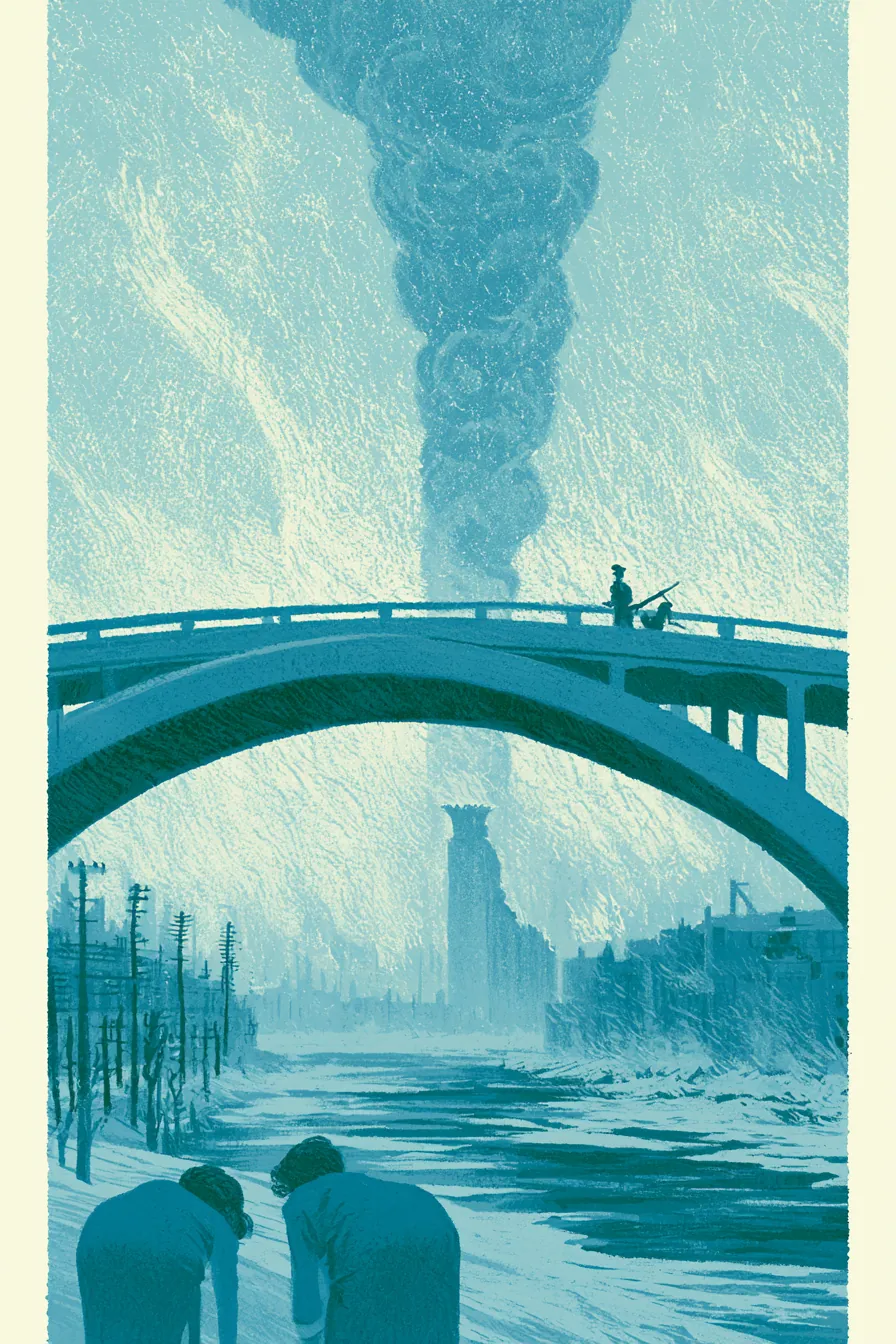
Chapter Twenty-Four — Bloody Saturday
Saturday the fourteenth of August.
Sun Ya at noon had been the Sun Ya of an hour at the third table from the window with the lacquer ashtray on the marble table and the hum of the electric fan at the corner of the marble counter and the attention of Mr. Wei the clerk at the marble counter to whatever dish a Belgian woman of forty at the second table by the window had ordered.
Pearl had been at the third table from the window since half past eleven.
She had on the grey traveling coat over a navy poplin dress. She had on no jewelry except the gold chain at the neck the Portuguese boyfriend had given her at the second Christmas. She had on the expression of a Paramount singer of twenty-five who had finished packing.
Mr. Sá had been at the second table on the side wall at half past eleven.
Mr. Sá had not been with Pearl.
Mr. Sá had been at the second table because Mr. Sá at the flat at Avenue Pichon had told Pearl that he had a business at the third pier of the customs jetty and would, at one, come back for her at Sun Ya.
The Portuguese cousin at the business at the third pier was confirming the papers for the second Saturday of August at six in the morning of the third Saturday of August.
The third Saturday of August was the calendar of the Macau line of the Norwegian coal carrier that had moved its sailing from the second Saturday at six to the third Saturday at six.
Pearl had known about the reschedule since the Friday afternoon.
Pearl had not told me about the reschedule, because Pearl at the Thursday tea dance had not known there would be a reschedule. The reschedule had been the Friday afternoon's reschedule. The Friday afternoon's reschedule had been the consulate's reschedule.
Pearl had told me.
She said: The Norwegian has gone to the third Saturday and not the second. I am at the flat at Avenue Pichon for the week. We have the hour of a week. Mr. Sá is at the third pier with his cousin. He will, at one, come back. He will, at the flat at the Saturday evening at six, take me to the Italian restaurant at Avenue Joffre that he and I have eaten the ravioli at. We will eat the ravioli. We will drink the bottle of the red wine. We will, at the flat at Avenue Pichon at ten, sleep. We will, at the Saturday morning at six, drink the coffee. We will, at half past six, walk to the corner of Avenue Pichon and Avenue Joffre. We will, at quarter to seven, take a rickshaw to the third pier. We will, at the third pier at eight, be on the Norwegian coal carrier with the forged Tsvetkov papers Mr. Sá's cousin has been at the print-shop at Macau for since the second week of June. I would have wanted you on the Norwegian at the third Saturday of August. I would have wanted, by the calendar of a Macau line, to have you with me at the forged Tsvetkov papers Mr. Sá's cousin has been at the print-shop at Macau for. I had known the set of papers Mr. Sá's cousin had been at the print-shop at Macau for was a set of two and not a set of three. The set of two was for the second Saturday at six. The reschedule by the consulate at Wuhan Road at the Friday morning had moved the sailing to the third Saturday at six. The reschedule did not change the set of papers. The set of papers is at Mr. Sá's cousin at the third pier. The set of papers is for two and not for three. I had told you the third pier at six on the second Saturday because I had wanted you to be at the third pier. The third pier was a third pier at which the set of papers was for two and at which Mr. Sá's cousin had a third set for a third person at the reserve at the print-shop at Macau. The third set was a set Mr. Sá's cousin had been preparing for me to bring you. The third set was at the third pier at half past four when the reschedule moved the Saturday at six to the third Saturday at six and Mr. Sá's cousin had sent the set of two for the second Saturday back to the print-shop for the third Saturday and had not the reserve. The reserve had been used. I am sorry. I will, at the flat at Avenue Pichon at the hour of the next week, attempt to obtain — by Mr. Sá's cousin at the print-shop at Macau — a set for one. I will, by Mr. Sá's cousin, attempt. I do not know whether the reserve will be available. I will try.
She said: Set the price, sweetheart. Set it high.
She said: I am taking my own advice. I am setting the price. The price is the leaving with Mr. Sá at the third Saturday of August. The price is a price I am taking. The price I am going to try to set is a price for a set for one for you. The price for the set for one for you will, at the print-shop at Macau, be a sum I will, by Mr. Sá's cousin, pay. Drink the coffee. Drink it.
I had drunk the coffee.
The dish of almond biscuits had been at the marble table since the eleven-thirty when Pearl had ordered them. The dish had been the dish of Sun Ya's almond biscuits, which had been the dish of Sun Ya's almond biscuits since 1929. Mr. Wei the clerk had been bringing them to the third table from the window since 1932 in the white dish with the blue rim that Mr. Wei the clerk had been told by Mr. Sun Ya himself to bring the dish of almond biscuits in.
I had not eaten one.
I had taken a folded square of the wax paper Mr. Wei kept in the drawer beneath the marble counter, and I had wrapped four of the almond biscuits.
I had put the wrapped biscuits in the inside pocket of the handbag with the brother's letter and the lock of hair and the folded square of cotton from Longhua and the four pieces of Pathé staff paper and the folded square of paper from 1900 and the folded note from the cot at the Thursday morning and the folded cream-paper envelope from the old Japanese woman of seventy at the Paramount tea dance and the two folded notes from the Friday at the eight o'clock from the Major and Mr. Du.
The inside pocket of the handbag had eleven objects.
I had looked at Pearl.
Pearl had looked at me.
She said: We will have the next week. I will, every afternoon at three, be at the flat at Avenue Pichon. The flat is at the second floor of the second house at Avenue Pichon. The second floor is the floor with the green-painted door at the landing. Come to me. Bring the papers if Mr. Sá's cousin gets them. Come to me anyway if Mr. Sá's cousin does not.
She had set down the second coffee.
She had looked at the marble counter where Mr. Wei the clerk had been at the hour of the Saturday at noon.
The Belgian woman of forty at the second table by the window had finished her dish of soufflé. The Belgian woman of forty had paid the bill with the French paper note from the Banque de l'Indochine. The Belgian woman of forty had stood. The Belgian woman of forty had put on the white straw hat with the dark ribbon at the brim that she had been wearing on her Saturday outings to Sun Ya every Saturday at noon since the second Saturday of June.
The Belgian woman of forty had gone to the door.
At the door the Belgian woman of forty had paused.
The Belgian woman of forty had looked up.
The Belgian woman of forty had pointed at the sky outside the door of Sun Ya at the corner of Nanjing Road and Sichuan Road.
I had stood from the third table.
Pearl had stood from the third table.
We had gone to the door.
We had looked.
In the sky above the corner of Nanjing Road and Sichuan Road there were five Chinese airplanes — the five Northrop bombers the L'Echo de Chine had been writing about, going South down the Huangpu at the low altitude of a bomber on an attack-run at the Idzumo at the third anchorage off the consulate's third pier. They dropped a stick of bombs. The stick went short. It fell at three places: the corner of Nanjing Road and the Bund, at the façade of the Cathay; the corner of Avenue Édouard VII, at the Great World amusement hall; and the lanes of Hongkou — two hundred yards East of Sun Ya, half a mile South, and the lane.
I did not yet know the three places. I heard the three sounds — three concussions, each nine seconds after the last. At the third the Belgian woman sat down on the pavement, said nothing, and took off the white straw hat.
I ran East along Nanjing Road toward the Bund. Pearl followed, in the grey traveling coat and the grey rehearsal qipao I had borrowed from her at Avenue Pichon on the Friday. We stopped at the corner of Nanjing Road and the Bund.
The ninth-floor corner of the Cathay's East-facing wall had collapsed. The pavement was covered with the stones of the ninth floor, and with the bodies — men and women and children who had been at the corner at noon, a count beyond the count one took.
Pearl said, in the voice of a Paramount singer of twenty-five at the hour at the corner: Oh sweetheart.
She said: The third stick. The third stick. Hongkou.
We had turned.
We had gone North on the Bund toward the Garden Bridge.
We had come to the Garden Bridge.
The Garden Bridge had had at the North side of the bridge, where the Settlement ended and Hongkou began, a line of Japanese marines.
The line of Japanese marines had had at the post a Japanese sentry sergeant.
The sentry sergeant had held a rifle at the chest.
The sentry sergeant had gestured at the refugee to bow.
The refugee had bowed.
The sentry sergeant had let the refugee through.
The refugee had gone North into Hongkou.
I had gone to the head of the line.
I said: I must go through.
The sentry sergeant had looked at me.
I had bowed.
The bow had been the bow of a Suzhou-born singer of twenty-two who had bowed at a Japanese sentry sergeant at the North end of the Garden Bridge between the Settlement and Hongkou.
I had gone.
Pearl had bowed.
Pearl had gone.
We had gone into Hongkou.
Hongkou at half past twelve, at the corner of Garden Bridge Road and Boone Road, was on fire. The third bomb had fallen at the corner of Boone Road and the third lane — the corner where Miss Liu's cousin's noodle stall had been until quarter past four on the Friday. It was a crater of rubble, on fire, the fire spreading North toward the lane three blocks up.
I ran. Pearl followed. At twenty to one we came to the corner of the lane. The corner had not caught. At the pavement, in the grey cotton tunic of a Hongkou midwife of fifty-eight, was Mrs. Zhou, who had been at the second house since 1924.
Aliang, she said.
She said: The third bomb hit the third house — Mrs. Tsung's house — at noon. Mr. Tsung had come home from the rickshaw and was at the second floor. He was killed. The blast took the second house and the fourth. Mrs. Tsung was at the second house. Mrs. Lin was at the fourth house, on the chaise. The chaise was in the rubble. Mrs. Lin was gone. I have covered them, and Mr. Tsung also. I am sorry. I have, from the rubble at the chaise, the lacquer cup of weak tea. I knew you would come.
She handed it to me. The cup was empty, with a chip at the second quarter of the rim that had not been there at quarter to four that morning, when Mrs. Tsung had drawn the tea fresh. The collapse had made the chip. I put the cup in the inside pocket of the handbag with the eleven objects. The pocket had twelve objects.
I stood at the corner for the count of nine and did not weep. I looked at the rubble three house-lots into the lane — the rubble of the house I had lived in for eight years. Under it, somewhere, was the harmonium, with the right-hand phrase Auntie Lin had practiced for nine days closed under its lid, and the jasmine on the lid, and the lacquer box in the inner partition. I did not hear the harmonium. The rubble did not sound. I said: Auntie. The rubble said nothing.
Mrs. Zhou said: Go. I will keep them at the rubble. Go.
I looked at Pearl, two paces behind me at the corner, weeping — the way a Paramount singer of twenty-five weeps at the rubble of the lane house of a Suzhou-born singer of twenty-two she has been the older sister of for seven years.
I had turned.
I had gone with Pearl back along the lane to the Boone Road and along Boone Road back to the corner of Garden Bridge Road and the Garden Bridge.
At the Garden Bridge at the hour of one o'clock the sentry sergeant had been at the post.
I had bowed.
Pearl had bowed.
We had gone.
We had gone South across the bridge.
The Suzhou Creek under the bridge had been the Suzhou Creek.
The water of the Suzhou Creek under the bridge had been brown.
The brown of the water had been the brown the Suzhou Creek had been at since I had first crossed the Garden Bridge.
We had walked across the bridge in the brown of the Suzhou Creek at the hour of one o'clock without saying anything.
At the South side of the bridge we had kept walking.
We had walked South along the Bund.
At the corner of Nanjing Road and the Bund the rubble of the ninth-floor corner of the East-facing wall of the Cathay Hotel had been the rubble.
The pavement at the corner had had the stretchers of the French Hospital ambulances at the pavement.
The stretchers had been at the count of nineteen.
The count of nineteen had been the count of nineteen of bodies and wounded.
I had not stopped.
I had kept walking.
At the corner of Avenue Édouard VII the rubble of the Great World amusement hall had, at half past one, the French Hospital stretchers along the pavement — bodies and wounded the ambulances could not take, a count one did not take.
We walked South in silence. At the corner of Avenue du Roi Albert and Avenue Joffre the French Concession was quieter; the bombs had not fallen here. Under the plane-trees of Avenue Joffre, in the shade at two on a Saturday afternoon in August, I stopped and looked at Pearl.
Pearl said: Come to the flat. Mr. Sá will be back from the third pier by half past two. We will drink the brandy and wash and lie down on the sofa and close our eyes.
I said: I am going to the Paramount.
Pearl had not said anything for the count of nine. Then: Sweetheart.
I said: I will come to the flat at Avenue Pichon at three. Every day at three. The next week. Take the wrapped biscuits. I took the wax paper of the four almond biscuits I had wrapped for Auntie Lin at noon and handed it to Pearl. Eat them. At the flat. With Mr. Sá. At three.
Pearl said: Yes, sweetheart. Goodbye, Wanyin.
I turned and went West on Avenue Joffre, and at half past two came to the corner of Yuyuan Road and Bubbling Well. The Paramount's door was closed; Mr. Lin was not at it; the long red carpet was not rolled out. I went along the side wall to the back vestibule. The back door was unlocked, because Mr. Wei Liangzhi was at the back vestibule.
Mr. Wei Liangzhi had been on the wooden bench Mr. Hu had built in 1934.
Mr. Wei Liangzhi had stood.
Mr. Wei said: Miss Su. I heard the third sound at noon. I knew it was Hongkou.
I said: Mrs. Lin. At the chaise. At the fourth house. At the rubble.
He said: I am sorry. Go down. He is at the piano. He has known since quarter past noon — the dust-grey sparrow came down through the skylight and the kitchen corridor and the cold-storage stair to the brick room, landed at the candle on the music desk, sat for the count of nine, and flew back up. Feng Sheng knew.
I went through the cold-storage room (the stool at the wall, the pipe with Mr. Wei) and down the forty-two steps in the grey traveling coat and the grey rehearsal qipao. The candle above the second-to-last step had been lit. I came to the bottom and through the arch.
Feng Sheng was at the piano, not playing, the porcelain mask on, the grey wool coat over the gloves. He stood, turned to face me, and opened his arms. I crossed the brick room and walked into them and wept — a Suzhou-born singer of twenty-two in the arms of a man whose left fourth finger had no second joint, whose mask was cool against the side of my head, on the day three bombs had fallen on the Settlement and her foster-mother had been killed.
I wept for the count of fifteen minutes. He held me and said nothing and set his cheek at the side of my head. Then I said: Jiyuan. The lane. Auntie Lin. Mr. Tsung. Mrs. Tsung. At the rubble. Mrs. Zhou the midwife gave me the lacquer cup.
I took the lacquer cup from the handbag — the chip at the second quarter of the rim — and handed it to him. He took it in his bare right hand, looked at it for the count of nine, and handed it back. I put it back in the inside pocket.
He said: Aliang. The brick room is the brick room. Mr. Wei is at the back vestibule. The Paramount is closed for the weekend by Mr. Du's word; it will reopen at the first night the Settlement Council does not interfere. Tonight you will sleep at the cot. Tomorrow at noon Mr. Wei brings a meal from the Sichuan-Road vendor. Tomorrow at three you go to the flat at Avenue Pichon. Pearl will give you the papers for one if Mr. Sá's cousin has them, and take you on the Norwegian on the third Saturday at six. You will leave with Pearl.
I had stepped back from him. No.
No, Jiyuan. Listen. The third verse is at the cot in the leather case. It has not gone out, because the forty-two at the bandstand last night were not the room. I am not leaving Shanghai until the third verse has gone out.
I said: The chaise is the rubble. The lane is the rubble. Auntie Lin is gone. Mr. Tsung is gone. Mrs. Tsung is gone. The country is in the lane. The country is in the lane because the country is the country. The country at the lane on the second Saturday of August was a country that had fallen on the lane. The country at the lane on the second Saturday of August was a country that had landed a shell at the corner of Boone Road. The country at the lane on the second Saturday of August was a country that had been at the third printing press at Zhabei in 1934 and at Longhua in 1927 and at the parlor at the Bund in 1916. The country is also the Chinese pilot at the altitude. The country is also Constable Wu of the Settlement police at the cot at Beihai Road and Mr. Hong Jingming's nephew at Sun Ya and Mr. Du Yuesheng at table four with the beads at his wrist and the kitchen boy at the consulate at Wuhan Road who has been kind to Pearl since November. The country is the country. The country at the lane on the second Saturday of August killed my foster-mother. The country at the lane on the second Saturday of August did not know it had killed my foster-mother. The country at the lane on the second Saturday of August was a Chinese pilot at the altitude at the hour of noon who had dropped the stick at the wrong corner. The Chinese pilot will not know. I am going to sing the third verse. I am going to sing it in a room with three foreign journalists. I am going to sing it in a room with a microphone connected to a wire-relay that goes out to Hong Kong and to Manila without the thirteen-minute delay.
He said: Tell me how.
I said: I do not know.
I said: *Listen. The Major left me a note last night — I am at the consulate tonight, please be careful, K. He is the staff officer at the consulate who is the country, and the thing the country will send him to ask me, by the second week of October or November, is to be the singer of a Japanese radio station the consulate is building at Hongkou — a station to broadcast songs in Chinese to Shanghai and to the wire-relay at Manila and Hong Kong. I will accept. I will accept because that station is the room with the microphone on the wire-relay without the thirteen-minute delay. It is the room the third verse needs. At the inaugural broadcast I will sing the third verse, before the country can cut the broadcast.
The third verse will be pressed onto a black disc by the Pathé engineer Mr. Mendelsohn on the morning of the broadcast.*
I said: Mendelsohn. The Pathé engineer at Avenue du Roi Albert. By his own account he was a visiting professor of harmony from Hamburg at the Conservatory classroom of Mr. Lu Jiyuan at twenty-two, on a Wednesday in November of 1929. He fled Hamburg in 1933.
He said: I remember him. He corrected my voice-leading in the bridge of the second exercise. He fled Hamburg in 1933. You did not tell me he was at Pathé.
I said: Pearl told me to tell you when the Mendelsohn became the Mendelsohn. He has, at this hour, become the Mendelsohn. He will press three discs — one by sea to Hong Kong, one by air to Hong Kong by way of Manila, one by rail to Chongqing. Teddy Harmsworth takes one, the Portuguese boyfriend one, a Green Gang half-cousin of Pearl's named Liang one. Teddy will get two foreign journalists into the gallery by the Major's own invitation.
He said: You have thought this through. When.
I said: At two o'clock today, at the corner of Avenue du Roi Albert and Avenue Joffre. The thinking had been the thinking for fourteen days.
He said: And after.
I said: After the inaugural broadcast, the country will arrest me and take me to 76 Jessfield Road and interrogate me. By my counting of the Major at the Cathay, it will not have me shot. You will come for me the day after — with Liang and three Green Gang men and Teddy Harmsworth and Mendelsohn. We will leave Shanghai by the coal boat at the third pier. Tell me you will agree.
He said: I will agree.
I said: Jiyuan. I am sorry.
He said: Aliang. I am proud.
I said: I am going to sleep at the cot tonight, because I have not, at this hour, a lane. Tomorrow at noon I eat the meal Mr. Wei brings. Tomorrow at three I go to the flat and tell Pearl. Pearl will try to talk me out of it. I will not be talked out of it. Jiyuan. Take off the mask.
He had not said anything for the count of nine. Then: Aliang. Not tonight. I am not, on the day Auntie Lin has been killed at the rubble of the lane, the man you ask to take off the mask. On this Saturday I am the man at the piano. The man at the piano is the man at the piano. I will be the man who takes off the mask on the morning of the inaugural broadcast.
I said: On the morning of the inaugural broadcast. I will wait. Jiyuan. Sleep with me on the cot.
He said: With the mask on.
I said: With the mask on.
He turned to the cot, took off the grey wool coat and laid it across the crate, sat, and looked up at me. I knelt, took off the grey traveling coat and the grey rehearsal qipao and laid them across the crate beside his coat, and lay down. He lay down beside me — the mask on, the gloves on, the white shirt and dark trousers and dark shoes still on. He set his right arm under my head and his left hand on the curve of my hip, at the lining where the brother's letter and the lock of hair and the cotton from Longhua and the four pieces of Pathé staff paper and the paper from 1900 had been. I set my head at the hollow of his shoulder where the porcelain mask met the white shirt at the seam. The porcelain was cool. The shirt was warm.
I closed my eyes.
I slept — at the cot, on the afternoon of the second Saturday of August, 1937, in the arms of a man whose left fourth finger had no second joint, on the day my foster-mother had been killed at the rubble of the fourth house at the corner of Sichuan Road N. and Hongkou Park.
I did not dream.