Chapter Twenty-Nine — The Mask
Tuesday the ninth of November.
At the second song of the second set, under the chandelier at its rose setting, I sang Walking on the Wide Road in the warm contralto of the arrangement Jimmy King had cut down to one voice. The one voice was mine. Pearl's part was not in the score; Pearl's part was the rest. I left the bar of the rest where she had once sung the third measure of the bridge a sixth above me, and I sang the measure that came after it. The room said nothing.
The room was not the room it had been in June. The chandelier was at the rose setting Mr. Du had set since the curfew at the second emergency session. The second mezzanine was closed. Half the tables on the floor were empty, and the half that were not held men in the dark wool of the third week of the year that the third week of November of 1937 had become — Settlement merchants with the small flat colour of men who had not slept well in eleven weeks, a Russian consul of the Tsarist line at the third table from the bandstand with his second glass of vodka and his fourth small dry cough, a Portuguese couple from Macao at the corner table whose tickets out by the second coastal of December had been the only thing they had talked about for forty minutes. Jimmy King at the conductor's stand had nodded once before the downbeat, the small nod that meant: I will hold the band, you sing what you can. I had sung what I could.
I finished at quarter to ten and came up the gallery stair to the dressing room, where Miss Liu set the chignon at my nape with three steel pins and the small silver pin Pearl had given me at my eighteenth birthday in 1933. The pin was the pin. Miss Liu had washed the pin that morning at the second basin with a small drop of jasmine eau de toilette, the way she washed it on the second Tuesday of every month. The pin caught the light at the third lamp on the vanity.
The vanity, this evening, held what it had held for fifty-one weeks: the half-bottle of jasmine eau de toilette of the Sun Sun department store; the second comb; the small lacquer box of Pearl's silver hairpins, of which she had given me the smallest in 1933; the brass-edged hand mirror Auntie Lin had bought for me at thirteen at the corner of the second lane in Wuxian; the wax-paper twist of three almonds Miss Liu kept for the third hour of any night I had not eaten. I had not eaten. Miss Liu set the wax paper at my left and said, in her Hangzhou Mandarin, Eat them. The third hour. The second song after the second set takes a singer's third hour. I took the almonds. I ate them, slowly. The almonds were the almonds. The wax paper was the wax paper.
She ran the order through once more, low, the way she gave instructions. Tomorrow at half past nine, the Pathé studio. She would be there herself at half past nine on the morning of the inaugural broadcast — the second Thursday of November, not the third Wednesday, she had it the right way now — with the silver gala qipao on its wooden hanger at the door, by her Hongkew cousin's word at the noodle stall on Yongxing Road. She would set the chignon at the mirror with the three steel pins and Pearl's silver pin. And at half past six on the evening of the second Thursday she would be at the station on the third floor at the second corner of Boone Road, with the gala qipao.
Miss Su, she said. Mr. Lin the doorman has set Mr. Hu's rickshaw at the back service door for midnight tonight. It will take you to the Bechstein. Mr. Hu is Mr. Tony's cousin's friend; he is the one who, by Mr. Tony's word, knows the name of the man at the Bechstein. He is not afraid. Go.
I looked at the woman in the mirror. The woman in the mirror said, in her own voice, Set the price.
Yes.
I stood, took the grey travelling coat from the wardrobe hanger, put it on over the grey rehearsal qipao, and went out — down the back stair, past the boiler, to the cold-storage room. The boiler had been ticking the small dry tick of a second pipe at the second furnace for five years and three months, and tonight it ticked the same tick. The pipe was not on the second ledge; the cook was at the kitchen with it and the second bowl of the third hour. The cook, this evening, was sharing the bowl with the dust-grey sparrow at his left shoulder, the small companionable arrangement they had at the third hour on a Tuesday in November. The sparrow looked at me. I went through the arch and down the forty-two steps at quarter to eleven, in the travelling coat over the rehearsal qipao. The candle on the wall ledge above the second-to-last step had been lit.
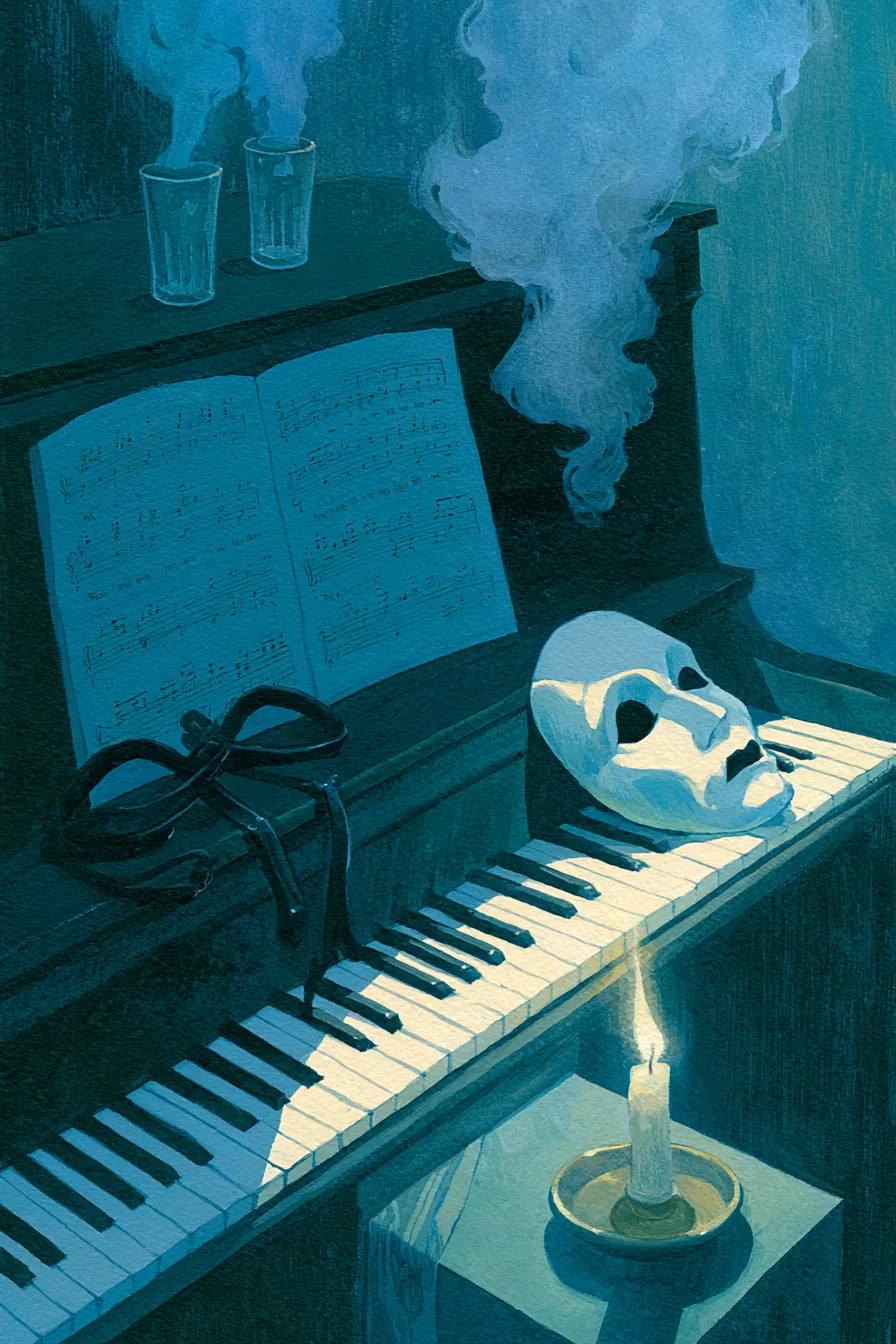
The brick room was the brick room. On the music desk of the Bechstein was the score of Night Shanghai, the third verse open; on the second crate the leather case with the passport; on the third crate the lacquer box with the diary; at the foot of the cot a folded wool blanket. The lamp on the small table by the piano was at the second wick. The candle in the brass dish at the keyboard ledge had been lit. At the stool was Feng Sheng — in the porcelain mask, the gloves, the grey wool coat, the white shirt — playing the bridge of the third verse at the major third the score had opened at.
He stopped, stood, and turned to me.
Aliang.
Jiyuan.
He went through it once: tomorrow at half past nine, the Pathé studio, Mendelsohn, the three pressings. Teddy at half past four, Mr. Sá at half past two in the morning, Liang at the second cup of tea at half past nine. The Sikorsky at half past two. The afternoon coastal at the customs jetty at half past five on the morning of the twelfth. The North-China Daily News at the corner of the Bund at half past five on the afternoon of the eleventh with the typed transcript. The Hongkou station at the second corner of Boone Road at the eight o'clock on the evening of the eleventh. I said yes to each. The yeses were small. The yeses were dry. The yeses were what one said to the small unhurried voice of a man who had been keeping the count of nine for me at the Bechstein for fourteen months.
Aliang. Listen. You have set the plan. You have set every step. I have been at the steps for the count of five weeks.
Yes.
Aliang. You will not survive it without me visible to you.
I said nothing.
The candle in the brass dish on the keyboard ledge held its small wick. The lamp at the small table held at the second wick. The grey wool coat hung on the porcelain at the seam where the porcelain met the white shirt at his collar. I had been, for fourteen months, the singer at the stool at two feet from him. I had been, for fourteen months, the singer who had not asked. I had set the asking at the inside seam of the silver gala qipao, behind the brother's letter, where the asking would stay.
He reached up and set his right hand at the leather strap behind the left ear. He untied the knot Madame Anya had taught him in 1935 — the small flat surgeon's knot Anya had learned from a French naval doctor in 1934 because the knot did not, under perspiration, slip. The knot came undone. He set the strap on the music desk of the Bechstein, and he set the porcelain mask on the music desk on the score of Night Shanghai, where it laid a shadow over the bar of the third verse. He stood facing me.
The face of Lu Jiyuan, in the brick room under the Paramount at the corner of Yuyuan and Bubbling Well at quarter to eleven on the Tuesday evening of the ninth of November of 1937, was the face of Lu Jiyuan.
The face of Lu Jiyuan was a face of two coasts.
The right side of the face was the unmarked side. It was the shape of a man of twenty-nine at the candle. The brow was even. The cheek was the cheek of a man of twenty-nine. The jaw was clean-shaven by the razor of Mr. Hu the carpenter at three that afternoon. The corner of the mouth was the corner. It was the face of the man who had sat in the classroom of the visiting professor of harmony from Hamburg, who had corrected his voice-leading; the face of the man who had played the bandstand piano on the song he had set in the warm contralto of a French Concession blues singer; the face I had, over fourteen months of Friday lessons at the candlelight, almost known.
The left side of the face was the other coast. The left side was a country at the shore. The burned skin had laid down, from the temple to the jaw, a keloid in the shape of a country. The keloid was raised, and the colour of weak tea, and it set a ridge that went down to the jaw the way the coastline of a country went. The coastline set an isthmus of unscarred skin two centimeters from the lower lid. The isthmus was the isthmus. The eyelid was thickened; the eye beneath it was intact. The corner of the mouth on the left side had been drawn upward by the burn, into the expression of a half-smile that was not a smile.
It was the face of a man who had been at the ceiling of a lane house at Zhabei at half past four on the second Saturday of February of 1934, who had there set down the burden of saving An Wenjing, and who had, in the third week of December of that year at Dr. Morancy's parlor, taken up another.
The face was the face.
I did not flinch, and I did not perform the not-flinching. I had been preparing not to flinch for fourteen months, in the small bathroom of the lane house at Hongkou and in the mirror at the vanity at the dressing room and against a brick wall behind the second arcade, the way a singer prepares the breath at the rib for the bridge of a song she has not yet been allowed to sing. The preparation, this evening, was the preparation. I crossed the brick room and set my right hand at the coastline on the left side of his face. The coastline was warm. It was the skin of a man of twenty-nine that the burn had made. I moved my hand to the isthmus. The isthmus was the thinnest strip of unscarred skin between the keloid and the lower lid, a narrow band of plain ordinary cheek the burn had not, in 1934, taken. I set my forehead at the temple at the top of the coastline. The temple was warm. He said nothing.
I set my lips at the corner of the mouth on the left side, the side the burn had drawn upward, and kissed it. Then I set my lips at the corner of the mouth on the right side and kissed it. He wept, without sound. The tears on the left went the way the coastline went; the tears on the right went the way a tear on the cheek of a man of twenty-nine went. I set my right hand at the keloid and held it there, and he set both his hands at my back.
Aliang.
Jiyuan.
Aliang.
Now I have seen your face, I said. Ask me again whether I will do this.
For the count of nine he did not say anything. At the third tick he nodded. He did not ask.
I set my hand at the side of his head where the coastline began. Jiyuan. Listen. And I gave it back to him, plainly: the face of Lu Jiyuan was the face of Lu Jiyuan, the face of the man at the Bechstein, the face of the man who had set down the burden of An Wenjing at the ceiling on the second Saturday of February of 1934 — the face I had seen. To each he said yes. I would not sing without him visible to me. Tomorrow at half past nine at the Pathé studio he would be at the booth, and not behind the porcelain. Mendelsohn would know, and would say nothing.
Jiyuan. We have forty-eight hours.
Forty-eight hours.
Forty-eight hours to the eight o'clock.
Forty-eight hours to the eight o'clock.
He set his right hand at the isthmus of unscarred skin between the keloid and the eye, his thumb at the pad of it. I am visible, he said.
Yes.
He leaned down and set his mouth at my forehead — the corner of his mouth on the left side that the burn had drawn upward, and the corner on the right, both against my forehead. I closed my eyes and said, in the voice of a Suzhou-born singer of twenty-three, in the brick room under the Paramount, in the arms of a man whose left fourth finger had no second joint and whose face was the face:
Aliang.
Aliang, he said.
Lu Jiyuan.
Shen Aliang.
Forty-eight hours.
Forty-eight hours.
We stood like that for a long while in the small dark of the second wick. The candle in the brass dish at the keyboard ledge held. The lamp on the small table held. Above us, two floors above, the Paramount at quarter past eleven on a Tuesday evening had begun its third set, and the small low above-the-head sound of the Filipino brass section had come down through the brick — a Cuban number Jimmy King had been folding into the third set since August, with the small dry trumpet at the second bar and the muted double bass at the fourth. The sound came down through the sprung floor of the Paramount and the second floor of the kitchen and the cold-storage room and the forty-two steps and into the brick at the West wall and out of the brick at the music desk and into the silence of the brick room, where it became, by the third bar, no longer a Cuban number but a memory of a Cuban number — the way every sound in the brick room became, by the third bar, a memory of what it had been on the floor above.
I thought, with my forehead at his temple at the top of the coastline, about the count of times I had heard him through the brick from the floor above. I had been singing on that floor for five years and three months. I had been hearing him through the brick for fourteen months. The first hearing had been on a Friday in September of 1936, when I had been on the bandstand at the second song of the second set, and the small dry rasp of a fountain pen capping itself two floors below had, by a small accident of acoustics, come up the freight shaft and made itself audible at the bridge. I had not known, on that Friday, what the sound was. I had thought it was a cricket in the second arcade. The sound had been him. The cricket had been him. The brick had been carrying him to me, in the small slow way of brick, since September of 1936. I had been listening, in the way of a singer who did not know what she was listening to, for fourteen months.
I said, against the warm of the temple at the top of the coastline, I have been hearing you since September.
He said, I know.
I said, Through the brick.
He said, I know. I have been hearing you back.
The Paramount above us moved into the second bar of the Cuban number. The double bass was muted at the fourth. The brick carried it down.
He led me, after a while, to the cot. He sat. I sat. The cot was the cot. He did not put the mask back on. He did not put the gloves back on. The left hand at the cot was the left hand with the distance of the missing second joint at the fourth finger and the small clean smoothness at the first joint above the air. He set the hand at the grey blanket at my hip in the small careful way he had set it at the second Sunday of August, so that the missing joint lay against the bone of the hip and not against the soft of the abdomen. The consideration was the consideration.
I lay down with him. We did not, that evening, sleep. We lay with the breath at the four counts in and the six counts out. The bridge of the third verse held in my head at the major third, and held in his right hand at the small unconscious tap of the fourth finger against my hip — the second tap at the second measure, the half-step rise at the third — and the room held the two of us and the count of forty-eight hours that was, by the count, the count.
At a quarter past midnight he sat up. He took the porcelain from the music desk. He set the strap behind the ear. He did not knot it. He held the strap loose against the collar of the shirt, the way a man held a strap he intended to take off again in five minutes. He went to the Bechstein. He sat at the stool. He set the score at the music desk, with the porcelain to the right of the score, and he played the bridge of the third verse one more time, in the major third, slowly, the small half-step rise at the third measure held the half-count he had heard in his head for nine months and had not, until tonight, played at the half-count he had heard.
I sang from the cot.
I sang the bridge.
He played. I sang. The brick room at the hour of half past midnight held the bridge.
He stopped at the last chord. He set both his bare hands at the keyboard, palm-down, for the count of nine. The left hand had the small clean smoothness at the first joint above the air. The right hand had the callus at the pad below the thumb.
He turned at the stool.
He looked at me.
The face of Lu Jiyuan was the face of Lu Jiyuan.
The candle on the wall ledge had burned to the third mark. The mask lay on the score. The face was the face. I set the candle out.