Chapter Thirty-One — The Studio
Thursday the eleventh of November, evening.
The station at the third floor at the second corner of Boone Road and the alley was the station of the Japanese radio.
The building was a four-story red-brick at the second corner of Boone Road and the alley in Hongkou, requisitioned in the third week of August of 1937 by the Imperial Japanese Navy from the tea-house at the third floor, the print-shop at the second floor, and the boarding house at the first floor. The teahouse proprietor had been an old man of seventy-one who had set the second tea at his second table for forty-two years; he had not been seen since the eighteenth of August. The print-shop had been Mr. Chen the printer of Zhabei's brother-in-law's; the brother-in-law had at the time of requisition stood at the third doorway of the third floor and asked, in his Wuxi Mandarin, what was to become of the boxed type at the second wall. The marine of twenty-one at the doorway had not understood the question. The boxed type was at a small kerosene pyre at the alley four hours later. The boarding house tenants had been told, in writing, by the second consulate clerk at Wuhan Road, that they had until midnight on the second Friday of August. They had left.
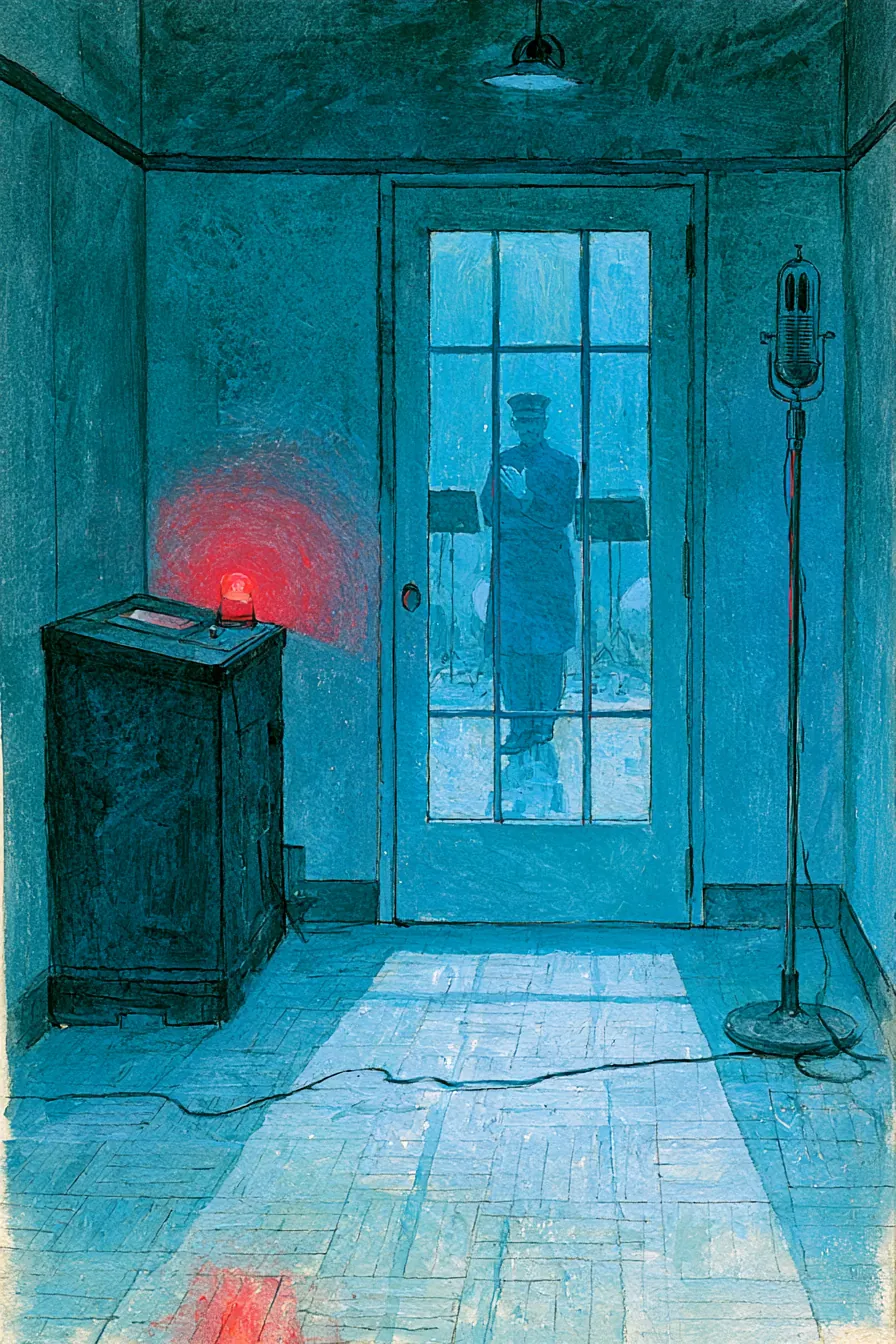
The recording room was on the third floor at the East end — forty-two feet by twenty-two feet, with a maple floor laid in 1924 and a plaster ceiling at nine feet. The RCA microphone stood at the East wall on its stand. The conductor's stand was at the South wall, three feet from the microphone. The rhythm section's bandstand was at the North wall, nine feet from the conductor's stand. The glass-paned door to the control room was at the West wall.
The control room had at the East end of the control desk the transmitter; at the West end the telegraph key; at the South end the red broadcast light.
The gallery was at the second wooden door at the North wall, nine feet behind the recording room.
The gallery, at five minutes to eight on the evening of the eleventh of November of 1937, had at the first row three journalists.
Teddy Harmsworth of the North-China Daily News was at the first chair, in the rumpled white linen suit. Mr. Ellsworth of the Shanghai Mercury was at the second chair, in the brown wool suit of the third week of October. Mr. Hagedorn of the L'Echo de Chine was at the third chair, in the dark blue serge suit and the pince-nez at the nose of an L'Echo de Chine journalist of forty-eight. Mr. Hagedorn had a small notebook on his lap, in which he had been writing, for the count of nine minutes, in his small careful French shorthand.
The second row of the gallery was empty. The chairs were the small folding wooden chairs the station had bought in the third week of August at the corner of Nanjing Road for two silver dollars apiece, from a furniture dealer who had not asked who would be sitting in them. No second-row audience had been invited. The marine of twenty-three at the door at the foot of the stair had told Mr. Lopes of the cargo line club, who had come up at quarter to eight with a folded note from Mr. Du, that the gallery was for accredited press only. Mr. Lopes had handed over the note and gone back down.
The control room had at the control desk the Chinese engineer Mr. Chen Daming.
Mr. Chen Daming was forty-one. He had been the Chinese engineer of the Japanese radio station at Hongkou since the third week of August of 1937, when the building had been requisitioned. He had been, before that, the second engineer at the Pathé studio at Avenue du Roi Albert under Mendelsohn. He had taken the Hongkou job because the Pathé studio could not, in August, keep all its engineers; and because the woman in the bed at the third floor at the French Hospital — the woman he had not yet known the name of — had, on the corner of Avenue Joffre and Rue Bourgeat on the third of August, set down her hat-box and taken his son of nine in her arms.
I knew the story by the third time Pearl had told it to me, in a different version each time. The version Pearl had told the last week of her life, in the bed, was the version that mattered.
Mr. Chen Daming had been at the alley with his son of nine, who had been bleeding at the head from the blow of a Settlement police constable at the corner. Mr. Chen Daming had been bleeding from the mouth.
Pearl had been at the corner of Avenue Joffre and Rue Bourgeat on her way back from the Hong Xiang tailor. Pearl had set down her hat-box. Pearl had taken Mr. Chen Daming's son in her arms. Pearl had set Mr. Chen Daming at her rickshaw. Pearl had taken Mr. Chen Daming and his son to the French Hospital at the corner of Avenue Joffre and Rue Lafayette. Pearl had paid the bill of thirty-two silver dollars for the stitches at the head of Mr. Chen Daming's son. Pearl had not given her name.
Mr. Chen Daming had learned the name from Sister Marie-Claire at the desk, who had recognised Pearl from a Pathé record sleeve on the desk of the second-floor parlor. Mr. Chen Daming had not, in nine years, seen Pearl again.
He had, on the desk at the control room of the Japanese radio station, received a folded note Pearl had dictated to the Portuguese boyfriend Mr. Sá at the bed at the third floor at the East end of the French Hospital on the morning of the twentieth of September.
The note, in the Portuguese boyfriend's Macanese hand in pencil, said:
Mr. Chen. Pearl Bai Zhu of Ningbo asks one favor. The inaugural broadcast of the second Thursday of November at eight. The third verse. Hesitate the order to cut. Forty seconds. — Bai Zhu, with love.
Mr. Chen Daming had set the folded note in the inside pocket of his blue serge jacket. He had kept the folded note for fifty-two days. He had read it, in those fifty-two days, perhaps thirty times. He had not, in those fifty-two days, decided.
He decided at five minutes to eight on the evening of the eleventh of November of 1937, when the small dry weight of the folded note at his inside pocket became, in the second second of his deciding, the weight of a thirty-two-silver-dollar hospital bill, the weight of a son of nine who had grown to a son of nine and a half, the weight of a woman in a bed at the third floor at the East end who had died at fourteen minutes past three on the morning of the fourth Tuesday of September with the round still in her hip and the older-sister thing still in her teeth.
The weight was the weight.
I was at the microphone of the RCA at the stand.
I had on the silver gala qipao Mr. Hong Xiang had cut me in May of 1937. I had on the chignon at the nape with three steel pins and the small silver pin Pearl had given me at my eighteenth birthday in 1933. I had on the chrysanthemum pin Mr. Du had set at my hair at half past seven, with the small dry nod of a man who had decided, at the third hour of his consideration, not to interfere. I had on no jewellery except the small silver bracelet from Auntie Lin at the wrist.
The silver gala qipao had at the inside seam: the brother's letter and the lock of hair from 1925; the folded square of cotton from Longhua; the four pieces of Pathé staff paper; the folded square of paper from 1900; the folded note from the cot at the Thursday morning; the folded cream-paper envelope from the old Japanese woman of seventy at the Paramount tea dance; the two folded notes from the Friday at the eight o'clock from the Major and Mr. Du; the folded note from the Major at the second Friday of September; the cup at the chip at the second quarter at the rim from the rubble of the fourth house; and the folded note from Pearl on the morning of the third Wednesday of September. Fifteen objects.
I knew their weight at the right hip. I had been carrying it for forty-five days.
The control room at the West end had at the control desk Mr. Chen Daming and the Major.
The Major had on the uniform of the Imperial Japanese Navy in the winter weight of December. He had on the decoration of the Imperial Japanese Navy's Order of the Sacred Treasure at the breast. He had on the small flat expression of a Major of the Imperial Japanese Navy who had decided, at half past ten on the night of the tenth of November after reading the typed transcript Teddy Harmsworth had taken to the North-China Daily News, that he would, on the evening of the eleventh of November, be at the control room.
He looked at me through the glass-paned door at the distance of nine feet. I looked at the Major through the glass-paned door. The Major set his right hand at the breast. He bowed.
I did not bow.
The bow of a Major of the Imperial Japanese Navy in a control room at the second corner of Boone Road on the evening of the eleventh of November of 1937 was the bow of a man who had, by the third week of October, understood that the third verse would, at some hour, go out. The bow was the bow of a man who had decided to be the man at the control room when it went. The bow was not the bow of a man who had asked me, in April, to come on Wednesdays at three with Persian tea, and had asked me, in August, to come to a back room at the third floor of the Wuhan Road consulate, and had asked me, in September at the second Friday, to consider whether I might let him love me. The bow was the bow that came after those three askings had been refused, three times. The bow was the bow a man who had been refused gave when the refusal had been final.
The Major set his right hand at the red broadcast light. He looked at Mr. Chen Daming. Mr. Chen Daming set the telegraph key at the head of the transmitter. Mr. Chen Daming set the wire-relay to Manila by way of Hong Kong at the switch.
The Major said, into the intercom, in his Mandarin: Miss Su.
He said: Eight o'clock. Are you ready. I have read the typed transcript Mr. Harmsworth has taken to the North-China Daily News.
I did not say anything for the count of nine.
He said: I have known since last night at half past ten. I will let you sing. I will let you sing because I will not, on this evening, be the man who stopped you. I will, at the hour of the second bar of the third verse, give the order to cut. I will, at the hour, give the order because I am required to. I will, at the hour, give it in the voice of a Major who has been told by his orders to give it. I will not be the man at the switch. I am at the control room. I am at the control room because I am required to be. And because I am at the control room on this evening of my own deciding.
The red broadcast light at the South end of the control desk came on.
Mr. Chen Daming set the switch.
Jimmy King at the conductor's stand lifted his hand. He set the downbeat. The Filipino brass section set the opening — Mr. Almeida at the trumpet, with the small dry New Orleans inflection at the second bar; Mr. Lopes at the alto; Mr. Ferenc at the muted trombone. The rhythm section set the rhythm.
I set my breath at the interval of four counts in and six counts out.
I sang the first verse.
The first verse went out at the corner of every parlor and the corner of every dance hall and the corner of every café at the wireless on the Hongkou frequency. The first verse went out at the wire-relay to Manila by way of Hong Kong. The first verse went out at the Telefunken at the corner of the editor's desk at the L'Echo de Chine in the second column where Mr. Hagedorn's colleague had set the Telefunken at the Hongkou frequency at half past seven. The first verse went out at the second Telefunken at the second-floor parlor of the cargo line club where Mr. Lopes's cousin had set the dial. The first verse went out at the third Telefunken at the third-floor apartment of Madam Khorshid above the Persian-tea shop at the corner of Bubbling Well and the third arcade. The first verse went out.
I sang the second verse.
At the second bar of the third verse Mr. Chen Daming set his right hand at the folded note.
He set both his hands at the control desk.
He did not move them for the count of forty.
The red broadcast light at the South end of the control desk stayed on.
I sang the third verse.
I sang the first measure: Constable Wu of the Settlement police at Beihai Road, the seventh name of the firing-order at Longhua on the twelfth of April, 1927.
I sang the second measure: Mr. Hong Jingming's nephew at Sun Ya, on the payroll of the Japanese consulate at Wuhan Road since 1934.
I sang the third measure: Inspector Hua of the Songhu Garrison Command, who gave the order to set the kerosene at the third printing press at Zhabei on the second Saturday of February of 1934.
I sang the fourth measure: Mr. Chen the printer of Zhabei, who set the list at the rear of the third printing press at the hour.
I sang the fifth measure: The Japanese consulate clerk in the dark coat at the corner of the lane.
I sang the sixth measure: Mr. Pang the Yu Garden tea-house proprietor, who sold the rear room to the Settlement police inspector at the rickshaw at the lane.
I sang the seventh measure: Mr. Yao Sanye of the Green Gang.
I let the note sit where the composer had set it. I did not hold it. I sang the bridge of the third verse.
At the bridge Mr. Chen Daming moved his right hand at last.
He set the switch at the telegraph key at the head of the transmitter. The red broadcast light at the South end of the control desk went out. The wire-relay to Manila by way of Hong Kong had, by the second clerk at the Hong Kong relay station, already taken the third verse at the second by-second buffer the Pathé syndicate had set up in 1933 for the rebroadcast of European opera. The third verse had, by the second buffer, gone out.
The rhythm section set the close. The Filipino brass section set the final chord. Jimmy King lowered his hand.
The recording room at the hour of seven minutes past eight on the Thursday evening of the eleventh of November of 1937 was the recording room.
The Major looked at me through the glass-paned door. I looked at the Major through the glass-paned door. The Major set his right hand at the breast. He did not bow. I did not bow.
The Major said, into the intercom: You are relieved. Go home.
Mr. Chen Daming stood. He took his hat from the wooden hook at the door. He set the folded note from the inside pocket of his blue serge jacket at the table at the control room. He left the folded note at the table. He went out.
The Major set his right hand at the door of the recording room. He opened it. He came into the recording room. He went to me at the microphone.
He said: I have two MPs at the stair. I am required to take you to 76 Jessfield Road. I will take you there myself. You should have let me love you.
I looked at the Major. I had, for eleven months, learned to read the small specific way a man looked at me from the second seat of table eleven on a Friday at the eight o'clock. The Major, this evening, looked at me with the small flat expression of a man who had been refused three times. He was not, this evening, asking. He was, this evening, taking.
I said: You should not have asked.
He did not say anything for the count of nine.
I set the microphone at the stand. I took my grey travelling coat from the wooden hook at the South wall. I put it on over the silver gala qipao. The qipao at the inside seam carried fifteen objects. The coat over the qipao carried, at the inside pocket, the small wax paper that had once held four almond biscuits and now held nothing but the small dry shape of them.
I looked at Teddy Harmsworth in the gallery at the first row.
Teddy had set his pencil at the notebook. He had not, at any moment of the third verse, lifted the pencil. He looked at me. I nodded at him. He nodded at me. I knew, in the second of his nodding, that the typed transcript was, at this hour, at the corner of the Bund at the North-China Daily News in the hand of Mr. Williams the night editor of the third desk; that the second column of the afternoon edition of Friday the twelfth of November would have, by half past two on the Friday afternoon, gone to press; that Teddy would be, by half past nine on the morning of the Saturday, at the customs jetty at the pier on the Empress of Asia with the first small black disc in his leather portfolio under the rumpled white linen suit. The country had heard the seven names. The country, by Monday, would be unable to un-hear them.
The Major said: Come.
I went with the Major to the stair at the East end.
The two MPs of the Imperial Japanese Navy Special Landing Force were at the stair. They had on the dark khaki of the Force in the winter weight, the small white star at the cap, the leather belt with the holster at the right hip and the truncheon at the left. They were perhaps twenty-four. They did not, at the stair, meet my eye. They did not, the Major had instructed at the second moment of his giving the instruction at half past four on the afternoon of the eleventh, meet my eye.
I went down the stair with the Major and the two MPs.
At the door at the second corner of Boone Road and the alley I looked back up the stair at the third floor. The plaster ceiling at the third-floor landing had a small water stain at the second corner. The water stain had been there, by Mr. Chen Daming's word at half past seven, since the third week of October when the roof had leaked at the second night of the third typhoon. The water stain was the water stain. The third floor was the third floor. The country had the seven names.
I went out to the black sedan at the curb.
The sedan was the black sedan from the Pathé studio at half past nine. The driver was the driver of thirty-five. The back seat was empty. The Major opened the door of the back seat. He set his right hand at the small of my back, the smallest pressure of a hand that had not, in eleven months at table eleven, ever set a hand at the small of my back. The pressure was small. The pressure was the pressure of a man taking a woman, on the evening of the eleventh of November of 1937, to 76 Jessfield Road.
I sat. He sat beside me. The two MPs sat at the second seat behind us at the small fold-down. The driver of thirty-five did not look in the mirror.
The sedan took me to 76 Jessfield Road.
As the sedan turned at the corner of Boone Road and Sichuan Road N. I looked at the Major. The Major did not look away.
The Major said, in a voice the driver of thirty-five would not, by the small acoustical fact of the second screen, hear: Miss Su. I am required to take you to 76 Jessfield Road. I am not required to remain. I will not remain. I am sorry.
I said: Yes.
He said: I will, at the second hour after the second hour of the third officer's questioning, leave the building. I will, by the second night, send a third officer in my place. The third officer will be the third officer.
I said: Yes.
He said: I am sorry, Miss Su.
I said: Goodbye, Major.
The sedan turned at the second corner. The city outside the window was the city at the eight o'clock at the evening of the eleventh of November — the gas-lamps at the Bund three blocks East at the chain of small yellow flames the lamp-lighter at the hour of dusk had set in the order he had set them, the small flat above-the-ear sound of the Filipino brass at the cargo line club two streets South where Mr. Lopes's cousin had set the Telefunken at the Hongkou frequency, the small dry sound of the second tram at the corner of Avenue Foch. The city had heard the third verse. The city, at this hour, did not yet know what it had heard. The city would, by Saturday morning at the North-China Daily News, know.
The Major did not look away.
I did not look away either.