Chapter Thirty-Five — The Take
Saturday the twelfth of March, 1938.
The doorman at the EMI building on Boundary Street in Kowloon does not call me Miss Su. He is a Cantonese man of fifty in a green serge uniform with a brass cap, and at half past nine on this Saturday morning he opens the door for me and Jiyuan and says, in his Cantonese: Madam. Sir.
The Cantonese morning at Boundary Street has a particular brightness it does not have in the lanes of Mongkok five blocks South. The street is broad. The plane-trees are younger than the plane-trees of Avenue Joffre, planted in 1928 by the second Public Works Department of the colony, with the small pale plates at the bark only just beginning to lift. The sun comes over the third roof of the building opposite at quarter past nine on a March morning in the way it has been doing for fifteen years, and the sun is, in March, the gentle yellow of a Hong Kong winter at its last week. The colony, this morning, smells of yi mein from the noodle stall at the corner of Sai Yee Street and of jasmine from the small back-garden of the Sœurs de Saint-Paul-de-Chartres at the third corner. The jasmine of Hong Kong is, in March, a different jasmine from the jasmine of the Sun Sun department store at the second counter on the third floor in Shanghai in May. The jasmine of Hong Kong has a small sweet ginger undertone. I have been learning, in the four months since we came in on the Lyngen at the second pier of the Star Ferry, the small particular differences of the jasmine.
I have on the navy poplin Mr. Lin packed into the suitcase at the customs jetty at half past four on the thirtieth of November. I have on no jewellery but the small silver bracelet from Auntie Lin at the wrist, and the chignon at the nape with three steel pins and the small silver pin Pearl gave me at my eighteenth birthday in 1933. The left wrist has, since quarter past four on the second Tuesday of December at the French Hospital in Causeway Bay, carried the pin Dr. Liu set. The pin at the wrist is the pin.
Jiyuan has on the blue serge suit Dr. Stanisław left at the wooden hanger in the back room of the safehouse on Rue Bourgeat, the grey wool overcoat, the grey felt hat at the brow. He has on no porcelain mask. He has on the face.
He has on, also, the small careful look of a man who has, since the second week of December in the parlor of Dr. Liu at Causeway Bay, been told that the round at the rib of the eleventh of November had taken the third joint of the second rib and would not, in the second year, fully heal. The third joint is the third joint. Jiyuan has learned, in the four months since, the small particular way one stood up from a chair when the third joint did not, in any month, take a deep breath without giving the small sharp catch of a third joint. He stands up at the doorman's door at half past nine with the small particular way. The doorman of fifty does not notice. The doorman of fifty has been a doorman of fifty for thirteen years and has, by trade, learned the discipline of not noticing.
The doorman does not look away. He says, Sir, and Jiyuan says, Good morning, and we go in.
The lobby of the EMI building has a small green tile floor laid by Mr. Chan the tile-setter of the second lane of Sai Yee Street in 1931, and a small carved teak desk at the corner where Mr. Tang the porter of forty-six sits with a ledger and a small dark wireless on the second shelf playing, very softly, the Hong Kong frequency at the third hour of the morning. The wireless is at the second song of the Shanghai shidaiqu set the colony's stations have, since the second Friday of January, been playing in rotation — Zhou Xuan's Selling Flowers from 1935, in the warm contralto of the second pressing. Mr. Tang looks up. He says, Miss Su, and I say, Mr. Tang, and we go to the lift.
The lift is the small wood-panelled cage of the EMI building lifts of 1931, with the small brass arrow above the door at the second mark. We take it to the second floor.
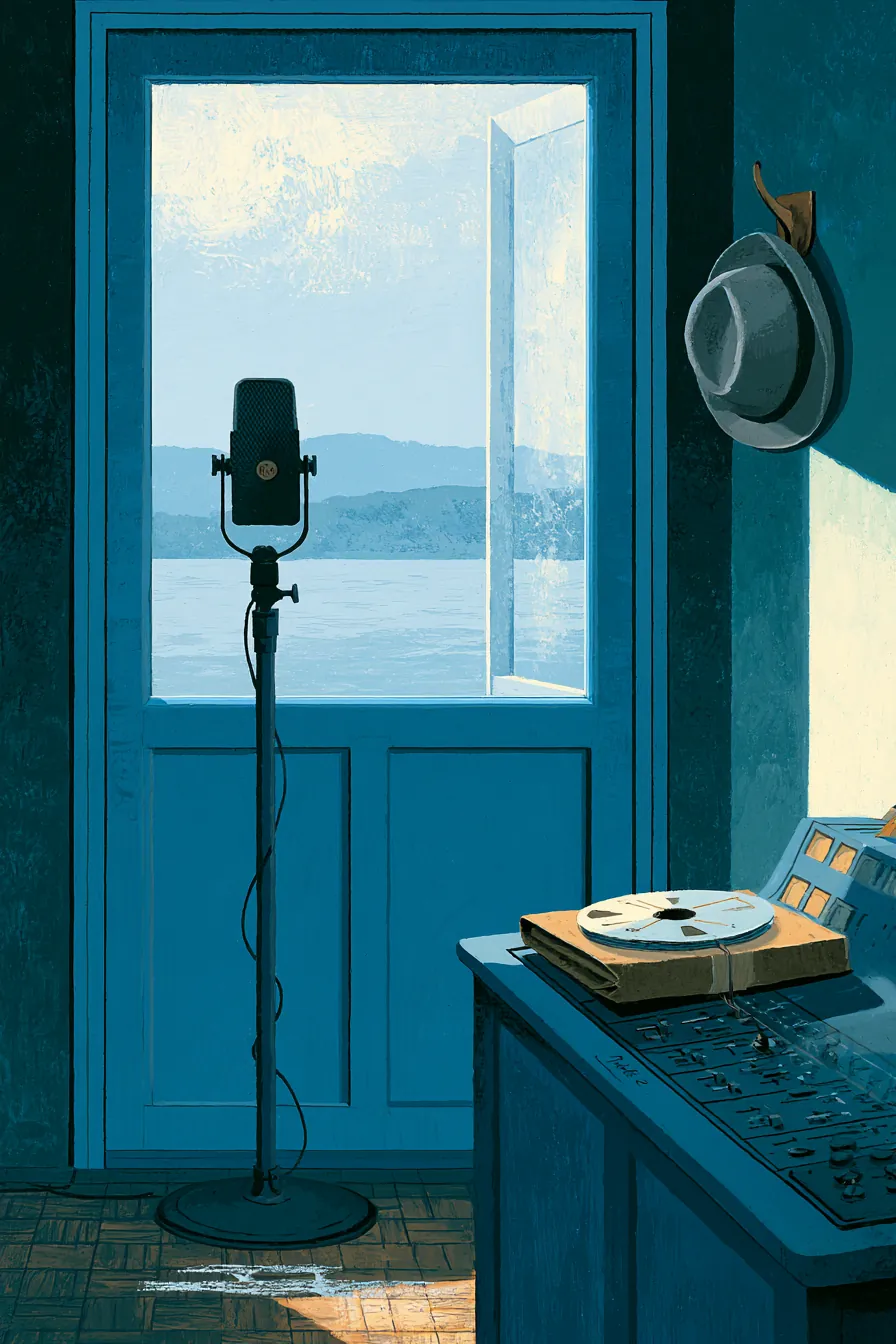
The recording studio is on the second floor: the recording room at the East end, with the RCA microphone on its stand at the centre and a Steinway upright at the South wall; the control booth at the West end, with the console and the English engineer Mr. Henley. Mr. Henley is forty-one, in a grey wool waistcoat over a white shirt, no jacket, the round wire glasses of an EMI engineer at quarter to ten on a Saturday morning in Kowloon. He has been an EMI engineer at the Hayes press at the second floor since 1925, and at the Kowloon studio since the second Monday of August of 1937 when EMI Hayes had sent him out to set up the second Hong Kong satellite. He came on the Empress of India with his wife of thirty-eight and his daughter of twelve. The daughter is at the second form at the Diocesan Girls' School at Mongkok. The wife is at the second branch of the British YWCA at Causeway Bay.
Miss Su, he says, in his English Mandarin. The Mandarin is the second Mandarin of a man who has been learning it for eight months. The Mandarin is good. The Mandarin is not native. The Mandarin is the Mandarin of an Englishman who has been listening at Mr. Tang's wireless every morning for thirty minutes.
Mr. Henley.
We set the roll at ten. Two takes.
Two takes.
Go.
I take off the grey wool coat Mr. Lin packed and hang it on the wooden hook at the door of the recording room. Jiyuan hangs his grey felt hat on the hook beside it and goes into the control booth and sits at the chair beside Mr. Henley and looks at me through the glass. At fifteen feet through the glass the face of Jiyuan is the face of Jiyuan — the coastline on the left side, the isthmus, the corner of the mouth on the left, the unmarked right. The face is visible to me. I nod at him; he nods at me.
I stand at the RCA. I set my breath at four counts in and six counts out. I set my mouth at nine inches from the microphone — the distance Mr. Henley has, at half past eight, marked on the parquet of the recording room floor with a small piece of white chalk, the same way Mendelsohn marked the parquet of the recording room at the Pathé studio at Avenue du Roi Albert at half past eight on the morning of the eleventh of November. The distance is the distance. The chalk is the chalk.
Mr. Henley sets the roll at the head of the recorder and presses the red button, and the red light at the corner of the booth comes on. Take one, he says into the intercom.
I sing Night Shanghai — the first verse, the second, the third. In the third verse, at the seven measures, I sing the seven names. At the bridge I let the note sit where the composer set it. The note is the note. I finish the song.
Take two, says Mr. Henley, and I sing it again. He sets the second take, listens at the headphones to the second verse and the third and the bridge and the seventh measure and the final chord, then sets the headphones down. All right, Miss, he says into the intercom. We've got it.
Yes.
He presses the stop button, and the red light goes out.
I set the microphone at the stand, walk across the recording room, and go through the glass-paned door into the control booth. Jiyuan stands and turns to me. I set my right hand at the coastline on the left side of his face. The coastline is warm. Mr. Henley looks at my hand at the coastline, says nothing, and goes back to the console. I set my left hand at the corner of the mouth on the left side that the burn had drawn upward, and I say, in my Shanghainese:
Jiyuan.
Aliang.
Tomorrow we find a piano with a better D-flat.
For the count of nine he does not say anything. Then he laughs — the way a man of twenty-nine laughs at a Saturday morning in a recording booth in Kowloon at a singer of twenty-three who has set her left hand at the corner of a mouth a lane-house ceiling at Zhabei drew upward in 1934.
The laugh is the first laugh.
I set my forehead at his and close my eyes, and he sets his bare right hand at the side of my head. The side of my head is warm. The laugh settles. I think, in the second after the laugh, that the laugh is the second sound I have not heard him make in fourteen months at the brick room and four months at Hong Kong. The first sound was the small dry sound of a pen capping itself on a wooden desk on a Friday in September of 1936. The second sound is this. The list of sounds he has made for me — the breath, the silence, the small clean smoothness at the first joint of the fourth finger, the count of nine, the small dry rasp of the pen — has, this morning, taken its second laugh. The second laugh is the second laugh.
Mr. Henley takes the master tape from the recorder, sets it in the cardboard sleeve at the corner of the console, and takes a pencil from his waistcoat pocket. Miss, he says. The label. Your name. The name for the sleeve.
I look at Jiyuan. Jiyuan looks at me.
S. Wanyin, I say.
S. Wanyin, says Mr. Henley, and writes it in his English: S. Wanyin / Night Shanghai / Take 2 / 12 March 1938 / EMI Kowloon.
I take the pencil from him and write, beside S. Wanyin, in my own hand — in the Shanghainese romanization of a name a singer of twenty-three had kept behind her teeth where the city could not reach it: Shen Aliang.
Mr. Henley reads it. Miss Su, he says. I have written on the sleeve S. Wanyin. You have written Shen Aliang. The pressed record will carry S. Wanyin, at the EMI press at Hayes, by the third Saturday of April. The name Shen Aliang will be on the master tape, in the sleeve, in the vault at Hayes.
Yes.
Miss Su.
Shen Aliang.
Miss Shen.
Mr. Henley.
Thank you. And then: Tomorrow. The piano with the better D-flat.
Jiyuan laughs a second time. The second time is shorter than the first — the small dry second laugh of a man who has, at the second laugh, learned how to laugh again. I will, in the four years and seven months he is, by the small dark mathematics of the third joint at the second rib, given to me after this morning, hear the laugh another two hundred and four times. I will, on the second Tuesday of November of 1942 at a small back room of a house at Wanchai with the second cot at the West wall, hear the last laugh. The last laugh will be the last laugh. The first laugh is this morning.
I hand the pencil back. Jiyuan takes his grey felt hat from the hook, I take the grey wool coat from the hook beside it, and we go out. We pass Mr. Tang at the desk. Mr. Tang nods. The wireless at the second shelf has, by the second song, moved to He Ri Jun Zai Lai in the warm contralto of the third pressing. The Cantonese man of fifty in the green serge uniform with the brass cap opens the door. Madam. Sir, he says, in his Cantonese.
Thank you, I answer, in the Cantonese the hairdresser on Nathan Road has been teaching me on Tuesdays since the third week of January. The hairdresser is a woman of forty named Mrs. Wong, who has been teaching me the small particular phrases of a Hong Kong morning at the second basin while she sets the second wave in the second chignon at the third pin. Jiyuan says, Thank you, in the second tone of a Cantonese he has been learning, also on Tuesdays, with Mr. Cheung the tea-merchant at the second arcade of the corner of Boundary Street.
Have a good day, the doorman says.
Yes.
We go out into the Kowloon morning. The sun at Boundary Street at quarter to eleven is the sun. The street has, this morning, the small particular Saturday-morning movement of Kowloon at March — the second milk cart at the third corner, the small bell of the noodle man at the corner of Sai Yee Street, the second tram of the third line going North toward Sham Shui Po. I set my right hand at Jiyuan's left arm, at the sleeve, three inches below the rib where the round of the Imperial Japanese Navy MP at the rear yard of 76 Jessfield Road on the afternoon of the twelfth of November of 1937 went in.
Aliang, he says.
Jiyuan.
He tells me about the piano. By his walking yesterday at the corner of Nathan Road and Jordan Road, he found it second-hand at Mr. Choi the piano-tuner's shop at the corner of Jordan Road and Temple Street: a Bechstein upright of 1929, and Mr. Choi says it has, at the D-flat, the D-flat. The Bechstein of 1929 was, by Mr. Choi's word at the second Tuesday, the piano of a Russian widow of the Tsarist line who had come from Harbin in 1933 and had set the piano in a small flat at the corner of Nathan Road and had played, every Sunday afternoon at four, the second nocturne of Chopin and the third nocturne of Chopin, in that order, on the Bechstein. The widow had died in February of 1938. The flat had been let. The piano had come to Mr. Choi.
I have been listening to Jiyuan describe pianos for fourteen months. I have not, in those fourteen months, ever heard him describe a piano he had found by walking. The walking is, in the second second, a small new fact. The walking is a fact a man with the third joint at the second rib does not, in any month, do without consideration. He has, on a Friday afternoon of March, walked the corner of Nathan Road and Jordan Road and the corner of Jordan Road and Temple Street and found the second Bechstein for me. The walking is the walking.
Tomorrow at half past two we will go to Mr. Choi, and we will buy it, and find a flat with an East-facing window, and set the Bechstein in the corner, and sing.
Yes, I say — the woman who has, in her own hand, set her name at the label on the master tape.
The doorman has not called me Miss Su, and has not called me Wanyin. He has called me Madam, and I answer to it, because at this hour it is the word for a woman of twenty-three on Boundary Street in Kowloon on a Saturday morning in March, walking with the man whose left fourth finger has no second joint, whose face is the face the ceiling of a lane house at Zhabei made in 1934, whose laugh in the control booth has been the laugh. The word madam is not my name. The name is in the cardboard sleeve, in the vault at Hayes. The name is Shen Aliang.
I take Jiyuan's hand. He takes mine. We go South toward Jordan Road and Mr. Choi's shop, where the Bechstein upright of 1929 has the D-flat.
We walk slowly. We walk at the second pace of a man with the third joint at the second rib and a woman with a pin at the left wrist. We pass the noodle stall at the corner of Sai Yee Street. The noodle man — a man of forty-eight in a white tunic and a small white cap — has been at his stall since five in the morning. He looks at us. He nods. I nod back. The yi mein in his second copper bowl steams in the small flat morning light. The smell is the smell of a Hong Kong morning. The smell is not the smell of jasmine eau de toilette at the second counter on the third floor of the Sun Sun department store; it is not the smell of cold-storage at the second basement of the Paramount; it is not the smell of the rubble at the corner of the second lane in Hongkou. It is a different smell. It is the smell of yi mein at a noodle stall in Kowloon at a quarter to eleven on a Saturday morning in March of 1938. The smell is the smell.
We turn the corner.
The sun comes through the small gap between the second roof and the third roof of the buildings opposite, and falls on the pavement at the second slab. The slab is warm under the small thin sole of the leather shoes the small shop on Granville Road has been making for me since the second Tuesday of December. The warmth comes up through the leather. The warmth is the warmth of a March morning in Kowloon.
The sun at Boundary Street at quarter to eleven on the Saturday morning of the twelfth of March of 1938 has been the sun.
The sun has been warm.