Chapter One
The Lamp Goes Out
Yongchong Ward, Chang'an. The third hour past dusk.
The drum tower had spoken twice — once for the closing of the avenues and once, fainter and further west, for the wards beyond the Vermilion-Bird road — and after that the city held its breath in the way cities do when the watchmen are running new rosters. Wanjun stood in her own courtyard in the dark, because in her own courtyard the curfew was not a crime. She had been reciting, under her breath, the seventh chapter of the Tang Code on widow's property rights. She was on the sub-clause concerning a widow's dowry in the case of childlessness when the runner came.
He came over the back wall. That was the first thing she noticed. The front gate had been bolted at the fifth section of the dusk-drum, as the law required and as Nanny Zhou liked, and a man arriving by gate at this hour would have meant fists and a Gold Bird patrol and a small administrative disaster. The man over the wall meant Pei.
He landed badly. He was perhaps sixteen. He was dressed in the dun-grey of a Censorate runner, and the grey had been dusted further with something pale and gritty — millet flour, she thought, from the sleeves; he had cut through a granary court — and his right shoe was wet to the ankle. He had crossed at least one of the night-canals between his master's office and her wall. He straightened with the careful dignity of a young man trying very hard not to limp, and he said, in the formula they all used because Pei made them learn it:
"My lord has been observing aloud, mistress."
"At this hour."
"At this hour."
"Then come in," she said, "before the patrol observes you."
Nanny Zhou was at the kitchen doorway already, a horn lamp shielded in her sleeve. The old woman did not look at the runner; she looked at Wanjun, with the small flat displeasure she used for any caller after the second drum.
In the writing-room Wanjun lit the second lamp herself and motioned the boy to a stool. She did not offer tea. He was not here long enough for tea.
"Speak," she said. "The soliloquy."
He had it memorised. They always did. Pei dictated his summons in soliloquy form because, in soliloquy form, no order had been given and no order could be cited. A censor who did not give orders could not be impeached for giving them. The boy folded his hands inside his sleeves and began, in the slightly singing voice of a man reciting another man's words.
"My lord observes that a house in the northwest quadrant of the Western Market, in Liquan Ward, has gone quiet. My lord observes that the gate has not been opened to the market crier since yesterday's noon-drum. My lord observes that the household concerned is of the An clan — the middle-tier branch, the one with the spice-warehouse against the south wall and the painted screen that came in from Bukhara six years ago. My lord observes that the sabao's deputy has been to the gate. My lord observes that the sabao's deputy will not say what he saw. My lord observes that the Office of the Western Market has not yet been informed and may not be informed before the seventh hour of tomorrow. My lord observes" — and here the boy paused, because the line was Pei's signature — "that a certain widow holds a license which has not been formally rescinded, and that the license, by its terms, extends to the drafting of deathbed petitions, and that a Daoist nun may pray over a corpse in any ward of the city without question, and that these two facts have not, to my lord's knowledge, ever before been observed together in a single woman."
He stopped. He was breathing hard from his canal-crossing and from the small effort of remembering Pei's syntax. Wanjun did not move.
"How many," she said.
"My lord did not say, mistress."
"How many did the sabao's deputy see."
"My lord did not say."
"What did your lord not say first?"
The boy thought about it. He had a face that did not yet hide its thinking. "He did not say one," he said. "I have run the An family before, mistress. They were five households on that street, but the middle-tier branch is — was — only seven people. My lord did not say one. He said the household."
She nodded once. Seven, then. Or near it. A household was the word for a roof, not a person, and Pei was a man who did not use household when patriarch would do. Patriarch implied a single death and a clean line of succession; household implied a sweep.
"And the Office of the Western Market," she said. "Why does my lord believe the Office will not hear of this until the seventh hour tomorrow."
"He did not say, mistress."
"Then I will say it. The Office has been told already and instructed to be slow. By whom, your lord did not say, because your lord does not yet know. Go back. Tell your lord I have observed his soliloquy, and that I will be at the third gate of Liquan Ward before the dawn drum, and that I will require — " She stopped. She did not require anything. Pei would have anticipated, and to enumerate her requirements aloud was to permit the runner to remember her enumerating them. She said instead, "Tell him I have observed."
The boy bowed. He paused at the door.
"Mistress," he said. "The deputy who came to the gate — the sabao's man — he was not Sogdian."
"What was he."
"Tujue, mistress. Half Tujue. Big." He thought. "He had a knife sheath under his coat, on the left, where a clan bodyguard would carry one. My lord told me to tell you that as well, but not in the soliloquy."
"Your lord wishes me to know that the An clan has already sent its own man before sending for me."
"Yes, mistress."
"Then go," she said. "By the front. Walk like a drunk. If a patrol stops you, you are my brother's groom returning from the wineshop and you will be flogged for it and pay your fine in the morning. Do not, under any circumstance, go back over a wall."
He grinned, which she had not expected. "Yes, mistress."
He went. Nanny Zhou unbolted the gate for him, scolded him out into the lane, and bolted it again. Wanjun heard the bar drop into its iron cradle and the old woman's slippered tread coming back across the flagstones and then, a moment after, the kitchen door, and then nothing. The lamp on the writing-desk burned in its level small way.
She did not sit down.
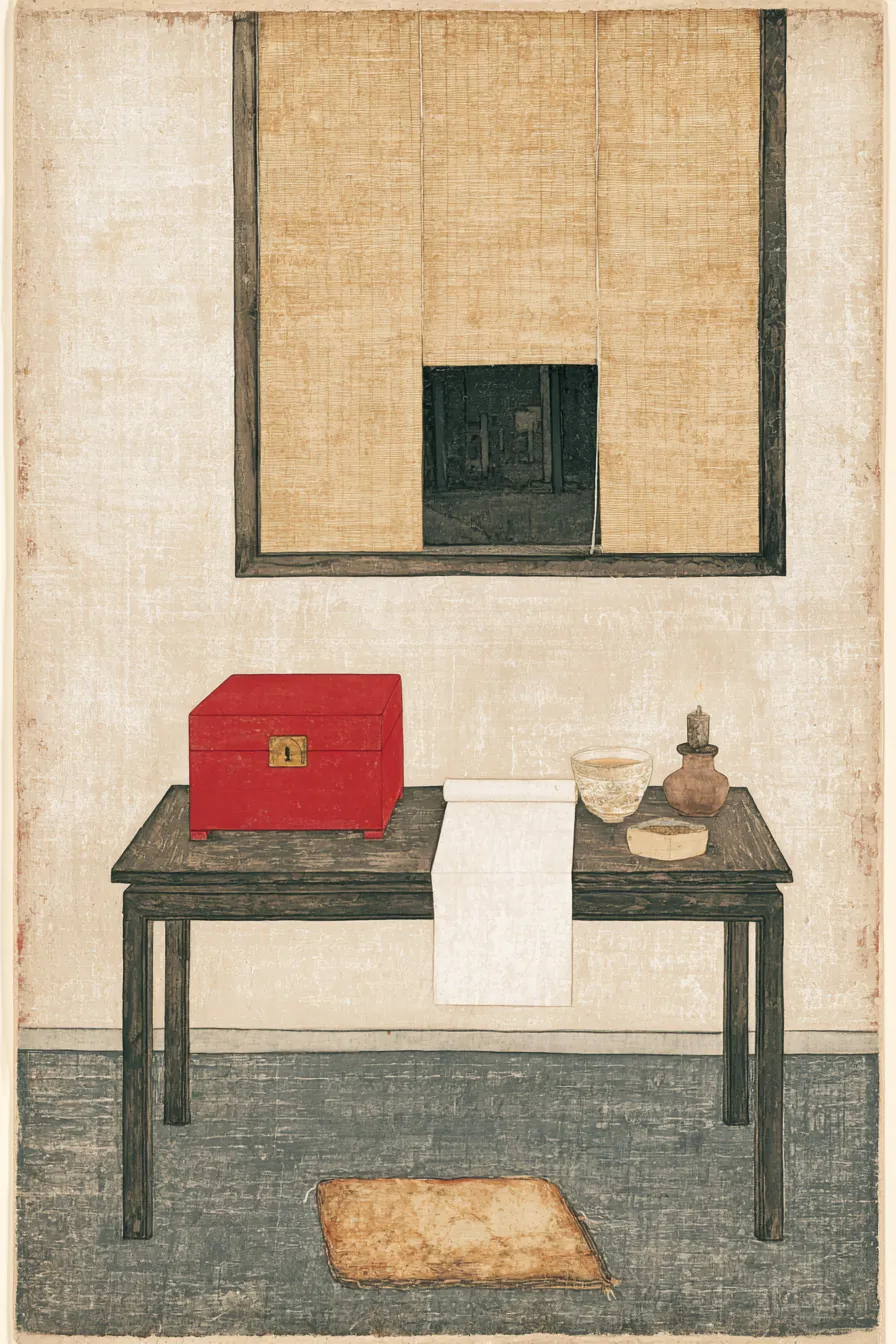
On her desk was the lacquered letter-box, black with a single red plum-blossom inset, a craftsman's piece from the Eastern Market that her husband had ordered the autumn before he died. He had told her, lightly, that it was for letters he had not yet decided to send. He had used the future tense. He had been very careful, throughout their marriage, with his tenses. The box had come back from Hexi with the body. The body had come back sealed in lacquer. She had not been permitted to open either.
She did not open the box now.
She stood looking at it instead, with the runner's soliloquy still arranging itself in her head: quiet since yesterday's noon-drum. Twenty-eight hours. A household of seven behind a closed gate for twenty-eight hours, in the height of late spring, in a quarter where the cellars smelled of saffron and damp leather and the wineshops at the next corner sold fermented mare's milk to the Sogdian camel-drivers who would not drink anything else. The bodies would already be telling a story that nobody had yet asked them to tell.
She walked once round her desk. Then twice. Then she stopped at the south wall, where she had hung, in lieu of decoration, a wax tablet on which she sometimes drew. She took the tablet down. She wiped it. She drew, from memory, the northwest quadrant of the Western Market.
She had never set foot in any of it. She had read every customs filing the An clan had submitted in the last seven years; she had read every petition for warehouse expansion; she had read the sabao's annual roster of registered fire-tenders, three years running, in her late husband's study after he had brought them home for a circuit report she had not been meant to see. She drew the gates. She drew the angle of the spice-warehouse against the south wall. She drew, in the smaller hand she used for things she was not sure of, the painted Bukharan screen, which the youngest An wife had been said, in a Pingkang anecdote two springs ago, to use for hanging her wet linen. The Bukharan screen had cost two thousand strings of cash. The Bukharan screen had been used for wet linen. She had filed that as a fact about the household before she had ever needed it.
A household of seven. Father, two adult sons, two daughters-in-law, a nephew, an aunt — that was the roster the customs office had on file for tax. There was probably a servant girl as well; there usually was; the An clan kept Tang girls in the kitchens, because Tang girls would touch the pig the Zoroastrian household would not. A girl would not be in the seven. A girl might be the only person who had walked out.
She put down the stylus.
"Nanny," she called. Her voice came out lower than she had meant it. "Barley tea."
"Mistress, the lamp."
"Bring two cups."
"Mistress, you have not eaten."
"Bring two cups."
The cups came. Nanny Zhou set them down without comment, and stood behind Wanjun's left shoulder, and did not go. Nanny had been with her since she was eleven. Nanny had buried her own husband at twenty-six, her own son at thirty-one, and her own father at forty-four; Nanny had, in some private accounting, decided that Wanjun's grief was an underfed creature she would not allow to die in her kitchen. Nanny was here because she had heard the boy come over the wall, and she had heard Liquan, and she did not approve.
"A widow," said Nanny Zhou, to the air, "does not go to a Sogdian's house at the fifth watch."
"I am not going at the fifth watch. I am going at the dawn drum."
"It is the same thing, mistress."
"It is not. The fifth watch is illegal. The dawn drum is the law."
"It is the same thing to your father's people."
"My father's people," said Wanjun, very gently, "are not in this room."
Nanny Zhou did not move. She had a way of not moving that was louder than most women's shouting. Wanjun took the second cup of barley tea and put it into the old woman's hands, and closed the old hands around it, and held them closed for a moment.
"It is seven people, nanny. Possibly seven. In a closed house. For twenty-eight hours."
"They have their own watch. They have their sabao."
"The sabao's deputy came to the gate and would not say what he saw."
The old woman absorbed it. Her face did the thing it did when she was about to give in: a small shift around the mouth, a settling in the shoulders. She had been, before she was a nurse, a barber's daughter in Bianzhou, and once in Bianzhou she had seen a sealed compound opened in the wrong week. Nanny Zhou had not yet, in eighteen months of widow's mourning, told Wanjun what to do. She kept that authority in reserve. She used it on shoes and on barley tea.
"Mistress," she said. "A house with the doors closed too long becomes a tomb."
Wanjun looked at her.
"Yes, nanny," she said. "I know."
She let the old woman go. The kitchen door closed; the courtyard was quiet again; the lamp on the writing-desk burned in its level small way. Wanjun went back to the wax tablet. She added, at the bottom, the sabao's fire-temple, and the alley to the camel-yard, and the second-class wineshop where Madam Khorshid's youngest cousin worked — Madam Khorshid would have heard already, Madam Khorshid would have heard within two hours of the deputy's visit, and Madam Khorshid would not have sent word, because Madam Khorshid did not interfere in An-clan business unless the An clan paid her to. Wanjun underlined the wineshop. She would walk past it tomorrow.
Then she sat down.
She sat for a long time, looking at the lacquered box. The plum-blossom inset was a kind of red her husband had liked: not the imperial vermilion of the Daming gates, not the dark blood-red of a censor's seal — a fruit red, a Pingkang red, the red of a fan held shut. He had owned three fans of exactly that color, and she could draw all three from memory, and she would not, tonight, draw any of them. She put her hand flat on the lid of the box. She did not lift it.
She thought, instead, about the runner.
She thought about the runner's right shoe, which had been wet to the ankle.
Pei's office was in the Censorate building, in the Imperial City, two blocks north of the Daming Palace's southwest gate. To reach her courtyard in Yongchong Ward, the runner had crossed nine wards south and three east. He had said he had cut through a granary court — the millet flour on his sleeves. There were three granary courts on that route. None of them had a canal. The night-canals in this part of the city ran east-west along the second and fifth great avenues, and the boy's path from the granaries to her wall did not cross either.
His shoe had been wet on the right only.
She had grown up in magistrates' residences. She had stood, at eleven, in her father's outer hall while the Bianzhou clerks took depositions, and she had learned to listen to the small things men did not know they were saying: the pause before a name, the wrong hand on a cup, a shoe wet on the wrong side. A man who had crossed a canal would have both shoes wet. A man who had stepped, in a hurry, into a single shallow puddle would have one shoe wet — and the puddle would have been on his weaker side, because a tired man falls inward, toward the leg he is favoring, and the boy had been favoring his left. Right shoe wet, left leg favored: the puddle had been on his right, which meant he had been moving south-to-north when he stepped in it, which meant he had not come from Pei's office at all. He had come from somewhere south.
South of her courtyard, in Yongchong Ward, there was nothing but the back lane and, beyond the back lane, the small unnamed alley that ran behind the houses to the next ward's wall. There was a single open drain at the mouth of that alley. The drain was on the east side of the alley, which would put it on the right of a man walking north into her courtyard. The drain leaked in spring. It was, in fact, leaking now: she had registered the smell three nights running, faintly, when the wind turned. The puddle would be there.
The runner had not come from the Censorate. He had come from somewhere in the southern wards, or from her own back lane, and he had taken the trouble to cross her back wall as if he had come from Pei.
She sat very still.
It was possible that Pei had sent the boy by a longer route — through the southern wards to lay a false scent for any watcher. Pei did this sort of thing. It was also possible the boy had stopped for a noodle and a piss and ended up with one shoe in a drain. It was possible.
She did not believe it.
She believed, instead, that there were now two summons-runners. The boy in her writing-room had said his soliloquy in the correct Pei syntax — my lord observes, my lord observes, my lord observes — and behaved, in every visible respect, exactly as a Pei runner should behave. He had also told her, unprompted, that the sabao's deputy was half-Tujue and carried a left-side knife sheath. He had told her this at the door, not in the soliloquy. Pei had spent fifteen years in the Censorate not telling people things, and a bodyguard's knife sheath was precisely the sort of detail he would have buried for nine more soliloquies before he let it surface in front of a young widow he was officially not sending into a foreign-quarter death-house.
The boy had been sent by Pei to deliver the soliloquy. The boy had been paid — somewhere along the southern route, where his shoe had got wet — to deliver one extra sentence.
She did not yet know by whom. She did not yet know whether the extra sentence was a kindness or a baited line. A bodyguard with a left-side knife sheath was, after all, a useful image to plant in the head of a woman about to walk into a Sogdian house at dawn; she would look, now, for that bodyguard, and if the bodyguard was there she would trust the source of the extra sentence, and if the bodyguard was not there she would not, and either way the source would know which of her she was. The extra sentence was a sounding.
She had been pinged.
She lifted her hand from the lid of the box.
Twenty-eight hours, she thought. Seven dead, possibly. A sabao's deputy who had seen something and would not say. A Censorate that would not be told until the seventh hour tomorrow. A runner with a wet right shoe who had come, by way of the southern wards, with one sentence too many. And, somewhere in this map, an interested party whose first act on hearing of the deaths had been not to dispatch his own men to Liquan Ward but to plant a question in her ear.
She stood up. She put on her travelling coat. She did not, yet, take down her Daoist gray; the gray was for the dawn. She put the wax tablet in her sleeve. She picked up the second lamp, lit it from the first, and walked to the back of the courtyard.
The drain was where she had thought it was. The puddle was where she had thought the puddle would be. She bent, in her good coat, and looked. There were two sets of footprints in the soft edge. One was small — the boy's, going both ways. The other was larger and ribbed: a soldier's boot, the kind the Gold Bird Guard wore on night patrol. The soldier had stood a long time. The cigarette of clay where his weight had sunk was the shape of a man waiting.
She straightened. She put out the lamp. She stood in the back of her own courtyard, in the dark, and listened.
Somewhere two wards over, a dog barked once and stopped. Somewhere east, a watchman's clapper. Closer — much closer, at the mouth of the back lane — the small dry sound of a man clearing his throat.
She walked back to the writing-room.
She sat down again. She did not, this time, look at the lacquered box. She took up her brush instead, and on a clean slip of paper, in her own hand, she wrote three lines.
One: the An household has been quiet since yesterday's noon-drum. Possibly seven dead.
Two: the Office of the Western Market has been bribed to be slow.
Three: a Gold Bird guardsman waited in my back lane while a runner who was not entirely Pei's came over my wall.
She read the lines back. She held the paper to the lamp.
It caught and curled and turned to soft black flakes in her bowl. She watched until the last edge had gone, and the lamp had eaten the last of it, and the bowl was only ash. Then she rose, blew out the lamp on the desk, and stood for a moment in the courtyard, looking up at the corner of black sky her walls allowed her.
The drum tower would sound the dawn at the fifth watch. She had four hours. She would not sleep them, but she would lie in her own bed for the look of the thing, because Nanny Zhou would be awake at the kitchen door and would know if she did not.
At the kitchen door, on her way past, she stopped.
"Nanny."
"Mistress."
"Tomorrow, when I have gone, do not open the gate. Not to a runner, not to a friend, not to a Sogdian, not to a censor. Bolt it at the dawn drum and do not open it until I am back."
The old woman did not turn from her brazier. "Mistress."
"And nanny."
"Mistress."
"If I am not back by the dusk drum, send word to Lady Wei Wan in Anyi Ward. Tell her the box on my desk is hers."
There was a small clatter — Nanny Zhou had put down a copper ladle, very carefully, on the brick — and then the old woman said, in the level voice she used for funerals, "Yes, mistress."
Wanjun walked back across the courtyard to her sleeping-room. She lay on her bed in her travelling coat. She thought, with the clarity she always had when she had decided a thing and not yet done it, about the Bukharan screen and the wet linen and the painted lacquer of the front gate of the An compound, which her father, in 744, had described to her by accident in three sentences over supper; about the saffron in the spice-cellars and the small flat dread which was not, after all, dread — which was the thing she had felt every time, for eighteen months, when she had stood in her own courtyard reciting other people's law to herself because she could not yet decide to read the only letter that mattered.
The thing she had felt was not dread. It was attention. The attention had finally been asked a question it could answer.
A house, she thought, with the doors closed too long becomes a tomb.
She turned her face to the wall. She closed her eyes.
She did not sleep. She waited for the dawn drum, and she counted, in her head, the doors she had not yet opened, beginning with the lacquered box on her desk and ending with the gate of a Sogdian house in Liquan Ward, where a sabao's deputy had come to look and not spoken, and where, somewhere in the cold spring courtyard, seven people had not yet been asked what they had seen.
Outside her gate, on the other side of the lane, the Gold Bird guardsman who had been waiting in her drain shifted his weight. She heard him do it. She did not move. She did not, yet, decide what she would do about him. She filed the sound. She added it to the room she kept for sounds of men outside walls.
The room was already crowded.
The drum tower, four hours away, did not yet sound.