Chapter Twenty-Two
All Is Lost
The arrest of Nanny Zhou was by the middle of the fifth watch of the morning of the fifteenth day.
It came not by the Gold Bird Guard and not by a runner of the Censorate but by two prefectural patrolmen of the third southern arcade. They had been told at the dawn drum that the old maid at the inner door of the third house of Yongchong had set, mid-fourth watch of the night before, a small wrapped half of a dried fish at the upper edge of the wall of the lane behind the empty house of the old Mistress Lin — a household exceeding, by the prefect's reading, the Tang Code's chapter on after-dusk-drum movement.
The wrapped half of the dried fish was not Nanny's.
The half had been at that wall at the noon-drum of the eleventh day, when Wanjun had set it for the stray cat. The cat had eaten it. Nanny had not, in the four days since, set foot in the inner stretch behind the empty house.
The patrolmen knocked at the front gate the middle of the fifth watch.
The patrolmen took Nanny Zhou at the inner door of the third house in the unhurried civic taking of an old woman who had not, in fifty-seven years of service to two generations of the Cui household, set foot on the avenue of Yongchong at the third watch of any night of any week of any year.
They walked her to the gate at the half-pace of an old woman who had been on her feet since the second watch and who carried, at the inside of her left cuff, the cotton wrap of the dried-fish half.
The patrolmen did not look at her.
Wanjun walked to the gate in her grey.
The patrolmen did not look at her either.
"Mistress Cui."
"Patrolman."
"The old mother is summoned. By the prefect's reading of the public-paths regulation of the Tang Code's chapter twelve at the dusk drum yesterday, the old mother is to be received at the prefectural office of the third southern arcade mid-sixth hour. By the prefect's clerk's reading mid-fourth watch, the lady will not, mid-sixth, be at the prefect's office. The lady will, at the noon-drum, be permitted to deliver, by the prefectural clerk's quiet hand at the receiving-bench of the prefect's office, a brief slip of intercession."
"Patrolman."
"Mistress."
"At the noon-drum."
"At the half, mistress."
He inclined his head a finger's width. He took the old woman, at her left elbow, at the slow patient half-pace of two patrolmen taking an old woman of the third house of Yongchong Ward to the prefectural office of the third southern arcade midway into the fifth watch of the morning of the fifteenth day.
Nanny did not turn at the gate.
Leaving, she did not look at Wanjun.
She set her right hand at the inside of her left cuff, at the cotton wrap of the dried-fish half, and walked out at the half-pace of the patrolmen without, in walking, turning.
\ \ \*
Wanjun closed the gate.
She walked, in the inner court, to the cistern.
The cistern the fifth watch half-spent was at the upper third of its standing — the rain of two nights ago had not been drained, the eastern lip's mossed corner unchanged since the dawn drum yesterday.
She set her hands at the rim.
She held them there.
At the rim she did not allow her hand to register the patrolmen's taking. The testimony was the testimony of an unnamed informant at a wineshop of the second southern arcade at the dusk drum of the fourteenth day — set, by the small clean idiom of the prefectural-grade Han hand at the slip's lower edge, by the senior clerk of Lu Zhongming's office. The same senior clerk who, at the dawn drum of the fifth day, had set an unsigned fold in her own hand into the senior clerk's filing.
The testimony was a forged testimony.
She kept his reckoning of the testimony at the rim of the cistern.
She set her hands flat against the cold stone.
The cold of the stone was the cold of the morning the fifth watch at its midpoint.
She held the cold against the inside of her chest for perhaps twenty breaths.
She did not weep.
She rose.
She walked, in the grey, to the writing-room.
At the writing-desk she did not, lift the lacquered letter-box.
She drew a clean slip from the inner drawer. She wrote, in her own careful hand:
Vice-Censor. The old mother of the third house of Yongchong is, in the heart of fifth of this morning, in the keeping of the prefectural office of the third southern arcade on the matter of an after-dusk-drum movement of a half of a dried fish at the inner stretch of the lane behind the empty house of the old Mistress Lin mid-fourth watch of the night of the fourteenth day. The fish was not the old mother's. The fish was at the wall in front of the stray cat of the corner at the noon-drum of the eleventh day. The matter, by my reading at the rim of the cistern the middle of the fifth watch, is the senior clerk of your colleague's office. The lady asks, by the quiet hand of the deputy at the tea-house behind the Censorate, the intercession of Vice-Censor Pei Yu at the noon-drum.
She rolled the slip. She tied it.
She walked to the inner door.
She had not, this morning, a kitchen-boy. She had Nanny. Nanny was, midway into the fifth watch, at the front gate of the prefectural office of the third southern arcade.
She walked, in her grey, to the corner of the lane behind the bakery of the second eastern ward, where the bakery's apprentice — a Han boy of perhaps fourteen who had, in the past sixteen months, run six small private errands for the lady of the third house at the careful idiom of the inner door at the dawn drum and the dusk drum — was, the fifth watch half-spent, setting the second-day flour-sacks at the gate of his master's shop for the morning carter.
She set the rolled slip in his hand.
"Master."
"Lady."
"The tea-house behind the Censorate. The deputy at the second alcove. By mid-sixth hour. Wait. Bring the answer."
"Lady."
He inclined his head a finger's width.
He set the flour-sack down.
He left at the run.
\ \ \*
The answer came the seventh hour at its midpoint.
It came by the apprentice. He was at the inner door at the half-quarter past the seventh nearing its midpoint, with the small folded slip of Pei's careful private hand at the inside of his left cuff. He had not, in the waiting, eaten.
She gave him a small piece of bronze coin and a half of a steamed bun.
He inclined his head.
She unfolded the slip at the writing-desk.
Lady. The old mother will be at the noon-drum at the gate of her own ward by the quiet hand. The matter at the prefect's office of the third southern arcade, by my reading mid-sixth, was the carelessness of a junior patrolman who had been at the second cup of the third southern arcade's wineshop at the dusk drum of yesterday. The matter, by my hand at the dawn drum of this morning, has been re-filed by the prefect's senior clerk in the slow patient idiom of a misdated patrol-record. The old mother will, by the prefect's clerk's discretion, not be summoned a second time on the matter. The senior clerk of my colleague's office, lady, has set, at the dusk drum of the fourteenth day, the slip in the wineshop. The slip, by the senior clerk's idiom, has been registered in the misdating. The slip is dead.
Lady. By the senior clerk's setting at the dusk drum of the fourteenth day, the senior clerk has read, at the dawn drum of the fifteenth, the picture of the lady walking the lane behind the empty house at the noon-drum of the eleventh day. The senior clerk, lady, is reading.
By the dawn drum of the second day from this morning, the senior clerk will be reading the measure of the lady's walking the back lane to the An caravanserai the seventh hour half-spent of the fourteenth evening. By the dusk drum of the third day, the senior clerk will be reading the picture of the lady's walking, this afternoon, to the third house of the lady's old maid in the inner stretch of the third southern ward.
The lady will not, this afternoon, walk to the inner stretch of the third southern ward.
Vice-Censor Pei.
She read the slip a second time.
She rolled it. She set it at the inside of her left cuff at the careful place she had set Pei's three-line slip two evenings ago.
At the writing-desk she did not, allow her hand to lift to the corner of the lacquered letter-box.
\ \ \*
Nanny Zhou came home at the noon-drum.
She came at the rear gate on the quiet hand of a porter of the prefect's clerk's house, who had walked her by the back lanes at the noon-drum.
She walked, at the gate, by herself.
She had at the inside of her left cuff the cotton wrap of the dried-fish half.
She walked, in the grey under-tunic of an old maid of a Han household of Yongchong Ward, in the slow patient half-pace of an old woman who had been on her feet for six hours.
Wanjun took her at the gate.
"Mistress."
"Nanny."
"They brought me back."
"They did."
"The fish."
"Was, Nanny, at the wall in front of the cat at the noon-drum of the eleventh day. The fish was the second half I had wrapped and set in my sleeve at the noon-drum on my walking back from the Eastern Market. I had set it at the wall before I came in the gate. The cat had eaten it at the third watch of the night."
"Mistress."
"The fish, Nanny, was mine. The fish was not yours."
The old woman did not, at the gate, lift her eyes.
She set her hand at the inside of her left cuff.
"Mistress."
"Nanny."
"At the prefect's clerk's house mid-sixth hour."
"Yes."
"They sat me at the kitchen yard at the second bench."
"Yes."
"They gave me a bowl of millet rice and a cup of barley tea."
"Yes."
"They did not, mistress, ask me a question."
"They did not."
"They held me at the second bench for six hours."
"They held you."
"At the noon-drum a porter came to the bench. He walked me back, mistress, by the back lanes."
"Yes."
"Mistress."
"Nanny."
She held her eyes for three breaths.
She did not give her a word.
She turned at the gate and took Nanny Zhou by the right elbow in the slow patient idiom of a daughter taking her own old maid at the elbow at the inner door of the third house of Yongchong Ward at the noon-drum of the morning of the fifteenth day.
She walked her, slow, to the kitchen yard. She set her beside the brazier, on the small wooden stool the old woman had been at for fifty-seven years. She set a clean cup of warm barley tea at her hand.
She did not lift her hand to the cotton wrap at the inside of Nanny's left cuff.
Nanny drank.
\ \ \*
Wanjun walked back to the writing-room.
She did not light a third lamp.
That afternoon she did not, sit at the writing-desk.
She stood on the desk where the lacquered letter-box had been at its corner since the dusk drum of the second evening, by the wall of the third house of Yongchong, on the corner of the writing-desk her late husband had drafted, in the autumn of 748, the second paragraph of his circuit-letter at.
She kept his reckoning of the senior clerk reading at the inside of her chest.
She held also, in the same inside, what she had kept of Nanny at the second bench of the prefect's clerk's house's kitchen yard for six hours the fifth watch at its midpoint of an unwarranted summons.
She held also, in the same inside, the weight of it of the eighth gate at the third watch of the night the lady would walk in.
She did not, on the desk, lift her hand to the lid of the box.
She set her right hand at the inside of her left sleeve, at the inside of the cuff where Pei's slip of two evenings ago and Pei's slip of this morning had both been set. She drew out the slip of this morning. She set it on the desk beside the box.
The box, on the corner of the desk, was the box.
She had not, in the eighteen months since the body had come back from Hexi, opened it.
She set her hands, palms flat, on the wood of the desk on either side of the lacquered letter-box.
She held them there.
The dusk drum sounded.
Nanny Zhou did not come to the writing-room.
She had been told, beside the brazier of the kitchen yard, that the mistress would, at the dusk drum, be at the writing-desk and that the kitchen-yard fire would, well into the dusk, be banked for the night against the cold of the rear gate.
She lifted her hands.
She set them, slow, on the lid of the box.
\ \ \*
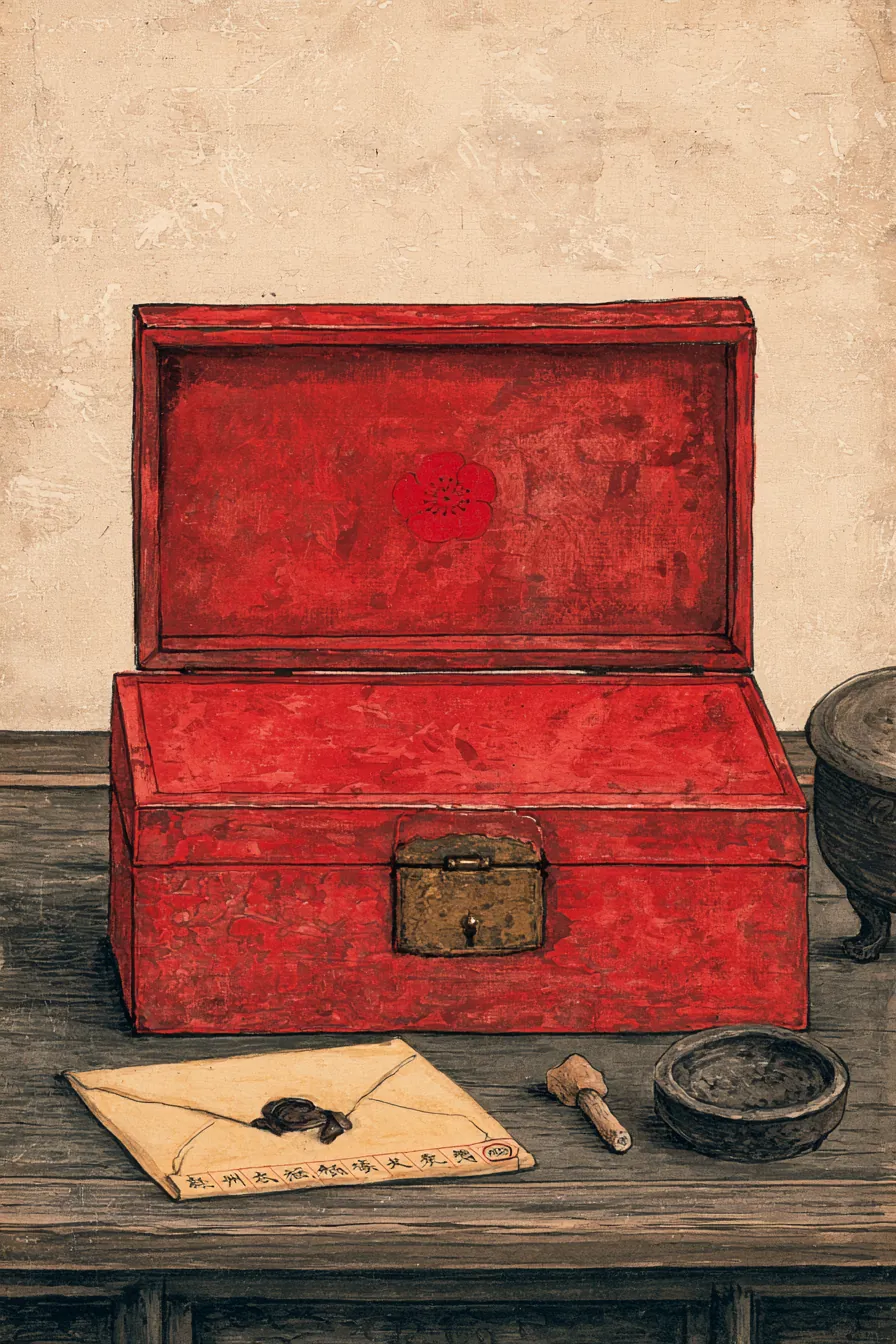
The lacquered letter-box was perhaps the length and breadth of a small Han man's hand.
It was lacquered in the vermilion her late husband had chosen on his appointment to the second tier of the Yushitai in the autumn of 747.
The lid was hinged at the upper edge by a small brass hinge.
The brass at the hinge had darkened, in the eighteen months, to the colour of an old coin.
She set her right hand at the brass at the hinge.
She lifted the lid.
\ \ \*
The lacquered letter-box held, at the upper edge of the inner padding, a small folded square of pale yellow oilcloth.
She had not, on the receiving of the box deep into the third hour of the second day after the body had come back from Hexi, opened the oilcloth.
She had, in the eighteen months, known what the oilcloth was. It had wrapped, at the autumn of 748, a small private writing-box her late husband had set into the lacquered letter-box at the morning of his departure for Hexi, against the chance that, in returning, he would have to set into it a thing he had decided not to set at his own writing-desk.
The writing-box was at the inside of the oilcloth.
That evening she did not, unfold the oilcloth.
She set, at the writing-table beside the box, the wax tablet of the four days' notations.
She drew, from the inner drawer, a small clean square of plain paper.
She set the paper at the writing-table.
She lifted the oilcloth.
She set the oilcloth on the writing-table.
\ \ \*
The writing-box was a small box of dark walnut perhaps a third the size of the lacquered letter-box.
It had a small brass hinge at the upper edge.
She set her hand at the brass.
She lifted the lid.
\ \ \*
Inside the writing-box, at the upper edge of the inner padding, lay a single folded letter on the pale yellow paper of the silk-traders of Liangzhou.
It was folded in three.
It was sealed, at the lower edge, with a small dark wax she did not recognise.
The wax had not, in the eighteen months, been opened.
The hand on the upper face of the letter was her late husband's.
She had, in the eighteen months, set her hand on the inside of her chest in the small careful idiom of a widow who had decided not, in any week, to read a letter in her late husband's hand without first deciding what reading the letter would, on the second reading, ask of her.
This evening, near the dusk drum, she set the letter at the writing-table.
She broke the wax.
She unfolded the letter at the three folds.
\ \ \*
The letter was eleven lines on the pale yellow paper of the silk-traders of Liangzhou, in her late husband's careful private Han hand. The paper had been folded into three, and the three folds were the three folds of a junior censor of the Yushitai who had set, by the unhurried idiom of his own private folding, the upper third of the paper against the middle third and the middle third against the lower third in the careful order in which the unhurried civic idiom of a junior censor of the second tier of the Yushitai folded a private letter at the writing-desk of an inn in Hexi on the night before he was to begin the return journey to Chang'an.
She read the letter.
Wanjun. By the Hexi inn at the third watch of the morning of the eleventh of the third moon of the autumn of 748. I write because by the small private reading at the second cup of barley tea past the dawn drum I have set, at the writing-desk of the inn, the slow private record of the kiln-mark of the prefectural kiln of Hexi against the customs-office filings's filings at the third arcade of the eastern wards. It runs three times the measure the kiln, by the brother of the kiln-master at the dusk drum of the eleventh, has fired. The pigment is, by the accounting, not pigment. The kiln, by the accounting, is laundering. The names, wife, are at the lower edge of this paper. Three of the names are Sogdians of the An clan of the Western Market. One is a Han merchant of the second arcade of the Eastern Market. One — and this name, wife, I have circled at the lower edge — is a name whose holding of office at the second tier of the Court of the Imperial Stables is, by my reading at the second cup, the name of the man whose hand has set the kiln-mark on the upper face of the customs-office filings of 748. He is, wife, the next chancellor. He is, by the accounting at the writing-desk of the inn at the third watch, the man whose name is the picture of the kiln. Burn this. Do not, wife, in the autumn of 748, walk on the matter. By the small private reading at the second cup, the matter stands of a man whose name will, in two seasons, be the second name at the Daming Palace. I am, wife, well. I will be at Yongchong at the dusk drum of the seventh day. Burn this paper. By the small private hand of your husband. Cui Yanzhi.
At the lower edge of the paper, in her late husband's careful private hand, the five names.
She read the five names.
The first was An Bayar — the patriarch of the An clan of the Western Market.
The second was An Datis — his eldest brother.
The third was An Lupan — the sabao's deputy of the spring of 748.
The fourth was Zhang Cong.
The fifth, set at the lower right of the paper, was circled in the small private circle of her late husband's careful private hand.
The fifth name was Yang Guozhong.
\ \ \*
She set the letter at the writing-table.
She set her right hand on the writing-table.
She set her left at the lower edge of the paper, at the circle of the fifth name.
She did not weep.
She held the letter for perhaps thirty breaths.
She lifted her right hand from the corner of the writing-table.
She drew, from the inner drawer, the small clay flint and the kindling-stick.
She struck the flint at the brazier.
She lit the small flame.
She lifted the letter from the writing-table.
She held it, briefly, at the angle the brazier's light reached.
She did not lower it to the flame.
She held it at the angle for perhaps fifteen breaths.
She lowered the letter back to the writing-table.
She set the flint and the kindling-stick on the desk.
That evening she did not, burn the letter.
She set the letter at the inside of the writing-box and the writing-box at the inside of the oilcloth and the oilcloth at the inside of the lacquered letter-box.
She did not close the lid.
She left the lid of the lacquered letter-box open on the desk for perhaps an hour.
She walked, slow, to her bedroom.
She lay at her own bed in the grey.
She did not, at the bed, weep.
She rose, in the second half of the second watch.
She walked, in the inner court, to the writing-room.
She drew the wax tablet of the four days' notations from the corner of the desk.
She set the bronze stylus at the upper edge.
She wrote, below The friend was Cui Yanzhi, two lines.
My husband knew. Anaxa knew my husband. Anaxa did not say so.
She read the two lines back.
She set the stylus down.
She lifted the wax tablet.
She held it for perhaps four breaths.
She did not erase the lines.
She set the tablet, with the lines, on the desk beside the lacquered letter-box, where the second lamp's spill reached.
She walked, slow, to the inner court.
The avenue, mid-second watch, was the avenue of curfew. Beyond her own wall the lane behind the empty house of the old Mistress Lin was the empty unhurried lane of a ward at the third watch. The Gold Bird Guard of the western quadrant was, somewhere on the avenue west of her wall, walking.
She did not, at the inner court, walk to the rear gate.
She had walked, eighteen months ago, at the third watch of the seventh night of her widowhood, into her own avenue in her grey beside the rear gate of the third house of Yongchong Ward, in the unhurried civic idiom of a widow daring the Gold Bird Guard to take her.
That morning she did not, walk to the rear gate.
She walked, instead, to the bench by the cistern.
She sat in the dark.
She held against the inside of her chest the five names at the lower edge of the paper and the circle at the fifth.
She kept his reckoning of her husband at the writing-desk of the inn at the third watch of the morning of the eleventh of the third moon of the autumn of 748, with the second cup of barley tea at his hand, setting in his own private fold what she had kept of the kiln-mark against the customs office's filings.
She kept his reckoning of his returning at the dusk drum of the seventh day.
She kept his reckoning of the body coming back from Hexi sealed in lacquer at the noon-drum of the third day of the second moon of 749.
She kept his reckoning of the lacquered letter-box on the writing-desk in the third house of Yongchong Ward for the weight of it of eighteen months.
She did not weep, nor, this morning, light a third lamp.
She rose, in her own slow patient time, and walked to the kitchen door. Nanny Zhou had set, beside the brazier, the small clay water-jar of the boiled water cooled to the inside-of-the-wrist temperature.
She drank.
She walked, slow, back to her bedroom.
She washed her face at the basin at the lower edge of the platform-bed.
She dressed, slow, in her best Daoist grey.
The dawn drum of the morning of the sixteenth day sounded at the western quadrant of the Western Market.
She lifted her head.