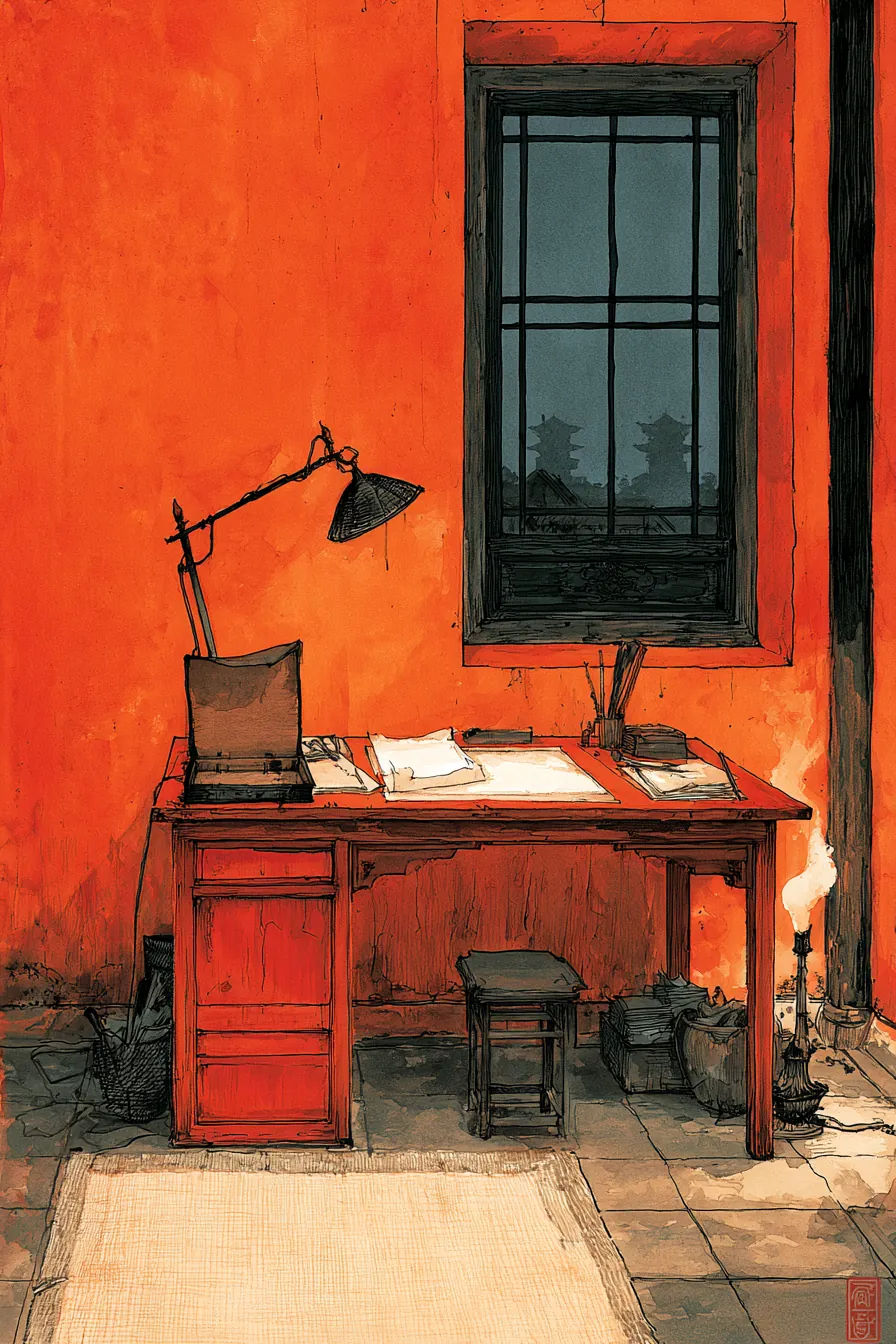
Chapter Thirty
The Lamp Goes Out
Three weeks had passed since the audience.
The rear gate of the third house of Yongchong Ward had stood bolted at every dusk drum of those three weeks. The brazier of the kitchen yard, at whose edge Nanny Zhou had set the small clay jar of the laundress's daughter on the morning of the twenty-fifth, had been banked for the night every evening since. The jar sat there still, the folded square of unbleached cotton above it, the stalk of southern willow below.
Wanjun had not, in three weeks, lifted the jar.
The late spring of 750 had been a slow late spring. The apricot at the retired-minister's wall two lanes south had finished a week into the fourth moon; the pomegranate at the inner court of the seven-doored compound she had walked through on the eighteenth had been, by the laundress's daughter's daughter at her own back gate on the morning of the third week, in its third small flowering; the swallows at the kitchen eave had set their second brood and were at the third feeding of the first chick. She had registered each of these in the small flat civic idiom in which a Daoist nun of Yongchong registered the passing of a season. She had not, in three weeks, set any of them into the wax tablet at her writing-desk.
\ \ \*
She had spent those weeks at small work. She had drafted four petitions for Pingkang clients of the second arcade and the third southern arcade — a vegetable-seller's wife on stolen wages, a barber's daughter on an unsigned contract, a weaver's apprentice on an unpaid wage, a quiet matter of silver miscounted at the Eastern Market customs bench. Into each she had folded the small private silver of a Han widow whose hand at the senior clerk's receiving-bench never varied, and the petitions had been received.
The vegetable-seller's wife had wept at her rear gate in the second week of the fourth moon, in the small flat voice of a woman whose husband had been carted east at the dawn drum of the eleventh of the third without his copper. Wanjun had set a cup of boiled water into her hand and had set, into her cuff, the small private clause of the relevant sub-section. The barber's daughter, perhaps twelve and Sogdian on the mother's side, had come at the dusk drum of the third evening with a Persian phrase her mother had taught her against grief — garmî-yi del — and had not, in the saying, looked at the ground. Wanjun had drafted her contract in the slow careful idiom of the prefecture and had not, in the drafting, registered the Persian phrase to her face. She had set the phrase, with the others, in the inside of her chest.
In the second week she had walked, mid-afternoon, to Pei's tea-house behind the Censorate. Pei had set a slip of the Yushitai on the matter of his colleague's senior clerk — the man who had forged the licence and the wineshop testimony. The clerk, by Pei's reading, had sat at his own bench for three weeks and filed nothing further against her. He was, Pei said, reading.
In the third week the Censor Lu Zhongming had sent her a single line in his careful private hand: Lady Cui. I have not yet read.
She had not answered. She had set the slip inside the lacquered letter-box, beside the husband's writing-box.
She had not lifted the lid a second time.
\ \ \*
The eleventh day of the fourth moon of 750 — three weeks and three days after the audience — was the morning of the spring caravan from Liangzhou.
It would not be the spring caravan of 751.
It would be the late departure of 750.
A Sogdian caravan-master of the second tier of the An clan — a man whose hand at the inner gate of his own compound had set no second hand into it in the eleven years since the autumn of 739, a man whose clan-sister had been at the fanyang garrison since the spring of 745 — would walk west at the dawn drum of the eleventh. In the six weeks since the nineteenth he had moved the caravan forward a year, setting the spring of 750 in the place he had once promised her would be the spring of 751.
His hand had never, in eleven years, moved that schedule. It had moved now.
\ \ \*
On the tenth day, at the dusk drum, the bakery-apprentice had brought her a folded slip in An Naxia's careful Persian-grade Han:
Lady. At the dawn drum of the eleventh, the spring caravan from Liangzhou. The late spring caravan of 750.
She had not answered. She had set the slip on the writing-desk beside the box.
The slip was in An Naxia's careful Persian-grade Han — the hand she had read first, eighteen months ago, in the small folded note of inquiry a Sogdian caravan-master had set into the rear gate's slot at the dawn drum of the second day after the body had come back from Hexi. The note of inquiry had asked, in nine flat characters, whether the widow of Cui Yanzhi would accept a small private offer of condolence in the form of three bolts of Khotanese silk for the funeral linen. She had refused the silk. She had set the note, with the carved wooden token of the third-arcade death-rite, inside the lacquered letter-box at the upper edge of the inner padding. She had not, in eighteen months, lifted the lid a second time.
She had walked, in the long grey of an evening, to the inner court, and sat at the bench by the cistern in the dark. She had carried against her chest the picture of the An caravanserai's inner gate at the dawn drum of the eleventh.
She had not wept. She had risen, in her own time, and walked back to the writing-room.
From the second cabinet behind the cistern she had drawn the long Daoist grey of an unfinished case — the grey she had worn to Lady Wei Wan, and to the rite at the brazier, and to the threshold of the An caravanserai office on the evening of the twenty-fourth. She had set it on the inner shelf and laid no further grey beside it.
She had set the wax tablet of the four days on the writing-desk, the line of the twenty-fifth at its top. She had not taken up the brush.
\ \ \*
The third hour past dusk of the eleventh day came.
The drum tower spoke twice — once for the closing of the avenues, once, fainter and further west, for the wards beyond the Vermilion-Bird road — and after that the city held its breath, the way cities do when the watchmen are running new rosters.
She stood in her own courtyard in the dark.
She was not reciting. She had not, in three weeks and three days, recited a single chapter of the Tang Code in any courtyard, at any hour.
The sky above her wall was the slow flat black a Chang'an late-spring sky took at the third hour past dusk under a half-moon — the half-moon already west of the second arcade and behind the kitchen-yard roof, the small pale strip of its passing still visible at the eaves' upper edge. Beyond the wall a Sogdian apothecary of the second southern arcade was setting his shutters; a Han bell-keeper was at the second post of his evening; somewhere west of her, perhaps two streets past the empty house of old Mistress Lin, a Persian behdin household was at the small private evening reading of the Khordeh Avesta an acolyte read at his own corner-altar.
The lacquered letter-box sat on the writing-desk in the room behind her.
It was unlocked. The lid was closed.
Inside, the husband's writing-box held his letter of the third moon of 748, folded a second time. Beside it lay the three slips of pale Liangzhou paper; below, the six bars of unmarked fanyang silver; at the bottom, the three clay jars of the second-day compound. Lu Zhongming's slip lay against the inside of the lid, and beside it An Naxia's slip of the tenth.
The small jade weight from the silk-merchant's inkstone lay on the writing-desk beside the box, the wax tablet beside the weight, and Lady Wei Wan's small clay jar beside the tablet.
Her father's bronze pin was inside the cuff of the grey she wore.
She did not go to the writing-room.
She walked, in the grey, to the rear gate.
\ \ \*
An Naxia was at the rear gate.
He was in the dark grey under-robe of a Sogdian caravan-master, the dark cotton over-robe of a man on the eve of the caravan. He was on horseback in the dark, the long rein of a second saddle in his right hand.
The horse at the rear gate was a small bay of the Sogdian post-route sort, his coat brushed at the second watch and his hooves set with the iron of a Bukharan farrier of the second arcade; the second saddle was a Sogdian woman's saddle of the kind a Bukharan behdin household kept for its daughters at the day of the Now Ruz procession, the leather a deeper red than the saddle of the lead horse and worked at the cantle with the small carved figure of a winged disc her grandfather had cut into the leather at the autumn of 712. He did not look at the second saddle. She did not look. The second saddle held the small specific quiet of an offered hand the giving of which neither of them would, in this evening, name aloud.
He did not dismount.
He inclined his head a finger's width. She inclined hers.
\ \ \*
"Lady."
"Gongzi."
"By the dawn drum of the eleventh."
"By the dawn drum, gongzi."
"By the late spring caravan."
"By the late spring caravan."
He did not lift his eyes; he set his hand at the long rein of the second saddle.
"A man has moved his caravan a year forward, lady. A man whose gate has taken no second hand in eleven years."
"Gongzi."
She held her own breath a moment.
She did not reach for the second saddle's rein.
She did not weep.
\ \ \*
"Gongzi."
"By a Han widow of Yongchong who has, in three weeks and three days, drafted four petitions on her own late husband's scrivener license."
"Lady."
She held his eyes.
"And whose hand at the lacquered letter-box has not lifted the lid a second time — and will not, gongzi, until the dawn drum of the day the fifth name takes office at the second tier of the chancellors. On that morning her hand will lift it."
"By that dawn drum, lady."
"Five years, gongzi. The widow will be at her own writing-desk on the morning of that day."
"Lady."
\ \ \*
He held the second saddle's rein in his right hand.
He did not dismount.
He inclined his head.
"Lady."
"Gongzi."
"On the evening of the twenty-fourth, at the second stool of his own writing-desk, a Sogdian caravan-master set in your hand what he had kept of the spring caravan of 753, and the fanyang garrison, and his clan-sister's receiving-hand. At the dusk drum of the third moon of 753, at that garrison, he will set into that hand the news of the day the fifth name takes office."
"By the measure."
"By that reckoning, lady — of a man whose Persian first name."
He paused.
He did not lift his eyes.
"A man whose Persian first name was a Persian first name at the inn at the abbey on the morning of the eighth day. A man who will not, in the slow walking of the caravan at the dawn drum of the eleventh, carry that name west with him."
"Gongzi."
She did not weep.
She held, against the inside of her chest, the small specific picture of the inn at the abbey on the morning of the eighth day — the small wooden stool at the western wall, the half-cup of barley tea the Sogdian had not finished, the small dark embroidery at the inner edge of his over-robe's cuff that had been his mother's hand in the spring of his eighteenth year — and she set the picture, neither pressed nor lifted, beside the small specific picture of the husband at the second stool of his own back study on an evening of the third moon of 748. The two pictures sat in the inside of her chest at the small private distance she had been keeping, in the eighteen months and three weeks and three days, for the two men who had set into her hand the small folded slips a Han widow of Yongchong had not yet, in the eighteen months and three weeks and three days, lifted to the daylight a second time.
\ \ \*
"Lady."
"Gongzi."
"Yazata bashad."
He said it in the Persian register of a man whose Persian mother had died in the spring of his eighteenth year, whose Nestorian tutor had died in the autumn of his twenty-fourth, whose Han best friend had died in the autumn of his twenty-seventh.
He did not translate.
He set his hand at the long rein of the second saddle.
She held his eyes.
She gave him no Persian word, and no Han one.
She set her right hand inside his left sleeve, at the cuff, and held it there a few breaths.
She did not let her thumb move to the inside of his wrist.
She lifted her hand.
\ \ \*
He inclined his head a finger's width.
He set his hand at the long rein.
He turned the second saddle, slow, and his own horse after it, and rode west — through the back lane behind the third house, the public lane behind the second southern arcade, and west into the second arcade of the western wards.
In the quiet of the third hour past dusk she heard the slow patient sound of the second saddle's hoof at the bend of the back lane, by the empty house of old Mistress Lin.
The sound carried. She did not turn.
She stood at the rear gate, in the grey.
At fifty breaths the sound had reached the corner of the second southern arcade. At a hundred, west of the second arcade. At two hundred, in the back lane behind her own house, it had become no sound at all.
She did not weep.
She closed the rear gate.
\ \ \*
Nanny was at the inner door. She had stood there since as it neared its midpoint the dusk drum, through the first watch and the second hour, to the third hour past dusk.
She did not lift her eyes.
"Mistress."
"Nanny."
"The Sogdian."
"The Sogdian, Nanny."
"The west."
"The west, Nanny."
She walked, in the grey, into the writing-room.
\ \ \*
She came to the writing-desk.
She set the wax tablet of the four days at the corner, beside the box.
She drew a fresh slip of plain paper from the inner drawer, set it on the writing-table, and took up the brush at the inkstone.
She wrote, in her own hand, a single line.
He did not die of fever.
She set the brush down.
She read the line back.
She did not weep, nor let her hand drift to the corner of the box.
She set the slip inside the lacquered letter-box, at the upper edge of the inner padding — beside the husband's writing-box, beside the three slips of pale Liangzhou paper, beside Lu Zhongming's line, beside An Naxia's slip of the tenth.
She closed the lid.
She rested her right hand on the closed lid and held it there.
She did not lock it.
She lifted her hand.
\ \ \*
She walked, slow, to the south wall.
She lifted down the wax tablet that had hung there, in lieu of decoration, since the autumn of 748.
She wiped it. She held it in her right hand.
She did not draw.
She set the tablet back at the south wall and walked, slow, to the writing-desk.
\ \ \*
She laid out, side by side on the desk: the small jade weight from the silk-merchant's inkstone; Lady Wei Wan's small clay jar; her father's bronze pin; the folded vial of the third-strength antidote; the wax tablet of the four days.
She held her hand above them a long moment.
She lifted her hand away.
\ \ \*
She walked, in the grey, to the second lamp. It burned in its level small way, the way an ordinary lamp burns on a writing-desk at the third hour past dusk.
She lifted it and walked, slow, to the inner court.
She stood in her own courtyard in the dark, the lamp at her right hand.
The drum tower, somewhere to the west, did not speak a third time. Beyond her wall the avenue lay under curfew, and somewhere west of her the Gold Bird Guard of the western quadrant was walking.
She did not go to the rear gate.
She held the lamp a long moment. Then she set it on the lower edge of the bench by the cistern and stood at the bench in the dark.
She held against her chest the sound of the second saddle's hoof, fading west.
She held also the husband at the inn at Hexi, at the third watch of the eleventh of the third moon of 748 — the second cup at his hand, the five names at the lower edge of his fold, the small circle around the fifth.
She held also the husband at the writing-desk of his own back study, on an evening of the third moon of 748, with a Sogdian caravan-master at the second stool.
She held also her own elder sister, at the unclaimed yard of the south wall of Bianzhou, in the second moon of 733.
She held also Cui Hai, her father, at the writing-desk of his own back study in the second moon of 738 — the small clay jar at the brazier's edge, the rite at the dawn drum of the third day.
She did not weep.
\ \ \*
She lifted the lamp from the bench and walked, slow, back to the writing-room.
She set the lamp on the writing-desk.
She tucked the folded vial of the third strength into the cuff of the grey at her own left wrist.
She did not let her hand return to her wrist a second time.
She walked, slow, to her bedroom, set the grey at the bench by the wall, and lay down in the cotton under-tunic of a Han widow of Yongchong.
She did not weep. She closed her eyes. She did not sleep.
\ \ \*
In the writing-room, the second lamp burned on the desk.
It burned in its level small way, in the late spring of the year the husband had been buried two springs — the year the four men of the lay-cell would, in mid-fifth-moon following, be sent to the Hexi-prefect's caravan-grooming office for three months, and the year the fifth name on the lower edge of the husband's letter would, in mid-second-moon following, take office at the second tier of the chancellors.
It burned for perhaps two hours, on the desk where the lacquered letter-box stood — the box that a Han widow of Yongchong had, on the morning of the sixteenth, opened a second time.
The lid was closed. The husband's letter was folded a second time. The five names lay at the lower edge. The fifth was circled.
The lamp burned.
\ \ \*
Midway into the third watch the oil ran low and the second lamp burned down.
The lamp went out.
In the dark the writing-room held only its own furniture; the box was a box; the five names were five names.
In her own bed Wanjun lay in the cotton under-tunic.
She did not weep. Nor did she sleep.
She held against her chest the sound of the second saddle's hoof passing west of the second arcade. She held the husband at the inn at Hexi. She held the five years.
She closed her eyes.
The drum tower, somewhere to the west, did not speak. Beyond her wall the avenue lay under curfew.
She did not lift her hand to her face.
She slept, at last, a little past the third watch — the slow patient sleep of a Han widow whose own hand had, in the eighteen months and three weeks and three days since the body came back from Hexi, lifted the lid of the lacquered letter-box a second time.
Outside her gate, across the lane, the Gold Bird guardsman who had been walking the third watch walked west.
She did not, in the dark, mark the sound.
In the dark her room held only the dark.
She slept.