Chapter Ten
Bukchon Hanok Village, Gye-dong. March 1, 2026. 2:51 p.m.
Min-ji and I came up the hill from Anguk Station on foot because Min-ji had decided, on the platform of Line 3 at Yaksu, that the taxi would be cheating.
Cheating who, I had said.
Cheating you, Min-ji had said. You have nine more minutes of being a person who walks. After that you are a person who has gone in. Use them.
I used them. The hill on foot was a different hill from the hill in the back of the Genesis last Tuesday. A small persimmon-colored cat sat on the low wall of a yeonnamdong-priced renovation watching me at the angle a cat watches a person who has come up the same hill, in a different body, in a different century. The cat blinked. The cat went back to washing.
At the corner that turned up toward the compound Min-ji stopped.
"I am going to sit on that wall." She nodded at the granite block-wall of the next compound up the hill. "From three until five. If you, at any point, want me sooner, you are going to do this." She lifted her left hand and pinched the small crescent of skin at the base of her thumb between her right thumb and forefinger. "When you pinch, I will know."
"How will you know."
"I will know."
"Min-ji."
"Unnie."
"I love you."
"I love you too. Either way, in two hours, I am in the courtyard. Go."
I went.
The gate of the Yi compound was the small dark-wood gate I had stood in front of last Tuesday with Yi-jun's hand under my palm. I had not, on Tuesday, used the knocker. I used the knocker now. I struck the bronze ring twice against the bronze plate. The sound arrived twice, once at the ear and once at a place at the base of the throat where the body had been keeping a small reserved space for it.
The gate opened.
He had opened it himself. He was in the navy durumagi he had been wearing on Tuesday afternoon when he had carried me from the Genesis to the anbang. He bowed. Fifteen degrees. The correct bow by JL house grammar for host receiving an invited guest of near-equal age-bracket carrying a serious matter. He had read the grammar book in the four days since the office.
"Han-ssi."
"Sajangnim."
"Please."
I crossed the threshold. I did not, in crossing, look at the lintel.
I had told myself in Min-ji's bathroom at 11 a.m. that I would not, today, look at the lintel. I had not yet looked at the small thumbprint I knew lived on the underside of the eastern lintel — left there in the third month of King Injo's first year by a man who had not, at the time, known the woman would be the woman. I had decided to come to the thumbprint on my own time, and the form did not include looking at the lintel before I had sat down on his floor.
He walked half a pace behind my right shoulder across the courtyard. The pace was the pace Min-ji had walked behind me up the hill. He had calibrated to it.
He slid the door of the middle hanok anbang. I went in.
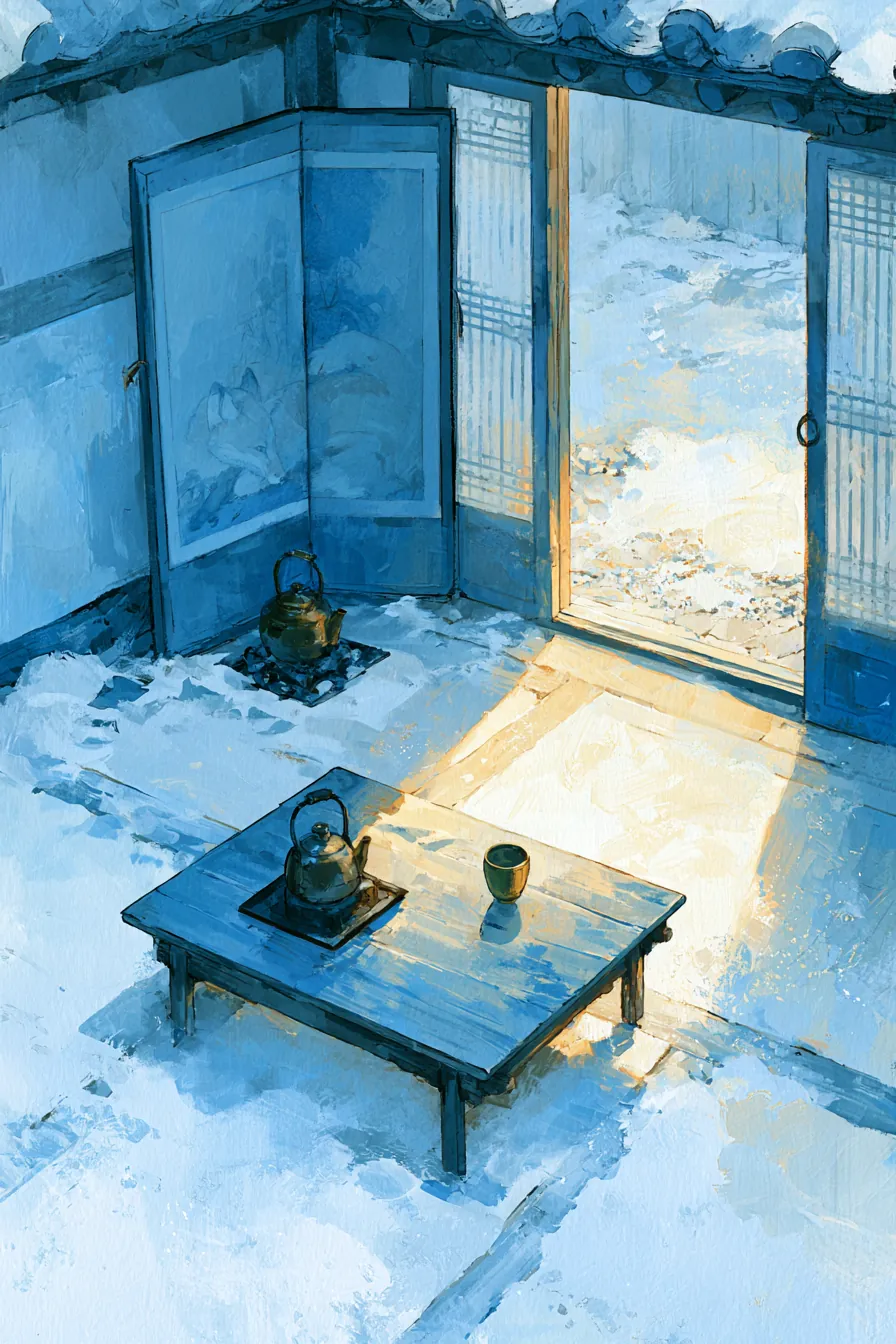
The folding screen was folded back against the wall, as I had asked. Eight panels, the fox on the third panel now an inward face pressed against the second panel and not, in any literal sense, in the room. The brass kettle was on the brazier. The brazier was lit. The low table had been moved into the center of the anbang. Two cushions on opposite sides at a distance of one floor-board — the jeong distance a Joseon host seats a guest for a difficult conversation.
He had not set out a celadon tea set.
He had set out, on the low table, a single brass cup on his side, and a single celadon cup on mine.
I looked at the brass cup. I looked at the celadon cup. I looked at him.
He said:
"On Tuesday I gave you tea in a celadon cup. The cup was correct by every register I know. The cup is, however, not the cup that has, in your body, been recognizing. I have, this morning, set out the brass cup on my own side because I am the person who carried it down from the Seonbawi rocks on the seventh of the fifth month of the first year of King Injo's reign. The celadon is yours. You may, at any point, take the brass cup. If you take it, I will know what the taking means. I will not, however, hand it to you. The handing of it to you is, four hundred years overdue, the part of the gesture I am no longer permitted."
He waited.
I sat. He sat — the slow folding-down at the knees, the placement of the hands palm-down on the thighs, the way an old Korean man sits. He had been, in every room I had been in with him, the chairman at sixty-three different angles of standing. He sat, this afternoon, as the man.
I poured water from the brass kettle into the celadon cup. I did not pour for him. The not-pouring was correct by no Korean grammar I knew. He did not move toward the kettle. He let it stand.
I drank.
"Sajangnim. The third question. I am asking it now."
"Yes."
I had found the syllables at 7 a.m. in Min-ji's bathroom while combing my hair. The syllables had been in my mouth on Line 3 and on the hill at Anguk and at the gate, and the syllables in the room were not the syllables I had carried in. The room had recalibrated them.
I said:
"What do you want."
He looked at me.
"Han-ssi — "
"What do you want, sajangnim. Of me. In this room. In the next ten years. In the centuries you will outlive me. You have told me, on Friday morning, what I am. You have told me what you remember. You have not told me what you want. The third question is the question of want. You do not get to evade it because the question is, of the three questions, the most embarrassing one. Answer."
He set his hands palm-up on his thighs — the Joseon scholar's gesture of opened defense. I will not, in answering, conceal a weapon. I do not carry one.
He said:
"I want, Han-ssi, to be permitted to grow old."
I did not, for a moment, understand.
He saw the not-understanding. He waited one breath.
"For four hundred years I have not aged. The not-aging is, by my own discipline, a thing I have done to myself. The gumiho ages slowly by nature. The gumiho can age more slowly by discipline. The discipline is the cold marble. The marble has been cold under my tongue since the seventh of the fifth month of the first year of King Injo's reign. In 1741, in 1813, in 1862, in 1898, in 1932, in 1953, in 1971, in 1998 — on these dates I met a woman who could have warmed it. I refused. The refusal was the discipline. The woman in each of those years was not you."
He drew a breath.
"What I want, Han-ssi, is to grow old. I want, on a Sunday afternoon in a year of your choosing, to wake in the anbang of a house with you in it and find a gray hair. I want my left knee to begin, in a decade I have not yet lived through, to ache in the cold. I want a granddaughter, if you will permit one, to ask me, at the age she is old enough to ask, why the photographs of me from the year you met me look exactly like the photographs from the year before she was born. I want, eventually, to die. I want to die in the same century as you. I want the marble to leave my mouth and be put into the ground in the cedar box I have been keeping in the western cabinet of the sarangbang since 1953. I have prepared the box. I have not, in seventy-three years, put a single object in it. I have been keeping the box for the marble."
He paused.
"The wanting is not a wanting of you. The wanting is the wanting of the small finite life of an old Korean man. I have not, in four hundred years, been permitted to want it. I am telling you because you have asked, and because I owe you, of the three answers, the embarrassing one."
I had prepared, on Min-ji's rug, for I want you. I had prepared for I want forgiveness. I had prepared for the small smooth romantasy-pulp answer in which an immortal Korean man tells a Stanford-trained twenty-six-year-old that what he wants is her. I had not prepared for the answer of a man who wanted a knee that ached, and a granddaughter, and a small cedar box on a shelf.
The brass cup was on his side of the low table.
I looked at it. He saw me look. He did not move.
I reached across.
I picked up the brass cup.
The cup was warm in the way the oak of his desk on Friday morning had been warm — by transferred heat, the slow patient transfer that was the only kind of warmth this house had ever permitted itself to give. The cup was the same cup I had held in a wayside shrine on the slope of Inwangsan in a snowstorm in the fourth month of the first year of King Injo's reign with my fingers brushing the fingers of a man whose name I had not yet known and had, also, known.
I poured. I drank.
The water went down my throat and the small reserved space at the base of my throat — the space the bronze knocker had landed in — opened into the small finite shape of an anbang I had, in 1623, been a girl in. The space did not, this time, tilt me. The space received the water.
I set the brass cup down on my side of the low table.
He did not, in his face, react. The non-reaction was a courtesy — the only thing he had to give me, this afternoon, that was not a piece of himself, and he gave it.
"Sajangnim. I am going to do a thing now. The thing is the decision. I am going to say it before I do it, because if I do not say it, you will not, after I have done it, know what I have done."
"Yes, Han-ssi."
"Naneun dangshin-eul yongseohaji anseupnida. Naneun dangshin-gwa hamkke ileul hagessumnida. I dul-eun da gat-eun mun-jang-i aniyo. I am not forgiving you. I am deciding to work with you. These are not the same sentence. I am holding forgiveness in reserve. The forgiveness may, someday, be possible. It may not. The working-with-you is, regardless, the thing I have decided. The decision is mine. The decision is not reversible by you. The decision is not, also, reversible by me, because I am, in saying this, taking a thing I have been carrying for ten days and putting it down on your low table and walking away from the place where I have been holding it. It will not be there for me to pick back up. I will, after this afternoon, walk on the side of the path you are on. I do not, in walking on the side of the path you are on, become your wife, or your bride, or your bound thing, or your daughter, or your apprentice, or your fox. I become a Korean woman of twenty-six in a gray Theory blazer with a Stanford degree and a green-ribboned JL notebook who has decided the work of her life is going to be done on the same side of the path as the work of yours. The decision has been made. I am informing you of it."
He did not, for a long moment, move.
Then he bowed. Forty-five degrees. The bow a Joseon scholar gave in receipt of a verdict from a magistrate that he had not, in his lifetime, expected to receive and which he was accepting in full. He held the bow for three breaths. He straightened.
His eyes were wet. He did not weep.
I had said, on Friday morning, that I would reserve weeping for Sunday. I had reserved it. I was no longer in the part of Sunday in which weeping was the form. The weeping had been done in advance, in the cup, by the woman who had been carried.
"Han-ssi."
"Yes."
"Thank you for the decision."
"You are welcome."
"I will, for the rest of my life, do the work in such a way that you, on a Sunday afternoon many years from now, will not regret the deciding."
"I know."
Hanyang, Joseon. The third month of King Injo's first year. The night after the execution.
In the willow grove east of the Geunjeongjeon courtyard the snow has begun, in the second hour after midnight, to fall again, and Da-eun, eighteen and three months, who has not eaten and not wept and not slept, sits with her back against the third willow from the south wall and holds, between her palms, the small white knotted ribbon her mother passed to her at the moment the executioner's hands took her mother by the shoulders.
The ribbon is wet.
Her mother, in the cell beneath the consort's pavilion the night before the execution, was permitted, by the mercy of a guard who owed her a favor from the fifth month of King Gwanghae's eleventh year, one cup of water. Her mother had not drunk it. Her mother had wet the ribbon. With the wet ribbon she had knotted into the cloth a sentence of seven syllables in a script Da-eun's grandmother had taught Da-eun's mother and Da-eun's mother had, at thirteen on a riverbank in Chungcheong-do, taught Da-eun.
The ribbon holds the seven syllables. Da-eun has not, on this night, untied the knots.
She thinks of the man in the black scholar's robe who was, this morning, the only guest at her mother's last gut in the cell. The man is not Yi Hwan. The man came at the third watch. The man drank a cup of the prisoner's water her mother offered him in a chipped clay bowl. The man held, for the duration of the jeseok-geori passage, a brass kettle on his lap with his palms cupped around it the way an older Korean man cups his palms around a kettle he is preparing to pour. He did not pour. He set the kettle down. He bowed. He left.
Da-eun knows three things about the man, in the small flat way her mother taught her to know things she was not formally told.
That the man is not a man.
That the man loved her mother in the small clear unembarrassed way an older creature loves a smaller creature whose finite life he has spent his own finite life standing outside of.
That her mother, in the eight hours of the night, asked the man for a favor in the silence between two passages of the gut. The man inclined his head once. The incline was the incline of an older creature accepting a debt he had, in the four hundred years before the asking, been preparing to accept.
Da-eun does not, on the willow-bench, know the content of the favor.
In her palms the ribbon, slowly, begins to dry.
In a house in Bukchon four hundred and three years later — a house Da-eun has never been to and will not, in her life, visit — the same man, on a Sunday afternoon, sits at a low table across from a woman who has, ten minutes earlier, taken a brass cup from his side and set it down on hers. The man does not yet, in 1623, know that the house in Bukchon will be the house. The man knows only that he has accepted a debt.
The debt has, four hundred and three years later, been called in.
He is paying it.
Cheong Wa Dae annex, Samcheong-dong. March 1, 2026. 3:47 p.m.
Yi Han-saem, fifty-six, special senior secretary for cultural affairs, born in Andong in 1969 to a family that had — until 1623 — been of some standing in the Yi clan of the Pungsan branch and had not, in three centuries, recovered the standing, was at his desk on Sunday afternoon when he laid his head on his folded forearms because the headache he had been carrying since Friday morning had begun to taste of something.
The taste was the taste of a brass cup.
He did not own a brass cup. He had not, in any conscious moment of his fifty-six years, drunk from a brass cup.
The taste, however, was the taste. Brass at the slow transfer-temperature of a kettle on a brazier. Behind it, the smaller taste of a wayside shrine in a snowstorm, of yakju cut with mustard-heat. Behind that, the iron taste of a thing in his palm at the third hour of the third month of the first year of his reign — his, not the king's, his, Yi Hwan's — the seal pressed onto the execution-warrant of a court mudang named Kim Gae-hwa of the paje lineage of Chungcheong-do.
The taste he had, since 1623, kept down. Was coming up.
He turned his hand over.
On the inside of the wrist, below the pulse where his pulse was sitting at ninety-three, there was a thin pale seam he had assumed since boyhood was a scar from a fall against a stone fence in the Andong yard when he was four. The seam was no longer pale. The seam had come up in the faint ink-color of an old red ink, in an older Korean script Yi Han-saem could not, in his conscious life, read.
He could not read it.
He could read it.
The script said, in seven syllables: yi geos-eul ilji malla.
Do not forget this.
He sat down on the floor in his suit with his back against the wet-bar cabinet. He did not weep. He waited.
He took out his phone. He scrolled past security director. He scrolled past Soo-jin — his wife. He scrolled to Shin Mu-young, who had been, in the late 1990s, senior senior secretary for cultural affairs and had, in 2003, resigned to enter a Jogye-order temple in Gangwon-do and had not returned to public life in twenty-three years.
He stared at the contact. He did not call. He put the phone away.
He had, on Friday afternoon, written the name Han Ji-won on a square of his official notepaper and slid it across his desk to his security director with the flat quietly he used when he did not want to be asked, in the same conversation, why. The security director had said Yes, sir. Had — Yi Han-saem now understood, in the slow way the body that has been a body for fifty-six years comes to understand a thing it had decided two days earlier with a different part of itself — already filed the request. By Monday morning at nine it would be on the desk of a National Intelligence Service liaison Yi Han-saem had not personally selected.
He looked at the bell on his desk. The security director was, even now, two doors down, drafting the Monday-morning brief. He did not reach for the bell.
The script on the inside of his wrist, slowly, over the next eleven minutes, went back down. By 4:09 the script was gone.
By 4:09 he had decided he would not, on Monday morning, withdraw the request.
The wanting of the woman's name on his security director's desk was, in Yi Han-saem's life, the older wanting. The older wanting had come up with the brass cup at the back of his palate and had not, in eleven minutes, been put back down.
The wanting at 3:58 p.m. had not been the wanting of Yi Han-saem. The wanting had been the wanting of Yi Hwan, who had, in the eighth month of the fifteenth year of King Gwanghae's reign, walked past a court mudang and her daughter in the inner courtyard of Gyeongbokgung and had read the mother's face the way a butcher reads a side of beef.
Yi Han-saem did not know the difference.
He sat down. He waited for Monday morning.
Bukchon. March 1, 2026. 4:48 p.m.
In the anbang the brass kettle had been refilled twice. The celadon cup on my side had been pushed to the corner to make room for the brass cup, which had not moved.
We had talked. Between three-fifteen and four-fifteen, the way a Korean man and a Korean woman who had decided to walk on the same side of a path talked — about the path. About Monday. About the A&R boy on the fourth floor I had marked, on Friday morning, for later. Yi-jun, on that question, said sooner and then, when I lifted an eyebrow, Han-ssi. I will tell you why on Tuesday at lunch in a place of your choosing that is not the JL building. The small office-political room of yours that opened on Friday is the most accurate small room in the building. Use it.
About Min-ji on the wall. He said the cat is on the wall with her now. The previous owner of the compound told me in 1953 the cat has been in the alley for sixty-three years. The cat is not a cat. The cat has decided you are the resident, Han-ssi, and Min-ji is the guest. I am, in the cat's grammar, neither.
I smiled. The first smile I had given in the anbang. He returned it. The smile took a careful seven seconds to arrive on his face and was, on arrival, the smile of a fifty-six-year-old Korean man, not the smile of an immortal.
The smile was the answer to a question I had not yet asked. What does it look like when the marble begins to warm. The answer was the smile of a fifty-six-year-old.
At 4:48, Min-ji knocked.
Yi-jun stood. He bowed. He went out to the gate.
I looked at the low table. The brass cup was on my side. I did not take it with me. I left it where I had set it. By the small accumulated grammar of the four centuries it had been waiting for a side to sit on, the cup was a marker. The woman has, on this side, sat. The woman will, by the accumulated grammar, be returning.
I slid the door. I went out.
In the courtyard Min-ji was standing at the edge of the small stone water-basin with her bare hand on the rim, where the late-winter sunlight was sitting in a small flat band the width of two fingers. Her cream-gloved hand was off. She was looking at the basin the way a young Korean woman with the early shinbyeong looks at a thing she has been told, by the small system in her body that has been ruining her sleep for two years, is a thing.
She lifted her face. She did not smile. She did not need to.
"Unnie."
"Yes."
"I am going home with you."
"Yes."
"I am not, after this afternoon, calling you unnie in the same way. The unnie will, from now on, have a small system in it. The system is the system you have, this afternoon, agreed to be the resident of."
"Yes."
"I am all right with it."
"I know."
"Go say goodbye to him. I will be at the gate."
Yi-jun was on the maru porch with his hands in the sleeves of his durumagi. He had, I now saw, been waiting on the maru the entire hour and forty-three minutes Min-ji had been on the wall. The maru was the porch from which a Joseon-era Bukchon host watched a guest cross the courtyard. The watching-place.
I came up to him. I did not bow. He did not bow either.
"Sajangnim. I will see you on Monday. You will not look at me on the analyst floor. At twelve-thirty you will come down to the fourth floor and ask Han Ji-won-ssi, in front of the analyst pit, whether she has any work product the chairman's office should be looking at. You will say it in the polite jondaetmal you use with the entire fourth floor on the matter of work product. You will not look at her any longer than you would look at any other junior. She will say Yes, sajangnim. I have a deck. May I bring it up. You will say yes. The deck is the Q2 girl group debut. The closing slide has a single line of dry Pretendard I have not yet written. The discussion will take eleven minutes at twelve forty-five. It will not be about anything else."
He inclined his head. "Yes, Han-ssi."
"Walk us to the gate."
He walked with me across the courtyard, half a pace behind my right shoulder.
At the gate Min-ji bowed. Yi-jun bowed. I bowed. The gate opened.
We went down the hill. The cat did not, this time, watch me. The cat had decided, in the hour and forty-three minutes Min-ji had been on the wall, a thing about my residency in the alley, and had moved on.
At the foot of the alley I stopped. Min-ji stopped.
I did not look back at the gate. The not-looking-back was a discipline I had borrowed from him in his office on Friday, and from him at the gate of his own compound on Tuesday, and from him on the maru one minute and twelve seconds earlier.
The discipline was now mine.
I had taken a brass cup from a man's side of a low table and set it on my own. I had not smashed it. I had not given it back.
The cup was on my side.
I did not yet know whether the four hundred years of waiting had been a waiting for a forgiveness, or for a working, or for a small finite Korean life lived on the same side of a path as an older creature who had learned to want a knee that ached and a granddaughter who asked him questions.
I did know that the setting-down had not, in the room, killed me, and that the slope had, in the act of setting a thing down, finally stopped being a slope and started being a floor, and had given me back the small steady thing my Cupertino mother had told me, in the spring of my ninth year, was the thing that lived under the collarbone of every Korean woman who had, on the long high note of the Chuseok lullaby, ever sung.
I had it back.
Min-ji took my arm.
We walked.