Chapter Eleven
Hongdae, Eoulmadang-ro, the alley behind the Sangsudong exit. March 3, 2026. 9:47 p.m.
The alley was loud.
It was a Tuesday and the Hongdae alley was loud the way only a Hongdae alley on a Tuesday in late winter can be: small electric heaters, small orange tarps, small portable speakers playing a 1998 ballad and a 2024 ballad and a track from the JL girl group whose strategy deck I had cleaned up on Friday morning. The smell was octopus and acetylene and the cheap perfume of art-school students who had not gone home since Sunday. I had on, under my coat, the green-ribboned JL notebook and one of Min-ji's gloves. The other glove was on Min-ji.
She had said, on Line 2, unnie. The dokkaebi is not going to bite you.
I had said, I am not afraid of the dokkaebi.
She had said, yes you are.
I had not, on Line 2 between Itaewon and Hongik University Station, argued.
Yi-jun was already in the alley. He had on a charcoal wool coat and no tie and his hair was, for the first time I had ever seen, slightly out of its house-grammar shape — the wind had moved a small piece of it off his forehead and he had not, in the eleven minutes he had been waiting at the alley mouth, put it back. I noticed the piece of hair the way Ji-won-of-the-fourth-floor would notice a Pretendard kerning error.
He bowed. Fifteen degrees.
"Han-ssi."
"Sajangnim."
"Min-ji-ssi."
"Sajangnim."
He said: "Mr. Kang is six tarps in. He has set out a third stool. He has, in setting out a third stool, signaled to the alley that he is not, tonight, conducting business with the alley. The alley will leave us alone. Min-ji-ssi may sit on my right. Han-ssi may sit on my left. The third stool — the small low one — is Mr. Kang's, and he will not, this evening, take it. He will stand."
"Why."
"Because Mr. Kang, when he is conducting a thing he is taking seriously, stands."
I looked at Min-ji. Min-ji looked at me.
We followed him down the alley.
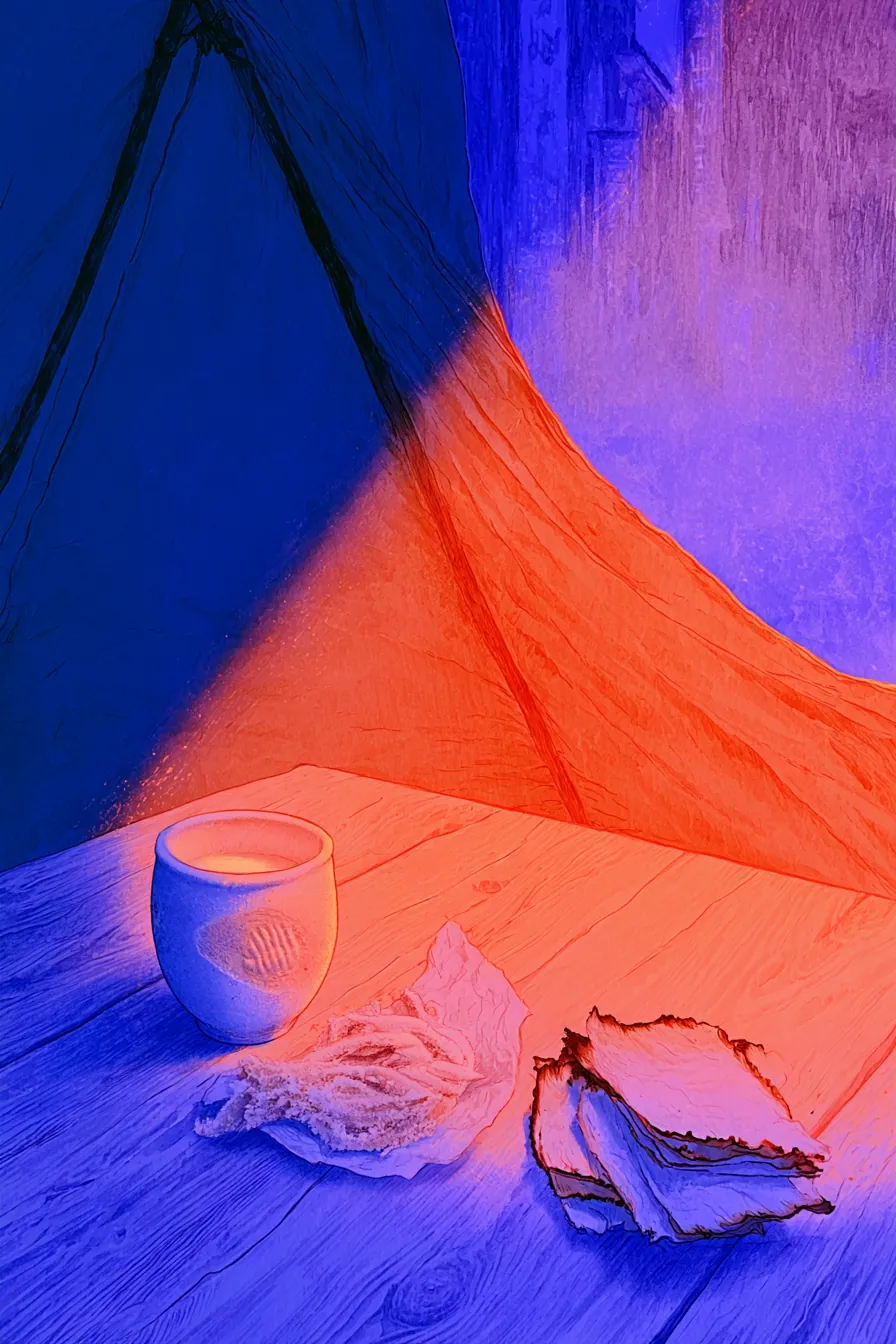
The pojangmacha was orange. The tarp was orange. The plastic stools were orange. The small electric lamp clipped to the cart was orange. The man behind the cart was not orange.
The man behind the cart was wearing a quilted vest the color of a winter river and a black baseball cap with no logo, and he was, on first look, fifty-three. On second look he was nine hundred. On third look the looking gave up.
"Sajangnim," said Mr. Kang. He did not bow.
"Kang-hyung," said Yi-jun. He bowed. Thirty degrees. The bow a younger Joseon scholar gives an older one of the same provincial origin.
Mr. Kang did not bow back.
"This is the girl."
"This is the girl."
Mr. Kang looked at me. The look was the look a man gives a brass cup he has not seen in four hundred years and has, for the duration of those four hundred years, occasionally wondered about. The look did not last. He looked next at Min-ji. The looking of Min-ji took longer.
"And the friend."
"Min-ji-ssi," said Yi-jun. "She is mudang-line. Recently come into it."
"I see."
Min-ji did not say anything. She had, on the train, put her glove back on. She was, in the orange light of the cart, holding the small crescent of skin at the base of her thumb between her right thumb and forefinger — the gesture she had taught me Sunday afternoon at the granite wall in Bukchon. Tonight she was using the gesture on herself.
Mr. Kang said: "Sit."
We sat.
He poured.
He had three small ceramic cups on the cart and a small brown bottle and a small black bottle and a small clear bottle. He poured from the clear bottle into Yi-jun's cup. He poured from the black bottle into Min-ji's. He poured from the brown bottle into mine.
He set the bottles down.
"Sajangnim drinks soju cut with mountain water from the spring above Inwangsan. The young mudang drinks black sesame makgeolli from a brewery in Pohang owned by a great-niece of mine. The girl — " he paused. He looked at me. "The girl drinks barley tea."
"Why barley tea," I said.
"Because, Han Ji-won-ssi, you are not, this evening, going to pay for what you drink. The barley tea is not a drink. The barley tea is a courtesy. The courtesy is the thing I am extending to you because the man on your left has, for four hundred years, owed me a favor I am, this evening, finally calling in."
I looked at Yi-jun.
Yi-jun said: "I owe Mr. Kang. I have owed him since the autumn of 1631. The favor he is calling in tonight is the favor of giving you the tutorial."
"Tutorial."
"The rules."
"Whose rules."
"All of them," said Mr. Kang.
He smiled. The smile was very small. The smile did not reach his eyes, which were, I now saw, the gray-green of a winter river under cloud.
He started.
He spoke in short sentences. I had been told, by a Stanford lecturer I had liked in junior year, that the dokkaebi spoke in short sentences because the dokkaebi was a creature of the Korean working folk, not the Korean court, and the Korean working folk had never had the leisure for a long sentence. The lecturer had been showing off. The lecturer had also, it turned out, been correct.
"Rule one. Do not accept a drink from a thing in an alley if you have not asked the price. You did not ask the price tonight. I gave you tea, which is not a drink. That was a courtesy. The courtesy will not be repeated."
"Rule two. Do not write your own name on a piece of mulberry paper. Other people can write your name on mulberry paper for you. You can write your name on receipt paper, on tax documents, on a JL onboarding form. Mulberry paper is the paper of binding. If you write your name on mulberry paper, the paper has a vote in what you do next. You do not want a piece of paper to have a vote."
"Rule three. Do not cross a threshold backwards. A threshold is not a door. A threshold is the place a door used to be when the door was a question. You cross a threshold by going forward into the room. If you go backwards across the threshold, the threshold thinks you are leaving a room you have not yet entered, and the threshold will, in punishing you for the lie, take a thing from you. Usually small. A memory. A name. Sometimes the name of a thing in your mother's kitchen you have not, since the age of five, needed."
"Rule four. The mountain gods do not own you. You do not, also, own them. You are in a relationship with the mountain gods that is, in legal terms, the relationship of a tenant and a landlord whose lease has been verbal since the Goryeo dynasty. Be polite. Pay on the Lunar New Year. Do not, on the mountain, urinate."
"Rule five. The fox under the tongue of the man on your left is not, in the technical sense, his. The fox is the fox. The man is the man. The marble is the contract between them. The marble has been cold for four hundred years. The marble, last Sunday afternoon at four-eighteen in the afternoon, in a hanok in Bukchon, warmed by a quarter of a degree. I felt it. I felt it from the cart. I felt it from the cart because I am the kind of creature that feels a thing like that the way you, Ji-won-ssi, feel the wind change direction on the rooftop garden of the JL building. The warming is a thing. It will continue to be a thing. You did not, in causing the warming, become responsible for the fox. You became responsible for the warming. Those are not the same sentence."
He paused.
I noticed he had said not the same sentence.
I looked at Yi-jun.
Yi-jun, very slightly, smiled. He had been listening to me say that sentence on a low table in a Bukchon hanok forty-eight hours earlier. He had, since hearing it, been carrying it in the same place under his tongue where he carried other things he had decided to keep.
Mr. Kang did not appear to notice the smile.
"Rule six. The mudang-line in your friend Min-ji-ssi is recent and steep. The line in the daughter of Yun Mi-young of Daejeon is old and shallow. The two of you, on the same mountain at the same time, will hold opposite weather. Min-ji-ssi will be a lightning rod for everything coming down. You, Ji-won-ssi, will be a deep root for everything going up. This is not a metaphor. This is the meteorology of being you and being her on the same mountain. Plan accordingly."
"Rule seven. The man on your left is, in the next eight weeks, going to be challenged by another gumiho. Her name is Hae-ri. She is twelve years past her marble. She is angry, fast, and bored. She has been in the city since the snow on Banpo Bridge last Tuesday. She knows where the man on your left lives. She does not yet know where you live. We will, for as long as we can, keep it that way."
"Rule eight."
He stopped.
He poured himself a small ceramic cup of the soju cut with the mountain water from the spring above Inwangsan. He drank it. He set the cup down.
He said:
"Rule eight is the rule I am not going to teach you tonight. Rule eight is the rule that lives inside you, in the part of you the man on your left has not yet asked about, and which the man on your left, by my reading of him over four hundred years, will not ask about until he has earned the right. Rule eight is your rule. When you find it, the finding will be the finding. You will not need a dokkaebi to translate. Take the seven I have given you. Go home. Drink the tea."
I drank the tea.
The tea was barley tea. The tea was the tea of every cha-jip in Seoul, of every train-station vending machine, of every kindergarten thermos. I had drunk this tea, in the small steady cold of a Cupertino backyard at the age of seven, out of a 1990s Hello Kitty thermos. I had drunk it in the breakroom on the fourth floor of the JL building on every weekday in February. The tea was exactly the tea.
The tea was, also, faintly different.
I could not, at the cart, name the difference. I could only register the difference as a small clear additional honesty the tea had, this evening, on the back of the tongue — as though Mr. Kang's tea had had, in the steeping, a small piece of the same patience the brass cup in Bukchon had had in the carrying.
I set the cup down.
Min-ji was looking at her cup. She had not yet drunk. Her cream glove was off. Her thumb was pressed to the small crescent of skin at the base of her other thumb.
Mr. Kang said, very gently: "Daughter."
"Yes."
"Drink, if you can. If you cannot, set the cup down. The makgeolli will not, in either case, hold it against you. The makgeolli has been holding things against people for a thousand years and has, recently, gotten tired."
Min-ji laughed. The laugh was a short laugh. The laugh was the first time I had heard her laugh that evening.
She drank.
She set the cup down. She breathed.
She said: "It tastes like my grandmother's jat-juk."
"It would," said Mr. Kang. "My great-niece in Pohang is descended from your great-grandmother's second cousin. The pine nuts are from the same hill. The hill remembers."
Min-ji did not say anything for a long minute. She picked the cup up again and held it between her palms. She did not drink. She held.
Yi-jun, very softly, in a register he had not used in the alley until that moment, said:
"Min-ji-ssi. The thing in your body is called shinbyeong. You have known the word for two years. You have not, until tonight, sat at the same cart as another creature who carried the word out loud. I am not — " he paused; he was using jondaetmal carefully; he did not want, in this moment, to overstep the friendship Min-ji had with me by inserting himself into the naming of her — "I am not the one who should name it for you. Mr. Kang has, in his rule six, named it for you. I am only confirming. You are not, in the form your body has taken this year, ill. You are coming into a thing."
Min-ji nodded. She did not look up.
"Thank you, sajangnim."
"Min-ji-ssi."
"Yes."
"On Friday afternoon, if you can, come to the Bukchon hanok. Halmoni Yun has been asked, by phone this morning, to send a small box of sungnyung-grade rice up from Daejeon. The box will arrive Friday. I would like, with your unnie's permission, to give it to you. The box is not a gift. The box is the small first inheritance your line, by way of the woman next to you, has decided you are ready to receive."
Min-ji, very quietly, said: "Yes, sajangnim."
I did not, on the orange stool, say anything. The gift in the box was not mine to consent to. The gift in the box was a thing my grandmother had decided about Min-ji, by way of me, by way of a man I had taken a brass cup from on a low table forty-eight hours earlier. The gift was, in the rule-seven meteorology Mr. Kang had named, the deep root sending a small first leaf up to the lightning rod.
Mr. Kang watched.
He said, after a moment: "Sajangnim. That was well done."
"Thank you, Kang-hyung."
"You have, in four hundred years, never been better."
"I am trying."
"I see."
We sat at the cart for another forty minutes.
Mr. Kang did not, in those forty minutes, lecture. He cooked. He cooked a small plate of odeng and a small plate of tteokbokki and a single skewer of grilled chicken hearts for Yi-jun, who ate the hearts in the slow patient way I now knew was the only way he ate any animal flesh in 2026. He cooked, also, a small plate of fried sweet potatoes for Min-ji, who, the first one she ate, closed her eyes for two full seconds.
I ate the odeng. I ate the tteokbokki. I did not, at the cart, talk about JL or about Sunday or about the brass cup. I let Min-ji do most of the talking. Min-ji talked to Mr. Kang about her grandmother in Geochang who had, in 1987, been the manshin for a village of two hundred and had, in 1991, retired into a small ceramics workshop. Mr. Kang knew the workshop. Mr. Kang had, in 1993, on a trip back from Tongyeong, bought a celadon water dropper from the workshop. He still had it. He used it for ink on Lunar New Year.
Min-ji cried a little. She did not, at the cart, hide it. Yi-jun handed her his pocket-square. The pocket-square was white linen with a small hand-stitched chrysanthemum in the corner. Min-ji used it. She did not return it. He did not ask for it back.
At ten forty-three Yi-jun took out his phone. He looked at it. He put it away.
He said: "The hour is good for going home. Han-ssi has work in the morning. Min-ji-ssi has, in addition to work, a thing in her body she is learning. Kang-hyung, may we leave."
"You may leave."
"Thank you."
"Sajangnim."
"Yes."
"Bring the girl back in a month. Bring the friend back next Tuesday."
"Yes, hyung."
"Take her home now."
We stood. Yi-jun bowed forty-five degrees. Mr. Kang, this time, bowed back. Fifteen. Min-ji bowed. I bowed. We left the cart.
At the alley mouth Mr. Kang called after us once.
He said: "Ji-won-ssi."
I turned.
He was, from six tarps away, a small orange figure in a quilted vest.
He said:
"You did well tonight. You did not pay. You did not, also, take. The cup is, even now, on the side it ought to be on."
I said: "Thank you, ajeoshi."
He said: "Go."
We went.
In the taxi Min-ji sat between me and Yi-jun. She had asked, at the alley mouth, to sit between, and Yi-jun, without speaking, had moved over. She was holding the pocket-square in her lap and turning it over and over with her thumb.
The driver was a quiet man in his sixties. He had the radio low on a 1980s ballad station. He drove the Hongik back roads to Sinchon-ro and Sinchon-ro to Mapo-daero and over the Mapo Bridge to Yongsan-gu without looking once in the rearview mirror.
Min-ji said, half to me and half to the cab: "Unnie. I am, in the body, less afraid than I was last week. The thing I have been carrying since the autumn of my twenty-second year has a name. The name is not a small name. The name is, however, a name. I had been carrying a thing without a name. I am no longer carrying a thing without a name."
I said: "Yes."
"You are not, also, an unnie in the small-friend way anymore. You are an unnie in a way I do not yet have the vocabulary for. I am asking you, this evening, in front of the sajangnim, to teach me the vocabulary when you have it. You will have it before I do."
"I will teach you," I said.
Yi-jun, very quietly, said: "Min-ji-ssi. The vocabulary is older than you and older than her. It will, when it arrives, be a vocabulary that has been waiting. You are not, in not yet having it, behind."
"Yes, sajangnim."
"Yes."
The cab climbed the small hill into Mapo. Min-ji got out at her one-room. I got out behind her. I told Yi-jun, through the window: I am sleeping at Min-ji's tonight. He said: yes, Han-ssi. Tomorrow at twelve-thirty I will come to the fourth floor. I said: yes, sajangnim. The taxi pulled away.
Min-ji and I went up the stairs.
In the one-room Min-ji set the pocket-square on the small low table by the window. She did not, that night, wash it. She set it down the way one sets down a thing that is, for the moment, a witness.
She made the bed for me on the floor mattress. She made tea. She made, in the small kitchen, two slices of the white bread her mother had been mailing her from Geochang since the autumn, with a thin layer of strawberry jam and one slice of American cheese, which was the bedtime snack of her childhood and which she had, since the autumn of her twenty-second year, eaten on every night the shinbyeong-name-she-had-not-yet-been-given had moved hardest in her chest.
She handed me one of the sandwiches.
"Unnie."
"Min-ji."
"Did you hear what he said at rule eight."
"Yes."
"Do you know what your rule eight is."
"No."
"I do not, also, know mine."
"That is correct, by the form."
"Unnie."
"Yes."
"I am glad we went tonight."
"I am also glad."
We ate the sandwiches. We brushed our teeth at the small bathroom sink one after the other. We turned out the lamp.
I lay on the floor mattress in the small dark of Min-ji's one-room and listened to her breathe on the bed above me. She was asleep inside four minutes. She had not slept inside four minutes since the autumn of her twenty-second year. I lay on the mattress and watched the small orange wedge of streetlight on the ceiling and did the small accounting Stanford had taught me to do at the end of a day.
I had been given seven rules and the gestures of an eighth.
I had been given a name for the thing in Min-ji's body.
I had been given a pocket-square my best friend had decided, in front of the man whose office I worked under, to keep.
I had been given a cup of tea by a creature who had elected, in four hundred years, not to be paid.
I had not, on the orange stool, paid for any of it.
I had also not, on the orange stool, taken any of it.
I had been, for the first time since Sunday afternoon, simply present at a small low table in a small loud alley with two of the four people I was, in the slow accumulating Korean of the spring of my twenty-sixth year, going to spend my life paying attention to.
I closed my eyes.
I slept.
I slept the way a person sleeps when the small steady cold pressure under the collarbone has, for a Tuesday evening in late winter, agreed to lie down with her.
I did not dream.
I did not, in not dreaming, take it as a victory. I took it as the small first night of a small new ordinary. The ordinary was, by the accumulated grammar of the past ten days, going to be the rarest thing in my life.
I slept.
Cheong Wa Dae annex, Samcheong-dong. March 3, 2026. 11:18 p.m.
Yi Han-saem, who had not gone home, was at his desk.
The Monday-morning brief on Han Ji-won had arrived on his desk at nine-twelve and he had read it once. He had read it twice. He had read the third page, which contained a photograph of a young Korean woman in a gray Theory blazer crossing the JL lobby on a Tuesday afternoon in late February, four times.
He did not know the face.
He did not, also, not know the face.
He laid his palm flat on the photograph and waited. He waited the way he had been waiting since Sunday afternoon at three fifty-eight, when the taste of brass had come up at the back of his palate.
The wrist did not, this evening, write anything on him. The script had not returned. The script had been once. The script had said, in seven Korean syllables he had read and not read, do not forget this, and the script had gone back down into the body that had held it for four hundred and three years.
He picked up his desk phone.
He dialed.
He let the phone ring twice. He hung up before the third ring.
He took out his personal phone. He scrolled past security director and Soo-jin and Shin Mu-young. He scrolled to a contact he had not opened in nineteen years. The contact was an old number with no name attached, only the small letters I.S. in the field where a name would normally be.
He stared at the contact.
He did not call.
He put the phone down. He laid his head on the brief, on the photograph of the young Korean woman crossing the JL lobby. He breathed.
He said, aloud, in the silence of his office:
"I do not know what I am doing."
The wrist did not answer.
The brass at the back of the palate, faintly, did.
He did not, at his desk at eleven-eighteen on a Tuesday night in late winter, hear the answer in language. He heard it the way a much younger man, four hundred and three autumns earlier, had heard a lamp lean away from him in the inner court of Gyeongbokgung. The answer was not in language. The answer was in the small unmistakable tilt of the air toward a thing he was already, in some quieter part of himself, doing.
He sat up.
He picked up the desk phone again.
He dialed the security director's after-hours line.
The security director picked up on the first ring.
"Sir."
"I want a second-tier on Han Ji-won."
"Yes, sir."
"I want to know who she is sleeping next to."
"Yes, sir."
"By Thursday."
"Yes, sir."
He hung up.
The brass at the back of the palate, this time, did not faintly answer. The brass at the back of the palate sat. It sat the way a creature that had been waiting four hundred years for a thing it had set in motion sits, on the lip of a long bony tongue it had once owned, when the thing has finally begun to move.