Chapter Thirteen
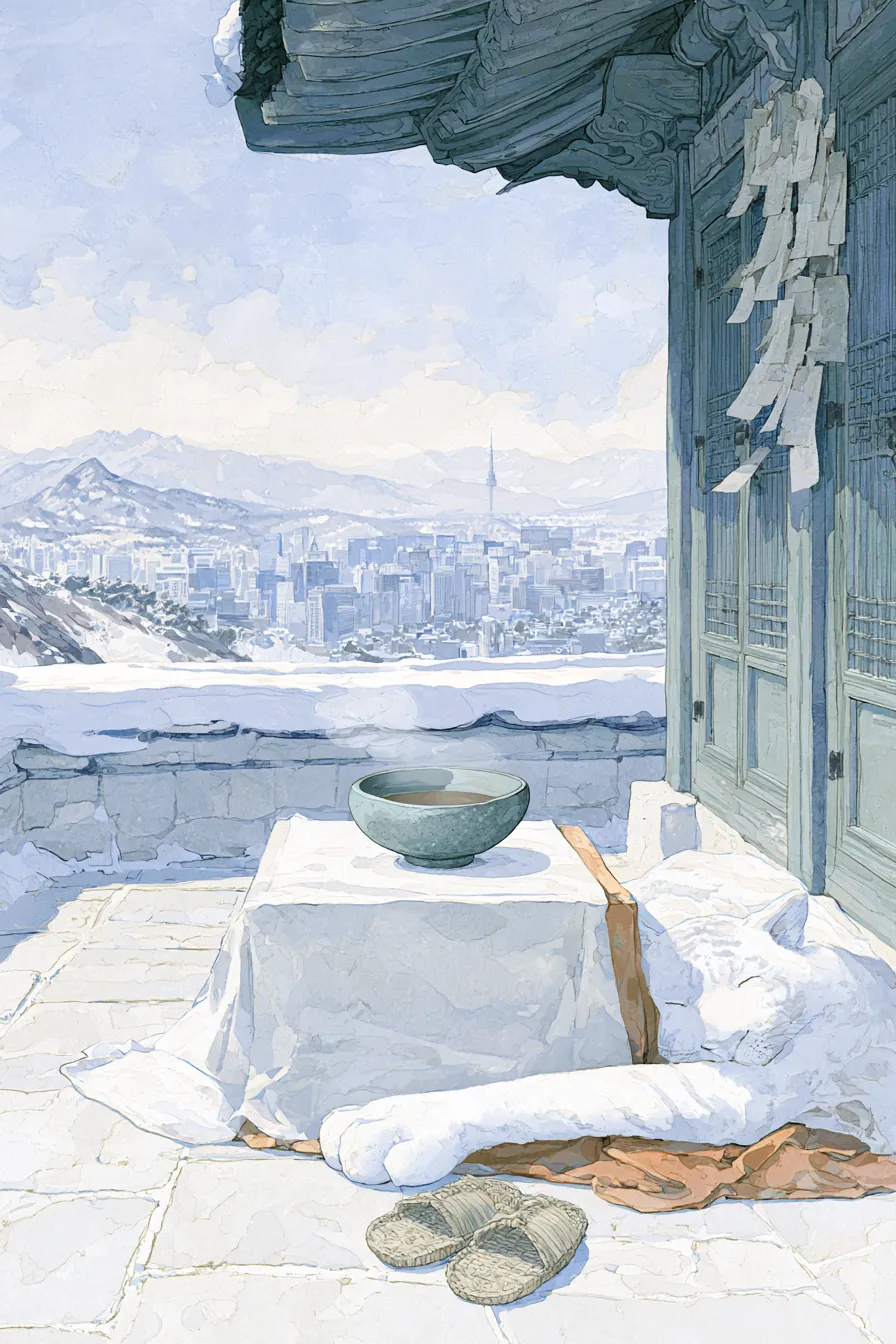
Inwangsan, the Guksadang shrine on the southwest shoulder of the mountain. March 5, 2026. 7:42 a.m.
He had told her, over the Mapo Bridge, that Inwangsan-sanshin in 2026 accepted only a small thing — a clear glass thermos of cold buckwheat tea and a single dried apricot. They had stopped at a 7-Eleven on the Donuimun-ro. She had bought the packet of three apricots (the cashier did not sell them singly), eaten one in the car, and watched Yi-jun, without comment, eat the second and set the third back into the center of the foil. She had laughed. It was the second laugh she had given in his company since Sunday afternoon. He had let the laugh land on his face without translating it into anything else.
He drove the rest of the way to the small lot below the southwest shoulder of Inwangsan in silence.
The lot was empty.
It was a Thursday before eight on a March morning and the lot was empty in the small predictable way of a city that had not yet, on this hour, sent its joggers up. He parked. He cut the engine. He turned to her.
"Han-ssi."
"Yes."
"The sanshin will, on first look, be an old man. On second look he will be an old man with a tiger asleep across his sandals. On third look he will be neither. Do not, in the third looking, try to fix the looking. Let it stop where it stops."
"Yes."
"He will know, on your face, that you have braided a thing with your own teeth. He will probably say so. You do not, in the saying, have to account for it. The accounting is between you and the mountain."
"Yes."
"He will speak to me, in front of you, in a register that is older than my register and is meant to set me, in your hearing, in my place. The place he sets me in is, on the mountain, my place. I am, on the mountain, the junior. I am, in the office on the seventh floor of the JL building, the chairman. The two are not, on this mountain, the same person. Do not, in his hearing, treat the two as the same person."
"Yes."
"He will, very probably, tell me to let you go."
I looked at him.
He looked at me.
He said: "I am telling you now because I want you to hear his telling, in the moment, without the surprise. The surprise would, in the moment, take from you a second of your face. I am keeping that second for you."
"Yes."
"He will be correct that he is telling me to let you go. He will also be correct that I will not."
"Yes."
He got out of the car. He came around to my side. He opened the door. He did not, in the opening, offer me a hand. He had decided, in the four days since the brass cup, that he was no longer going to offer me a hand without first being asked.
I got out of the car under my own arm.
We walked.
The path was small flat stones, cigarette butts, the drift of plastic prayer-ribbons tied on the low pines by the small Buddhist groups out of the Seodaemun temples. He walked half a pace behind my right shoulder — the walk of Sunday afternoon up the Bukchon hill, and Tuesday evening down the Hongdae alley.
The shrine was a single tiled-roof stone hall with a low pine porch and a small enclosed forecourt of swept gravel. He had told me, on the bridge, that he had carried one of the four corners of the dismantled altar down the south face of Bukhansan in 1925, with three older Koreans whose names he had not since spoken in any room.
The forecourt was, on a Thursday at seven forty-two, empty.
The shrine was not, on a Thursday at seven forty-two, empty.
He came to the threshold. He did not, at the threshold, bow. He did, however, briefly, lay his palm flat to the lintel — the way one lays a palm to the bonnet of a car one has driven for forty years. He said, in a small clear soft Korean I had not heard him use before:
"Sanshin-nim. I have come."
The voice from inside the shrine said: "I know."
The voice was, on first hearing, the voice of an old man with a Gyeonggi accent and the small softened consonants of a man who had been smoking for sixty years and had, recently, stopped. The voice was, on second hearing, the voice of a mountain.
I did not, in the second hearing, try to reconcile the first.
I crossed the threshold behind him.
I did not, in the crossing, cross backwards. Mr. Kang's rule three.
The old man was sitting on a small low pine bench at the back of the shrine.
He was in a quilted brown vest and the kind of soft cotton trousers an old Korean man wears around a country house, and he had on the small round wire-frame glasses of an old retired schoolteacher in a small town in Chungcheong-do, and he had, in his lap, a small white earthenware cup of cold buckwheat tea.
Across his sandals there was a tiger.
The tiger was the size, at rest, of a medium dog. The tiger was, by the curl of the body and the slow breathing, asleep. The tiger had on its right shoulder a small flat scar of a kind that would, on a real tiger, have been the souvenir of a snare. The tiger's tail moved very slightly in the way the tail of a sleeping animal moves when the animal is doing, in sleep, a small accounting of the room.
I did not, on the third looking, try to fix it.
The old man looked up.
He looked at Yi-jun first. He looked at Yi-jun for the length of a careful one-second pause. He inclined his head — fifteen degrees, the bow a senior gives a junior who has, after a long absence, returned.
Yi-jun bowed back. Forty-five degrees. He held the bow for three breaths. He straightened.
The old man looked, then, at me.
The looking, on me, was a different looking. It was the looking, I now understood, that he had earlier given me by way of the voice from inside the shrine. The voice had said I know before either of us had named me. The looking did not name me either. The looking, on me, was the slow flat attention of a creature for whom the act of looking was, by long professional habit, the closing of a small ledger.
He said:
"Ah."
He did not say more.
After a small pause he said:
"You braided this knot, child, with your own teeth."
I had not, on the Donuimun-ro, prepared a sentence for this.
I said: "Yes, sanshin-nim."
He smiled. The smile was small. The smile was a smile of a creature who, on a Thursday in early March of 2026, was not, by the smile, in any sense pleased.
He held out the small white earthenware cup of cold buckwheat tea.
I had brought up the small clear glass thermos of cold buckwheat tea in my coat pocket. I had brought up the foil packet of one remaining dried apricot. I had, on the threshold, removed the thermos and set it, two-handed, on the small flat pine sill of the shrine. I had unwrapped the apricot and set it on a small folded square of receipt paper from the 7-Eleven.
The old man had not, in any visible sense, attended to my offering.
The old man was holding out his own cup.
He said, very quietly: "Drink, child. The tea you brought is on the sill. I will drink it after you go. The tea in this cup is the tea I will give you. It is cold buckwheat tea. The tea is, in addition, four hundred years of cold buckwheat tea, by way of the small old pretense that on a mountain we share what we already, in fact, share. Take it."
I took it.
The cup was earthenware. The earthenware was rough. The earthenware was the rough earthenware of a small kiln in Yangsan circa, by the look of it, the late 1500s, although what I knew about ceramics was what Min-ji had once explained on a winter Saturday afternoon at the Leeum.
I drank.
The tea was cold. The tea was buckwheat. The tea was, in addition, faintly mineral, in the way of a spring above the third pass.
I set the cup down on the small low pine bench beside the tiger's sandals.
The tiger did not move.
The old man said: "Sit, child."
I sat. On the floor. The floor was swept pine. I sat cross-legged, the way I had been told by a Korean church auntie in Cupertino at the age of seven was the polite way for a small Korean girl to sit on a wood floor in a small Korean room.
Yi-jun did not, in the floor, sit. He remained standing one pace behind my right shoulder.
The old man said: "Junior. Sit."
Yi-jun sat. He sat in the kneeling-rest of a Joseon scholar, palms down on his thighs.
The old man said: "Junior. The kneeling-rest of a Joseon scholar is, in 2026, archaic. Sit cross-legged. The girl is sitting cross-legged. She is from Cupertino. You are old enough to sit in 2026."
Yi-jun, after a small breath, sat cross-legged.
The old man laughed.
The laugh was the laugh of a creature who had not, since 1925, watched Yi-jun adjust the angle of his legs to suit another person. The laugh was small. The laugh ended, in the small sweet way old-Korean laughter sometimes ends, in a small cough, which the old man covered with his palm.
He said, when he had finished: "Junior. The girl is, in addition, owed your better posture."
"Yes, sanshin-nim."
"Now. To the matter."
He looked at me.
"Child. You came to this mountain on a Thursday morning in March of 2026 with the man across the floor from me, who has, by my count, asked permission to bring you. The permission was the small clear permission a junior asks a senior in a register I had not heard from him in seventy years and which I gave him, on the phone last night at six-eighteen p.m., with the single syllable yes. I gave the permission because, in the four days since the small Sunday afternoon at the low table in the Bukchon hanok, a warming has been at the surface of the marble under the junior's tongue, and the warming is, by the meteorology of this mountain, your doing. I have, in seventy years of holding this mountain, had no occasion to receive a girl whose body was the cause of a marble warming. I receive you now. I am not, in receiving you, in any sense pleased."
"Yes, sanshin-nim."
"Do not, child, expect of me what the dokkaebi at the cart in Hongdae offered you on Tuesday evening. The dokkaebi is a creature of the small alleys and the small mortal customers. The dokkaebi will, in your presence, lecture. I am a creature of the mountain. I am, in your presence, only the small mirror the mountain holds up to you. The lecturing the mountain does is the lecturing you do, looking in."
"Yes, sanshin-nim."
"The braiding."
"Yes, sanshin-nim."
"You braided this knot, child, with your own teeth, on the fifth month of the first year of King Injo's reign, in a small flat moment on the snow-side of the Seonbawi rocks, with your mouth full of the blood of an eyetooth that had, on the third blow of the fourth man, given way. You did not, at the time, know you were braiding. You braided in the small flat way a daughter who has been her mother's daughter long enough braids — by the small instinctive language of the mother having handed her the small thread. The knot, however, was your knot. I want, in this Thursday morning of 2026, that fact in the room."
I had stopped breathing somewhere in the second sentence.
I was, on the floor, sitting in the small careful Cupertino cross-legged of a girl whose throat had, on the third repetition of the word fourth blow, gone cold.
The old man said: "Breathe, child."
I breathed.
He said: "I will not, on this mountain, ask you to remember the day. The remembering will come on its own schedule, not on mine. I tell you the day only so that, on the day the remembering arrives, you will have, at the back of the mind, the small clear stamp of the mountain having previously named the day. This is, on a Thursday morning in 2026, the small administrative kindness I have to offer."
"Yes, sanshin-nim."
"Take the apricot back."
I looked at the small folded square of receipt paper with the dried apricot on the sill.
The old man said: "I will keep the tea. The apricot is not mine. The apricot you brought, by my count, with the intention of giving the mountain the small thing. The apricot, by my reading of the small thing, is for the junior. The junior has been, for four hundred years, the kind of junior who eats two apricots out of a packet of three on the way up a mountain and returns the third in the center of the foil. The third is his."
The old man looked at Yi-jun.
He said, in a register slightly older than the one he had been using on me:
"Junior. The third apricot is, in the small accumulated economy of small things, the only piece of fruit I have, in seventy years, watched anyone give you. Eat it. You will need the sweetness in the second hour."
Yi-jun, after a small pause, bowed. Forty-five degrees. He took the small folded receipt paper. He took the apricot. He ate it slowly. He folded the receipt paper into a small flat square and pocketed it.
The old man said: "Now. The second matter."
He looked at Yi-jun.
He said:
"Junior. You should let her go."
The room did not, on the saying, change.
I had, on the Donuimun-ro, been told the saying was coming.
The room did not change because the saying was, by my prior warning, expected. The room also did not change because Yi-jun, on the floor in the cross-legged posture an old mountain god had asked of him, had set his palms quietly on his knees and had not, on the saying, looked away from the old man's face.
He said: "Yes, sanshin-nim."
The old man said: "You will not."
"No, sanshin-nim."
"You are decided in this."
"Yes, sanshin-nim."
"The girl is also decided in this."
The old man looked at me.
I said: "Yes, sanshin-nim."
The old man said: "Then I am not, on the mountain, asking. I am only telling, for the record of the mountain that has held this knot in its rocks for four hundred years, that the right thing, by the small flat ethical grammar of the mountain, would be for the junior to let the girl go. The right thing is not what is going to happen. The mountain has, in four hundred years, gotten used to that."
He smiled, again, the small not-pleased smile.
"Child. Look at me."
I looked.
"The marble in his mouth, on this Thursday morning, is one-quarter of a degree warmer than it was on Sunday afternoon. If the marble continues, at the rate it has been warming, the marble will, by the lunar new year of next year, have come to the temperature at which it is no longer cold. The not-cold marble is, in the gumiho-language, the marble that has begun, on its own initiative, to age. The aging marble will, by the count of the mountain, give him roughly forty years. Forty years is, in his count, an unfamiliar number. Forty years is, in your count, the count of a Korean woman who will be, at the end of it, sixty-six. The arithmetic is not romantic. The arithmetic is the arithmetic. I want you, on the small mountain pine floor in 2026, to have the arithmetic."
"Yes, sanshin-nim."
"You braided this knot with your own teeth. You have not, in four hundred years, decided whether the knot was for the binding of him or for the binding of yourself. I will not, on the mountain, decide it for you. I will tell you only that the small clear unembarrassed thing you decided on a Sunday afternoon at a low table in a Bukchon hanok — I am deciding to work with you — is, by my reading, the closest a person of your line has come, in four hundred years, to undoing the knot without cutting it. Go on undoing. Do not, in the undoing, hurry."
"Yes, sanshin-nim."
"The third matter."
He looked, now, at the small foil thermos on the sill.
"The buckwheat tea you brought is from a 7-Eleven on the Donuimun-ro. The buckwheat is from a contract farmer in Hwangju. The water is, by the small unmistakable mineral note, from the bottling plant in Jincheon. The thermos has, in the bottling, picked up a faint plastic — you will notice it on the second swallow. I will, after you go, drink the tea. The tea is sufficient. Choongbun-hada. I want you, before you go, to know the word choongbun-hada — "
I said, without thinking: "I know it."
He stopped.
He looked at me.
He looked at me, this time, with the small flat second-look of a creature who had not, in the looking, expected to be interrupted.
He said: "Say it, child."
I said: "Sufficient. Choongbun-hada. The word means enough for the matter at hand. Hidden inside it is the word cha. To cut. Sufficient is what is cut to the size of the wound it must dress."
The old man, for a long moment, did not say anything.
The tiger, on the sandals, opened one eye.
The tiger looked at me. The tiger had the eye of a slate-blue river under cloud, the same eye Mr. Kang had had on Tuesday evening at the cart, although the tiger's eye was a deeper slate. The tiger held the looking for the length of two breaths. The tiger closed the eye.
The old man said, very quietly: "Child."
"Yes, sanshin-nim."
"You did not learn that word from the junior."
"No, sanshin-nim."
"You did not learn that word, also, from your grandmother in Daejeon."
"No, sanshin-nim."
"You learned it on a kitchen floor in Chungcheong-do, in the autumn of your ninth year, when a man had come to your mother's gate with a question your mother had decided in advance would not be answered with a weapon. Your mother gave the man the small flat choongbun-hada. You watched. Your mother folded her hands. The man bowed. The man left."
I did not, on the small pine floor, breathe.
The old man said: "That was, in this life, the autumn of your ninth year. In the prior life — the life from which the marble carries — the kitchen was a kitchen on a hill in Chungcheong-do in the autumn of your ninth year as well. The same word. The same posture. The same man. The man, in this life, is not the man you think. The man, in this life, is a sajangnim from Cupertino who came to your mother's gate in the spring of 1998 with a Realtor's question about a backyard easement, and your mother gave him the small flat choongbun-hada, and the man bowed and left. I am telling you, on the small pine floor in 2026, that the word lives inside you, child, the way a small steady cold lives under your collarbone. It was not your mother's by accident. It was not yours by accident. It is, by the four hundred years of the knot, yours."
I did not, on the floor, weep.
I had, on a low table on Sunday afternoon, reserved weeping for a Sunday I had already passed through and the weeping had, in the cup, already been done. I was not, on a Thursday morning in March, going to give the mountain a weeping it had not asked for.
I said: "Yes, sanshin-nim."
The old man, very slightly, bowed. Fifteen degrees. The bow a senior gives a junior who has, in the small accounting of the moment, taken the lesson the senior had not, in his telling, expected the junior to take.
He said: "Go, child. Take the junior with you."
I bowed. Forty-five degrees.
I stood up.
Yi-jun stood up.
We bowed once at the threshold.
We crossed the threshold.
We did not, in the crossing, cross backwards.
In the small swept gravel of the forecourt I stopped.
Yi-jun stopped half a pace behind my right shoulder.
I said, without turning: "Sajangnim. The third matter — "
"Yes."
"You did not, in the room, look surprised that I knew the word."
"No, Han-ssi."
"You have, in your four hundred years, met other women in whom the word lived."
A long pause.
"Yes, Han-ssi."
"How many."
"Two."
"Were they — "
"They were not you. They were women of the paje line who shared the small flat choongbun-hada with her, in the years between 1623 and 2026. One in 1798. One in 1937. Both married. Both lived ordinary mudang-line lives. The line ran through them but did not, in them, return."
"You did not pursue them."
"No, Han-ssi."
"Why."
"Because the warming did not, in their presence, begin. I am not, Han-ssi, a creature who pursues the line. I am a creature who attends to the marble. The marble, in their presence, did not warm. In your presence it did."
"You waited."
"I waited."
"For how long."
"Four hundred and three autumns."
I stood at the edge of the swept gravel. The sun was just over the second ridge. The pines on the lower path were, in the new light, the new green of a March pine that has, in the last week, begun to push the new needles past the last year's. The plastic prayer-ribbons on the low limbs were, in the breeze, doing the small flat work of small flat ribbons in a March wind.
I said: "Sajangnim."
"Yes, Han-ssi."
"The sanshin-nim did not, in the room, tell me to let you go."
A long pause.
He said, very quietly: "No, Han-ssi."
"He could have. By the same small flat ethical grammar of the mountain."
"He could have."
"He did not."
"He did not."
"Why."
He did not, for a moment, answer.
He said, after the moment: "Because the mountain, by my reading, has decided that the letting-go that would, by the small flat ethical grammar, be the right thing — would, by the slightly larger accumulated grammar of four hundred years and a small white ribbon and a kitchen floor in Chungcheong-do, be a thing that would no longer be possible. He told me, because the telling-me is still, on his mountain, formally available. He did not tell you, because the telling-you is, on his mountain, no longer formally available. He is, in not having told you, doing you the small last courtesy of his office. He is, also, gu-na — "
He stopped.
He said, in the small clear soft Korean he had used at the threshold an hour earlier:
"Geu-rae-i, sanshin-nim-i da algo gye-shin-gu-na."
So, the mountain god has known all along.
The -gu-na ending — the small ending of a Joseon scholar marking a thing he is, in the act of speech, just now realizing — landed in the small swept gravel of the forecourt the way the same ending had landed in the cell beneath the consort's pavilion four hundred and three years ago in the mouth of a mother passing a curse to a daughter, and in the elevator in the JL building on the twenty-third of February in his mouth on the syllables of Neo-gu-na, and in the lacquered box at the shrine in the Bukchon hanok at six a.m. on a Wednesday in late February.
I had been, in the four months since the welcome hwesik, training my ear to the ending.
The ending was, this morning in the new March sun on the southwest shoulder of Inwangsan, the small private signature of a man who had been, for four hundred years, looking for me.
I did not, in the gravel, take his hand.
I did, however, in the gravel, lift my left hand and lay the back of it, very briefly, against the back of his hand, where his hand was at his side. The contact was the contact of two hands at a mountain shrine, on the morning of the fourth day of working-with each other, in the small acknowledged grammar of two Korean adults who had not, before that contact, touched each other on a mountain.
He did not, on the contact, react.
The non-reaction was, by his now-established grammar, the courtesy.
I lowered my hand.
I said: "Sajangnim. Take me back to the city."
"Yes, Han-ssi."
We walked down the path.
The plastic prayer-ribbons on the low limbs of the pines did, in the breeze, the small flat work of small flat ribbons in a March wind. The Genesis, at the foot of the path, started without complaint. The road into Sodaemun-gu was, on a Thursday at eight-thirty-eight a.m., already the road of a city of ten million Koreans who had, in the small accumulated grammar of a Thursday morning, decided to be at work.
I did not, in the car, look at him.
He did not, in the car, look at me.
We did, in the car, on the lane that swung off the Donuimun-ro toward the Mapo Bridge, share without speaking the small clear understanding that on a Thursday morning of early March 2026 a mountain god in a quilted brown vest had, in the small swept gravel of his shrine, given me the autumn of my ninth year back, in a Korean word, in a kitchen in Cupertino, on a Sunday afternoon in 1998 — and had, in the giving, also told the man on my right that the only person whose permission for the next thing he needed, on this mountain, was mine.
We crossed the Mapo Bridge at eight forty-one.
He dropped me at the corner of Itaewon-ro and Bogwang-ro at nine-oh-three.
I went to work.