Chapter Twelve
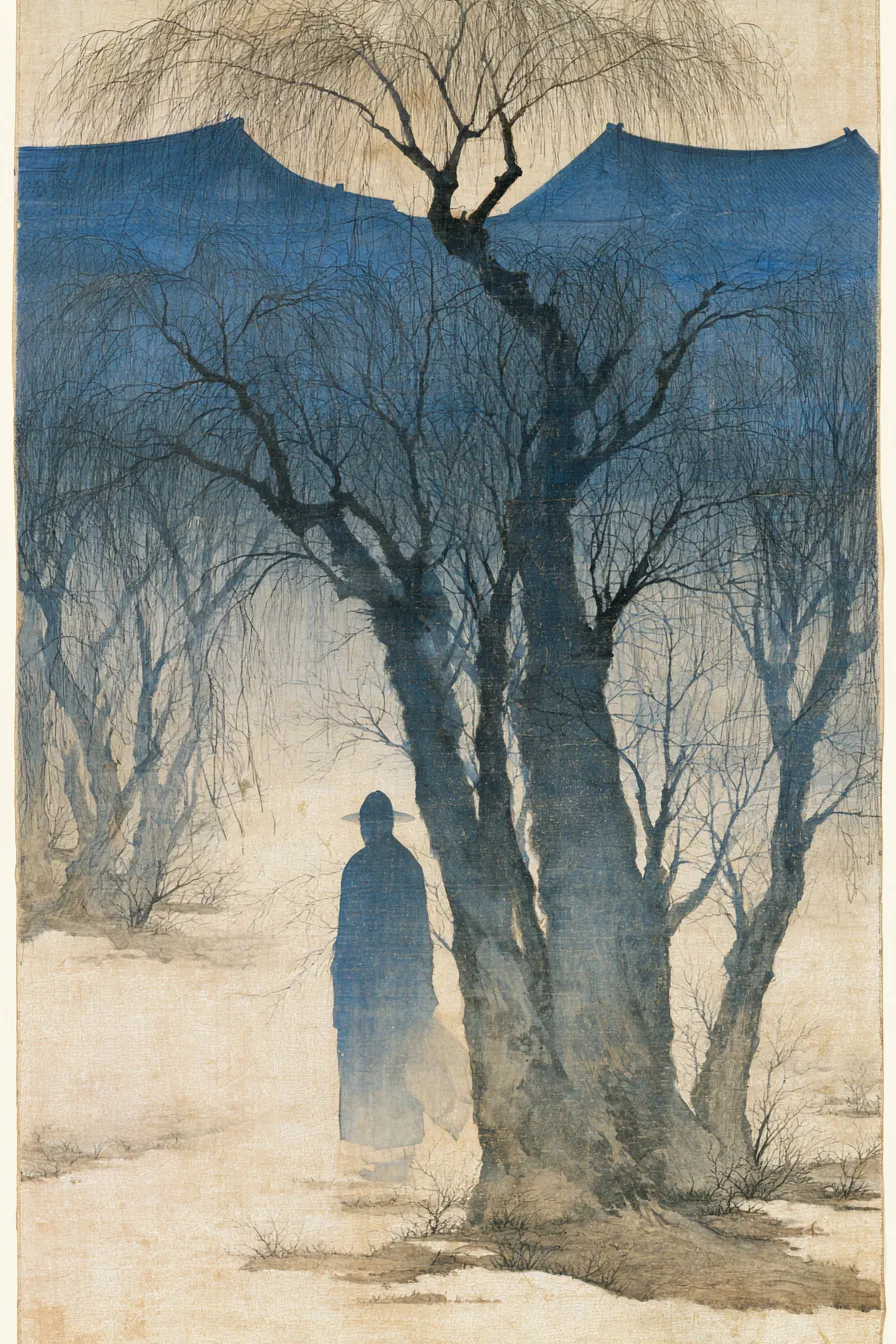
Inwangsan foothills, a wayside shrine on the eastern path. The third month of King Injo's first year, the twenty-fourth day. The snow not yet ended.
Da-eun, eighteen and three months, who has been walking since the third hour past dawn and has not, in the walking, eaten, comes through the second pass above the willow flats and into the small slow wind that announces the snow before the snow.
The wind is not, on her face, cold.
The wind is the small slow wind a mountain sends down to a small slow daughter to tell her, in the language her mother taught her on a hill in Chungcheong-do at the age of eleven, that the next thing the daughter does is going to be the thing the daughter is, in the doing, deciding. The wind, Da-eun's mother said, is the gentlest of the four warnings. The gentlest is the one to obey.
Da-eun does not, on the second pass, obey.
She has not eaten.
She has not, in five days, slept.
She has, knotted at the inside of her left wrist under the henna her mother applied with the small bone stick three days before the execution, the small white ribbon with its seven syllables of court-script wrapped against the pulse. The ribbon, this morning, is dry.
She has, in the pouch at her hip, the three things her mother insisted she carry — the small bronze knife with the willow handle, the small folded paper of jijeon dust, the small round wooden talisman with her birth-hour inked at the back. She has, in the pouch's second pocket, the four coins that are the entirety of her inheritance.
She has, at the back of her throat, the small unmoving cold weight that has been there for five days, which her mother had said, in a passing breath two summers ago in the inner court, was the weight a mudang's daughter carried in the throat when the gods had decided a thing for her and not yet, in the deciding, told her what.
The weight is heavier this morning than it was yesterday.
The wind is not, on her face, cold.
She walks on.
The snow begins on the third pass.
It begins small. It begins the way the snow above Inwangsan begins — a single flake on the back of the left wrist, a second flake on the right shoulder, the small fine third flake that lands on the eyelash and stays. Da-eun, who has been her mother's daughter long enough to count snow on instinct, counts six flakes in thirty heartbeats and stops counting. The seventh flake is the flake at which the counting stops being a counting and starts being the snow.
By the fourth pass she cannot see the path.
She knows the path is under her. She has, in seventeen years of being walked up this mountain by her mother on the small spring errands a court mudang ran in the foothills, learned the path the way she learned the patterns of her mother's hair in the morning. The path is, even invisible, under her foot. The body remembers.
The body, this morning, also does not.
The body, after five days of not eating and not sleeping and three watches of walking, is becoming a body Da-eun is no longer fully renting. The body is becoming the body a mudang's mother had said, in the kitchen on a winter morning in Da-eun's eighth year, the body became when the gods had decided to take a thing from it and the thing had not yet been agreed upon.
Da-eun keeps walking.
She keeps walking because the walking is the only thing that is, in the snow, still hers. The not-running is not, here, available. The running is also not. The walking is. She walks.
On the fifth pass the path turns east and the path goes up over the small lip of stone where, in three summers, she has come with her mother to leave a single cup of barley water for the small spirit of the spring that lives in the rock. The spirit, her mother had said, was an old creature without much language. The spirit accepted the cup. The spirit did not pour.
Da-eun stops at the rock.
She has, in the pouch, no cup. She has, in the snow, no water.
She kneels at the rock. She lays her palm flat to the stone. She says, in the small flat way her mother taught her to say a thing in a place where the spirit was older than the language: Ajumeoni. I have come up the path. I have not eaten. I have not slept. I am, on this morning, my mother's daughter. I have not, on this morning, anything else to be.
The stone is cold under her palm.
The cold does not move.
She lifts her palm. She walks on.
The shrine, when she finds it, is at the place she remembers.
It is the smallest of the wayside shrines on the eastern path — a single roofed stone hut, two wide steps, a door of split pine. She has been to this shrine once, with her mother, in the autumn of her thirteenth year, when the queen consort's jeseok had been moved to the foothills and the women of the inner court had walked up the path in the late light and stopped, at this shrine, to leave a small offering of dried persimmons. Da-eun, at thirteen, had not gone inside. She had stood at the steps with the dried persimmons in her palms and watched her mother bow at the threshold.
The shrine, now, has a lamp in it.
She can see, through the small split between the door panels, the faint orange flicker of a lamp that has been lit, and which is not, by any small grammar of the path, supposed to be lit. The shrine is unmanned. The shrine has been unmanned in this mountain's understanding since the spring of King Seonjo's twenty-eighth year. The lamp in the shrine is not the shrine's lamp.
Da-eun stops at the second pine.
She does not, for a long moment, move.
The body does not, in the stopping, move either. The body has, after five days, given the choosing back to her — for one minute, for this minute — and the choosing is hers.
She considers.
She considers turning. She considers walking back down the path and dying, between the third pass and the second, in the snow, the way a daughter who had not chosen the door dies on a mountain in the spring of the year of the new king. She considers it without horror. She considers it the way her mother considered all small finite things — by laying it flat on the kitchen table of the mind and looking at the four sides.
She does not, at the second pine, decide.
She walks up to the door.
She lays her palm flat to the pine.
She says, in the small flat way her mother taught her to say a thing in a place where the lamp inside might be the lamp of a god or a man or the small mistake of a younger pilgrim or the older mistake of an older one:
I am Yun Da-eun, the daughter of Kim Gae-hwa of the paje line of Chungcheong-do. I am coming in. I am asking, in coming in, no shelter I have not earned. I am giving, in coming in, no debt I have not the means to pay. The lamp inside is yours. I do not ask for it. I ask only that the door open.
She waits one breath.
The door opens.
The man is sitting on the floor of the shrine with his back to the small east wall and his knees folded under him in the formal kneeling-rest of a Joseon scholar. He has on a black scholar's robe and a small black headcloth and no sword and no badge of office and the boots of a man who has been three days on a mountain. The lamp is on the floor at his right knee. The lamp is the small mustard-cut lamp of a Hanyang household.
He is, on first look, twenty-eight. On second look he is sixty. On third look the looking gives up.
She has, in her body, seen this man before.
She has not, in her conscious mind, met him.
She has, however, in the four days since the execution, watched her mother's last gut in chains in the cell beneath the consort's pavilion by way of the small reconstruction the body does of a thing the body was not, at the time, in the room for. In the reconstruction the cell had a single guest in a black scholar's robe. The guest had cupped a brass kettle in his palms. The guest had not poured.
The man at the lamp does not have a brass kettle.
The man at the lamp has, on the floor at his left knee, a small flask of unglazed clay and a small pewter cup.
He does not, on her entering, stand.
He does not, also, not rise to her. He rises, in the small accumulated movement of a creature who has been waiting in a shrine for a thing for a length of time he is not, in the moment, willing to count, exactly the distance of his head to the door — a small inclination of the upper body that is, by Joseon grammar, the bow a senior gives a junior whose grief is older than the senior's own.
He says nothing.
She does not, in the doorway, bow.
She steps in. She slides the door closed.
The lamp is the only light.
He pours.
He pours from the small clay flask into the small pewter cup. The pour is not, by the cup, the pour of a man pouring for himself. The pour is the careful pour of a man pouring for a guest he has been preparing the pour for, over a length of time he is not willing to name.
He holds the cup out, two-handed, the cup held below the level of his own chin.
The two-handed offering is, by court grammar, the offering a junior makes to a senior. He is not a junior. She is not, in any register, his senior. He is, however, in the offering, giving her the courtesy.
She takes the cup.
She takes it in both her hands.
The cup is warm.
The cup is warm in a way she has not, in seventeen years of mudang-line living, encountered. The flask is unglazed clay. Unglazed clay does not hold heat. The cup is pewter. Pewter holds heat for the length of two breaths. The wine in the cup is, on the smell of it, yakju cut with the mustard-heat of a winter house. The wine is, in addition, warm in the unaccountable way the brass kettle was, in the cell, warm under his palms.
She does not drink.
She holds.
He, this time, sits back into his earlier kneeling-rest. He sets his palms on his thighs, palm-up. The Joseon scholar's gesture of opened defense.
She knows the gesture.
She has seen her mother stand into the same gesture on the kitchen floor of their small house in Chungcheong-do, in the autumn of her tenth year, when a man had come to the gate with a question Da-eun's mother had decided, in advance, would not be answered with a weapon. The gesture is, on a Joseon scholar of the inner court, the gesture of a kind of person.
The man across the lamp is, in the gesture, that kind of person.
She does not, on this knowledge, relax.
She tightens.
She tightens because the body, on the fifth day, has stopped renting itself out and has begun, in small quiet increments, to decide. The body has decided, in the doorway, that the man at the lamp is the man at the cell. The body has decided, in the cup, that the warmth in the yakju is the warmth in the brass kettle. The body has decided, in the gesture, that the man at the lamp is not, by the four warnings, going to harm her. The body has decided, in the not-harming, that the not-harming is the harm.
She drinks.
She drinks the wine in two long careful swallows the way her mother taught her, in the autumn of her ninth year, to drink a thing she did not yet know the price of. The first swallow is the swallow at which the body decides. The second swallow is the swallow at which the deciding is over.
The wine is good.
The wine is the wine of a winter house in Chungcheong, where the mustard had been ground fresh and the yakju was the small clear yakju of a farmer who had set aside the better fifth of his year's brew for a daughter he had not yet known would not, in three more years, be alive.
She drinks.
She sets the cup down on the floor of the shrine between them.
She says: Thank you, sir.
The man inclines his head.
He says nothing.
They sit.
They sit for the length of the small mustard lamp's burning down by one finger. The snow is on the roof of the shrine. The snow is on the path. The snow is, by the small auditory grammar Da-eun has been taught to attend to, beginning to drift over the second pass, and the second pass is the pass back. The pass back is, by the fourth hour of the snow, closing. The pass back is, by the fifth hour, closed.
She does not, on the floor of the shrine, ask his name.
He does not, on the floor of the shrine, give it.
He pours a second cup.
This time he does not offer it. He sets it, two-handed, on the floor halfway between them. He returns his palms to his thighs.
She picks it up.
She drinks.
She sets it down.
He says, on the third pouring — the only word he has spoken since she came in —:
Choongbun-hada.
Sufficient.
She knows the word. The word is the word her mother used, in the autumn of her ninth year, on the kitchen floor, when the man at the gate had given the answer her mother had decided in advance would be the answer. Choongbun-hada. It is sufficient. It is, hidden inside, the word cha. To cut. The thing the man at the gate said was sufficient — cut to the size of the wound it had to dress.
He, the man at the lamp on this mountain in this snow on the third day of the third month, is saying the same word in the same register.
She does not, at the third cup, drink.
She looks at him.
He returns the look. He does not avert. He does not, also, intensify it. He looks at her in the small flat way her mother used to look at the kettle on the brazier in the cell beneath the consort's pavilion — as if to a creature whose attention he had earned, by a long quiet patience he was not going to advertise.
She says: Sir. The pass back is closing.
He says: I know, daughter.
The word daughter — ddal-ah — lands in the small unheated air of the shrine and does the work of three days of not having been named anything but fugitive and mudang-orphan and the one who got out. The word is not a flattery. The word is a small precise placing of her, in this shrine, in the small accurate position of a person whose mother is dead and whose father, dead seven years, is also dead, and whose only living adult in any room is the one currently across the lamp from her.
She does not, in the placing, relax.
She does, however, breathe out.
The breathing out is the second time, on the fifth day, the body has agreed to release a thing. The first time was the cup.
He says, into the breath: I will not, in the night, take. I will not, in the morning, pursue. I am, in this shrine, a creature on a small patient errand of my own, and I have been on it for a length of time you do not need to be told.
She says: Sir.
She says: I would prefer, in the night, not to be touched.
He says: Yes.
He pours, this time, for himself. He drinks. He sets the cup down. He does not, on his side of the lamp, move.
He does not, for the rest of the night, move.
In the smallest hour she sleeps.
She sleeps with her back to the west wall of the shrine. She sleeps with her left wrist tucked under her right palm at her throat — the ribbon at the wrist under the palm, the palm at the throat, the throat at the small steady cold that has, on the fifth day, decided to lay itself down for an hour.
The man on the other side of the lamp does not sleep.
She knows he does not sleep, in the small flat way one knows of a creature in a shrine when one's mother has been a mudang and one's own body has, in five days, become a body that knows things. He does not sleep. He keeps the lamp. He keeps, at the door, the small inaudible patience of a watchman who is, in the watching, neither protecting nor preventing. He is, on his side of the lamp, simply at his post.
At the third watch — the watch the snow falls hardest, the watch the lamp goes down to its last thumb of oil — she wakes once.
She wakes to a small flicker of warmth on the inside of her left wrist where the ribbon is.
The warmth is not the warmth of the cup.
The warmth is the warmth of a thing that has, in her sleep, been read.
She lifts her wrist. She holds it close to the lamp.
The ribbon, under the henna, is dry. The seven syllables her grandmother taught her mother and her mother taught her are, under the henna, in their small knotted court-script.
She lowers the wrist.
She looks across the lamp.
The man is looking at the door. He is not looking at her. He is, in the not-looking, doing her the small courtesy he has done her in the gesture and in the pour and in the not-pursuing — the courtesy of letting her, in her own waking, decide whether to ask the question.
She does not, at the third watch, ask.
She lays the wrist back at the throat.
She sleeps.
In the morning the lamp is out and the man is, on his side of the floor, in the same kneeling-rest she found him in.
He has, in the night, set out on the floor between them a small folded mulberry paper.
She unfolds the paper.
The paper contains, in a careful old-fashioned hand, four lines.
Daughter of Kim Gae-hwa of the paje line. The pass back is, this morning, closed for three days. I will go down the eastern path at the second hour. The shrine is, after my going, yours. There are, in the box under the floorboard at the north corner, three days of dried persimmons and one small jar of bean paste and a clay pot of barley. There is, in the smaller box behind the smaller box, a single woman's robe and a single woman's sash. The robe was my mother's. My mother has been dead, by the count of the small calendar I keep, four hundred and ten years.
She reads the four lines twice.
She refolds the paper.
She looks across the lamp.
The man inclines his head, the same inclination of yesterday, the bow a senior gives a junior whose grief is older than his own.
He says, in the small clear unembarrassed voice of a creature who has, in the quiet of the night, made his decision and is, in the morning, informing her of it:
Daughter. I am called Yi-jun. The other names of mine you may, on this mountain, hear in the next three days are not mine in the way Yi-jun is mine. Yi-jun is the name my mother gave me. I have not used it in three centuries. I am, in the act of giving it to you, lending it to you for the duration of this snow.
He pauses.
He says:
Geu-rae-i ji-eum-iyeotgu-na.
So it has, after all, been the time.
The -gu-na ending lands in the small cold dawn-air of the shrine the way her mother's -gu-na used to land on the kitchen floor in Chungcheong — the small ending a Joseon scholar uses to mark a thing he is, in the act of speech, just now realizing. The man at the lamp has, on his side of the lamp, just now realized.
She does not, on her side of the lamp, ask what.
She lays the folded paper at her knee. She bows.
She bows the small careful bow of a junior receiving, in the morning, the small careful lending of a name from a senior who has, for the duration of the snow, agreed to be the senior.
He rises.
He goes to the door. He slides it. The snow falls past in the small white slow falling that is, by Da-eun's mountain-reading, the snow that has decided to last.
He turns. He looks back at her once. He says:
I will, at the second hour, come back with a sack of charcoal and a small wrapped jeotgal the woman at the foot of the path keeps for me in the winter. The food I have left under the floor will not, by Tuesday, be enough. I will return with the charcoal and the jeotgal and one further small thing, and I will set them at the second pine and I will not, in the leaving, come in. You are, in the shrine, the resident. I am, in the morning, the messenger.
She says: Yes, sir.
He bows. He goes out.
She slides the door behind him.
In the silence she sits.
She sits the way her mother taught her to sit when a thing had, in the night, been read on her body without her permission and the reading had not, in the reading, harmed her.
She sits for one breath.
She sits for two.
She sits for the small count her mother had given her once in the autumn of her eleventh year, on the kitchen floor of the small house in Chungcheong-do, when the man at the gate had given the answer her mother had decided in advance and the answer had been choongbun-hada and her mother had then sat at the kitchen table for the count of forty breaths before she had, on the forty-first, moved.
On the forty-first breath Da-eun moves.
She unwraps the henna at her left wrist.
She unties the small white ribbon her mother passed her at the moment the executioner's hands took her mother by the shoulders.
She lays the ribbon flat on the floor of the shrine in the small fading-warm circle the lamp's last oil has left.
She reads, in the small mudang-script her mother taught her in the autumn of her seventh year on a riverbank in Chungcheong-do, the seven syllables.
The seven syllables say:
Cheonbeon jugyeotdaedo, hanbeon-eun gat-eul-ji-ni.
Even a thousand killings, one will return.
She has, in five days, not read the ribbon.
She reads it now.
She lays the palm of her right hand flat over the seven syllables.
She does not, in the laying, weep.
She does not, in the laying, speak.
She does, in the laying, decide.
The deciding is small. The deciding is exactly the size of a small white ribbon under a palm in the smallest hour of the second day of a snow on a mountain east of a city in which her mother had, four days earlier, been executed by a man who would, in the count of four hundred and three autumns the man on the other side of the lamp had let slip in the morning, not be the only man.
She lifts the palm.
She folds the ribbon, four times, on the four lines of her mother's wrist-script.
She slides it under the henna she has already broken, and she ties the henna again — not with the bone stick her mother used, which is in the pouch, but with the small careful tying her own fingers, this morning, on a mountain east of Hanyang, in the second snow of King Injo's first year, decide.
She sits with the wrist in her lap.
She waits for the second hour.
She waits for the man at the second pine.
She does not, on the floor of the shrine, know whose daughter she will be by the end of the snow.
She knows only that she is, on the floor of the shrine on the second day of the snow on a mountain east of a city that has, in five days, eaten her mother and her name and the small clear unembarrassed Chungcheong-do childhood she had carried into the inner court at the age of eight, still her mother's daughter.
She does not, this morning, ask the gods for more.
She sets the wrist down.
She breathes.
In the box under the floorboard at the north corner there are, as promised, three days of dried persimmons.
She eats one.
She eats it slowly.
She eats it the way her mother taught her, in the autumn of her seventh year, to eat a thing a senior had left for her in a kitchen the senior had decided to leave.
The persimmon is sweet.
The body, on the sixth day, accepts it.