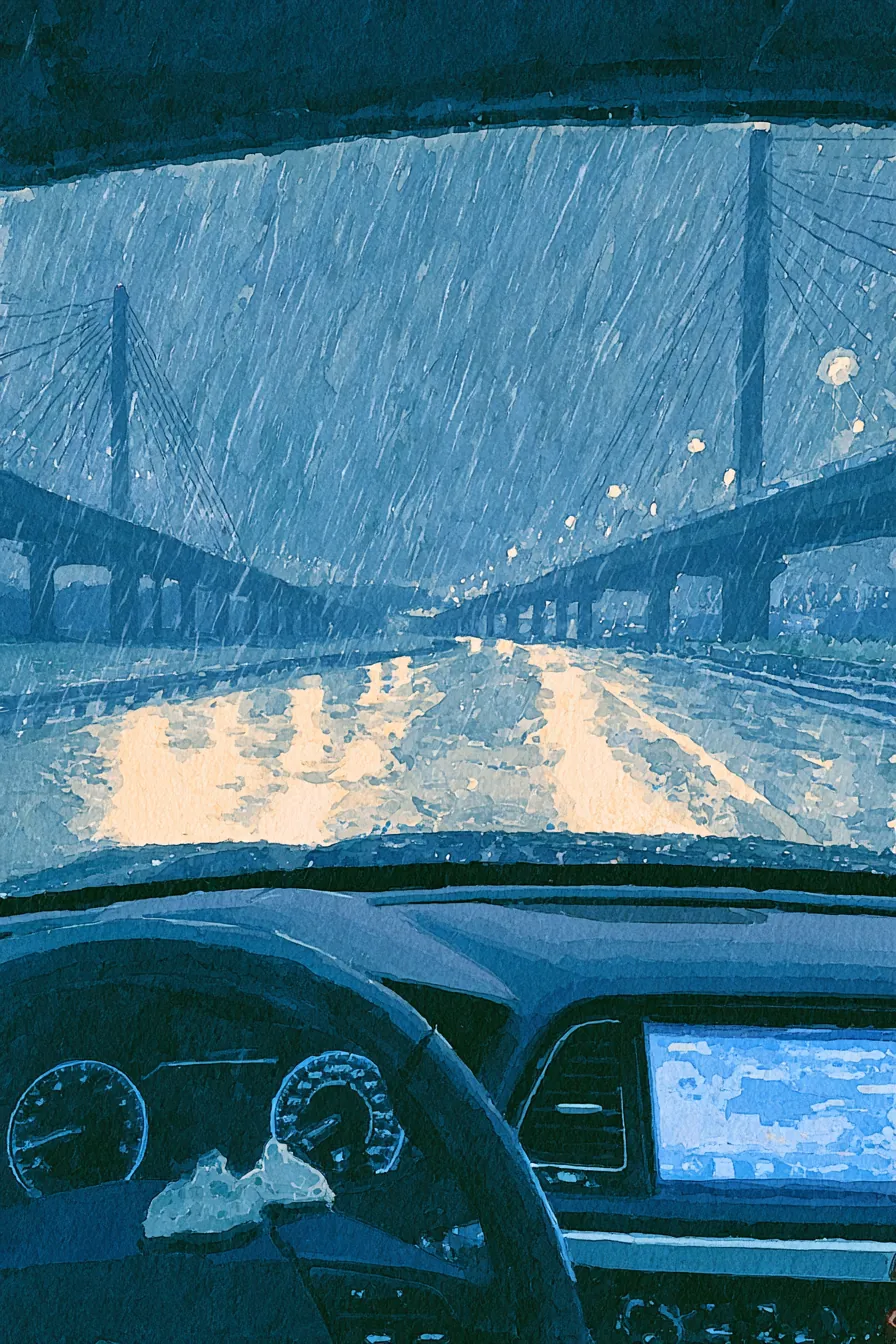
Chapter Sixteen
Han River, Banpo Bridge underpass, then the lane east of the Yongsan rail yards. March 12, 2026. 11:38 p.m.
He picked me up at the concrete loading-dock behind the JL building because I had told him, on the fourth floor at five-fifty-three p.m., that the Banpo Bridge underpass at the late hour would be a thing I wanted, by my own count, to see with him in it.
He had said, on the floor, Yes, Han-ssi.
He had said it in the polite jondaetmal he used with the entire fourth floor on the matter of work product, and he had said it loud enough that the analyst on the desk three feet from mine had looked up from his monitor for half a second and looked back down. The grammar of the saying had been clean. It had not, in the loud-enough, made me a thing the fourth floor was going to put up on the chat the analyst's wife ran. The chat had not been put up on. I had checked.
I had finished the last edit to the Q2 deck at seven-eleven, the way I had been finishing decks for the past fourteen months, by sitting in the long flat slow attention of a Stanford-trained gyopo at the end of a Thursday. I had put on the gray Theory coat. I had taken the elevator down. I had not, in the elevator, run into him. He had been, by his own discipline, on the seventh floor.
He had come down to the loading-dock at eleven-thirty-six in the black Genesis.
I had been waiting four minutes.
The wait had been the wait of a young Korean woman in a coat at the back of a building at a late hour, hands in her pockets, breath visible in the late-winter air — a woman who had agreed, two weeks earlier, not to live in dread of a Thursday turning into a Friday.
He pulled up. He did not, on the pulling up, open the passenger door from the inside. He got out. He came around the bonnet. He opened the door. He did not, in the opening, offer his hand. He stepped half a pace back and waited at the lip of the lane until I was in the seat and had reached, of my own arm, for the seatbelt.
He closed the door.
He went around. He got in. He did not, on getting in, speak.
He drove.
The Genesis was warm.
It was warm in the over-engineered way the cabin of a German-coded Korean executive sedan is warm at the eleven-forty hour on a March night, when the chairman of the company is — for the seventh time in the four-month tenure of his junior A&R — taking her out of the city on a road she had asked him for.
The dashboard threw its low green glow. The Spotify on the auxiliary jack was off. He had cued, by his own quiet discipline, only the hum of the engine and the hum of the heated seat. He had not, on the road, said anything since Yes, Han-ssi.
I had not, in the seat, said anything either.
We went over the Hannam Bridge at eleven-forty-three. The Hangang was on both sides — the long bones of light I had thought, four months earlier at the welcome hwesik above the river, were the bridges I would be looking at for the rest of my Seoul tenure. The bones had not moved. The river ran black and steady beneath them, carrying a city's light the way it had for two thousand four hundred years.
He took the Olympic-daero east.
He took the ramp down at the Banpo interchange.
At eleven-fifty-one he pulled off the under-bridge lane and parked on the flat asphalt strip where, on a Saturday in July, the chimaek boys spread out their blue plastic tarps and the makgeolli girls plug their portable speakers into the grid-points. The strip, on a Thursday night in March, was empty.
He cut the engine.
He did not, in the cutting, take the key from the steering column.
He sat.
I sat.
The river ran black under the bridge. The bridge stood twenty meters above us. The cars passed, far away. The under-bridge sodium lamps threw down their ungenerous yellow light. There was a man three hundred meters to our left, walking a white dog under the second pylon. The dog did its ten seconds of mortgage-paying business and walked, unbothered, on.
He said, after a long pause: Han-ssi.
I said: Yes.
Why this lane.
I said: Because it is, by the accumulated grammar of my life in Seoul, the lane the screaming woman has been at.
He turned. He looked at me. He did not, on the looking, react.
He said: I see.
I said: I have not, in the four months since the night of the welcome hwesik, walked down Itaewon-ro at the late hour without hearing, somewhere behind the concrete pylons of the Noksapyeong overpass, a woman screaming in 1623 Korean. I have not, in the four months, said this aloud to any person. I am, this evening, saying it aloud. To you. In a car. Under a bridge. At eleven-fifty-three on a Thursday night in March of 2026.
He did not, for one long beat, breathe.
He said, very quietly: Han-ssi. Thank you for the saying.
The woman is —
The woman is me. By my own count. By Inwangsan-sanshin's count on a Thursday morning at a pine bench. By the count of an eight-panel folding screen in a Bukchon hanok on a Tuesday in late February. The woman is me. I am no longer asking, sajangnim, whether the woman is me.
What I am asking, sajangnim — in the car, on the strip, on a Thursday in March — what I am asking is whether the woman, in the four months I have been hearing her, has been screaming at me or screaming for me.
He did not, on the heated seat of the Genesis, move.
He said, after a careful pause: Han-ssi. The woman is not, by my reading of her, screaming at you.
She is screaming for you.
She has been screaming for you, by my count, since the seventh of the fifth month of the first year of King Injo's reign. She has been screaming the two-syllable name your mother in 1623 gave her in the autumn of her seventh year. The two syllables are the two syllables I had not, in my four hundred years, been permitted by my own discipline to say aloud at the entrance of any concrete pylon of any overpass in any Korean city. The two syllables are Da-eun. The woman has been screaming Da-eun. The screaming has been for you, Han-ssi, in the way a calling is for the person whose name the caller has been keeping, in the body, for four hundred and three winters.
I had — in the careful breathing I had been doing on the heated seat — stopped breathing somewhere in the second sentence.
I said: Sajangnim.
The screaming is going to stop.
The screaming is going to stop because you have, on the strip, in the car, said the two syllables in my hearing. The body had been waiting, in the four months, for a senior who knew the two syllables to say them in front of me. You have said them. The body has heard them.
The body — and I am, on the seat, telling you in advance, because you are now a person to whom these things will be told in advance — the body, in the not-screaming, is going to sit in the seat for a long minute and not say anything.
The body sat in the seat for a long minute.
The body did not say anything.
It listened to the under-bridge wind. It listened to the unhurried twelve-bar rhythm of headlights crossing the Olympic-daero forty meters away. It listened to the private engine of an older Korean creature who had, across four hundred and three years, paid it the courtesy of not saying the two syllables in its hearing until it had asked.
The body, in the minute and twelve seconds of silence, did not weep.
It had, since Sunday afternoon at the low table, learned to reserve weeping for a Sunday that was — by the grammar of a working-with-him week — no longer the only Sunday available.
He, after the minute and twelve seconds, very softly — in the Korean of an older creature who has had four centuries to learn how to say the next thing without making the saying the awkward weight that ends a silence — said:
Han-ssi. I have, in the back of the Genesis, a thing. The thing is a packet of hodu-gwaja from the old Cheonan-style hodu-gwaja stall my mother used to bring up to the third-floor Bukchon hanok in the autumn of my sixth year. The stall has, since 1986, stood outside the Cheonan station. It is run by the third-generation daughter of the original stall-keeper. I called her at four-twelve this afternoon. She mailed up a box of six hodu-gwaja by motorbike at six-forty. The box arrived at the JL building at eight-fifty-three. The hodu-gwaja are warm. They are, by the accumulated grammar of a Thursday-into-Friday on the strip, the only hodu-gwaja in the city of Seoul.
I said: Sajangnim.
Give me one.
He turned. He reached into the back seat. He came back with a folded brown-paper bag, which he had set on a folded white linen napkin laid out on the seat for the purpose. The napkin had a hand-stitched chrysanthemum in the corner. The chrysanthemum was the one that had been on Min-ji's lap in the noraebang on Saturday and on Min-ji's window-table since.
The pocket-square was not Min-ji's pocket-square.
It was a second one, identically made.
I did not, in the seeing, comment.
He set the brown-paper bag on the console between us.
He unfolded the top.
He took out, with two-handed care, one hodu-gwaja.
He held it out.
He held it out in the unhurried Joseon-scholar pour I had watched him do on a celadon cup on a Tuesday afternoon in the Bukchon anbang, on a brass kettle on a Friday morning in the chairman's office, on an earthenware cup of cold buckwheat tea in front of an old man in a quilted vest on Inwangsan on a Thursday morning.
He held the hodu-gwaja two-handed. He held it below the level of his own chin.
The hodu-gwaja was warm.
It was warm in the way the brass cup had been warm in the Bukchon hanok on a Sunday afternoon, and in the way the brass cup had been warm in a wayside shrine on a mountain east of Hanyang in the fourth month of the first year of King Injo's reign.
I took it.
I took it in both hands.
I bit it.
It was hodu-gwaja, plainly. Pressed walnut and bean paste, sweet and flat, in a thin glutinous-rice shell. It was the hodu-gwaja of my mother in Cupertino on the Sunday afternoons of my eighth and ninth years, when she had been able — by way of a Daejeon-coded niece in Seoul who had been able, by way of a Cheonan-coded cousin of her grandfather's — to mail a box of six across the Pacific. It was the hodu-gwaja Halmoni Yun had been mailing my mother for thirty-eight years.
I did not, in the biting, weep.
I had reserved weeping. The reservation was holding.
I held out the half-eaten hodu-gwaja.
I held it out two-handed.
I held it out below the level of my own chin.
He looked at me. He looked at the hodu-gwaja. He looked back at me.
He said, very softly: Han-ssi.
I said: Eat.
He took the half-eaten hodu-gwaja.
He took it in both hands.
He bit it.
He ate it slowly, the way he ate any mortal sweet — the careful chewing of a creature who had, in his own four-hundred-year ledger, decided that the sweet of a mortal kitchen was a thing he would give the honesty of his full attention.
He finished it.
He did not, in the eating, look away from me.
He swallowed.
He set his hands palm-down on his thighs.
He said: Han-ssi.
I have not, in four hundred years, eaten half of a hodu-gwaja a young Korean woman started before me. I have not, also, given a young Korean woman a hodu-gwaja she had asked me to bring up. The bringing-up was, by my own discipline, mine. The eating of half was, by your discipline, yours. The eating of the other half was, by the accumulated grammar of the bringing-up and the eating-of-half, mine.
I am —
He stopped.
He looked, briefly, at the windshield.
The Olympic-daero, forty meters away, did its honest twelve-bar work of carrying the headlights of a Thursday night across the river.
He said: I am, on the strip, at eleven-fifty-eight, asking your permission to do a thing I have not asked any hodu-gwaja-sharing companion for in four hundred years.
I said: Ask.
He said: I would like, Han-ssi, to lean across the console of the Genesis and place my mouth, at whatever angle the console permits, against the angle of your mouth, for the count of one breath. I would not, in the placing, touch you with my hand. I would not, in the breath, ask of you what is not, by the grammar of the night, mine to ask. I would, on the breath, return to my side of the console.
I said: Sajangnim.
Why are you asking.
He said: Because I have, since the elevator on the twenty-third of February, been training the body of a creature older than you — a body that has, by long discipline, not asked. The body has, on the strip, asked. I am, on its asking, asking on its behalf. This is, by my registers, a new kind of asking. I do not want to ruin it by failing to ask.
I sat in the heated seat of the Genesis at eleven-fifty-nine on the strip under the Banpo Bridge in March of 2026 and listened to the under-bridge wind and the under-engine of an older Korean creature who had, in the asking, asked.
I had, in the four months, not been asked for a single thing. I had taken the brass cup. I had laid the palm of my hand on the back of his hand at the laminate of a noraebang couch. I had said I am deciding to work with you and had bowed forty-five degrees and had walked down a Bukchon hill with my best friend on my arm, and the deciding had been mine, and the deciding had not been a thing I asked his permission to do.
He had not, in the four months, asked me for a thing.
He was asking now.
I said: Sajangnim. Lean.
He, very slowly, very carefully, leaned across the console of the Genesis.
I, very slowly, very carefully, leaned across from my side.
The console of the Genesis was, by the manufacturer's measurement, twenty-eight centimeters wide. The leaning, from each side, was fourteen centimeters of an older creature in a wool coat and fourteen centimeters of a younger creature in a Theory coat at the breath of an under-bridge in Seoul in March of 2026.
His mouth met my mouth for the count of one breath.
The mouth was warm.
It was the mouth of an older creature whose steady cold under the tongue had, in the four months since the elevator, been agreeing to be not-cold for thirty seconds at a stretch.
The mouth — the warmth — did not, on the breath, ask for the second breath.
He pulled back.
He returned to his side of the console.
He set his hands on the steering wheel.
He did not, on the returning, look at me.
The non-looking was the courtesy.
I sat in the seat.
I breathed.
The hodu-gwaja was finished.
The Genesis was warm.
The river was cold.
I said, after a pause: Sajangnim.
Why did you not, on the leaning, ask for the second breath.
He did not, for a long beat, answer.
He said, very quietly: Han-ssi. Because if I kiss you a second breath, I will tell you a thing. The thing is the thing that will, in the telling, make you hate me for a length of time I have not yet earned the patience for. I have not, on a Thursday at midnight on a strip under the Banpo Bridge, the bravery the second breath would ask of me. I would like to have it. I do not yet have it. I am asking you to wait for me to have it.
I said: Sajangnim.
What is the thing.
A long pause.
He said: Han-ssi. The thing is the grammar in which a young Korean woman of the paje line, in the spring of the first year of King Injo's reign, died on the snow of a mountain east of Hanyang at the iron of a wrong knife at her throat. The thing is the count of the strokes. The thing is the count of the men. The thing is the count of the things the creature attending to her — drawn off, on the day, by a false signal — was not in the room for.
He paused.
He said: The thing, Han-ssi, is the count of the things I am, by the unbearable arithmetic of a four-hundred-year creature, the one who did not arrive.
I sat in the seat.
I did not, in the sitting, weep.
I said: Sajangnim.
Drive me home.
He started the Genesis. He turned the key in the steering column. He pulled out, very carefully, off the strip and onto the under-bridge lane. He climbed the ramp back onto the Olympic-daero. He took the unhurried Thursday-night driver's-side route along the river and over the Banpo Bridge and up Itaewon-ro and into the dim alley of my officetel at twelve-twenty-one.
He did not, in the car, speak.
I did not, in the car, speak either.
At the lit-up alley-mouth of my building he stopped the Genesis. He did not, in the stopping, get out.
He turned slightly toward me. He did not, in the turning, look at me. He looked at the fixed point three centimeters above my left shoulder — the point, by his now-established Joseon-scholar grammar, an older creature looked at when he was doing me the courtesy of leaving me the private accounting of my next breath.
He said: Han-ssi.
The bravery —
The bravery, by my count, is going to arrive. I cannot tell you on what day. I can tell you it is going to be at the low table of the Bukchon hanok, on a Sunday I will not, in advance, know is the Sunday. When it arrives, I will ask you to come up the hill on foot, the way you came up on the first of March, and I will, at the gate, open it myself, and we will sit at the low table, and I will tell you. I will not, in the telling, ask of you a thing you have not already agreed to be ready for.
Until the bravery —
— I am, on the strip, going to be the flat working chairman in the polite jondaetmal of the entire fourth floor. I am, also, on the strip, going to be the man who, in four hundred years, has been waiting for a Joseon-coded permission from a young Korean woman whose mouth I have, on the count of one breath, met across the console of a Genesis under the Banpo Bridge on a Thursday at midnight in March of 2026.
The two are not, in the same person, contradictory.
They are not, also, the same person.
Han-ssi.
Go up.
I got out of the Genesis. I closed the door, very carefully, the way one closes the door of a Korean executive sedan at twelve-twenty-three on a Thursday night when one is leaving in it the man one has, by the breath of one breath, decided to wait for.
I bowed. Fifteen degrees. The bow a guest gives a host at the end of a private under-bridge evening.
He bowed, through the windshield. Fifteen degrees.
He pulled the Genesis away.
The ungenerous yellow alley-light of my Itaewon officetel building did the work it had been doing every Thursday night since the autumn of my twenty-fifth year.
I went up.
In the officetel I did not, in the kitchen, eat. I did not, in the bathroom, shower. I did not, in the anbang the building called a studio, turn on the lamp.
I sat on the foot of the bed in the dark.
I set my hands palm-up on my thighs.
I breathed.
The mouth, on the breath, was still the mouth. The warmth was still in the steady channel under the steady cold under the collarbone, where my mother had taught me, in the spring of my ninth year, the long high note lived.
I did not, in the dark, weep.
I had, on the strip, reserved weeping. I had reserved it for the Sunday at the low table on which an older creature would, by the careful accumulated grammar of his asking, finally tell me the count of the strokes and the count of the men and the count of the things he had not, on the day, been in the room for.
I would, on that Sunday, give the weeping. I would give it cleanly. I would give it the way my mother had given a man at her gate the flat choongbun-hada in the autumn of my ninth year — hands folded, in the private grammar of a Chungcheong-coded Korean woman who had decided in advance the kind of weeping the moment would ask for.
I would not, on the Sunday, hate him.
I would not, on the Sunday, also forgive him.
The forgiving was — and I understood this on the dark foot of my Itaewon bed at twelve-thirty-one a.m. on a Friday in March of 2026 — not on the list of things the Joseon-mother grammar of the night had agreed I would, on the Sunday, be ready to do.
The Sunday was, by the grammar of a Thursday under a bridge, going to be a Sunday on which I held the forgiving back.
I would hand the forgiving, the way my mother in 1623 had told her daughter, on the white ribbon, to hand it — forward.
I did not, on the foot of the bed, know to whom.
I knew only that the forwarding was the thing my line — by way of a Cupertino kitchen and a Chungcheong-do riverbank and a Daejeon herb garden — had been teaching me to do since the autumn of my seventh year.
I unbuttoned the gray Theory coat.
I hung it on the back of the chair.
I lay down on the bed in the dark.
I slept.
I did not dream.
I did not, in the not-dreaming, take it as a victory.
I took it, as I had on the floor of Min-ji's one-room nine days earlier, as the first night of a new ordinary that was going to be, by the slow accumulated grammar of the spring of my twenty-sixth year, the rarest thing in my life.
In the Genesis on the way back to Bukchon he drove with both hands on the wheel and the radio off and the engine doing the under-engine work of an older Korean executive sedan at a late hour.
He took the Hannam Bridge.
He took the hill into Bukchon.
He parked the Genesis on the Gye-dong slope at twelve-fifty-three.
He sat for a long minute with the engine off and his hands on the wheel.
He said, into the dark of the Genesis, in the clear voice of a creature who had, on a Thursday at midnight on a strip under the Banpo Bridge, been given a new word by a young Korean woman whose mouth he had, on the count of one breath, met across the console:
Da-eun-ah.
He had not, since the seventh of the fifth month of the first year of King Injo's reign, said the two syllables in an empty Genesis on a Bukchon slope at twelve-fifty-three in the morning.
He said them now.
He said: Da-eun-ah. The bravery is coming.
The Genesis, cooling, ticked.
He got out.
He locked the Genesis with the key.
He walked up the Bukchon slope to the dark pine gate.
He opened the gate himself.
He went in.
He did not, on the heated ondol floor of the sarangbang, sleep.
He sat with his back against the western cabinet where the cedar box for the marble had been, in seventy-three years, kept empty.
He breathed.
He breathed the careful breath of an older creature who had, on the count of one breath, kissed a young Korean woman across the console of a Genesis under the Banpo Bridge in March of 2026, and who had, in the not-asking for the second breath, kept the bravery for the Sunday he was going to have to earn.
He sat.
He waited for the dawn.
The dawn came up over the dark roof of the middle hanok at five-forty-seven.
The thumbprint on the underside of the eastern lintel — pressed there in the third month of the first year of King Injo's reign by a man who had not, at the time, known the woman would be the woman — was, in the early March dawn, the thumbprint it had always been.
He looked, briefly, at the lintel.
He bowed Fifteen degrees.
He went to make tea.