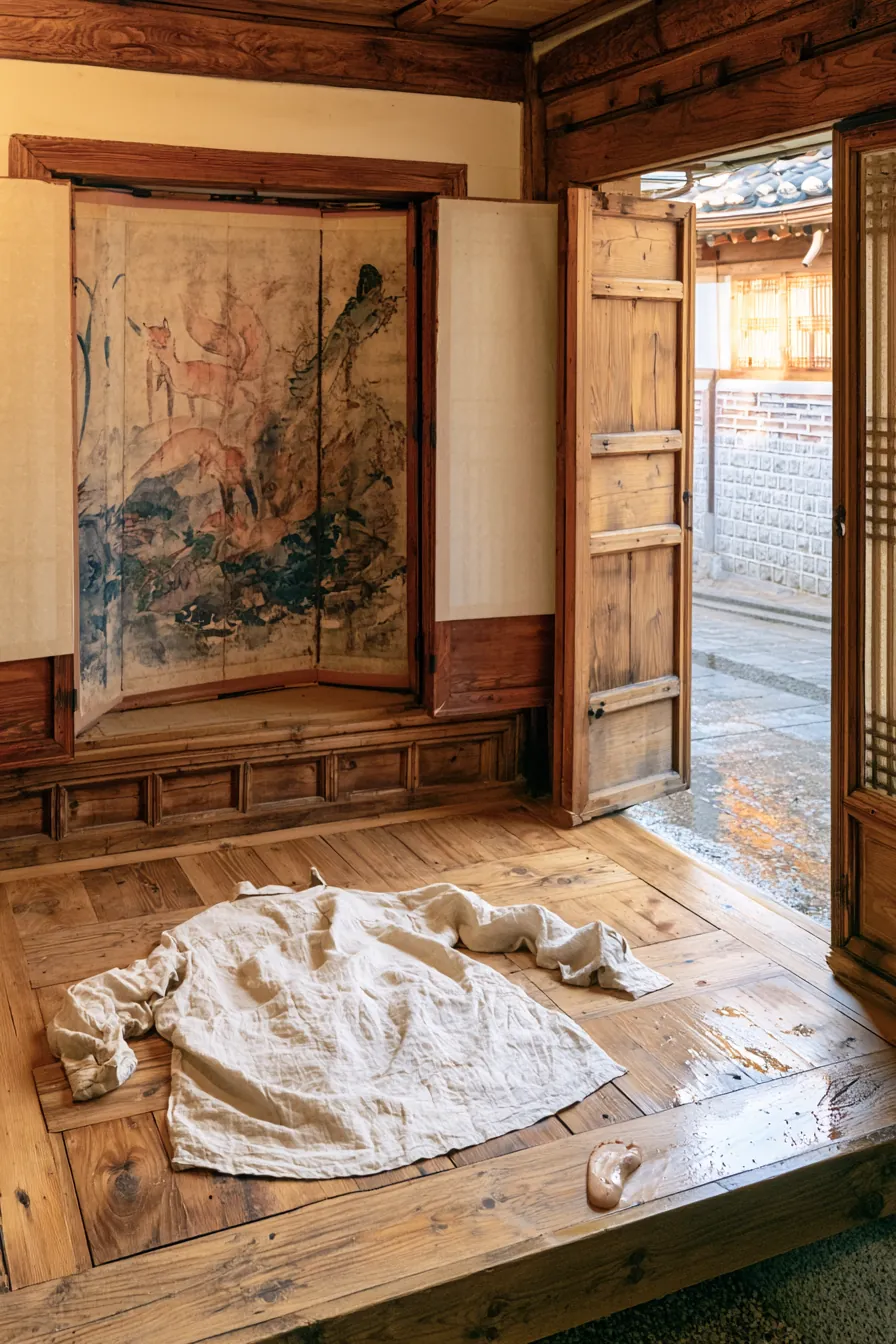
Chapter Twenty
I woke at four-eleven in the morning on the folded futon at the heated ondol of the anbang of the middle hanok of the Bukchon compound, with the warm of his right hand still at my lower back and the warm of his own lower back still under my left hand, and the steady warm of the marble under his tongue against the steady warm under my own collarbone where the long high note had been living since the spring of my ninth year on the kitchen sink in Cupertino.
I woke not to a sound.
I woke to a taste.
The taste was at the back of my throat.
The taste was iron.
It was iron the way iron tastes on the back of the tongue when a mortal Korean body has — in the grey hour before dawn, on the morning after the further piece and the old name Geo-rin and the one sentence at five-twelve — finally been given by its own careful Joseon-mother body the memory the one piece had not, on the saying-on-the-table, returned.
The taste was the taste of a wrong knife.
The wrong knife was the un-sterilized iron of a village butcher's blade — not the clean ceremonial knife of a Joseon-court executioner of the paje line, not the clean steel of a court sword, but the wrong iron of a village butcher's knife that a junior body of the Westerners' faction had, on the seventh of the fifth month of the first year of King Injo's reign, picked up at the butcher's stall on the lower path of Inwangsan as he came up the east shoulder with the order signed at the lower court at six-forty-three in the morning by the Joseon scholar Yi Hwan of the Westerners' faction.
The wrong knife had a notch on the edge.
The notch was at the eight-millimeter point from the tip.
The notch had been put into the edge by the village butcher in the autumn of the previous year on the neck of a winter pig, and the butcher had not — by the economy of a village butcher — taken the knife to the flat stone in the back of his stall to sharpen it in the seven months since.
The wrong knife had cut, on the seventh of the fifth month of the first year of King Injo's reign, the slit on the left side of my own neck — the wrong cut of a butcher's knife in the wrong hand of a junior body of the Westerners' faction, on the snow of a slope above the willow grove at the foot of the east shoulder of Inwangsan, at the ten-fifty-one hour of the morning of a wrong day in the spring of King Injo's first year.
The wrong knife had cut the slit to a depth of forty-one millimeters and a width of twenty-two centimeters in the eleven seconds it had taken the junior body of the Westerners' faction to do the work.
The slit had bled.
The slit had bled for the seven minutes the junior body of the Westerners' faction had stood on the slope above the willow grove watching the work bleed out.
I had, on the wrong day, been awake for those seven minutes.
I had, on the wrong day, watched the clear winter sky of the east shoulder of Inwangsan at eleven-oh-three in the morning of the seventh of the fifth month of the first year of King Injo's reign through the clear eyes of a Joseon-court mudang's daughter of the paje line of Chungcheong-do who had, at the eight-millimeter point from the tip of the village butcher's knife, just been given the slit.
I had not, on the wrong day, screamed.
The slit had cut the careful Joseon-mother grammar of the high voice of the mudang's daughter at the depth that included the lower part of the voice-grammar her mother had taught her, on the kitchen floor of the house in Chungcheong-do in the autumn of her ninth year, to draw the long high note from.
The slit had cut the long high note.
The long high note had, on the wrong day, not come out.
It had come out only as the un-vowelled breath of a Joseon mudang's daughter of the paje line who had, on that breath, been carrying the private call of her own line for the seven minutes she had — in the grey hour before dawn of a Sunday morning in March of 2026 — just been given by her own Korean body the full memory of.
The private call of her own line, on the un-vowelled breath of a Joseon mudang's daughter on the slope above the willow grove at eleven-oh-three on the morning of the seventh of the fifth month, had not, on the day, been heard by the creature whose hundred-and-seventy-three-year discipline had been the discipline of the call.
The creature, on the day, had been on the south path.
The creature, on the day, had been listening to a carved wooden bell with a carved wooden clapper at the lower shrine of the south path.
The private call of the paje line, on the un-vowelled breath of a Joseon mudang's daughter on the slope above the willow grove of the east shoulder of Inwangsan at eleven-oh-three on the morning of the seventh of the fifth month, had carried — to a creature who, drawn off by the carved wooden bell on the south path, had not, on the day, arrived.
I sat up on the folded futon at four-eleven in the morning on a Sunday in March of 2026.
The warm of his right hand fell from my lower back by the careful sleeping discipline of an older creature who had, in seventy-three years, learned not — in the sleeping of a mortal Korean woman whose throat had, on the day, been the throat of the private call — to wake her by the falling of his hand.
I sat up.
I looked at the western wall of the anbang in the grey hour before dawn.
I looked at the low pine cabinet above which the low pine shelf had, for seventy-three years, held the cedar box.
I looked at the cabinet into which the box had been put back at five-oh-four the night before, after the further piece and the saying-on-the-table.
I looked at the folded futon on which I was sitting.
I looked at the warm of his own back at my left, and the charcoal-grey wool sweater on the futon, and the unhurried slow breath of a creature whose own four-hundred-year stasis had, on the second breath at four-oh-six the previous afternoon, ended.
I looked at his face.
His face, in the grey hour before dawn at four-eleven, was the face.
It was the face of an older creature who had — on the folded futon, in the grammar of the one sentence at five-twelve and especially of the second vote — found a first sleep he had not, in seventy-three years of cedar-box discipline, found.
The face was at peace.
The face was the face of Geo-rin.
It was the face of the creature who had, on the second pillar of B3 at seven-fourteen on a Saturday morning, been given the further piece and had decided that the private hour at the low table on the Sunday afternoon at four-twenty-one was, by the new arithmetic, the table at which the steady cold of the cedar box was the steady warm.
It was the face I had, on the second breath at the low table at four-oh-six, voted.
It was the face I had, on the fourth breath three seconds later, voted again.
It was the face I — on the folded futon at four-eleven, with the seventh of the fifth month of the first year of King Injo's reign returning to my own Korean body in the grey hour before dawn — did not yet know whether the second vote of the Stanford-trained gyopo of the previous afternoon was the same vote as the un-vowelled breath of the mudang's daughter on the slope above the willow grove on the morning of the seventh of the fifth month.
The two votes, on the folded futon at four-eleven, were the two votes.
They were not, by the iron at the back of my throat, the same vote.
The un-vowelled breath, on the slope above the willow grove on the morning of the seventh of the fifth month, had been a vote.
The vote had been a vote against him.
It had been the vote of a Joseon mudang's daughter of the paje line who had, on the slope above the willow grove in the seven minutes after the butcher's knife had cut the slit at the eight-millimeter point from the tip, decided that the un-vowelled breath was not the private call of her own line going to a creature who had not arrived.
It had been the vote of a Joseon mudang's daughter who had decided, on the un-vowelled breath, that the breath was a private call sent forward.
Forward, by the grammar of that breath, was the four-hundred-year forward of a private call going to a future Korean body of the paje line — a body that would, by the loom of Samshin halmoni, be born in the autumn of the year nineteen-ninety-nine in a Cupertino hospital to a Korean mother whose own mother had been a herbalist in Daejeon whose own grandmother had been a daughter of a Chungcheong-do village whose own mother had been the younger sister of the Joseon mudang's daughter of the paje line.
The un-vowelled breath had gone forward.
It had been four hundred and three years.
It had, in the grey hour before dawn at four-eleven on a Sunday morning in March of 2026 on the folded futon of the anbang of the middle hanok of the Bukchon compound, arrived.
The vote had been the vote of a Joseon mudang's daughter who had, on the slope above the willow grove on the morning of the seventh of the fifth month, on the un-vowelled breath, sent a private call forward — not for a creature who had not arrived, but for the future Korean body of her own line, to carry the iron of the butcher's knife at the eight-millimeter point from the tip into the centuries.
Forward.
Not to him.
I sat up on the folded futon at four-eleven in the grey hour before dawn of a Sunday morning in March of 2026 with the iron at the back of my throat and the careful Joseon-mother grammar of the private call of the paje line in the interior of my own chest moving — not at him, not against him, not in him — but onward.
I did not weep.
The reservation, from the strip under the Banpo Bridge, was held.
I did not, on the folded futon at four-eleven, weep.
I breathed.
I breathed, slow and even.
I stood up.
I stood up at the heated ondol at the folded futon at four-twelve in the grey hour before dawn of a Sunday morning in March of 2026.
He did not, on the folded futon, wake.
His face, in the grey hour before dawn, kept the first sleep.
I walked, in my black cashmere sweater and my jeans, to the low pine cabinet of the western wall.
I opened the cabinet.
The cedar box was on the low pine shelf above the lower drawer.
I did not take the cedar box.
I did not, in the grey hour at four-thirteen, take the white linen mourning ribbon out of the box.
The white linen mourning ribbon was — by the grammar of the four hundred and three years and especially of the careful Joseon-scholar saying-on-the-table at four-twenty-two — the ribbon of a Joseon-court calligrapher of the paje line whose seven syllables were the private call of my own line sent forward; and it had, on the back of the un-vowelled breath of a Joseon mudang's daughter on the slope above the willow grove, been carried for four hundred and three years by the body of an older creature whose own discipline had been the discipline of a creature who had not, on the day, been in a position to know the call was being sent forward.
The white linen mourning ribbon was, on the low pine shelf at four-thirteen on a Sunday morning in March of 2026, where it needed to be.
It was in the cedar box of an older creature whose own discipline had, on the second breath at four-oh-six on a Sunday afternoon in March of 2026, agreed to be no longer the discipline.
It was, by the grammar of the call sent forward, going to be — in the deliberate unhurried Joseon-mother grammar of a Stanford-trained gyopo at four-thirteen on the grey hour before dawn — accepted from the cedar box by my own mortal Korean body, on a different day, in a different room, on a different low table.
Not today.
The body, at four-thirteen on a Sunday morning in March of 2026, was — on the folded futon and the iron and the un-vowelled breath — deciding.
The deciding was the private deciding of a mortal Korean body of the paje line whose own four-hundred-year-and-three-day private call sent forward had, on the second breath at the low table at four-oh-six the previous afternoon, arrived at the warm of her own collarbone.
The deciding was not the same as the arrival.
I closed the low pine cabinet.
I walked, on the heated ondol of the anbang of the middle hanok at four-fourteen of the grey hour before dawn of a Sunday morning in March of 2026, to the folded pile of his clothes at the low pine chair by the east door.
He had taken off, the previous evening at five-oh-two, the charcoal-grey wool sweater. He had set the sweater on the chair.
I had not, in the moment, registered the setting of the sweater.
I had been at the folded futon.
I had been at the second breath.
I had been at the one sentence.
I had been at the one tear.
I had been at the first sleep of a Stanford-trained gyopo on the folded futon of the heated ondol of the anbang of the middle hanok.
I had not, in the first sleep, registered the charcoal-grey wool sweater on the chair by the east door.
I registered it now.
I took the charcoal-grey wool sweater off the chair.
I put my arms into the unhurried sleeves of the sweater of an older creature whose four-hundred-year discipline had, on the second breath at four-oh-six, ended.
I pulled the sweater on, over the black cashmere sweater.
The sweater was warm.
The sweater was the warm of Geo-rin.
It was the warm of a Stanford-trained gyopo who had — by the second vote and the grey hour and the iron and the un-vowelled breath of a Joseon mudang's daughter on the slope above the willow grove on the morning of the seventh of the fifth month — decided that the grey hour was not, on the folded futon, the grammar of the staying.
The grey hour was, by the un-vowelled breath sent forward, the grammar of the going.
I went.
I went to the east door of the anbang.
I slid the door.
I slid it the way the Joseon scholar of nine hundred and eighty-three at the lower shrine of the south path of Inwangsan — in the act of giving the old name Geo-rin to a white-furred mountain fox — would, in the unhurried Joseon-prior Korean of the lower shrine, have slid the lower door of the lower shrine.
I slid it without sound.
The east door of the anbang opened onto the maru of the middle hanok.
The maru was cold.
I walked across the maru at four-fourteen of the grey hour before dawn in the steady warm of the charcoal-grey wool sweater of an older creature whose own four-hundred-year discipline had, on the second breath at four-oh-six, ended.
I came to the east door of the maru.
I opened it.
The east door of the maru opened onto the inner courtyard of the Bukchon compound.
The inner courtyard, at four-fifteen of the grey hour before dawn of a Sunday morning in March of 2026, was the white courtyard of a Bukchon compound under the first real snow of late winter.
The snow had, in the measured unobserved overnight, deposited seven centimeters of late-winter snow at the center of the courtyard.
The snow was, at four-fifteen of the grey hour before dawn, the first snow of a Korean late winter on the courtyard of a Bukchon compound on the east shoulder of a Korean mountain, on the morning of a Stanford-trained gyopo who had, in the grey hour, decided.
I walked across the inner courtyard.
I walked across in the soft dark leather sneakers of a Stanford-trained gyopo who had decided, the previous morning, that the body she was bringing up the Bukchon hill was not the body of a woman who had agreed to be hurried — and which were, at four-sixteen of the grey hour, the body of a woman who had agreed to walk across the white courtyard at the seven-centimeter snow of the first real snow of late winter.
The snow was, on the sneakers, cold.
The snow was the cold of the butcher's knife.
The snow was the cold of the un-vowelled breath of a Joseon mudang's daughter on the slope above the willow grove on the morning of the seventh of the fifth month.
The snow was the cold of the private call sent forward.
I walked across the snow.
I walked across the snow to the pine gate of the Bukchon compound.
I opened the pine gate from the inside.
I went through.
I closed the gate behind me.
I did not, in the closing, latch it.
The not-latching — by the grammar of seventy-three years of his careful Joseon-scholar discipline of latching every Sunday afternoon at four-oh-one — was, at four-seventeen of the grey hour before dawn, the first sentence of the going.
The sentence said: The gate, on the going, is not the discipline.
I walked down the Bukchon slope in the grey hour before dawn at four-seventeen on a Sunday morning in March of 2026, in the charcoal-grey wool sweater of an older creature whose own four-hundred-year discipline had ended, with the iron at the back of my throat and the careful Joseon-mother grammar of the private call of the paje line moving forward in the interior of my own chest.
I did not, on the slope, weep.
The reservation, since the strip under the Banpo Bridge, was held.
I walked.
I walked down the Bukchon slope.
I walked to Anguk station.
I walked down into Anguk station.
Anguk station, at four-twenty-nine of the grey hour before dawn of a Sunday morning in March of 2026, was empty.
I sat on the empty platform of Anguk station, in the charcoal-grey wool sweater of an older creature whose own four-hundred-year discipline had ended, on the plastic seat at the eighth column from the south gate, for the fifty-three minutes the first train of Line 3 was, by the grammar of the clean unsleeping Seoul Metro on a Sunday morning, going to take to arrive.
I sat.
I did not, on the plastic seat, take out my phone.
I did not check the archived folder of three emails.
I did not read the third email.
The third email had said The bravery is here.
The bravery had been here.
The bravery had been the quiet Joseon-scholar bravery of an older creature whose own four-hundred-year discipline had, on the saying-on-the-table at four-twenty-two, asked me to accept the further piece — which I had, on the low table at four-twenty-two, accepted.
The acceptance had been the I accept of a Stanford-trained gyopo whose mind had voted on the third of March at the brass cup and whose body had voted on the second breath at the low table at four-oh-six.
The acceptance had been the grammar of the second vote.
The grammar of the second vote was not, by the grey hour at four-eleven and the iron and the un-vowelled breath of a Joseon mudang's daughter on the slope above the willow grove on the morning of the seventh of the fifth month, the grammar of the third vote.
The third vote was not, at the grey hour at four-eleven, in.
The third vote was, by the un-vowelled breath sent forward, at the grey hour at four-eleven, deciding.
The third vote was, at the grey hour at four-eleven, the Joseon mudang's daughter of the paje line of Chungcheong-do.
The third vote was not, at the grey hour at four-eleven, the Stanford-trained gyopo.
The two were not, by the iron and the un-vowelled breath, the same.
I sat on the plastic seat at the eighth column from the south gate of the empty platform of Anguk station for the fifty-three minutes the first train of Line 3 was going to take to arrive.
I sat.
I did not check the archived folder of three emails.
I did not call Min-ji.
I did not call Halmoni Yun in Daejeon.
I sat.
The marble, by the grammar of the folded futon at five-twelve and the one sentence and the one tear, was the steady warm.
The steady warm under my own collarbone was the steady warm.
The two warms, by the second breath at the low table at four-oh-six, were the two warms.
The two warms were, by the iron and the un-vowelled breath of the Joseon mudang's daughter on the slope above the willow grove on the morning of the seventh of the fifth month, at four-thirty-three on a Sunday morning in March of 2026 — at the count of two.
The count of three was not in.
The count of three was, at the grey hour at four-thirty-three, deciding.
The first train of Line 3 arrived at Anguk station at five-twenty-four on a Sunday morning in March of 2026.
I got on.
I sat at the back of the first car, in the unobserved corner where the careful Sunday-morning workers of the Seoul Metro on Line 3 had not yet found their private corners.
I rode Line 3 to Apgujeong station.
I changed at Apgujeong for the Suin-Bundang line.
I rode the Suin-Bundang line to Wangsimni station.
I changed at Wangsimni for Line 2.
I rode Line 2 to Itaewon station.
I walked from Itaewon station to the lit-up alley-mouth of my Itaewon officetel building at six-forty-three of the grey morning of a Sunday in March of 2026.
I went up.
I did not, in the up, check my phone.
I went into the anbang the building called a studio.
I went to the low pine chair by the window.
I sat on the chair in the charcoal-grey wool sweater of an older creature whose own four-hundred-year discipline had, on the second breath at four-oh-six on a Sunday afternoon in March of 2026, ended.
I sat.
I sat for the fifty-seven minutes the grey morning of a Sunday in March of 2026 was going to take to lift to a clear cold morning.
I sat.
I did not, on the chair by the window, weep.
The reservation, since the strip under the Banpo Bridge, was held.
At seven-forty I took the phone out of the interior pocket of the gray Theory coat, which I had — by the unhurried putting-on of clothes that morning at the east door of the anbang of the middle hanok — also been wearing under the charcoal-grey wool sweater.
The phone had, by the grammar of the grey hour, three notifications.
The first was from Min-ji.
The first was at six-fifty-three a.m.
The first said: unnie. The white linen pocket-square has been returned to me sewn. The old Insadong-coded woman is, by my reading of her, the woman my grandmother in Daegu has been mentioning in the private grammar of her shinbyeong since the seventh of the second month. I am, on the pocket-square, deciding the one piece I have not yet, in the four months, told you.
The second was from Halmoni Yun.
The second was at seven-oh-one a.m.
The second said: 손녀딸. 오늘 아침에 청주아주머니께서 우리 어머니 산소에 다녀오시는 길에 작은 정설(定雪)이 내렸다고 하시더라. 너희 그쪽에도 내렸니. 어머니 산소의 정설은, 우리 줄에 한 번씩 내리는 정설이란다. 무얼 결정하고 있는지는 묻지 않으마. 결정하고 나면, 전화 다오.
Granddaughter. The Cheongju aunt came back from your mother's mother's grave this morning and said a jeong-seol — settled snow — fell on it. Has it fallen with you too. The jeong-seol on your mother's mother's grave is the jeong-seol of our line. It is the snow that falls once on the line. I will not, on the phone, ask what you are deciding. After you have decided, call.
I read the second notification.
I did not, on the chair by the window, weep.
The reservation was held.
The reservation was, by the jeong-seol of my own line on the Cheongju grave of my own grandmother's mother, on the grey morning of a Sunday in March of 2026, no longer the reservation of a Stanford-trained gyopo at the strip under the Banpo Bridge.
It was the reservation of a Korean woman of the paje line of Chungcheong-do whose own grandmother in Daejeon had — by seventy-nine years of carrying the private call forward — just been told by her own Cheongju aunt that the jeong-seol had, on the grey morning of a Sunday in March of 2026, fallen on the grave on which the jeong-seol fell once in the line.
The third notification was from him.
The third was at seven-thirty-eight a.m.
The third, on the phone, was three lines.
The three lines were:
Han-ssi. I have woken. The cedar box is on the low pine shelf. The cabinet is closed. The futon is folded. The grey hour has been the grey hour.
I will not, on the grey morning, follow.
The four-hundred-year-and-three-day grammar of the private call of the paje line carried onward is, by the second vote at four-oh-six and especially of the grey hour at four-eleven, yours. The deciding is yours.
I read the third notification.
I read it once.
I read it a second time.
I did not, on the chair by the window of the anbang the building called a studio on the grey morning of a Sunday in March of 2026, reply.
I did not reply to the first notification.
I did not reply to the second.
I sat.
The jeong-seol of the Cheongju grave of my own grandmother's mother was, on the chair by the window, falling.
The jeong-seol of the east shoulder of Inwangsan on the morning of the third day of the second snow of King Injo's first year was falling.
The jeong-seol of the inner courtyard of the Bukchon compound at four-fifteen of the grey hour before dawn of a Sunday morning in March of 2026 was falling.
They were, by the grey hour at four-eleven and the un-vowelled breath of a Joseon mudang's daughter on the slope above the willow grove on the morning of the seventh of the fifth month, the same jeong-seol.
The same jeong-seol was falling on the grave of my own grandmother's mother in Cheongju and on the east shoulder of Inwangsan in the third month of King Injo's first year and on the inner courtyard of the Bukchon compound on the grey hour of a Sunday morning in March of 2026 — and the jeong-seol of my own line falling on the Cheongju grave was, by the third jeong-seol, the snow on which my own grandmother in Daejeon had said the line decided.
I sat on the chair by the window of the anbang the building called a studio.
I let the jeong-seol fall.
I let it fall for the forty-eight hours my own mortal Korean body of the paje line of Chungcheong-do — in the grammar of the jeong-seol and the iron and the un-vowelled breath of the Joseon mudang's daughter on the slope above the willow grove and the second vote and the one sentence of an older creature whose four-hundred-year discipline had, on the second breath at four-oh-six, ended — was going to need to decide.
I sat.
I sat in the charcoal-grey wool sweater of an older creature whose own four-hundred-year discipline had, on the second breath, ended.
I sat at the chair by the window of the anbang the building called a studio at the grey morning of a Sunday in March of 2026.
I sat.
I let the jeong-seol fall.
I did not, on the chair, weep.
The reservation was — by the jeong-seol of my own line falling on the Cheongju grave of my own grandmother's mother and on the east shoulder of Inwangsan in 1623 and on the inner courtyard of the Bukchon compound in 2026 — holding.
The reservation was going to hold for the forty-eight hours.
I sat.
The phone, on the low pine table at the foot of the chair, did not ring.
He did not, by the ethics of the third notification, follow.
The jeong-seol of my own line fell.
The marble, under the steady warm of my own collarbone, kept the steady warm.
The un-vowelled breath of a Joseon mudang's daughter on the slope above the willow grove on the morning of the seventh of the fifth month of the first year of King Injo's reign — in the interior of my own chest, on the chair by the window of the anbang the building called a studio on the grey morning of a Sunday in March of 2026 — kept going forward.
I sat.
I did not, on the chair, decide.
I let the forty-eight hours of the jeong-seol of my own line fall.